
 Worksheets
Social Studies Literacies and Types of Sources – Grade 6 Quiz
Total questions: 30
Worksheet time: 15mins
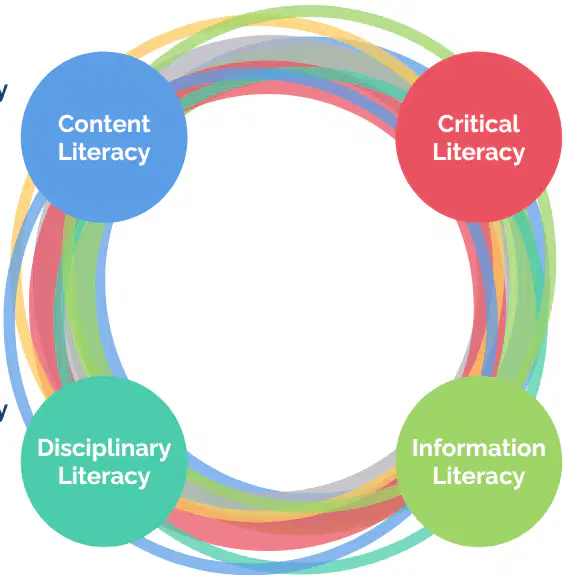
Based on the diagram showing four circles labeled Content Literacy, Critical Literacy, Disciplinary Literacy, and Information Literacy, which literacy is described as the ability to use reading and writing to learn subject matter in a given discipline?
Content Literacy
Critical Literacy
Disciplinary Literacy
Information Literacy
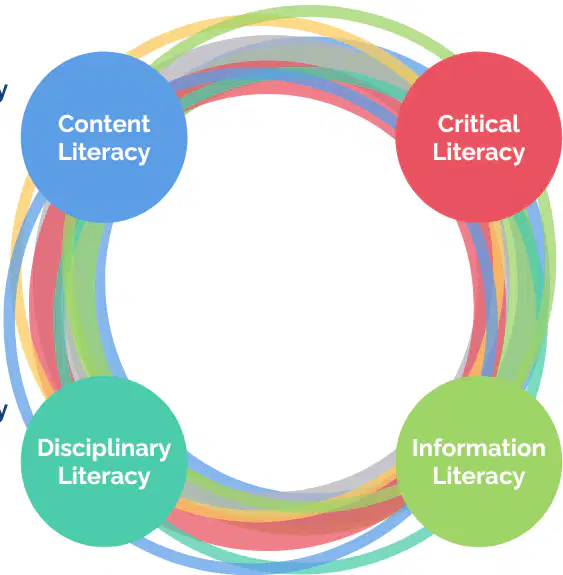
According to the infographic on literacies in Social Studies, which literacy focuses on locating and identifying information (including Media, Data, and Digital Literacy) that can be effectively used to solve an issue or problem at hand?
Content Literacy
Critical Literacy
Disciplinary Literacy
Information Literacy
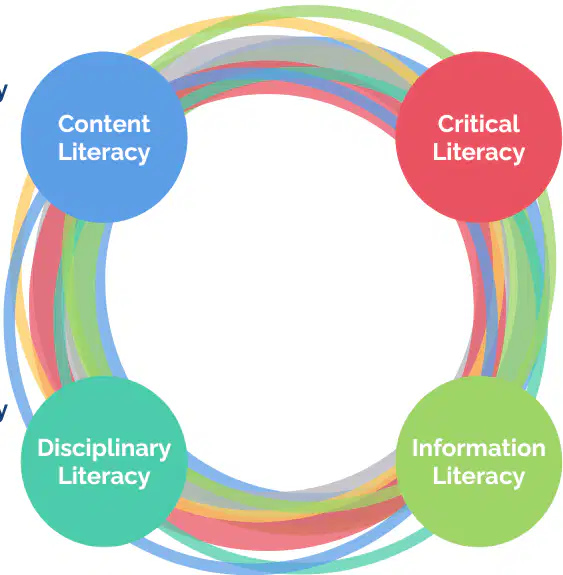
Which literacy is defined as a set of thinking skills and practices to examine the relationship between language and power through lenses of power, diversity, and access, promoting reflection, transformation, and action to make a more just world?
Content Literacy
Critical Literacy
Disciplinary Literacy
Information Literacy
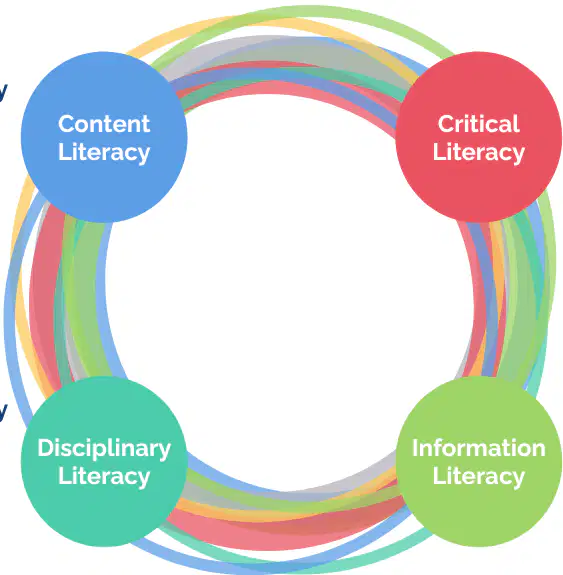
Which literacy emphasizes reading, writing, and thinking in a discipline and focuses on the ways of thinking, skills, and tools of experts in that discipline?
Content Literacy
Critical Literacy
Disciplinary Literacy
Information Literacy
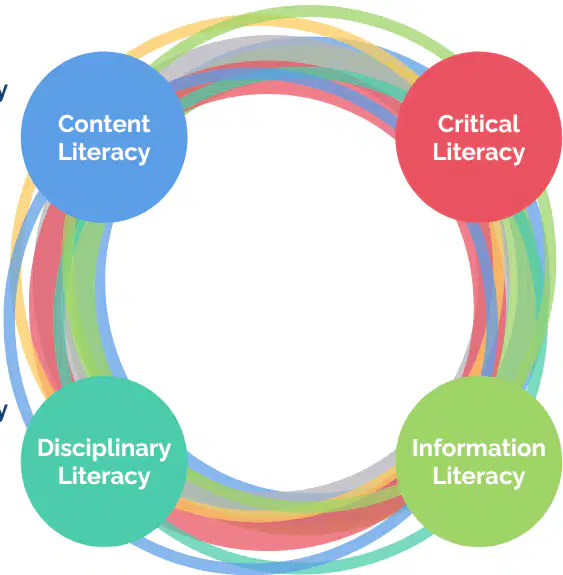
Match each literacy type to its description as presented in the Social Studies literacies diagram.
Content Literacy
Using reading and writing to learn subject matter in a discipline
Critical Literacy
Examining how language and power relate to promote reflection and action
Disciplinary Literacy
Reading, writing, and thinking in a discipline, focusing on expert tools and skills
Information Literacy
Locating and identifying information that can be used to solve a problem

In the "Types of Sources in Social Studies" poster, which type of source is created by someone who experienced the events first-hand?
Primary Sources
Secondary Sources
Tertiary Historical Accounts
Public History

Which type of source is described as created by someone who did not experience first-hand or participate in the events or conditions being researched and may include a scholarly book or article?
Primary Sources
Secondary Sources
Tertiary Historical Accounts
Public History

According to the sources poster, textbooks, Wikipedia, and traditional history lectures that present facts with minimal interpretation are examples of which type of account?
Primary Sources
Secondary Sources
Tertiary Historical Accounts
Public History

Which category is a historical account published primarily for a lay audience, including feature films, museum exhibits, historical fiction, webpages, and historical sites?
Primary Sources
Secondary Sources
Tertiary Historical Accounts
Public History

Select all items that the poster lists as primary resources (created by someone who experienced the events first-hand).
Diary
Scholarly article
Video recording
Autobiography
Textbook

Match each source type to the description provided on the "Types of Sources in Social Studies" poster.
Primary Sources
Created by someone who experienced events first-hand
Secondary Sources
Created by someone who did not experience events first-hand; may include a scholarly book or article
Tertiary Historical Accounts
Textbooks, Wikipedia, and lectures that present facts with minimal interpretation
Public History
Historical accounts for a lay audience (e.g., films, museum exhibits, webpages, historical sites)

According to the image labeled Contextualization, what does contextualization ask students to do?
Locate a document in time and place and understand how these factors shape its content
Summarize a document without considering when or where it was created
Decide whether a document is entertaining or boring
Identify only the author’s name and title

Which of the following is a contextualizing question shown in the image?
When, why, and/or where was this source created?
How credible is this source?
Who is the intended audience?
What is the author’s claim and evidence?
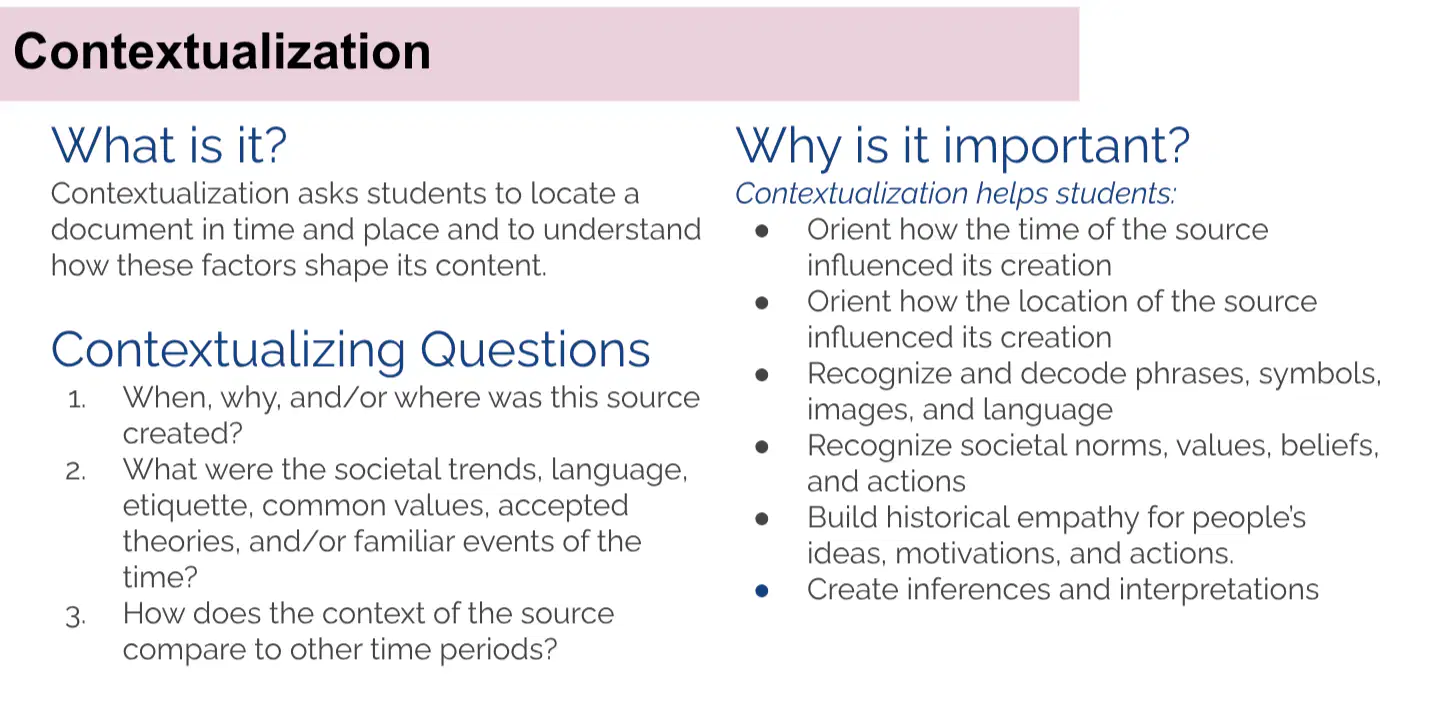
Select all statements that the image says contextualization helps students do.
Orient how the time of the source influenced its creation
Orient how the location of the source influenced its creation
Recognize and decode phrases, symbols, images, and language
Memorize every detail of the source without analysis
Write a biography of the author

Select all additional outcomes the image lists for contextualization.
Recognize societal norms, values, beliefs, and actions
Build historical empathy for people’s ideas, motivations, and actions
Create inferences and interpretations
Prove that all sources are unbiased
Ignore the time period of the source
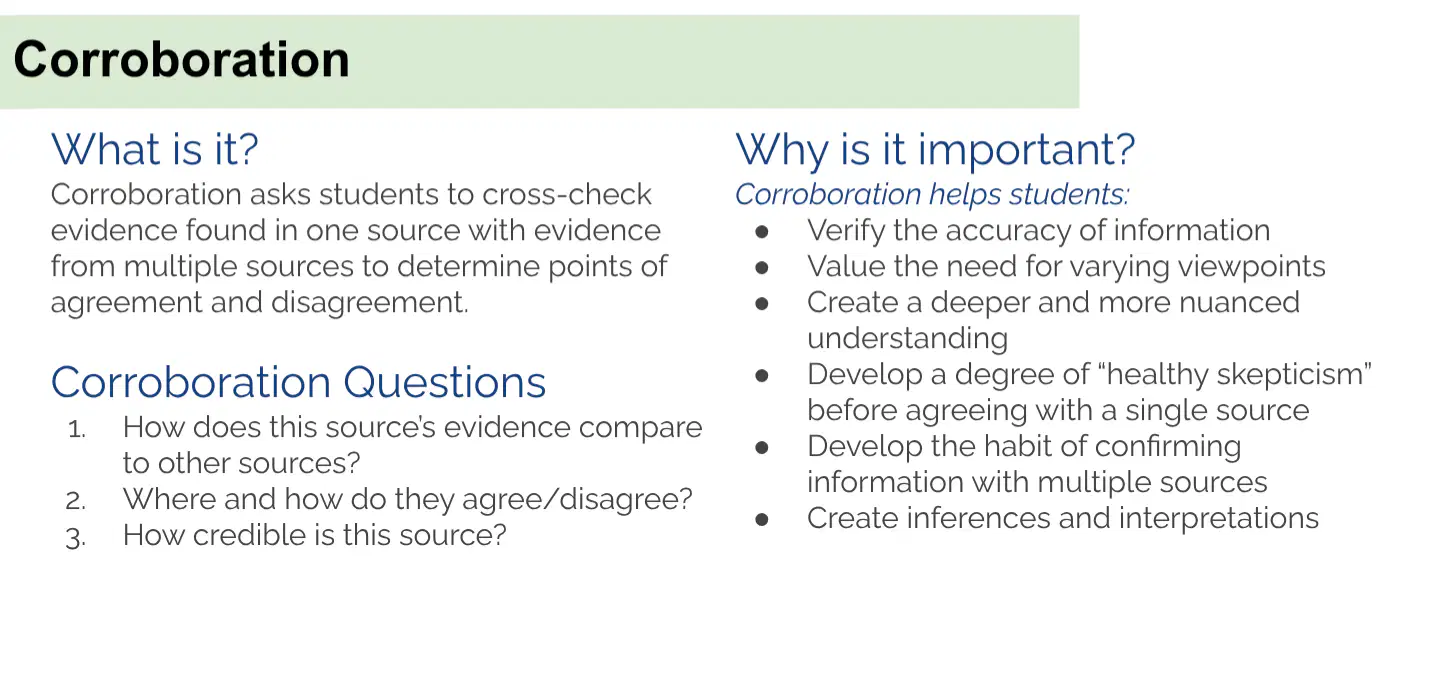
According to the image labeled Corroboration, what does corroboration ask students to do?
Cross-check evidence found in one source with evidence from multiple sources to determine points of agreement and disagreement
Summarize one source without comparing it to others
Rewrite a source using simpler words
Find the author’s favorite viewpoint
Which is a corroboration question shown in the image?
How does this source’s evidence compare to other sources?
What is the title of the source?
When, why, and/or where was this source created?
What language does the author use to persuade the audience?
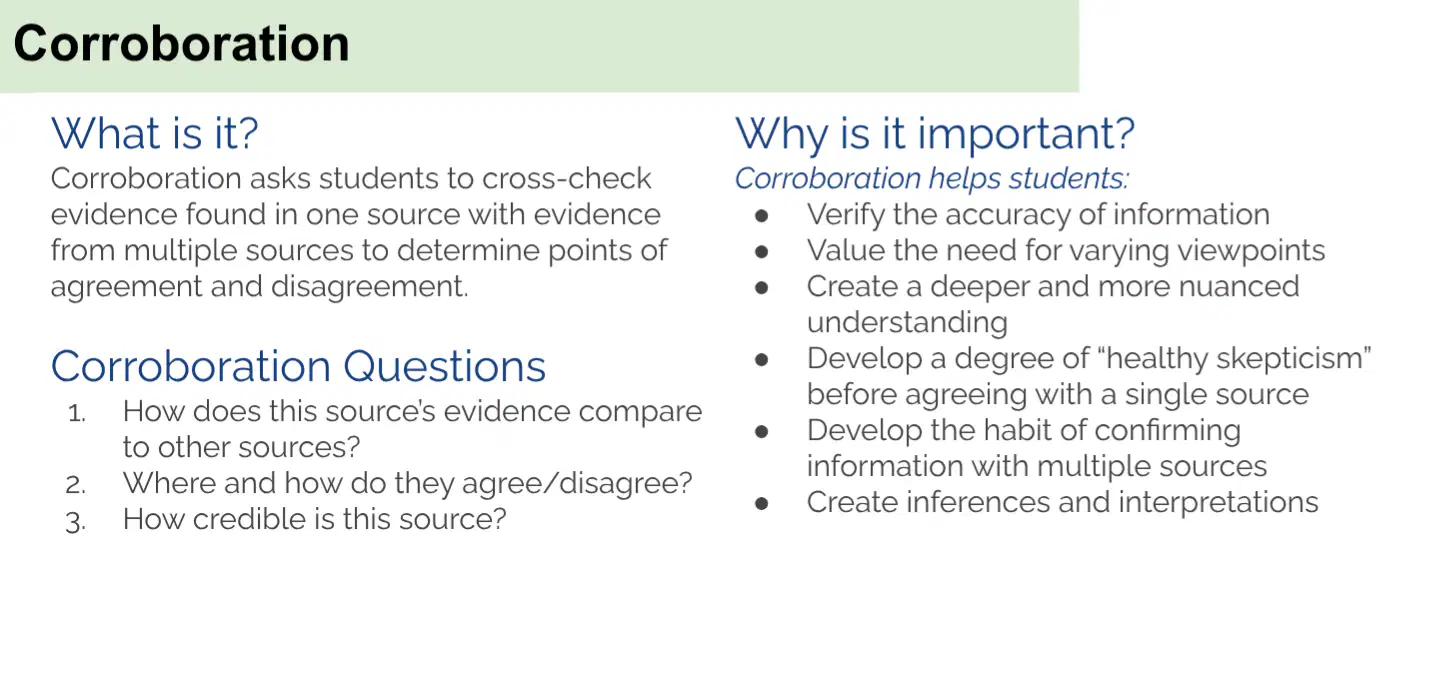
Select all statements the image says corroboration helps students do.
Verify the accuracy of information
Value the need for varying viewpoints
Create a deeper and more nuanced understanding
Decide based on a single source without skepticism
Avoid confirming information with multiple sources

Select all additional outcomes the image lists for corroboration.
Develop a degree of healthy skepticism before agreeing with a single source
Develop the habit of confirming information with multiple sources
Create inferences and interpretations
Ignore disagreements among sources
Select sources only if they agree with one’s beliefs

According to the image labeled Close Reading, what does close reading help students do?
Evaluate sources and analyze language by reading a source slowly and carefully
Summarize a source quickly without analyzing its language
Only identify the author’s name and date
Compare multiple sources without reading them

Which is a close reading question shown in the image?
What is the author’s claim and evidence?
When was the source created?
Who is the intended audience?
How credible is this source?
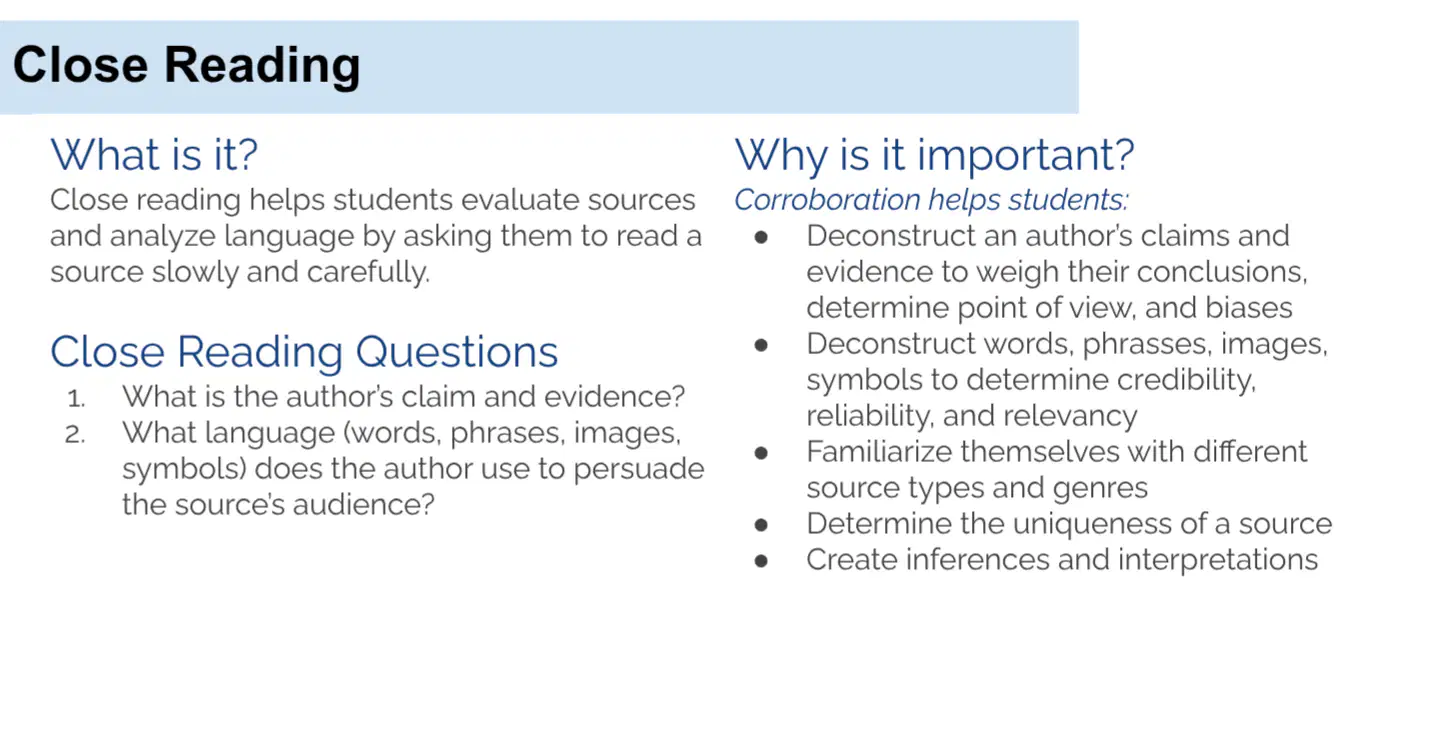
Select all statements the image says close reading helps students do.
Deconstruct an author’s claims and evidence to weigh conclusions, determine point of view, and biases
Deconstruct words, phrases, images, symbols to determine credibility, reliability, and relevancy
Familiarize themselves with different source types and genres
Determine the uniqueness of a source
Memorize without analyzing meanings
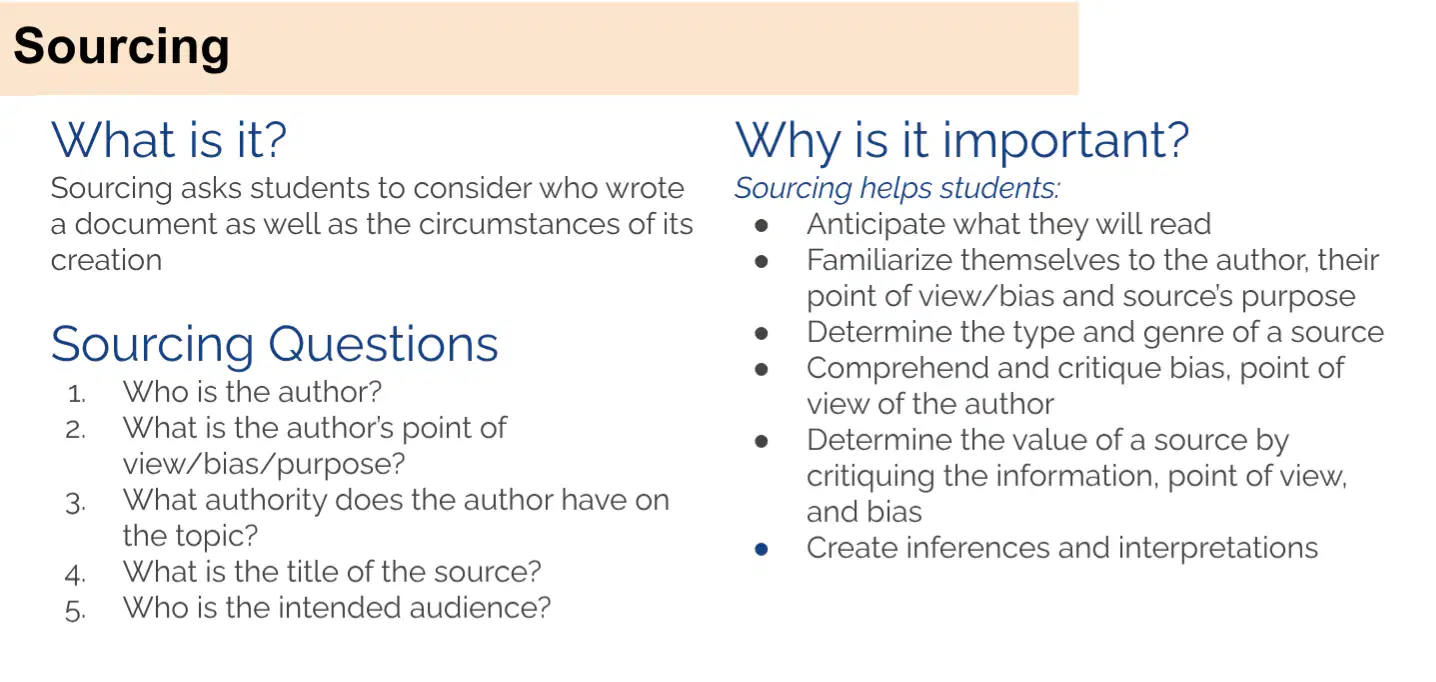
According to the image labeled Sourcing, what does sourcing ask students to consider?
Who wrote a document as well as the circumstances of its creation
Only the document’s topic
Only whether the document is long or short
How entertaining the document is

Select all sourcing questions shown in the image.
Who is the author?
What is the author’s point of view/bias/purpose?
What authority does the author have on the topic?
What is the title of the source?
Who is the intended audience?
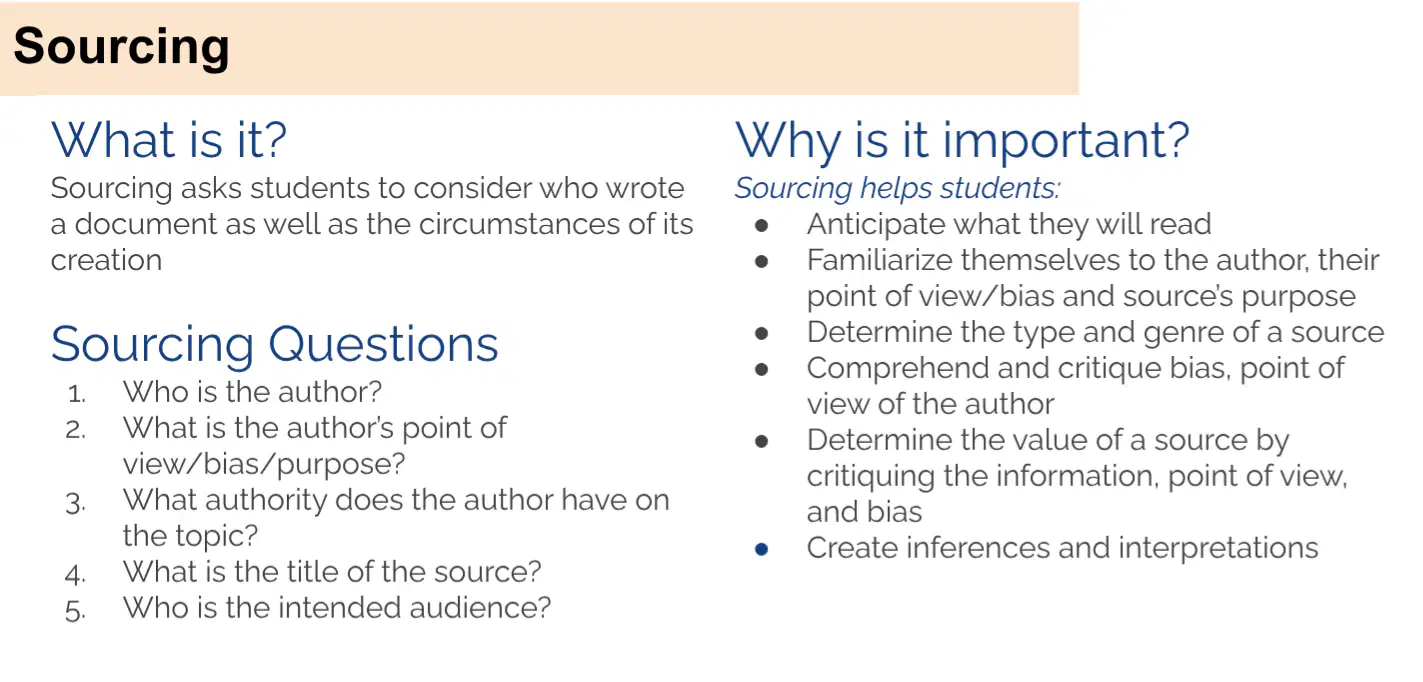
Select all statements the image says sourcing helps students do.
Anticipate what they will read
Familiarize themselves to the author, their point of view/bias and source’s purpose
Determine the type and genre of a source
Comprehend and critique bias, point of view of the author
Determine the value of a source by critiquing the information, point of view, and bias
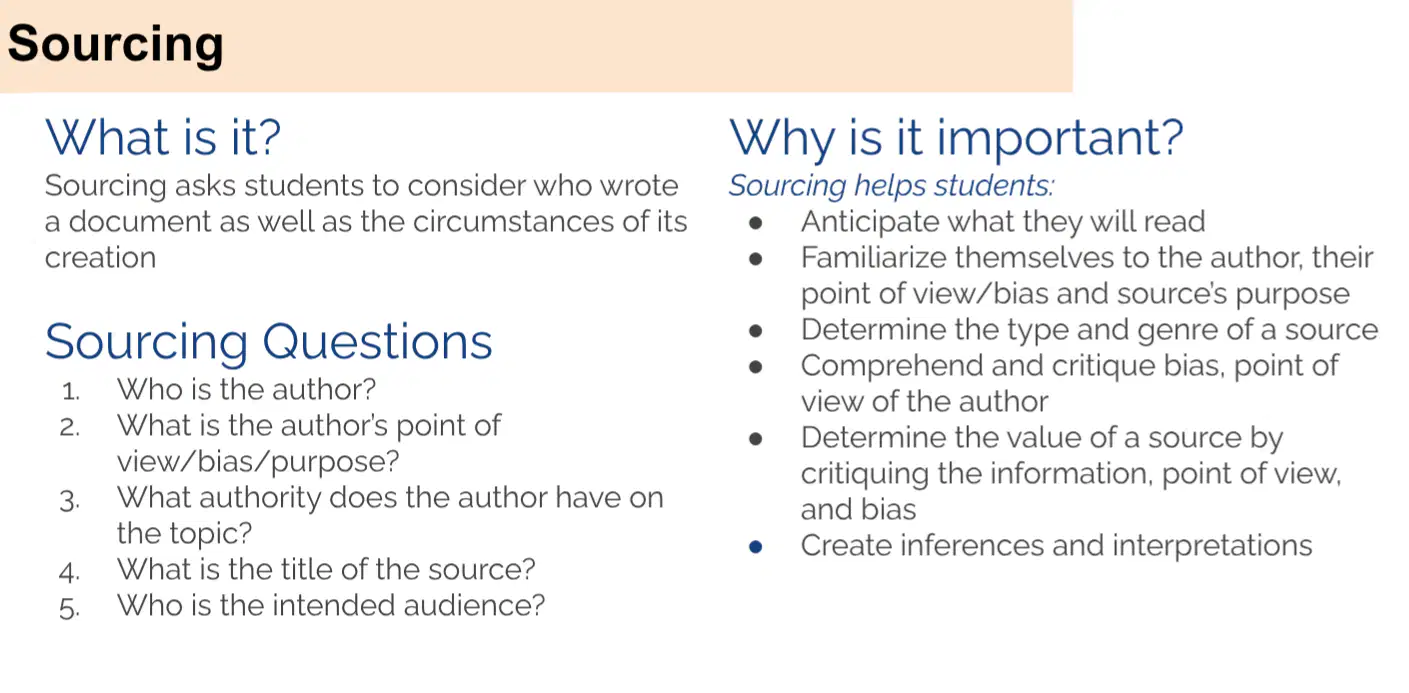
Select the additional outcome the image lists for sourcing.
Create inferences and interpretations
Ignore the author’s purpose
Avoid determining source value
Focus only on images
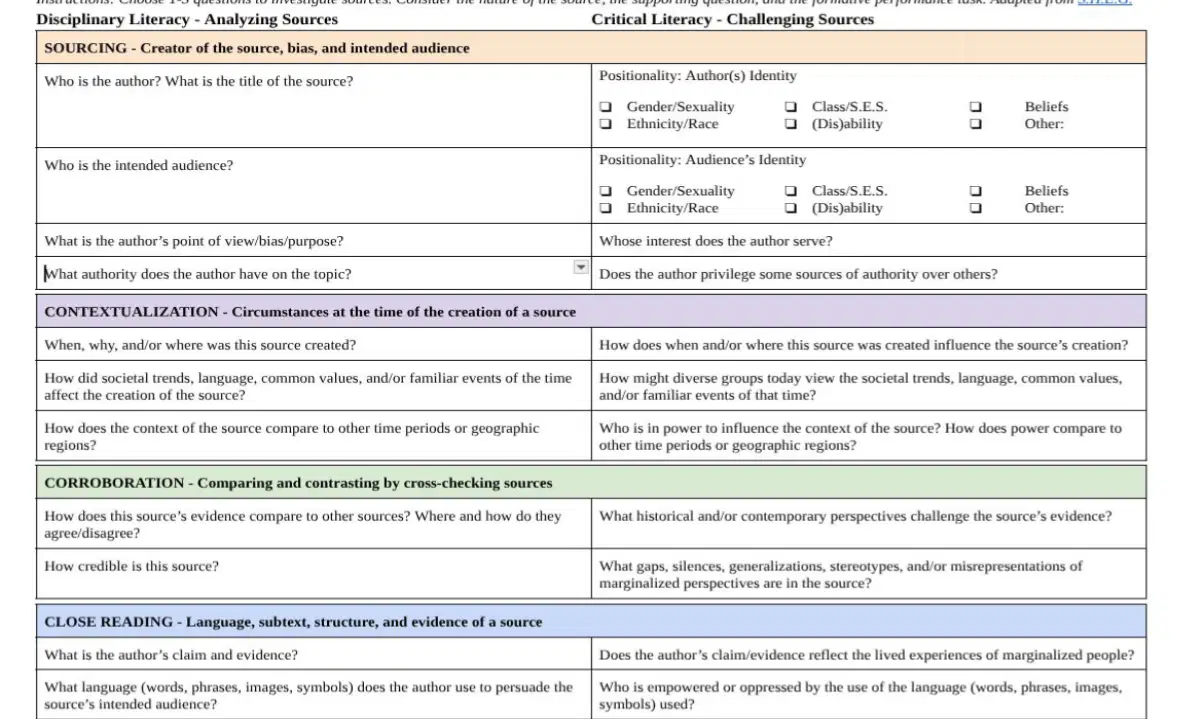
Match each historical thinking skill to one guiding question shown in the Source Analysis Tool.
Sourcing
Who is the author? What is the title of the source?
Contextualization
When, why, and/or where was this source created?
Corroboration
How does this source’s evidence compare to other sources?
Close Reading
What is the author’s claim and evidence?
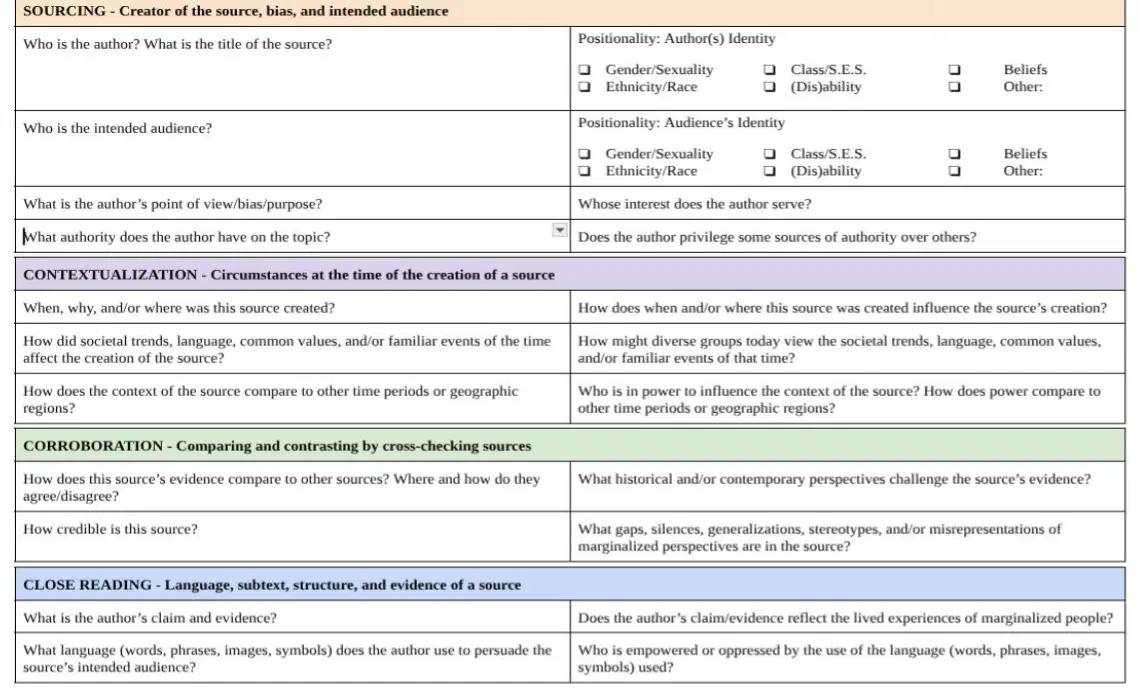
In the Source Analysis Tool, which question challenges sources by focusing on power and perspective within context?
Who is in power to influence the context of the source? How does power compare to other time periods or geographic regions?
Who is the intended audience?
How credible is this source?
What is the author’s claim and evidence?
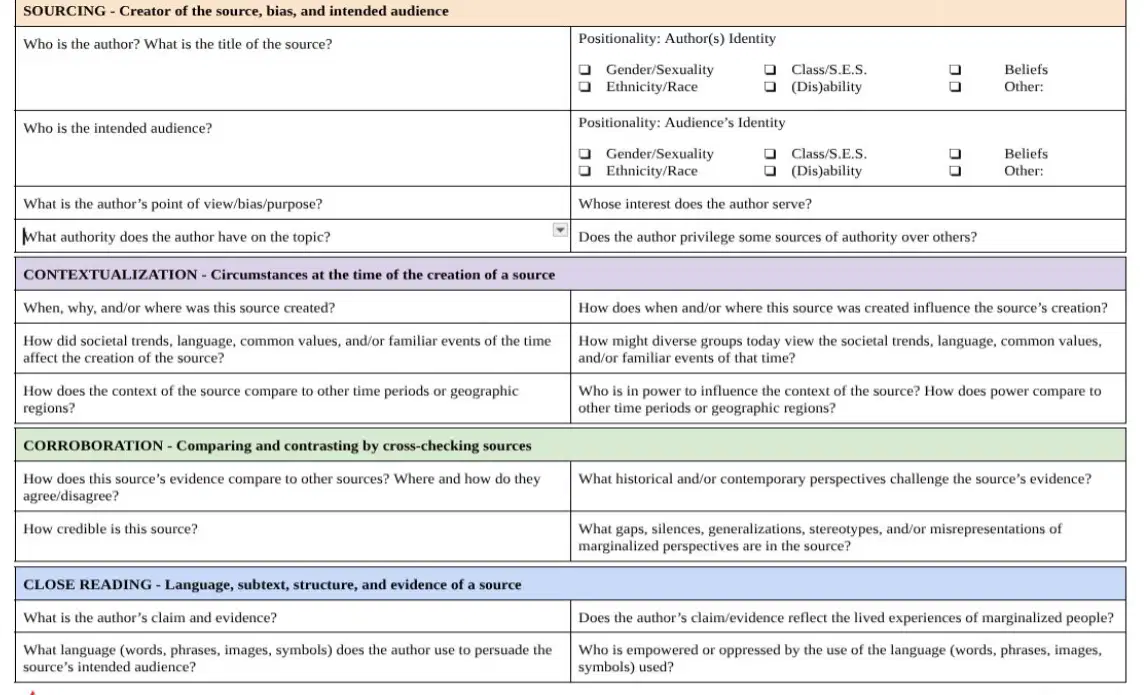
According to the Source Analysis Tool, which question asks whose interest the author serves?
Whose interest does the author serve?
How does this source’s evidence compare to other sources?
What language does the author use to persuade the audience?
When was this source created?
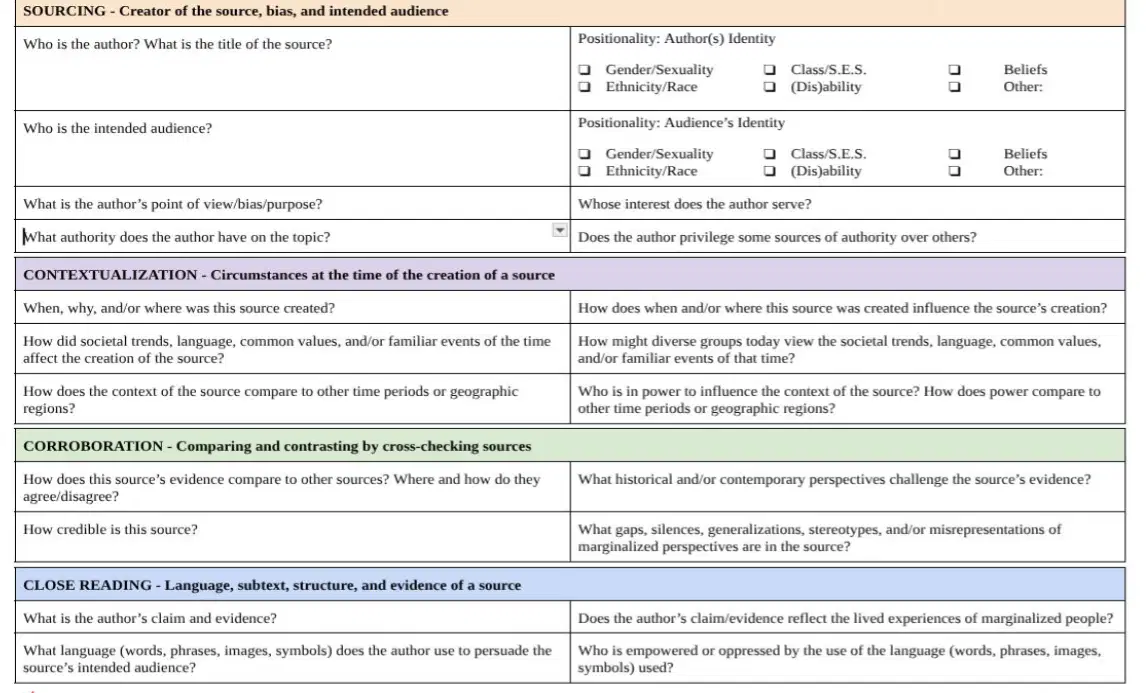
Select all questions from the Source Analysis Tool that examine credibility and representation.
How credible is this source?
What gaps, silences, generalizations, stereotypes, and/or misrepresentations of marginalized perspectives are in the source?
What is the title of the source?
Who is empowered or oppressed by the use of the language (words, phrases, images, symbols) used?

