
Font size
 Worksheets
Ecology Unit review
Total questions: 44
Worksheet time: 1hrs 4mins
The Florida panther once occupied areas from Florida to Louisiana. It now lives only in the southwestern tip of Florida. What is the most likely cause of the decline of the Florida panther population?
Competition for territory between panthers.
The weakening of species due to inbreeding
The loss of natural habitat due to human settlement.
The increase in the population of white-tailed deer
Which of the following describes a native population where there has been a decrease in the availability of food ?
An extinct wolf population remains extinct in a local forest.
A goldfish population that has fewer individuals than the prior year.
A pigeon population that has the same number of offspring as the past two years.
A frog population has more adults in a pond than when they were counted last year
A farmer wants to expand the family farm, but doesn't want to negatively affect the local red tail hawk population. The farmer knows the following about the red tail hawk. 1. They nest in the nearby forest in the tall parts of the trees. 2. They eat fish, rats, mice, rabbits, lizards and birds. 3. They hunt in open fields, plains, lakes and rivers. What choice below would have the largest negative impact on the red tail hawk population?
Cut down the forest to plant a wheat field.
Change the flow a nearby river to open up a field to plant corn
Plant an apple orchard on part of an open field.
Build a barn to park the tractor

Which of the following best describes the role of bacteria in the food web above?
Uses energy from light, to combine oxygen, carbon dioxide and water and converts it into energy in the form of sugar.
Uses energy from dead organisms or waste material to break down dead organisms and waste material into nutrients.
Controls the population by removing energy from living organisms
Uses energy from dead organisms or waste material to transfers energy
Gopher tortoises create their homes by digging holes in wee drained sandy soils throughout the southeast region of the U.S. The florida pine snakes will sometimes share the hole with the tortoises to shelter from weather or fire. Which of the following example demonstrates the same type of relationship?
Moths lay eggs in the seedpods of the yucca plant, the larvae hatch and feed on some but not all of the seeds and the moth acts as a pollinator for the plant.
The goby fish and blind shrimp live in a tunnel in the sand created by the shrimp and when a predator is near the goby fish will touch the shrimp to warn it.
Tapeworms live in the digestive system and eat partially digested food which eventually deprives the host of food and nourishment
A Pseudoscorpion is a tiny scorpion with no stinger that moves from place to place by hitching a ride on much larger insects
Mealy bugs are small insects that live on various types of plants and feed on their sap. When there is a large population of mealy bugs occupying a plant, they may remove too much sap causing the plant to change color or wilt. Ladybugs eat mealy bugs and are often used in greenhouses to control the population. Which type of relationship exists between the mealybugs’ ladybugs and plants?
The relationship between the ladybugs and mealybugs are an example of competition.
The ladybugs and mealybugs are an example of predation while the mealybugs and plants are an example of parasitism.
The ladybugs and plants are an example of mutualism while the mealybugs and plants are an example of parasitism.
The mealybugs and plants are an example of commensalism while the ladybugs and plants are an example of predation.



Barnacles are animals that cannot move. In order to get food, they attach to whales and catch any floating plankton in the water. The whale is neither helped nor harmed in the interaction. What type of symbiosis is this?
Mutualism
Commensalism
Parasitism
Neutralism

In the wild, some alligators gets their teeth cleaned by birds. The birds gets their food from the alligators' teeth.
What type of symbiosis is this?
Mutualism
Commensalism
Parasitism
Neutralism


Aphids are small insects that live on various types of plants and feed on their sap. When there is a large population of aphids occupying a plant, they may remove too much sap causing the plant to change color or wilt. Ladybugs eat aphids and are often used in greenhouses to control the aphid population. Which type of relationship exists between the aphids ladybugs and plants?
The relationship between the ladybugs and aphids are an example of competition.
The aphids and plants are an example of commensalism while the ladybugs and plants
The ladybugs and aphids are an example of predation while the aphid and plants are an example of parasitism.
The ladybugs and plants are an example of mutualism while the aphid and plants are an example of parasitism.

Which of the following best describes the role of bacteria in this food web?
Obtain energy from dead organisms and waste material and transfers that energy to living organisms
Controls the population by removing energy from the living organisms
Uses energy from dead organisms or waste material to break down dead organisms and waste material into nutrients.
Uses energy from light, to combine oxygen, carbon dioxide and water and converts it into energy in the form of sugar.

Which of the following best describes a relationship in the food web?
The green plant is a decomposer because it is consumed by the rabbit.
The goat is a primary consumer because it is consumed by the jackal.
The wild cat is a secondary consumer because it consumes the rabbit.
The mouse is a producer because it consumes the green plant.


If the amount of food resources increases, the population of an animal would
increase
decrease
stay the same
go extinct

The largest population an ecosystem can support is the
(a)

All living things need ____________ to survive
water
food
space
all of these

Which of the following is not a limiting factor for rabbits
sunlight
water
grass
foxes

True or False:
A mouse is eaten by an eagle; the mouse is the prey.
True
False
True or False:
Organisms need enough space to live, obtain resources, and reproduce.
True
False

What happens if a population grows past its carrying capacity?
The population keeps growing
The population starts to die off
The entire species will go extinct
The carrying capacity just increases
This may cause a population to increase
increase of food supply
removal of predators
removal of disease
all of these
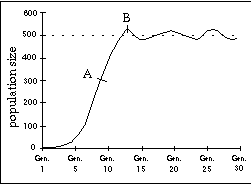
What is the carrying capacity of the graph?
around 500
more than 800
less than 300
around 700
Which of the following is a biotic factor that would affect the carrying capacity of a population?
Soil
Predator
Rainfall
Sunlight


