
NEW
Font size
 Worksheets
CPR and First Aid for Shock and Choking
Total questions: 30
Worksheet time: 15mins
Refer to the Chain of Survival diagram with four linked green blocks. Which action is the first link in the chain of survival?
Call 9-1-1 to alert emergency medical services
Perform CPR
Use defibrillation
Provide advanced care
According to the Cardiopulmonary Resuscitation (CPR) slide, what is described as a crucial link in the chain of survival?
Giving CPR as soon as possible
Waiting for advanced care before starting CPR
Performing defibrillation only
Calling a family member instead of 9-1-1
From the definition provided, CPR is a first-aid procedure that combines which components to supply oxygen to the body until normal body functions can resume?
Rescue breathing and chest compressions
Bandaging and splinting
Defibrillation and advanced care
Medication and IV fluids
In the adult CPR instructions, while checking for responsiveness, what should you say as you tap the person on the shoulder?
Are you okay?
Call 9-1-1!
Can you breathe?
What's your name?
According to the adult CPR steps shown, if the person does not respond, what should you do next to start the chain of survival?
Begin CPR without calling for help
Call 9-1-1
Look for a medical ID only
Move the person immediately
Based on the CPR for Adults guidance, who should perform Hands-Only CPR?
A trained rescuer
An untrained rescuer
A physician only
Anyone under age 12
According to the vocabulary note, rescue breathing is best defined as which of the following?
Breathing for a person who is not breathing on his or her own
Giving oxygen through an intravenous line
Using a defibrillator to restart the heart
Monitoring the pulse without intervening
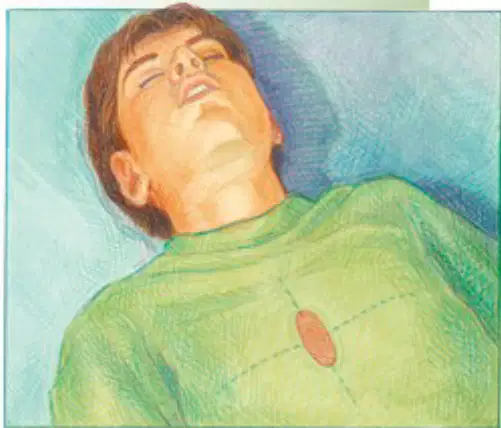
Hands-Only CPR for Adults: Position your hands correctly by following the described steps. Where should you place the heel of your hand to begin chest compressions on an adult?
Directly over the sternum, above the locating fingers
On the lower ribs near the abdomen
On the upper chest below the collarbones
On the shoulder closest to you
Hands-Only CPR for Adults: During hand positioning, what should you do with your fingers once both hands are placed for compressions?
Interlock and raise them so they do not touch the chest
Spread them wide to increase surface contact
Press them into the ribs to stabilize the hands
Curl them under the palm to grip the sternum
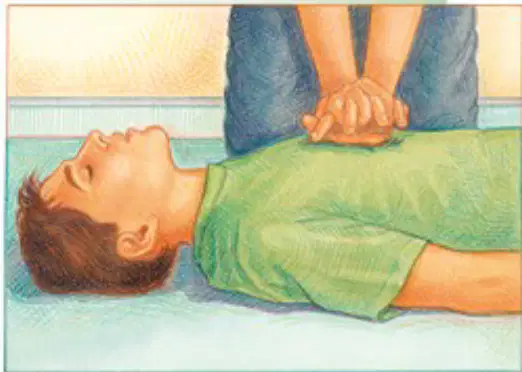
Hands-Only CPR for Adults: To prepare for chest compressions, how should you align your upper body relative to your hands?
Straighten your arms, lock your elbows, and position your shoulders directly above your hands
Bend your elbows slightly and keep shoulders behind your hands
Keep arms relaxed with elbows unlocked and shoulders to the side
Lean forward with elbows bent and shoulders ahead of your hands
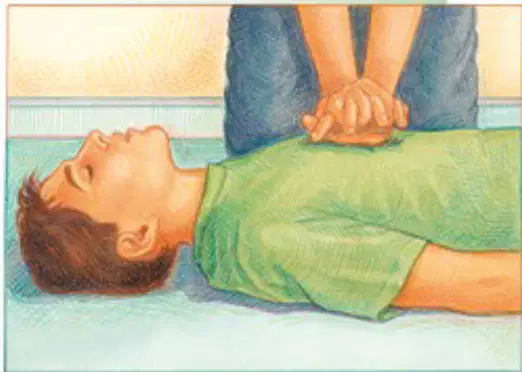
Hands-Only CPR for Adults: What is the recommended depth for each chest compression on an adult?
About 1.5 to 2 inches (3.8 to 5 cm)
About 0.5 inch (1.3 cm)
About 3 to 4 inches (7.6 to 10 cm)
About 2.5 to 3 inches (6.4 to 7.6 cm)

Hands-Only CPR for Adults: What compression rate is recommended by emergency medical experts?
About 100 compressions per minute or a little faster
About 60 compressions per minute
About 30 compressions per minute
About 150 compressions per minute
CPR for Infants and Children: When performing CPR on infants and children under eight, what cycle should be used?
30 chest compressions alternating with 2 rescue breaths
15 chest compressions alternating with 1 rescue breath
20 chest compressions alternating with 2 rescue breaths
10 chest compressions alternating with 2 rescue breaths
CPR for Infants and Children: What should you do first before calling 9-1-1?
Check to see if the child is breathing
Begin CPR immediately
Look for medical identification jewelry
Move the child to a seated position
CPR for Infants and Children: If the child is not breathing, how much CPR should you provide before calling?
Five cycles, about two minutes
Ten cycles, about five minutes
One cycle, about thirty seconds
Continuous CPR for fifteen minutes
CPR for Infants and Children: During rescue breathing for an infant, where should you place your mouth?
Over both the infant’s nose and mouth at the same time
Over the mouth only
Over the nose only
Beside the cheek to deliver air indirectly
CPR for Infants and Children: Which statement about equipment use is correct?
Do not use a face mask designed for adult CPR when performing CPR on an infant or child
Use any available adult face mask for all ages
A face mask is never needed for pediatric CPR
Use a face mask only after ten cycles of CPR
CPR for Infants and Children: Where should you position your fingers to perform chest compressions on an infant?
On the infant’s sternum
On the soft abdomen
On the left side of the ribcage
On the collarbone
CPR for Infants and Children: How far should you press the infant’s sternum during compressions?
About one-third to one-half the depth of the infant’s chest
About the full depth of the infant’s chest
About one-tenth the depth of the infant’s chest
Exactly two inches regardless of chest size
CPR for Infants and Children: For chest compressions on a child between one and eight years of age, which hand placement is appropriate?
Heel of one hand or both hands as in adult chest compressions
Two fingers at the center of the chest
Palm of one hand over the lower abdomen
Tips of two thumbs at the end of the sternum
CPR for Infants and Children: Where should you position your hands relative to the sternum when giving compressions to a child?
About two finger widths above the end of the sternum
Directly on the end of the sternum
On the upper ribs near the collarbone
Centered over the navel
CPR for Infants and Children: How far should you press the sternum down when giving compressions to a child?
About one-third to one-half the depth of the child’s chest
About one-quarter the depth of the child’s chest
To the full depth of the child’s chest
Less than one-third the depth of the child’s chest
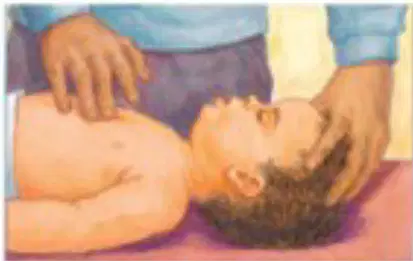
CPR for Infants and Children: According to the left image, what does it show about chest compressions?
How to position your fingers to perform chest compressions on an infant
How to place AED pads on an adult
How to position hands for chest compressions on a child between one and eight years old
How to perform rescue breaths on an infant
The Chain of Survival: What is a defibrillator?
A device that delivers an electric shock to the heart to restore its normal rhythm
A device that measures blood pressure during CPR
A mask used to provide rescue breaths
A monitor that records heart sounds only
Defibrillation: When a person’s heart is not beating rhythmically, what is needed to restore a normal heartbeat?
CPR
Only rescue breaths
Immediate transport without care
Cold compresses
Defibrillation: Who should use defibrillators?
Trained individuals
Any bystander without instruction
Only physicians
Only the person’s family

If air does not inflate the lungs when giving mouth-to-mouth breathing, you should:
Re-tilt the head to assure an open airway
Begin abdominal thrusts
None of the above
All of the above

CPR means .....
Caring Pulmonary Resuscitation
Cardiopulmonary Reflex
Cardio Pulse Response
Cardio Pulmonary Resuscitation

The three "C"s for a medical emergency are....
Care, Call and Check
Control, Call and Care
Check, Call and Care
Call, Care and Check
Which is NOT a sign of choking?
Someone clutching their neck
Can’t speak
The face is black and blue
Someone is clutching their stomach

