
Font size
 Worksheets
The First and Second Industrial Revolutions
Total questions: 39
Worksheet time: 20mins
Which development best characterizes the First Industrial Revolution in Great Britain?
Mechanization with factory system
Mass electrification of cities
Automobile assembly lines
Global air travel networks
Which invention most increased textile production efficiency during the First Industrial Revolution?
Spinning Jenny
Telegraph
Telephone
Bessemer Converter
What new power source, revised by James Watt, spurred the growth of factories in the First Industrial Revolution?
Solar photovoltaic arrays
Nuclear reactors
Hydroelectric dams
Steam engine power
Which change in work organization increased efficiency during the First Industrial Revolution?
Feudal obligations
Guild apprenticeships
Nomadic herding
Division of labor
Which transportation technology expanded rapidly in the First Industrial Revolution?
Interstate highways
Railroads and steam ships
Ride-sharing platforms
Commercial jet planes
Which pair correctly matches the Second Industrial Revolution with its power sources and production methods?
Windmills and manual looms
Electricity and internal combustion
Horse power and cottage industry
Water wheels and handcrafting
Which manufacturing innovation enabled far more efficient machines during the Second Industrial Revolution?
Handmade unique parts
Interchangeable parts
Stone tools and chisels
Nonstandard fittings
What process greatly improved steel-making and construction industries in the Second Industrial Revolution?
Bessemer process
Three-field system
Mercantilist tariffs
Pasteurization
Which technologies transformed communication and transportation in the Second Industrial Revolution?
Radios and satellites
Railways and canals
Telephones and telegraphs
Steam plows and ox carts
By the start of the 20th century, what outcome of the Second Industrial Revolution most changed everyday life?
Elimination of urban factories entirely
Exclusive luxury goods for elites
Return to small-scale cottage industry
Mass production of cheap, quality goods
Which statement best compares the First and Second Industrial Revolutions?
Second preceded the First chronologically
First used steam power; Second used electricity
Both relied on nuclear power for factories
First centered in Germany and the U.S.
Which geographic origins are correctly identified for these phases of industrialization?
First in Great Britain; Second in Germany and the U.S.
First in China; Second in South America
First in Italy; Second in Japan
First in Russia; Second in India
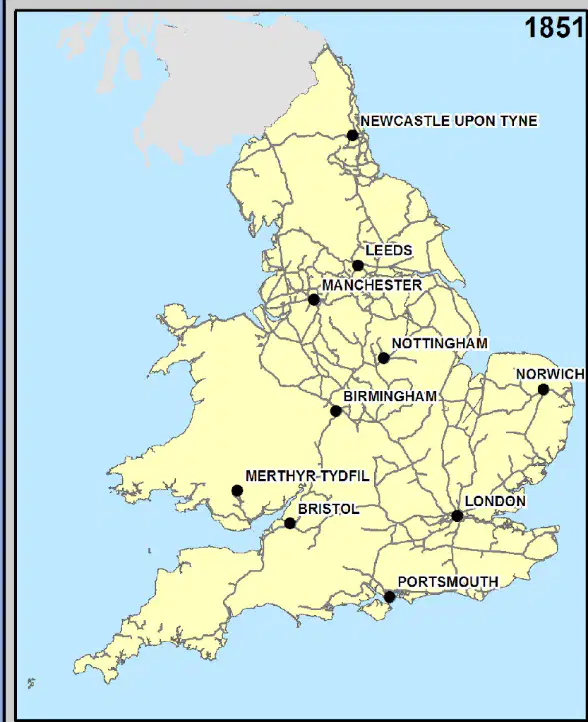
In the 1851 map of England, which pattern best describes where early rail lines were concentrated?
Mostly linking coastal ports to inland towns
Primarily circling London without branches
Evenly spread across all rural counties
Clustered only in Scotland and Wales
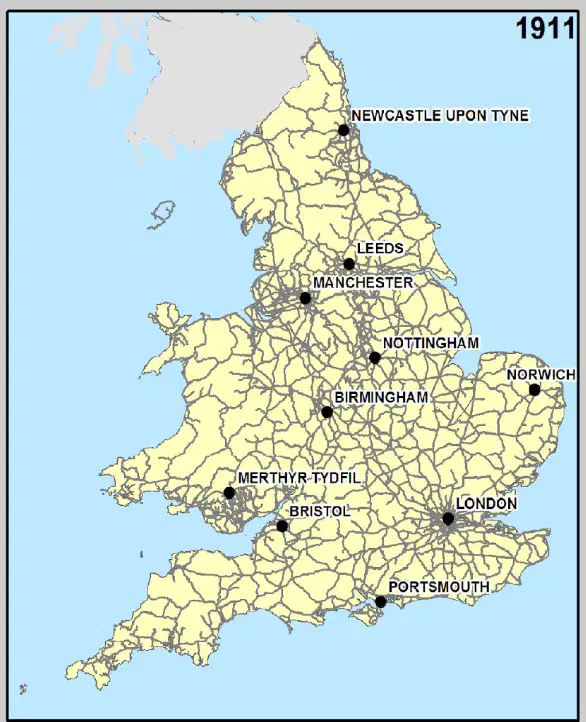
Comparing 1851 to 1911 in Great Britain, what change in the rail network stands out the most?
Dense web connecting most regions
Expansion limited to southern coastal areas
Fewer lines due to canal competition
Shift of lines away from industrial cities
Which cities appear consistently connected across all three Great Britain maps, indicating their importance in the rail network?
Manchester
Norwich
London
Birmingham

On the North American transcontinental map, which line completed the first east‑west connection across the United States?
Southern Pacific–Atlantic in 1883
Great Northern route in 1893
Union Pacific–Central Pacific in 1869
Texas & Pacific route in 1882
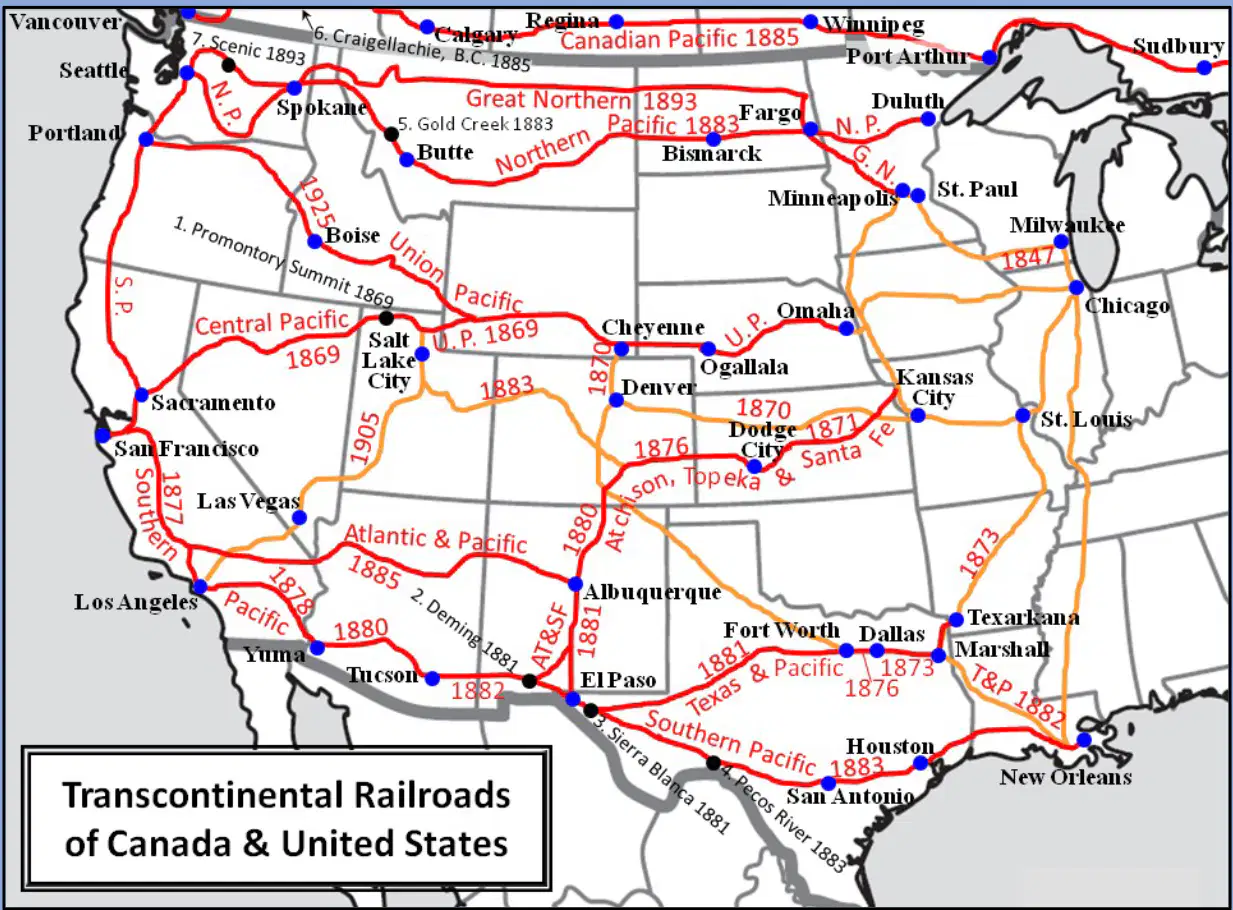
What geographic challenge did transcontinental railways most directly overcome for national integration in North America?
Lack of urban populations
Shortage of navigable rivers
Absence of natural resources
Long distances between coasts
Which occupations were commonly part of the upper middle class in the 18th and 19th centuries?
Merchants in growing cities
Factory owners and bankers
Unskilled urban laborers
Rural serfs on estates
Plantation or mine owners
What broad social change accompanied the rise of the middle class?
Elimination of urban political influence
Return to feudal landholding patterns
Creation of a new social level in society
Decline of industrialization in Japan
Who primarily made up the urban working class in 19th‑century cities?
Independent merchants and bankers
Landowning nobles with titles
Skilled artisans with high wages
Poor, unskilled laborers in factories
Which problems were typical for the working class during industrialization?
Dangerous work conditions
Low wages and long hours
Awful living environments
Guaranteed government pensions
Lavish housing in city centers
Which actions did working-class people pursue to improve their situation in the 19th century?
Organizing labor unions
Expanding noble privileges
Banning urban factories
Attempting to strike
Advocating for economic regulation
How did many middle-class businesses and governments respond to working-class activism?
They abolished industrial workplaces
They met labor efforts with violence
They welcomed strikes with tax cuts
They offered immediate universal suffrage
Which U.S. events illustrate violent responses to labor strikes in the late 19th century?
Pullman Strikes
California Gold Rush
New Deal labor reforms
Homestead Steel Massacre
Boston Tea Party
Which factor increased European wealth in the 18th century by expanding the money supply?
Stronger guild regulations across Europe
Higher state price controls on basic goods
The Columbian Exchange increasing precious metals
Reduced banking and venture capital activity
What role did banks and venture capitalists play in the rise of European wealth?
They replaced private property with communal land
They increased available money for investment
They enforced government price ceilings
They limited credit to reduce inflation
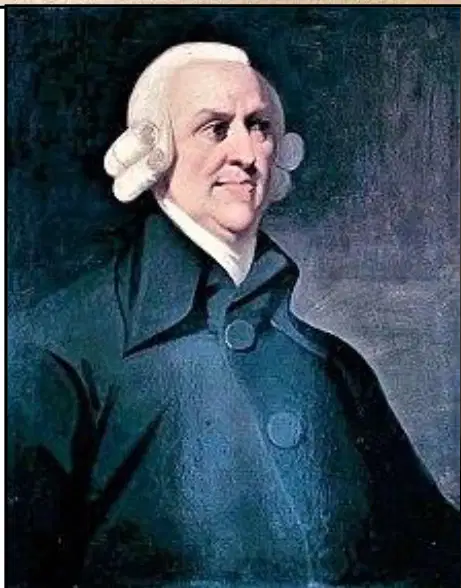
Which idea did Adam Smith codify in his 1776 book The Wealth of Nations?
Socialism run by state planners
Mercantilism guided by strict tariffs
Capitalism as an economic system
Feudalism supported by guild control
Why did Smith favor competition in the economy?
It replaces labor with state-run planning
It raises prices and limits consumer choice
It ensures lowest prices and better goods
It strengthens guild monopolies and tariffs
Which statement best describes a wealth-creation system?
Guilds control output to prevent surplus
Government sets all prices for stability
Wealth can be created by market activity
Total wealth is fixed and cannot grow
According to Smith, how does cheap labor contribute to economic growth?
It creates more jobs across sectors
It increases product sales volumes
It reduces the money supply overall
It lowers prices for consumers
Which combination helped spur rapid economic growth in early capitalism?
Religious tithes and feudal obligations
Colonial tribute and fixed-wealth views
Private property rights and strong finance
State price controls and guild monopolies
Which outcome is most likely when producers lower production costs in a competitive market?
Demand decreases for all products
Quality always drops for all goods
Government sets prices for producers
Consumers buy more with their money
A product is overpriced and low quality. What response from consumers pressures producers in this situation?
Consumers demand government rationing
Consumers buy more of the same product
Consumers wait for subsidies
Consumers switch to another business
In a market with strong competition, what are producers most likely to do to stay in business?
Limit supply to raise scarcity
Ignore customer preferences
Increase advertising only
Reduce price or improve quality
How do lower prices affect disposable income and overall economic activity?
Increase disposable income and sales
Leave disposable income unchanged
Decrease disposable income and sales
Increase taxes and reduce sales
What best describes the Invisible Hand in a free market?
Government planning production
Self-interest guiding innovation
Random chance deciding prices
Charity replacing competition
Which pair of forces most directly interacts in determining market outcomes discussed here?
Supply and demand
Inflation and taxation
Tariffs and quotas
Labor unions and guilds
In the medicine example, what effect does competition have over time?
Price and quality stay constant
Supply stops and demand ends
Quality falls and price rises
Quality rises and price drops
Which statements align with Smith’s view of a free market? Select all that apply.
Needs can be met without state supervision
Entrepreneurs respond to profit incentives
Guilds must control all production
Competition improves products and prices

