
 Worksheets
Gorham POE 25-26 Midterm
Total questions: 50
Worksheet time: 2hrs 38mins
What is the definition of isometric?
A method of projection in which a 3D object is presented by a drawing having all three axes equally inclined and all lines drawn to scale.
A rigid bar used to exert a pressure or sustain a weight at one point of its length by the application of a force at a second and turning at a third on a fulcrum.
The structure of or the relationship of the parts in a machine, or in a construction or process comparable to a machine.
The turning effect of a force about a point equal to the magnitude of the force times the perpendicular distance from the point to the line of action from the force.
What is the definition of lever?
A method of projection in which a 3D object is presented by a drawing having all three axes equally inclined and all lines drawn to scale.
A rigid bar used to exert a pressure or sustain a weight at one point of its length by the application of a force at a second and turning at a third on a fulcrum.
The structure of or the relationship of the parts in a machine, or in a construction or process comparable to a machine.
The turning effect of a force about a point equal to the magnitude of the force times the perpendicular distance from the point to the line of action from the force.
What is the definition of mechanism?
A method of projection in which a 3D object is presented by a drawing having all three axes equally inclined and all lines drawn to scale.
A rigid bar used to exert a pressure or sustain a weight at one point of its length by the application of a force at a second and turning at a third on a fulcrum.
The structure of or the relationship of the parts in a machine, or in a construction or process comparable to a machine.
The turning effect of a force about a point equal to the magnitude of the force times the perpendicular distance from the point to the line of action from the force.
What is the definition of moment?
A method of projection in which a 3D object is presented by a drawing having all three axes equally inclined and all lines drawn to scale.
A rigid bar used to exert a pressure or sustain a weight at one point of its length by the application of a force at a second and turning at a third on a fulcrum.
The structure of or the relationship of the parts in a machine, or in a construction or process comparable to a machine.
The turning effect of a force about a point equal to the magnitude of the force times the perpendicular distance from the point to the line of action from the force.
What is the definition of pitch?
Distance between adjacent threads in a screw.
A type of lever that is a wheel with a groove in its rim, which is used to change the direction or multiply a force exerted by a rope or cable.
Impeding effect exerted by one material object on another.
An inclined plane wrapped around a cylinder, forming the path and pitch.
What is the definition of pulley?
Distance between adjacent threads in a screw.
A type of lever that is a wheel with a groove in its rim, which is used to change the direction or multiply a force exerted by a rope or cable.
Impeding effect exerted by one material object on another.
An inclined plane wrapped around a cylinder, forming the path and pitch.
What is the definition of resistance force?
Distance between adjacent threads in a screw.
A type of lever that is a wheel with a groove in its rim, which is used to change the direction or multiply a force exerted by a rope or cable.
Impeding effect exerted by one material object on another.
An inclined plane wrapped around a cylinder, forming the path and pitch.
What is the definition of screw?
Distance between adjacent threads in a screw.
A type of lever that is a wheel with a groove in its rim, which is used to change the direction or multiply a force exerted by a rope or cable.
Impeding effect exerted by one material object on another.
An inclined plane wrapped around a cylinder, forming the path and pitch.
What is the definition of simple machine?
Any of various elementary mechanisms including the lever, the wheel and axle, the pulley, the inclined plane, the wedge, and the screw.
A type of lever that is a wheel with a groove in its rim, which is used to change the direction or multiply a force exerted by a rope or cable.
Impeding effect exerted by one material object on another.
An inclined plane wrapped around a cylinder, forming the path and pitch.
What is the definition of sprocket?
A toothed wheel whose teeth engage the links of a chain.
A type of lever that is a wheel with a groove in its rim, which is used to change the direction or multiply a force exerted by a rope or cable.
Impeding effect exerted by one material object on another.
An inclined plane wrapped around a cylinder, forming the path and pitch.
What is the definition of static equilibrium?
A condition where there are no net external forces acting upon a particle or rigid body and the body remains at rest or continues at a constant velocity.
A type of lever that is a wheel with a groove in its rim, which is used to change the direction or multiply a force exerted by a rope or cable.
Impeding effect exerted by one material object on another.
An inclined plane wrapped around a cylinder, forming the path and pitch.
What is the definition of torque?
A force that produces or tends to produce rotation or torsion.
A type of lever that is a wheel with a groove in its rim, which is used to change the direction or multiply a force exerted by a rope or cable.
Impeding effect exerted by one material object on another.
An inclined plane wrapped around a cylinder, forming the path and pitch.
What is the definition of wedge?
A substance that tapers to a thin edge and is used for splitting, raising heavy bodies, or for tightening by being driven into something.
A type of lever that is a wheel with a groove in its rim, which is used to change the direction or multiply a force exerted by a rope or cable.
Impeding effect exerted by one material object on another.
An inclined plane wrapped around a cylinder, forming the path and pitch.
What is the definition of wheel and axle?
Two different sized circular objects that are attached together and turn as one.
A type of lever that is a wheel with a groove in its rim, which is used to change the direction or multiply a force exerted by a rope or cable.
Impeding effect exerted by one material object on another.
An inclined plane wrapped around a cylinder, forming the path and pitch.
Correct example of Force
A box of book
Climbing a mountain
Walking down a street
Pushing a trolley in supermarket
Calculate the cost of operating a heater of 1.75kw for 20 hours at rate of $0.13 per kwh?
$6.75
$4.55
$53.43
$45.53
The unit of resistance is....
Volts
Siemens
Ohms
Amps
What are the 4 major categories of engineering?
Mechanical, Chemical, Civil, Electrical
Mechanical, Biomedical, Civil, Electronics
Mechanical, Chemical, Structural, Electrical
Mechanical, Biomedical, Structural, Electrical
What is Mass?
The amount of material in an object
The amount of density in an object
The amount of force in an object
The amount of gravitational force in an object

A 12 Tooth driving gear (connected to the motor) is connected to a 36 tooth driven gear. What is the gear ratio and mechanical advantage?
3 : 1 Torque Advantage
3 : 1 Speed Advantage
no Mechanical Advantage
1 : 3 Torque Advantage

What's the ratio?
Make sure ratio is reduced
7 : 1
12 : 84
84 : 12
1 : 7

isometric
multiview
perspective

isometric
multiview
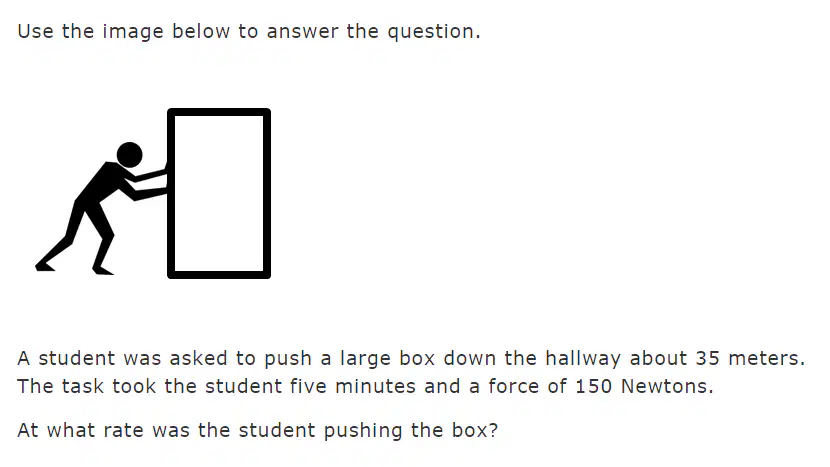
A student was asked to push a large box down the hallway about 35 meters. The task took the student five minutes and a force of 150 Newtons.
At what rate was the student pushing the box?
1286 Watts
18 Watts
70 Watts
1050 Watts

A winch system powered by a 7.2 volt motor is used to lift a 30 Newton load a distance of 2.5 meters. The motor's current rating is 0.370 Amps.
What is the efficiency of the electro-mechanical system if the time required to raise the load is 90 seconds?
3%
45%
22%
31%
A tow truck used a winch to lift a 10,000 N car, 15 m out of a ditch.
If the power of the winch system is 750 W, how long did it take to get the car out of the ditch?
3.3 sec
13.3 sec
3.3 min
13.3 min
Use 9.81 m/s2 for acceleration due to gravity. Force = mass * acceleration.
An electric winch lifts a 20 kg crate 2.5 meters.
If the winch must not exceed 100 watts during use, what is the fastest time that could be used to lift the crate?
5 seconds
6 seconds
4 seconds
3 seconds
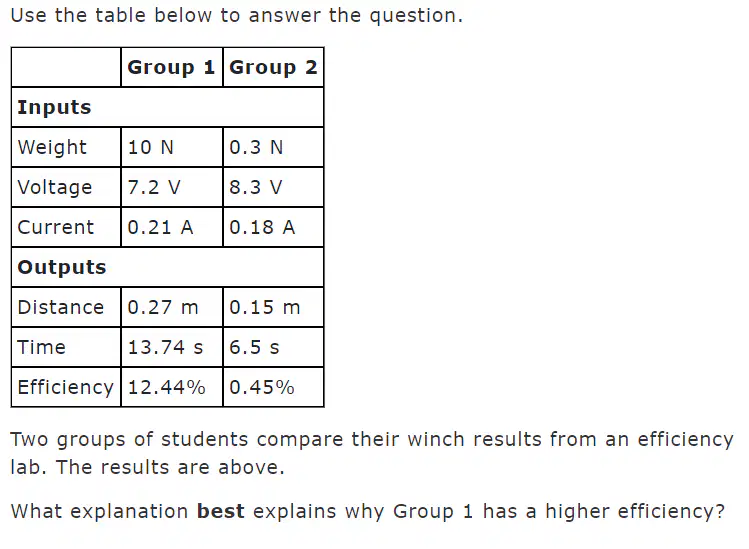
Two groups of students compare their winch results from an efficiency lab. The results are above.
What explanation best explains why Group 1 has a higher efficiency?
Group 1 experiences less resistance
Group 1 lifts their weight faster
Group 2 performs more work
Group 1 has a higher output power
What are the two fundamental concepts at the core of mechanical engineering?
Energy and Motion
Force and Work
Statics and Dynamics
Levers and Pulleys
What is the mathematical expression for work in mechanical engineering?
w = m \times a
w = f \times d
w = v \times t
w = p \times v
Which of the following is NOT one of the six basic types of simple machines?
Levers
Inclined Planes
Wheels and Axles
Motors
Explain the significance of simple machines in mechanical engineering.
They provide mechanical advantage to reduce the amount of force required
They are only used in electrical engineering
They increase the amount of force required
They are not used in modern engineering
Describe the different types of motion observed in mechanical systems.
Linear, rotary, reciprocating, oscillating, and irregular
Circular, elliptical, spiral, and zigzag
Static, dynamic, rotational, and translational
Uniform, non-uniform, periodic, and aperiodic
Explain how friction affects mechanical systems.
Friction only slows down objects and is always detrimental
Friction is beneficial in all mechanical systems
Friction can both reduce efficiency and be advantageous
Friction has no effect on mechanical systems
Describe how mechanical engineers utilize energy conversion in their designs.
They focus solely on electrical energy conversion
They convert energy to minimize efficiency
They transform energy to maximize efficiency and minimize waste
They avoid using energy conversion in designs
What is the primary advantage of a wheel and axle system in mechanical engineering?
It increases the speed of an object.
It reduces friction and allows easier movement of heavy loads.
It changes the direction of force.
It provides electrical energy.
How do screws function in mechanical engineering?
By increasing speed.
By converting linear motion into rotational motion.
By converting rotational motion into linear motion.
By providing electrical energy.
What is the role of wedges in mechanical systems?
To increase speed.
To convert rotational motion into linear motion.
To split or lift objects by converting force.
To provide electrical energy.
How do pulleys provide mechanical advantage?
By increasing speed.
By changing the direction and reducing the force needed to lift loads.
By converting rotational motion into linear motion.
By providing electrical energy.
What is the significance of compound machines in mechanical engineering?
They increase speed.
They combine simple machines to perform tasks more efficiently.
They convert rotational motion into linear motion.
They provide electrical energy.
What is power expressed as in terms of work and time?
p = w × t
p = w / t
p = t / w
p = w + t
In a first-class lever, where is the fulcrum located?
At one end
In the middle
At the load
At the force
What is the primary function of a pulley in a simple machine?
To increase speed
To change the direction of force
To generate electricity
To decrease weight

