
NEW
Font size
 Worksheets
Plates
Total questions: 55
Worksheet time: 55mins


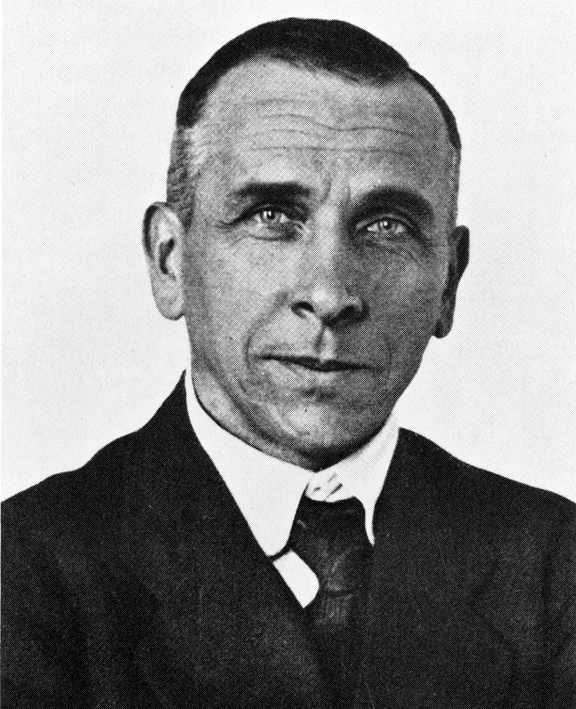
What evidence did Alfred Wegener use to support his theory of continential drift?
Fossil discoveries
The Himalayan Mountains
Ancient maps of the world
Charts of seismic activity

What is true of tectonics plates?
They are constantly moving
Earthquakes cause them to move
They don't move for centuries at a time
There are fewer & fewer of them

What is the underlying force that drives plate tectonics?
Ocean tides
Volcanic eruptions
The rock cycle
Convention currents

What makes the plates move?
Conduction in the mantle
Convection in the mantle
Why did other scientists did no believe in Wegener’s theory?
He could not explain how the continents moved
He didn’t have evidence
His data was wrong
He didn’t use the right technology to gather data


What did Alfred Wegener call the single supercontinent that he suggested existed about 200 million years ago?
Eurasia
Pangaea
Atlantis
Gondwana
What piece of evidence for Continental Drift states that the same plant and animal fossils are found on continents separated by oceans.
Continent Shape
Fossil/Climate Evidence
Landform/Rock Evidence
Glacial Evidence
What piece of evidence for Continental Drift states that similar types and ages of rocks are found on different continents?
Continent Shape
Fossil/Climate Evidence
Landform/Rock Evidence
Glacial Evidence
What cold environment feature was evidence to support the theory that the continents used to be joined?
Same rocks were found on different continents
Glacial grooves were found on different continents
Fossilized evidence of the same organism found on different continents
Africa and South America look like puzzle pieces that fit together

According to the continental drift hypothesis, the presence of similar fossils in South America and Africa supports which scientific idea?
Animals easily and frequently travel from Africa to South America.
Species of animals probably traveled between continents on natural rafts (such as trees destroyed in tsunamis).
Land bridges once existed that connected the continents.
South America and Africa were once connected together.

What scientists have contributed to the theory of plate tectonics?
Alfred Wegener and Harry Hess
Alfred Wegener only
Harry Hess only
scientists

What is the force that moves the continents?
Conduction
Convection
Radiation
Conveyor belts
Who proposed the theory of seafloor spreading?
Alfred Wegener
Harry Hess
Marie Tharp
Charles Darwin
What is the significance of Harry Hess's discovery of mid-ocean ridges?
They are the deepest parts of the ocean
They are sites of new crust formation
They are the oldest parts of the ocean
They are unrelated to tectonic activity


Which of the following offers a possible list of the layers in order from oldest to youngest?
A, B, C, D, E
E, C, B, D, A
E, D, C, B, A
C, B, A, D, E

Which rock layer was deposited first, and is the oldest rock, in this diagram?
B
C
D
E

Look at the diagram, what layer did animal E first show up in?
Layer #4
Layer #5
Layer #6
Layer #8
Which of the following is NOT evidence supporting the theory of continental drift?
Matching rock formations across continents
Similar fossils found on different continents
Glacial grooves found in regions now warm
Identical climate patterns on all continents
What process is responsible for recycling old oceanic crust back into the mantle?
Erosion
Sea-floor spreading
Subduction
Weathering
Subduction is the process where:
new oceanic crust is formed
oceanic crust thickens due to solidification of magma
one plate is pushed down into the mantle beneath another plate
two plates push together forming a mountain

Which point on the diagram represents where new crust is formed?
point A
point B
point C
point D

Which areas of rocks would be the oldest?
1 and 2
2 and 3
3 and 4
1 and 4
Which areas of rocks would be the youngest?
1 and 2
2 and 3
3 and 4
1 and 4

What is the process of one plate sliding under another?
Convection
Subduction
Convergent
Conduction

Convergent plate boundaries occur when crustal plates...
Come together
Move apart
Slide side by side

This type of plate boundary has the worlds most dangerous volcanoes either on land or in the water. These volcanoes are fed from the melting subducting plate. What type of plate boundary?
Convergent
Divergent
Transform
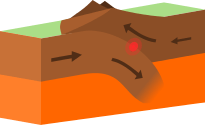
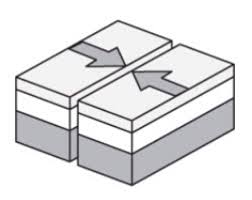

What is this image of?
Divergent Plate Boundary
Transform Plate Boundary (San Andreas Fault)
Convergent Plate Boundary

What type of Boundary is this? What event will occur at this boundary?
Transform / Earthquakes
Subduction / Volcano Eruption
Tornado / Rain
Mountain Building / Volcanism
What type of Boundary is this? What event will occur at this boundary?
Transform / Earthquakes
Subduction / Volcano Eruption
Tornado / Rain
Mountain Building / Volcanism

Tectonic Plate movement is caused by ______________.
the rotation of the Earth
ocean tides
convection currents in the mantle
the moon's gravity
Transform Boundaries
Create new crust
Destroy crust
Neither create or destroy

When a divergent boundary happens under continental crust, it's called a:
Rift Valley
Block Mountain
Folded Mountain
Mid-Ocean Ridge

When a divergent boundary occurs underneath the ocean, it's called a:
Rift Valley
Ocean Ridge
Subduction Zone
Fault Block Mountain


Which letter corresponds with the newest rock?
L
M
N
O

Which type of plate boundary is most likely to produce earthquakes?
Subductive boundary
Convergent boundary
Divergent boundary
Transform boundary
What is the name of the process where two continental plates collide and form mountains?
Subduction
Transform faulting
Sea-floor spreading
Convergent collision
Which scientist first proposed the idea of continental drift?
Marie Tharp
Alfred Wegener
Charles Darwin
Harry Hess

