
 Worksheets
FDHRC PREP TEST 4
Total questions: 75
Worksheet time: 38mins
Danika, 14 years old, presents for her continuing care appointment with a single ulcer on her hard palate adjacent to teeth 26 and 27. The borders are irregular and it is painful to touch. She recalls being quite sick when she was 8 years old, and had mouth sores and a high fever for several days. What condition should the dental hygienist suspect?
Focal epithelial hyperplasia
Aphthous ulcer
Pemphigus vulgaris
Recurrent herpes simplex
A dental hygienist is asked to visit a long-term care facility to provide periodontal therapy for 92 year old Mr. Whelan, who is confined to a single bed placed against a wall. The dental hygienist cannot provide dental hygiene therapy using her dominant hand. Which one of the following actions would be most appropriate for the dental hygienist to take?
Postpone periodontal debridement
Brush and floss, but postpone periodontal debridement
Reposition the bed and perform periodontal debridement
Enlist aid to transfer Mr. Whelan to a wheelchair

What deciduous tooth is retained in this occlusal radiograph?
Tooth 53
Tooth 63
Tooth 73
Tooth 83
Mrs. Knight, 70 years old, has generalized gingival recession of 2 mm and evidence of progressive demineralization on exposed root surfaces. She dislikes “taking pills” and rarely takes her calcium supplement. In addition to a physician referral, which of the following recommendations would be most appropriate for the dental hygienist to make?
Improve dental biofilm removal techniques and include citrus fruits and eggs in her diet
Switch to a powered toothbrush and include vitamin supplements in her diet
Replace the dental floss and a floss wand and include meats, fish, and fruit in her diet
Improve dental biofilm removal techniques and include green vegetables, sardines, and almonds in her diet
The dental hygienist is making a presentation to a local sports team about “chewing tobacco”. During the session, the dental hygienist notices that a group of players at the back of the room are whispering to each other. When questioned, the players state that the presentation is “boring”.
Express understanding of their concerns and request their tolerance of the presentation
Request that the group identify the issues they feel are important
Bring closure to the section they find boring and proceed to the next part of the lesson
Make them feel comfortable to leave the presentation if they so wish
Which one of the following oral health descriptions of a 37 year old male client would suggest the need for referral to a periodontist?
Generalized, moderate subgingival calculus deposits, posterior periodontal probing depths of 4-5 mm, and generalized bleeding on probing
Halitosis, sloughing tips of the gingival papillae, and bright red adjacent gingiva that bleeds spontaneously
Localized 4 mm periodontal probing depths with intermittent episodes of bleeding around the dental implant
Persistence of several posterior 5-6 mm periodontal probing depths after four consecutive 3 month continuing care appointments, and good oral hygiene
What must the dental hygienist do when experiencing difficulty angulating a curet on the distal surface of tooth 16?
Split the middle and the ring finger apart
Roll the handle between the index finger and thumb
Assess and placement of the fulcrum
Compensate with increased lateral pressure
Which one of the following statements is the best recommendation for applying an acid etch when preparing a primary molar for a pit and fissure sealant?
45 second application
Follow the manufacturer's instructions
15 second application
Consult a more experienced colleague
Jared, 19 years old, presents with partially erupted mandibular third molars. Which one of the following radiographic interventions would be most appropriate?
Posterior bitewing radiographs
Vertical bitewing radiographs
Cephalometric radiographs
Panoramic radiographs
Ms. Lake, 28 years old, presents for her continuing care appointment. Intraoral findings reveal less than 1 mm of keratinized gingival tissue on the buccal surface of teeth 34 and 44. Ms. Lake has a previous history of orthodontic treatment. What should the dental hygienist recommend?
Home fluoride therapy
Consultation for a gingival graft
Desensitization of root surfaces
Periodontal debridement
Mr. Rawleigh, 71 years old, returns for a 6 week evaluation appointment after completion of periodontal debridement. He states that he has noticed less bleeding when he brushes his teeth. What would be the best method for the dental hygienist to assess the changes in Mr. Rawleigh’s gingival health?
Ask Mr. Rawleigh open-ended questions about his oral self care
Have Mr. Rawleigh demonstrate his toothbrushing technique
Compare Mr. Rawleigh’s current to previous probing depths
Determine Mr. Rawleigh’s bleeding scores
The dental hygienist notes bilateral hypertrophy of the masseter muscles during the head and neck assessment of a client. Based on this finding, what should the dental hygienist investigate further in the client’s mouth?
The occlusal surfaces of the teeth
The soft and hard palate
The lateral border of the tongue
The buccal mucosa
The dental hygienist has been hired to assess the oral health of the residents of a long term care facility. Which one of the following indices would be most appropriate to determine the periodontal status of this population?
Gingival Index (GI)
Community Periodontal Index (CPI)
Periodontal Screening and Recording (PSR)
Sulcus Bleeding Index (SBI)
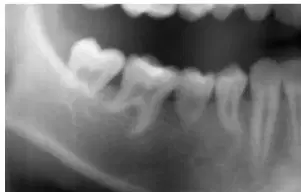
What is the correct term to describe the root morphology of tooth 44 as seen on the following periapical radiograph?
Internal root resorption
Taurodontia
Dens in dente
Dilaceration
Ms. Brown, 24 years old, had quadrants 1 and 4 debrided at a previous appointment. She presents today for the periodontal debridement of quadrants 2 and 3. The dental hygienist notices localized moderate inflammation on the lingual aspect of tooth 46. What is the most likely cause of this inflammation?
Ms. Brown is not brushing effectively
Ms. Brown is taking an oral contraceptive
There is residual deposit in this area
This area has been traumatized by flossing
Mr. Menard, 50 years old, has established the following two goals: 1) to be able to explain the relationship between dental biofilm and the gingival disease process; and 2) to master the sulcular brushing technique. At the next appointment, how should the dental hygienist determine if Mr. Menard has met these goals?
Question Mr. Menard to determine if he understands the etiology of dental biofilm and gingival disease and have him demonstrate toothbrushing
Have Mr. Menard demonstrate dental biofilm removal techniques and perform a Bleeding Index
Ask Mr. Menard questions to determine if he understands the etiology of gingivitis and its relationship to toothbrushing techniques
Have Mr. Menard demonstrate the sulcular toothbrushing technique and provide immediate feedback
What specific oral side effect is associated with most anticonvulsants and most calcium channel blockers?
Tissue sloughing
Gingival hyperplasia
Xerostomia
Gingival atrophy
Mrs. Sims, 67 years old, states she brushes with baking soda and hydrogen peroxide instead of a dentifrice. She questions the dental hygienist about the efficacy of this regimen. What information should the dental hygienist provide to Mrs. Sims?
Continuous use can cause staining of the teeth
This is an effective oral self care method
A saline mouth rinse would be more effective
Research does not support this technique
The dental hygienist is administering an inferior alveolar injection for an adult client. Which scenario indicates that the tip of the needle has reached the correct area for injecting the anesthetic?
Two-thirds of a short needle has been inserted into the tissue and has contacted bone
The full length of a short needle has been inserted into the tissue without contacting bone
Three-quarters of a long needle has been inserted into the tissue and has contacted bone
The full length of a long needle has been inserted into the tissue without contacting bone
The intraoral assessment of a 27 year old female client reveals a raised, white, non-sloughing, painless lesion on the left lateral border of the tongue. The client is on long-term corticosteroid therapy. Which one of the following conditions is most likely to be present?
Dietary induced erythroplakia
Thrush from human immunodeficiency virus
Focal epithelial hyperplasia
Frictional hyperkeratosis
What must the dental hygienist consider when assessing the client’s ability to make an informed choice for treatment?
Knowledge of oral hygiene
Ability to comprehend the treatment options
Preferences and treatment prognosis
Cost and risks of treatment
A dental hygienist critiques research journal articles on the efficacy of hypnotism as an anxiety management approach. Which population sample is appropriate to ensure the validity of this study?
A random sample
A stratified sample
A systematic sample
A convenience sample
The dental hygienist is presenting a proposal for an oral health education initiative to a community agency. Which of the following elements of a planning process should be described first?
The program plan, priorities, and alternatives
The required human resources to implement the program
The cost factors and time frame associated with the plan
The survey results of the community’s oral health status
Mr. Smith, 23 years old, is concerned about the black line stain on his teeth. What is associated with this condition?
Mature dental biofilm
Iron compounds
Black tea
Smokeless tobacco
What practice would illustrate cross-cultural sensitivity during the dental hygiene assessment and diagnosis?
Encouraging the client to discuss her cultural background
Using direct eye contact with the client
Avoiding questioning the client about cultural practices
Speaking slowly and clearly
What instrument should be used to debride a mesiopalatal class II furcation on tooth 26?
Ultrasonic standard-diameter universal tip
Extended shank Gracey specific curet 15/16
Miniature Gracey specific curette 11/12
Columbia universal curette 13/14
Mr. Proulx, 48 years old, has just completed non-surgical periodontal therapy for generalized Stage III Grade B periodontitis. What would be the most appropriate continuing care interval for Mr. Proulx?
1 month
3 months
6 months
9 months
Mrs. Wylie, 68 years old, presents for periodontal debridement. She informed the dental hygienist for the past 12 months, she has been treated for tuberculosis. Mrs. Wylie says that the tuberculosis is no longer active. What should the dental hygienist do?
Consult Mrs. Wylie’s physician to ensure the tuberculosis tests are negative
Ensure that Mrs. Wylie is on prophylactic antibiotic therapy
Treat Mrs. Wylie following standard precautions
Postpone Mrs. Wylie’s treatment until 6 months after the start of the anti-tuberculosis therapy
During a routine check of the emergency kit, the dental hygienist discovers the nitroglycerin (Nitrostat) has expired. What medical emergency treatment would be adversely affected by this finding?
Respiratory distress
Heart failure
Acute allergic reaction
Angina pectoris
The dental hygienist is not satisfied with the desensitizing product currently available in the dental office. What is the best strategy for selecting an alternative agent?
Reviewing dental product brochures
Asking his or her employer for recommendations
Searching for randomized clinical control trials
Conducting an internet search for testimonials
What information regarding a hazardous material should be on a Material Safety Data Sheet (MSDS)?
A list of the hazards of the material, and procedures that should be taken when the material is used and procedures to follow in case of an emergency
A list of all hazardous and non-hazardous chemical and ingredients used in the product
A list of all of the hazards of the materials used inside the dental office and the proper procedures to follow in case of an emergency
The name of the manufacturer of the hazardous material and the contact information in case of spillage
What ergonomic measures should the dental hygienist undertake to help prevent repetitive strain injury?
Employ proper client positioning, initiate wrist motion activation during instrumentation, and remove stains and dental biofilm
Maintain good operative positioning and a neutral forearm and wrist position, and use a unified motion during periodontal debridement
Wear proper fitting gloves, ensure the client is in a comfortable position, and use small-handed instruments
Maintain proper operator posture and a neutral wrist position, and use digital motion activation
What would purulent exudate indicate in a periodontal assessment?
Severe periodontitis
Deep periodontal probing depths
Acute inflammation
Presence of a systemic disease
The normal aging process includes which one of the following conditions
Smaller pulp chamber
GIngival recession
Xerostomia
Root caries
Mr. Carter, 86 years old, presents for his 6 month continuing care appointment. His health history indicates diet-controlled diabetes and high blood pressure controlled with MAO inhibitors. The dental hygienist determines that local anesthetic without epinephrine is appropriate for the planned periodontal treatment. In calculating the maximum recommended dose (MRD) of local anesthetic, what should the dental hygienist consider?
The client’s health is stable and well controlled so treatment can proceed with no changes to MRD
The client’s history of diabetes requires a medical consultation before proceeding with dental hygiene treatment
The client’s age is a predisposing factor and an indication that the MRD should be decreased
The client’s high blood pressure indicates that local anesthetic should be used with caution
Dimitri, 8 years old, arrives at the dental office for his first visit. He appears anxious. During the course of the appointment, Dimitri reports, “I’m dizzy and I can’t breathe”. During the appointment, the dental hygienist observes respirations of approximately 30-35 breaths per minute. What emergency strategy should the dental hygienist initiate?
Have the child drink a glass of orange juice
Ask the child to hold each breath for a count of ten
Initiate cardiopulmonary resuscitation on the child
Place the child in the Trendelenburg position
The dental hygienist ensures that 84 year old Mrs. Chipman takes prescribed premedication before a periodontal debridement appointment. Which one of the following ethical principles is being addressed?
Justice
Autonomy
Veracity
Beneficence
During the initial assessment of Ms. Anders, 69 years old, the dental hygienist notes generalized posterior gingival recession with associated shiny, wedge-shaped areas on a number of root surfaces. Ms. Anders’ general health is good. She takes diazepam (Valium) to treat her anxiety. How should the dental hygienist assist Ms. Anders in controlling these lesions?
Modify her tooth brushing technique
Introduce a daily sodium fluoride mouth rinse
Recommend the use of a saliva substitute
Apply a desensitizing agent
Charlotte, 16 years old, presents for her continuing care appointment. She completed active fixed orthodontic treatment 4 months ago and now wears a removable maxillary retainer and a fixed mandibular lingual bar. Clinical assessment reveals mobility of M2 on tooth 22 and radiography findings of resorption of approximately one third of the root length on tooth 22. What is the best explanation for this finding?
The fixed appliance has been removed too soon
Heavy continuous orthodontic forces were used
Idiopathic resorption is common in orthodontic treatment
Moderate intermittent orthodontic forces were applied
Andre, 13 years old, presents for his continuing care appointment with generalized dental biofilm-induced gingivitis. He states that he brushes his teeth 3 times a day, and demonstrates the scrub-brush method. The dental hygienist observes a moderate amount of dental biofilm in the cervical area of the teeth. Which one of the following brushing methods should the dental hygienist suggest?
Collis
Fones
Charters
Modified Stillman
Mrs. Braun, 72 years old, presents for dental hygiene care accompanied by her daughter. Mrs. Braun is withdrawn and waits for her daughter to respond to the dental hygienist’s questions. The dental hygienist notes abrasions at the left corner of the mouth, a fractured maxillary partial denture and that teeth 33 and 34 are fractured. What should the dental hygienist conclude?
Mrs. Braun needs time to begin to communicate
Mrs. Braun shows some of the signs associated with abuse
Mrs. Braun’s daughter should be involved in the planning of care
Mrs. Braun required diet counseling to address vitamin deficiencies
Mrs. Leong, 44 years old, has completed initial dental hygiene therapy. The dental hygienist explains to her the need for a continuing care appointment in 6 months. Mrs. Leong insists the appointment be in 12 months. Which of the following actions would be most appropriate for the dental hygienist to take?
Record the 6 month recommendation and Mrs. Leong’s preference
Convince Mrs. Leong of the need to make an appointment in 6 months
Document a 12 month appointment on Mrs. Leong’s dental record
Mail Mrs. Leong a reminder card for an appointment in 6 months time
What must the dental hygienist do when removing surgical sutures?
Use topical antiseptic and topical anesthetic
Count and record the number of removed sutures
Confirm that antibiotic premedication has been taken
Apply a new periodontal dressing over the site
Mr. Franco, 43 years old, is undergoing radiation therapy to the submandibular and sublingual salivary glands. Which one of the following oral hygiene mouthrinses should the dental hygienist recommend to Mr. Franco to help him cleanse his mouth?
Alcohol based mouth rinse
Phenol based mouth rinse
Sodium bicarbonate mouth rinse
Undiluted hydrogen peroxide mouth rinse
For which one of the following conditions is the use of nitrous oxide CONTRAINDICATED?
Hypertension
Nasal polyp
Emphysema
Coronary atherosclerosis
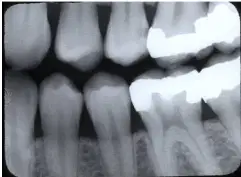
Mr. Fisher, 23 years old, presents for her continuing care appointment with a Biofilm Control Record of 10%, generalized pink gingiva and no bleeding on probing. Based on the following bitewing radiograph, what should the dental hygienist do next?
Refer her to a dentist for a consultation
Consult with a periodontitis regarding severe clinical attachment loss
Initiate subgingival periodontal debridement using local anesthetic
Recommend that she sees her physician to be tested for type 1 diabetes
Akesha, 8 years old, is a new client that presents for a dental hygiene assessment. Her mother has indicated in her health history that Akesha has epileptic seizures. Which one of the following questions would provide the most critical information regarding Akesha’s condition?
Does Akesha experience disorientation following her seizures?
Has Akesha refrained from eating prior to her appointment?
Has Akesha experienced swelling of her gums?
What factors cause Akesha’s seizures?
Salah, 13 years old, is undergoing fixed orthodontic treatment and presents for her 9 month continuing care appointment. The gingiva is generally inflamed and moderate dental biofilm is present. The dental biofilm score and gingival bleeding index have increased from Salah’s last visit. In addition to oral self care instruction, what should the dental hygienist recommend?
Pit and fissure sealants
Diet counseling
Tartar control dentifrice
More frequent continuing care
A client presents for periodontal debridement with a health condition that is a relative contraindication of a commonly used local anesthetic. What must the dental hygienist consider regarding the use of this particular anesthetic?
It should never be used for this client
It may be used in small doses if an alternative anesthetic is not available
It should not be used unless a vasoconstrictor has been added to the anesthetic solution
It may be used to the maximum dose but the client must be carefully monitored for side effects
The dental hygienist is interpreting the panoramic radiograph of 74 years old Mr. Jacob. There is a large radiolucent band superimposed over the apices of the maxillary teeth. What does this indicate about the exposure technique?
His head was tilted upwards
His tongue was not held against the palate
His head was too far forward
His acrylic denture was not removed
Mr. Nelson, 28 years old, presents for his continuing care appointment. His health history indicates that he had a kidney transplant 9 months ago. The client’s intraoral assessment reveals a low dental biofilm score and generalized gingival enlargement. What should the dental hygienist consider with regard to Mr. Nelson’s medication regimen?
Cyclosporine (Neoral) stimulates diffuse, firm, fibrous gingival overgrowth
Warfarin (Coumadin) causes generalized fibrosis and tissue hypertrophy
Acetylsalicylic Acid (Entrophen) causes inflammation and tissue bleeding
Phenytoin (Dilantin) causes generalized gingival hyperplasia
To determine why a client is no longer using a recommended perio aid, what must the dental hygienist assess?
Dental plaque biofilm levels
Enamel sensitivity
Physical ability
Interest in other oral devices
In order to avoid a hematoma, what should the dental hygienist consider when delivering local anesthetic using a posterior superior alveolar nerve block technique?
Ensure that bone is contacted prior to injection
A short dental needle is recommended
Orient the bevel of the needle towards the bone
Use only long needles
What blade angulation should the dental hygienist use when debriding residual deposits on root surfaces?
Between 0 and 40 degrees
Approximately 45 degrees
Between 60 and 70 degrees
Approximately 90 degrees
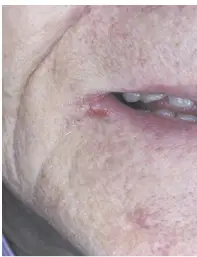
Based on the following photograph, which medication would most likely address the condition identified at the labial commissures?
Nystatin (Mycostatin)
Neomycin (Neosporin)
Acyclovir (Zovirax)
Corticosteroid (Fluocinonide)
What should the dental hygienist suggest to a client who has a relapse while trying to quit smoking?
“You may be more successful during the precontemplation stage of change”
“It may be best if you do not discuss the relapse with your family”
"Try to identify the strategies that seemed to work for you”
“Let’s review the risks associated with your continued use of tobacco”
Which one of the following techniques for removing soft deposits would result in the least amount of damage to a complete maxillary denture?
An air polishing device
Bag and immerse in an ultrasonic bath
Clean with hand instruments and rubber cap polish
Soak in a sodium hypochlorite solution
Ms. Bryant, 48 years old, presents with generalized Stage III Grade B periodontitis at her initial dental hygiene appointment. She received quadrant periodontal debridement with local anesthesia. At her 6 weeks post-initial therapy evaluation appointment, bleeding is minimal and periodontal probing depth are decreased; however, Ms. Bryant indicates she is surprised by the generalized sensitivity she is now experiencing. What error has been made in providing care for Ms. Bryant?
Failure to utilize current research on desensitizing products
Failure to explain the risks of treatment
Failure to adequately complete the periodontal debridement
Failure to provide effective postoperative analgesics
Mr. Sandowski, 45 years old, has a healthy history that includes recent phlebitis in his right leg. His medications include warfarin sodium (Coumadin) and acetaminophen (Tylenol Extra Strength). What action should the dental hygienist take with Mr. Sandowski for his dental hygiene care?
Place Mr. Sandowski in a semi-upright position during dental hygiene care
Discontinue his medication 24 hours prior to the dental hygiene appointment
Discontinue the medication 24 hours following the dental hygiene care
Consult Mr. Sandowski's physician before initiating dental hygiene care
Which one of the following indices should the dental hygienist use to determine caries experience in preschool children?
The Decayed, Missing and Filled Teeth index (DMFT)
The Decayed, Missing and Filled Tooth Surfaces index (DMFS)
The decayed, missing and filled teeth index (dmft)
The decayed and filled teeth index (dft)
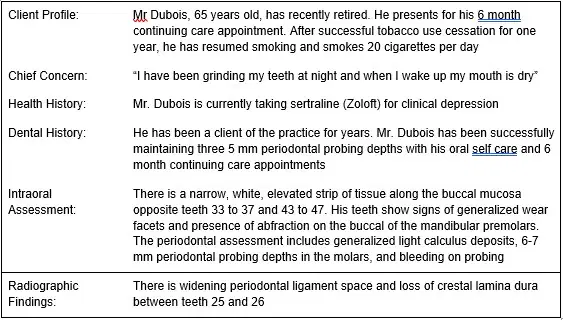
Which one of the following conditions best identifies the narrow white elevated strip on Mr. Dubois’ buccal mucosa?
Linea alba
Candida albicans
Lichen planus
Leukoplakia
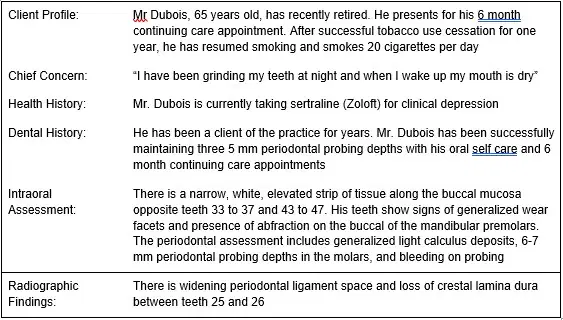
Which one of the following conditions is the most probable cause of Mr. Dubois’ radiographic findings?
Periapical abscess
Occlusal trauma
Necrotizing ulcerative periodontitis
Periodontal abscess
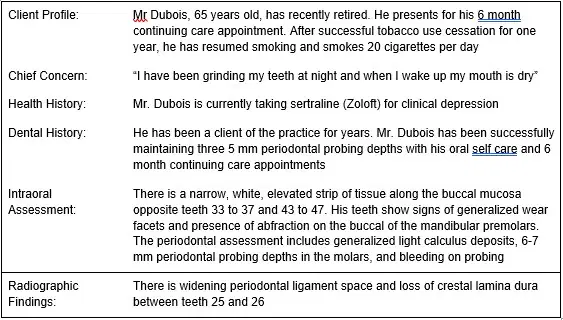
Which one of the following conclusions should the dental hygienist reach regarding Mr. Dubois’ dry mouth?
Nocturnal bruxism may result in mouth breathing leading to a dry mouth
Age related atrophy of the salivary glands reduces the amount of saliva
Smoking tobacco results in a decrease salivary flow
Xerostomia is a common side effect of antidepressant medication
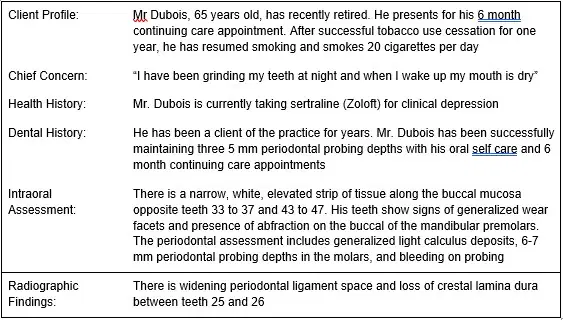
Mr. Dubois understands smoking is related to many health problems, but is not prepared to stop smoking at this time. Which one of the following responses would be most appropriate for the dental hygienist to make?
Many people attempt to quit smoking several times before they are successful
Further treatment may need to be delayed until you have stopped smoking
When relapse occurs, it is important to join a tobacco use cessation treatment problem
It is important you many a commitment to quit smoking today
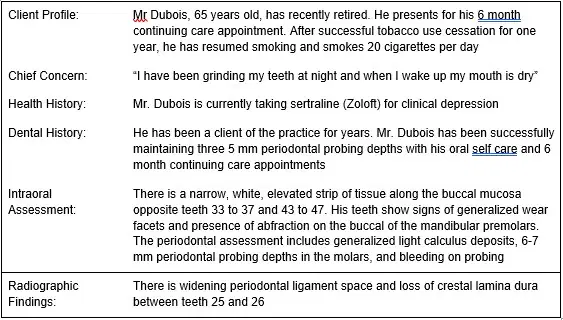
During the appointment, Mr. Dubois indicates he finds it difficult to fill the hours in his days and misses the contact with his co-workers. Which one of the following actions would be most appropriate for the dental hygienist to take?
Suggest he make new friends
Advise him it is important to keep busy
Provide phone numbers of local community agencies
Refer him to a psychiatrist to further discuss his psychological state
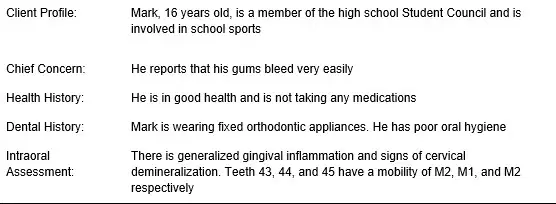
What is the first step the dental hygienist should take to best facilitate a behavior change for Mark?
Encourage him to improve his manual dexterity
Inform him of the facts of dental biofilm
Warn him about the effects of periodontal disease
Determine his oral health knowledge
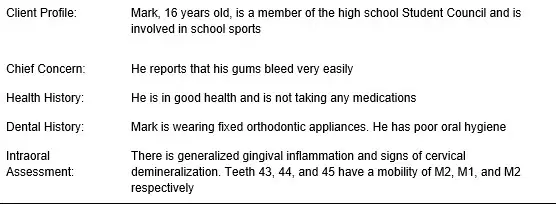
What would be the most likely effect of systemic fluoride supplements for Mark?
There would be some remineralization on pits and fissures of the teeth
There would be no benefit because Mark is wearing orthodontic appliance
It would prevent cervical demineralization from becoming carious
There would be limited benefit at Mark’s age
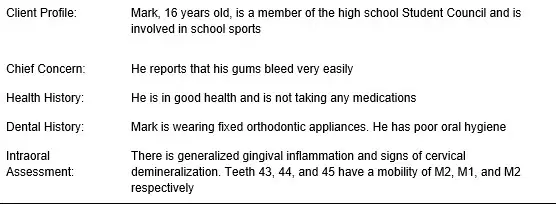
How would the condition of the gingiva affect the dental hygiene care plan for Mark?
This type of inflammation if fibrotic and should be brought to the attention of the orthodontist
Professional removal of dental biofilm is critical in preventing gingivitis
More time should be spent on implementation procedures, including rubber cap polishing and fluoride treatments
Dental biofilm control should be emphasized and reinforced to reduce inflammation
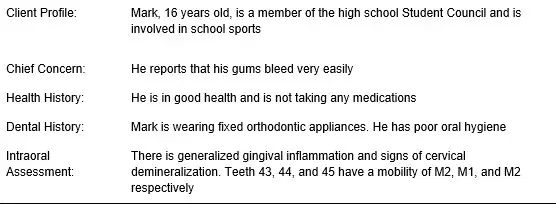
Which dental hygiene intervention would be most effective when teaching Mark about oral self care?
Giving him a pamphlet on appropriate oral self care for orthodontic clients with fixed appliances
Teaching the Fones method of toothbrushing and reinforcing the technique at each appointment
Teaching the Charter method of toothbrushing, then on successive appointments, introducing flossing techniques and fluoride use
Giving him an orthodontic toothbrush, tufted dental floss, and home fluoride mouth rinse on the first appointment
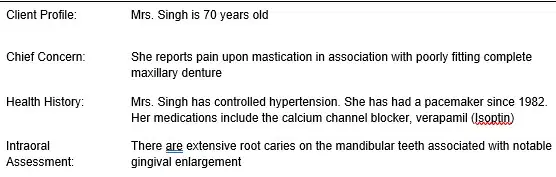
What is the most likely explanation for the gingival hyperplasia in Mrs. Singh?
High blood pressure
Cardiac pacemaker
Verapamil
Poorly fitting denture
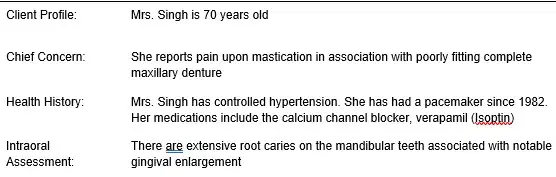
During the assessment, Mrs. Singh becomes pale, disoriented, and appears ready to faint. What intervention would be most appropriate?
Place Mrs. Singh in a supine position
Offer Mrs. Singh physical support until she is stable
Administer sugar orally to Mrs. Singh
Ask Mrs. Singh to sit for a minute
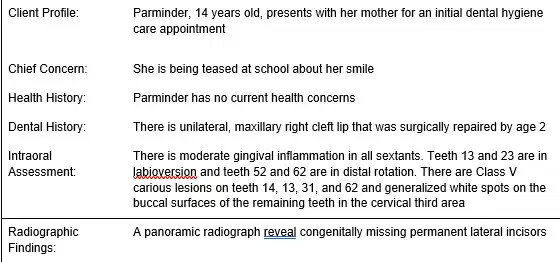
What is the most likely cause of Perminder's cleft lip?
Genetic predisposition
Prenatal vitamins
Racial predisposition
Premature birth
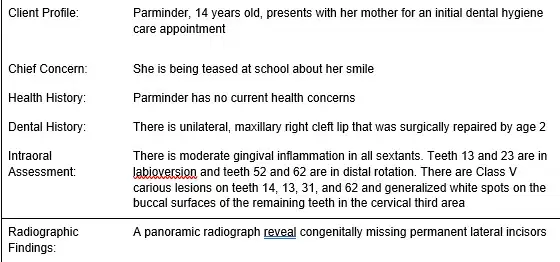
Which of the following developmental processes did not fuse in Perminder's case?
Frontal and maxillary
Medial nasal and palatal
Medial nasal and maxillary
Frontal and lateral nasal
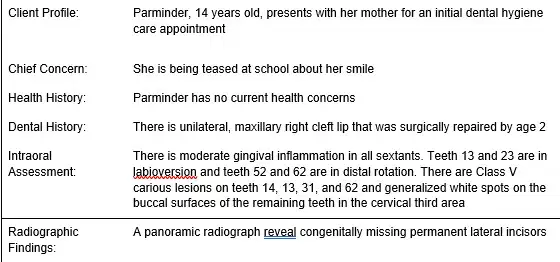
Upon further assessment, the dental hygienist notes a slightly rough surface on teeth 11 and 15. How did the dental hygienist determine the initial findings?
Visual inspection
Tactile assessment
Radiographic survey
Percussion

Perminder and her mother want teeth 13 and 23 extracted, thinking this will stop the teasing at school. How should the dental hygienist proceed?
Discuss the importance of keeping teeth 13 and 23 and encourage Perminder to seek counseling
Refer Perminder to the appropriate specialist and complete the periodontal debridement
Reassure Perminder that this eruption pattern is normal and that her smile will improve over time
Acknowledge their concerns and explain why extracting these teeth is not in Perminder's best interest

