
 Worksheets
Human Geo. Unit 2 – Population Composition
Total questions: 78
Worksheet time: 42mins
Why would geographers or governments want to study demographics?
To plan for the future by meeting population needs, using resources appropriately, and understanding current societal and economic issues
To identify famous landmarks for tourism marketing
To determine which languages should be taught in schools based on popularity
To select countries for international sports competitions
Where in the world can you find the greatest sex ratio imbalances?
China and India
Latin America and Southern Africa
Japan and South Korea
Papua New Guinea and Guyana
Where in the world can you find the oldest populations?
Japan and most of Europe
Central Africa
Latin America
Pakistan and Guyana
Where in the world can you find the fastest growing populations?
Central Africa
Western Europe
East Asia
North America
What can population pyramids be used for?
Assessing population growth and decline and predicting markets for goods and services
Mapping tectonic plate boundaries
Measuring daily weather patterns
Calculating a country’s gross domestic product
What can population pyramid irregularities reveal?
Changes in the population due to natural disasters
Large-scale conflicts and wars
Population control methods
Migration between regions and countries
Phases of the moon
Crude Birth Rate (CBR) → Choose the best definition.
The number of live births per year for every 1000 people
The average number of children born per woman
The number of deaths per year for every 1000 people
The share of people over age 65 in a population
Crude Death Rate (CDR) → Choose the best definition.
The number of deaths per year for every 1000 people
The number of live births per 1000 women aged 15–49
The average number of years a person can be expected to live
The percent of infants who reach their first birthday
Natural Increase Rate (NIR) → Choose the best definition.
The difference between the crude birth rate and crude death rate; a statistic estimating population growth not including migration
The number of babies who die before their first birthday for every 1000 births
The percent of population gained through immigration
The time a country will take to double its population
How do you calculate natural increase? Choose the correct formula.
NIR=CBR−CDR
NIR=CBR+CDR
NIR=CBR−IMR
NIR=TFR−CDR
Doubling Time → Choose the best definition.
A measurement of how long a country will take to double its population, based on its natural increase rate
The average number of children born per woman
The percent of the population aged under 15
The number of deaths per year per 1000 people
How do you calculate doubling time? Choose the correct formula.
Doubling time = 70/NIR
Doubling time = NIR/70
Doubling time = 70×NIR
Doubling time = CBR−CDR
Total Fertility Rate (TFR) → Choose the best definition.
The average number of children born per woman (aged 15–49)
The number of live births per year per 1000 people
The number of babies who die before age one per 1000 births
The share of women of reproductive age in a population
What TFR is needed to maintain the population of a country?
1.8
2.1
2.5
3.0
Infant Mortality Rate (IMR) → Choose the best definition.
A measure of the number of babies who die before their first birthday for every 1000 births
The number of deaths per year per 1000 people
The number of infants born per 1000 women aged 15–49
The percent of births attended by medical professionals
Life Expectancy → Choose the best definition.
The average number of years a person can be expected to live, given current social, economic, and medical conditions
The age when half of the population reaches retirement
The average length of schooling expected for a person
The number of years added by each stage of the DTM
What do the global geographic patterns of TFR, IMR, and life expectancy have in common, and why? Choose the statement that best reflects what we talked about in class.
TFR and IMR are higher and life expectancy is lower where economic development is low due to lower health education, limited access to medical care, and lower health expenditures; the reverse is true in regions with higher development and better-quality, accessible healthcare
TFR, IMR, and life expectancy are all higher in more developed regions because populations there grow faster
Life expectancy is unrelated to development; cultural factors entirely determine TFR and IMR
TFR is lower where development is low because families cannot afford many children, while IMR and life expectancy do not vary with development
Select all statements that describe criticisms of Malthusian Theory based on class notes.
The theory is unrealistic because resource supply is not fixed.
Population growth can spur ideas and manpower that increase food production.
The theory fails to account for opening new areas and regions of production.
Poverty and hunger are caused by institutions rather than population increase.
Food production will always outpace population growth regardless of conditions.
Select all statements that accurately explain China’s One Child Policy (1979–2015) and its outcomes according to what we talked about in class.
Parents could sign a one‑child contract and receive rewards such as free medical care, daycare, better housing, and job guarantees for children.
Families who broke the one‑child contract were punished.
The policy led to a balanced gender ratio and population growth.
A preference for sons contributed to gender imbalance and a declining population.
The policy mandated two children for all rural families without exceptions.
Define net migration rate.
The percentage of a country’s population that migrates each decade
The difference between the number of immigrants and the number of emigrants in a place in a year
The total number of immigrants entering a country each year
The ratio of immigrants to the total population
Define migration flow.
The legal status granted to arriving migrants
The immigrants entering or leaving a place during a given period of time
The number of refugees resettled in a year
The percentage of a nation’s workforce that is foreign-born
What motivates internal migration? Select all that apply.
Historically, claiming land on the frontier and establishing settlements
Presently, seeking better wages and economic opportunities
Availability of international humanitarian visas
Desire to avoid language barriers by staying in home regions
What are the three main patterns of internal migration flows? Select all that apply.
Rural to urban (globally since the Industrial Revolution)
Urban to suburban (North America since the 1950s)
East to west (Canada, USA, Europe)
International movement from Asia to Europe
What motivates transnational migration? Select all that apply.
Escaping violence and persecution
Seeking better employment and quality of life
Access to free university education worldwide
Mandatory military service requirements
What are the largest transnational migration flows? Select all that apply.
Asia to Europe
Latin America to the US
Poorer Asian countries to wealthy oil-producing countries of Southwest Asia
Western Europe to North America
Summarize the three eras of US migration by selecting the eras described in class. Select all that apply.
17th and 18th century colonial settlement (about 2 million Europeans moved to the US, including 650,000 Africans who were forcibly moved via slavery)
Late 19th and early 20th century mass European migration (primarily from Ireland, Germany, Norway, Sweden, Italy, and Russia)
Late 20th and early 21st century Asian and Latin American migration (primarily from Mexico, Central America, the Philippines, Vietnam, and India)
Mid-20th century internal migration only within the US with minimal international arrivals
Define unauthorized immigrant.
A migrant who receives temporary protection pending asylum
One who enters a country without the proper documentation or permission
A tourist who overstays a short-term visa but later departs
A refugee resettled through international agencies
What are the main source countries for unauthorized immigration in the US? Select all that apply.
Mexico
Guatemala
Honduras
El Salvador
China
Where do the majority of unauthorized immigrants settle in the US?
Florida and New York
Texas and California
Arizona and Nevada
Illinois and Pennsylvania
Why is Europe an attractive immigration destination?
Relative peace, an abundance of work opportunities, and freedom of movement for work and leisure
Strict border controls and limited labor markets
Primarily agricultural employment and limited urbanization
High barriers to movement within the region
What helps to propel the migration flow from Asia to Europe?
Increased educational exchange programs
Political and economic instability causing the migrant crisis of unauthorized immigration
Declining birth rates in Asia
Seasonal tourism policies
What are the main source countries of the migrant crisis in Europe? Select all that apply.
Eritrea
Syria
Afghanistan
Kosovo
Bhutan
Define selective immigration.
Open-border policy allowing all entrants regardless of background
Process to control immigration that bars individuals of certain backgrounds and gives preference to others who have traits viewed favorably
Temporary guest-worker program with fixed contracts
Policy that prioritizes family visits over work immigration
What criteria is considered with selective immigration? Select all that apply.
Skilled workers or specific professions
Countries of origin
Family reunification
Preference for short-term tourists
Define immigration quota.
A voluntary pledge by employers to hire migrants
A law that limits the number of prospective immigrants who can be admitted into a country every year
A guideline encouraging cultural diversity in schools
A fee charged to migrants when entering a country
How do immigration quotas affect a society?
They lead to a smaller pool of workers, less diversity, and discriminatory attitudes.
They increase diversity and expand the labor pool without social tensions.
They eliminate discrimination entirely and ensure equal treatment of all groups.
They guarantee equal representation from every country regardless of skill or need.
They have no significant impact on the workforce or society.
Remittances are money sent from a foreign worker to friends and family in their country of origin. Which statements accurately describe effects of remittances? Select all that apply.
They can raise household income for individual recipients.
They often contribute to economic growth and currency stabilization when citizens have more spending power.
They consistently reduce household income for recipients.
They can widen inequality within developing countries.
Governments can become too dependent on income from remittances.
Brain drain is emigration of skilled and talented workers (engineers, scientists, doctors, teachers) to other countries. Why is brain drain problematic for countries that experience it? Select all that apply.
It causes a loss of potential leaders and innovators who could help lift the economy.
It reduces the number of essential professionals like doctors and educators needed to provide services.
It immediately increases the country’s tax revenue and service availability.
It guarantees faster economic growth by removing unemployed workers.

This country has a low birth rate
True
False

Which statement is true?
There are more men in this country
There are fewer women in this country
There are more 30-34 year olds than 25-29 year olds
There are more people age 25-29 than 30-34

Describe the life expectancy of this country
People live a long time
People die early
Men live longer than women

There are a lot of immigrants that are coming into this country.
True
False

This country has a very large population
True
False


This map represents which of the following?
Hint: Population is shown using small dots so we are able to understand where people live and how spread out or close together they are.
Population Distribution
Population Density


What is infant morality rate?
The number of people in an area that can read or write
The measure infant deaths per 1,000 live births
The number of people living in a particular area
The number of people who are born in a particular area


How would you describe the population of this country?
Developing, Expanding Population
Developed, Steady Population
Developed, Declining Population

A characteristic of stage two of the Demographic Transition Model shows
Falling death rates and high birth rates
High death rates and low birth rates
Stable death rates and fluctuating birth rates
Rising death rates and high birth rates
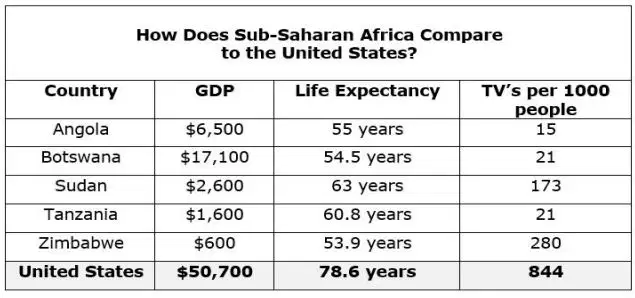
Study the chart and answer the question that follows.
Based on the chart, countries in Sub-Saharan Africa
Have lower GDPs and life expectancy rates than the United States
Have a high standard of living and are economically developed nations
Have higher GDPs and life expectancy rates than the United States
J Have more access to televisions compared to the United State

The world’s two most-populous countries are on which continent?
North America
Europe
Asia
South America
Africa

Where is the greatest population density in South America?
at the southern tip
near the Amazon
in the middle
Along the coastlines
Rural or Urban?
High Population Density
Rural
Urban
High population density, surrounding physical features, and abundant natural resources all contribute to which environmental issue?
Air pollution in Mexico City.
Acid Rain in the Black Forest
Deforestation of the Amazon Rainforest
Pollution of the Great Lakes
Which factor most directly influences a country's population growth rate?
Size of the capital city
Birth rate and death rate
Average annual temperature
Number of official languages
Which of the following best describes the concept of 'physiological density'?
The number of people per square kilometer of total land area
The number of births per year per 1000 people
The number of people per unit of arable land
The number of farmers per unit of farmland
India and the UK have approx. the same arithmetic Density. their landscapes and sizes are quite different -From this we can conclude that the two countries have the same
number of people per area of land
level of output per farmer
number of farmers per area of land
number of people per area of arable land
Which stage of demographic transition do death rates decline the FASTEST
Stage 1
Stage 2
Stage 3
Stage 4
Which stage of demographic transition is population level at its HIGHEST level.
Stage 1
Stage 4
Stage 5
Stage 3
In which stage of demographic transition are death rates the HIGHEST
Stage 1
Stage 5
Stage 3
Stage 2

Stage 2 of the ETM is known as-
Receding Pandemic Disease
Degenerative and Human Created Diseases
Reemergence of Infectious Disease
Delayed Degenerative Diseases
Stage 3 of the ETM is known as-
Famine
Reemergence of Infectious Disease
Degenerative and Human Created Diseases
Delayed Degenerative Diseases
An example of a degenerative disease is-
Ebola
Sports Injuries
Diabetes
Malaria
Stage 4 of the ETM is different from Stage 3 because-
People have access to medicines to control conditions such as heart disease, cancers, and diabetes
Fewer people are dying from infectious diseases in Stage 3 than in Stage 4
Stage 4 countries have eliminated most degenerative diseases
Life expectancies in Stage 4 countries are much shorter as a result of poor exercise and diet
Which factor is the greatest contributor to the potential remergence of infectious disease?
Globalization
Nationalism
Industrialization
Deforestation
Urbanization, antibiotic resistant bacteria, and faster transportation are all characteristics of-
Stage 2
Stage 3
Stage 4
Stage 5
What is the dependency ratio in a population?
The ratio of dependent individuals (young and old) to the working-age population
The ratio of young individuals to old individuals
The ratio of employed individuals to unemployed individuals
The ratio of males to females in a population
How does a high dependency ratio affect a country's economy?
It increases the economic burden on the working population
It decreases the need for healthcare services
It leads to a higher employment rate
It results in a lower birth rate
Which of the following age groups are considered dependent in the dependency ratio?
Under 15 and over 65
15 to 64
20 to 50
All age groups
Why is the dependency ratio important for policymakers?
It helps in planning for services like Social Security
It determines the literacy rate of a country
It measures the economic growth rate
It predicts the weather patterns
What can a country do to manage a high dependency ratio?
Increase retirement age
Decrease healthcare spending
Increase birth rate
Reduce immigration
Which of the following is a consequence of a low dependency ratio?
Higher economic productivity
Increased healthcare costs
Higher unemployment rate
Decreased educational opportunities
What role does immigration play in the dependency ratio?
It can lower the dependency ratio by increasing the working-age population
It always increases the dependency ratio
It has no effect on the dependency ratio
It only affects the ratio if immigrants are dependents
What is a potential challenge of a high youth dependency ratio?
Strain on educational resources
Increased pension costs
Higher healthcare costs for the elderly
Decreased birth rates

