wayground logo

Free Printable Worksheets

Font size

S
M
L
XL
Worksheets

Chapter 1 Test Econ

Total questions: 24

Worksheet time: 12mins

Name
Class
Date
1.

The Soviet Union excelled at:

a)

Being efficient

b)

production of wooden structures

c)

Achieving both underutilization and the impossible at the same time

d)

Achieving both scarcity and marginal benefit at the same time

2.

Limited amounts of resources trying to meet unlimited wants

a)
Scarcity
b)
Trade-off
c)
Efficiency
d)
Underutilization
3.
Which is not considered a need?
a)
Food
b)
Clothing
c)
Shelter
d)

race car

4.

Adding more resources to a nation allows them to

a)
produce more goods and services
b)
produce less goods and services
c)
decline into recession
d)
Underutilize production
5.

Producing fewer goods and services than resources allow is called

a)
Marginal cost
b)
Efficiency
c)
Underutilization
d)
Marginal benefit
6.

To increase military spending or food stamp spending?

a)
Underutilization of resources
b)
A "guns and butter" issue
c)
The law of increasing opportunity costs
d)
Decision making at the margin
7.

Deciding to play video games rather than do homework is an example of

a)
production possibility
b)
trade off
c)
marginal cost
d)
opportunity expense
8.
The extra cost of producing or using one more unit of a product
a)
Marginal cost
b)
Marginal benefit
c)
Trade off
d)
Economize
9.
The additional satisfaction from using one additional product
a)
Trade off
b)
Economize
c)
Marginal benefit
d)
economize
10.
Into what 4 categories do economists divide factors of production?
a)
Land, labor, resources, and money
b)
Land, labor, capital, entrepreneurship
c)
Resource, labor, capital, entrepreneurship
d)
Mining, labor, resources, entrepreneurship
11.
Which of the following factors of production would economists categorize as land?
a)
Factories, office buildings, assembly lines, workers
b)
Farm fields, tractors, pesticides, fertilizers
c)
Dams, bridges, rock quarries, oil wells
d)

Coal, cows, wood, soil

12.
Entrepreneurs must be willing to
a)
Play it safe
b)
take risks
c)
borrow money
d)
limit risks
13.
Which of the following explains economics as it is, not as it should be?
a)
microeconomics
b)
macroeconomics
c)
positive economics
d)
normative economics
14.

What does a downward sloping line on a cost benefit graph mean?

a)
Equilibrium
b)
Marginal cost
c)
Marginal benefit
d)
Slope
15.

What does an upward sloping line on a cost benefit graph represent?
a)
Marginal cost
b)
Maximum efficiency
c)
PPC
d)
PPF
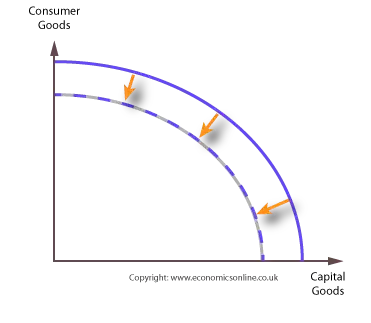
16.
What is this PPC model demonstrating?
a)
Economic equilibrium
b)
Economic growth
c)
Economic impossibility
d)
Economic cooperation
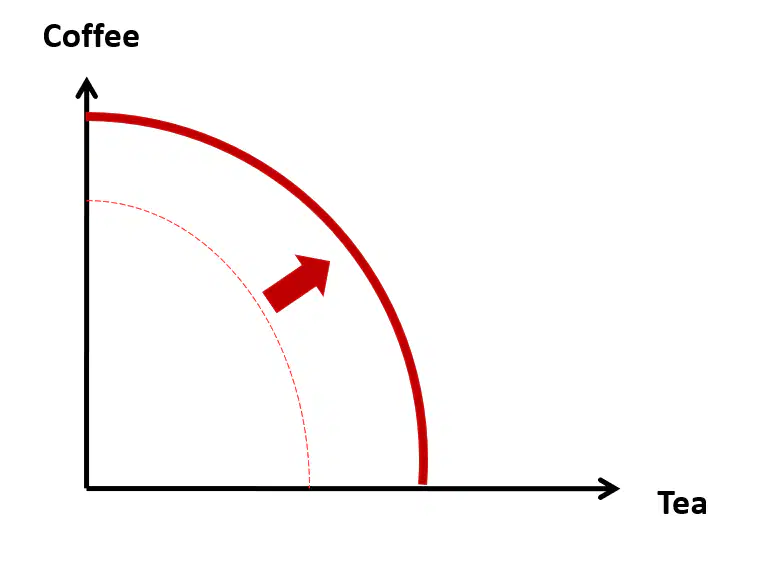
17.
What is this PPC model demonstrating?
a)
Economic growth
b)
Economic decline
c)
Economic equilibrium
d)
Economic efficiency
18.

Investing in new tatoos and beard products for coffee shop employees is an example of
a)
Land
b)
Labor
c)
Capital
d)
Entrepreneurship
19.
Why do we make choices in an economy?
a)
Scarcity
b)
equilibrium
c)
marginal cost
d)
effeciency
20.
The part of economics concerned with large scale or general economic factors
a)
Micro economics
b)
Normative economics
c)
Macro economics
d)
Positive economics
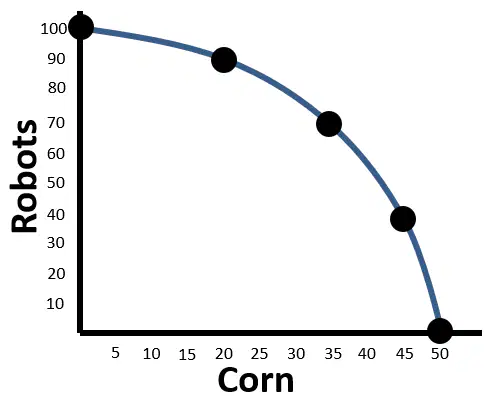
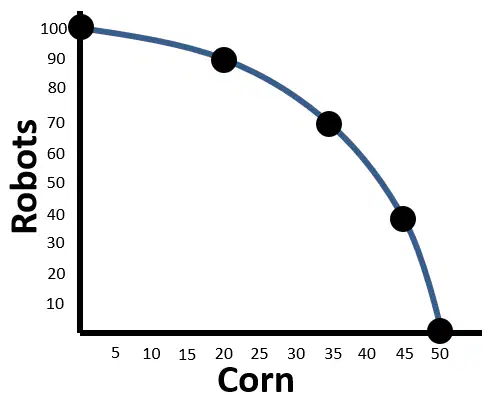
21.

On this PPC model, what would be the opportunity cost of increasing robot production from 0 to 70?

a)
20 corn
b)

15 corn

c)
45 corn
d)
100 corn
22.

What would the opportunity cost be of increasing corn production from 35 to 50 units?

a)

70 robots

b)
40 robots
c)
100 robots
d)
60 robots
23.

Type of economics that study's how an economy should be, rather than how it really is.

a)

Macro economics

b)

Micro economics

c)

Normative Economics

d)

Positive economics

24.

Every decision involves a trade off because

a)

resources are limited

b)

Not everyone has 24 hours in the day

c)

The PPC cannot function in a vacuum

d)

Marginal Benefit