
 Worksheets
Sedimentary Rocks and Fossil Fuels, 5.10BC - NEWTEKS
Total questions: 105
Worksheet time: 3hrs 30mins

Which of the following most likely caused the weathering shown in the image of a sea arch and surrounding water on the left?
Wind
Water
Ice
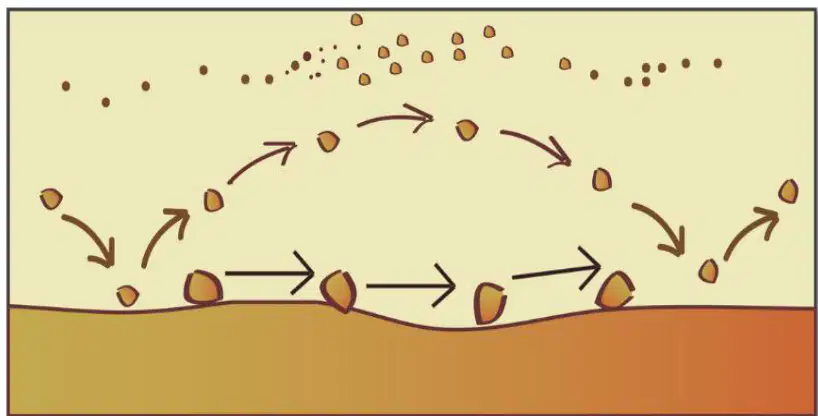
Based on the definition provided, how does erosion relate to weathering?
Erosion is the breaking down of rocks into smaller pieces.
Erosion moves and wears away sediments that were created by weathering.
Erosion squeezes sediments together, reducing the space they fill.
Erosion drops sediments in new locations, forming layers.
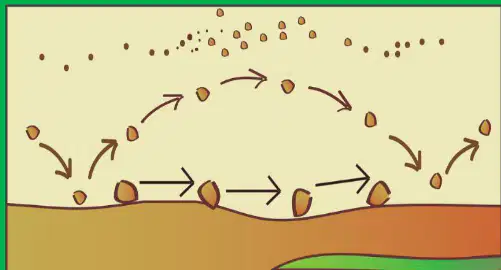
According to the definitions, how do weathering and erosion lead to deposition?
Weathering breaks rocks into sediments, erosion moves them, and deposition drops them in a new place.
Erosion breaks rocks into sediments, deposition moves them, and weathering drops them.
Weathering squeezes sediments together, erosion melts them, and deposition freezes them.
Deposition creates rocks first, then erosion and weathering remove them.

Sedimentary Rock Formation: Sediments become cemented or solidified together and harden into sedimentary rock. Which activity best models compacting and cementing objects together, similar to how sediments form sedimentary rock?
Pressing puffed rice together with melted marshmallow to make cereal bars
Painting a picture with watercolors on paper
Stretching a rubber band to test elasticity
Pouring sugar into water to dissolve it
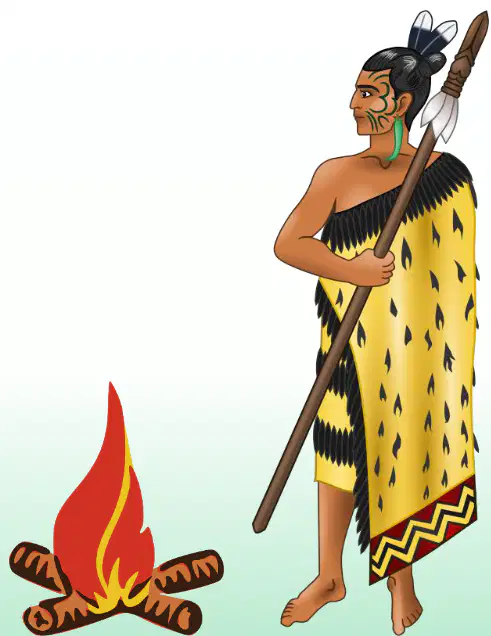
Think About It: Flint is a type of sedimentary rock historically used by indigenous peoples (such as the Caddo in Northeast Texas) to start fires and make tools and weapons. Today, modern techniques and equipment often replace flint with more efficient processes and materials. In a world with constantly developing technologies, will the tools, weapons, and equipment we currently use remain the same in the distant future?
No, they will likely change as new technologies make processes and materials more efficient
Yes, they will stay exactly the same because technology does not affect tools
They will all disappear in the near future and be replaced by nothing
They will change only if people stop using fire entirely
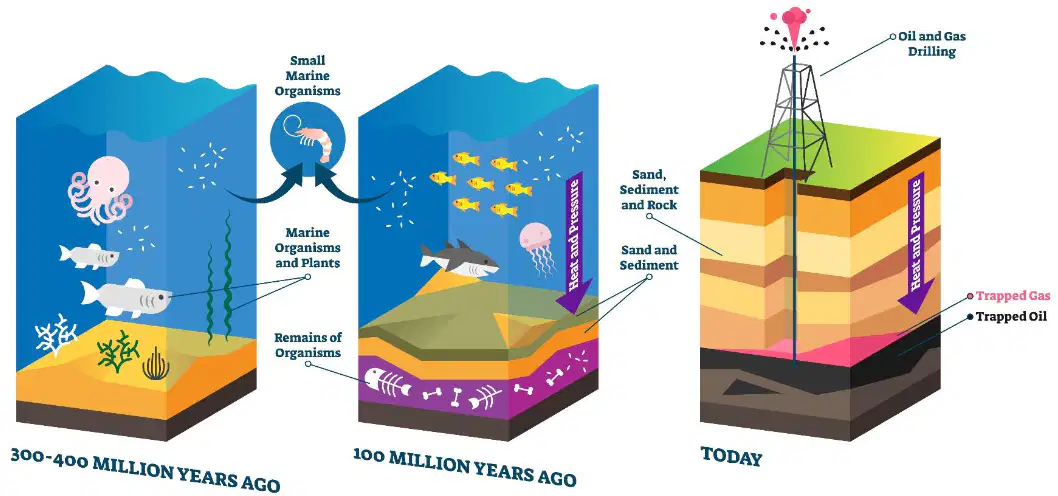
Fossil fuels are used daily by people around the world. Based on the formation process shown—marine organisms die, are buried by layers of sediment, and under heat and pressure over millions of years their remains turn into oil and gas that are drilled today—what is a major problem with fossil fuel formation compared to their use?
They form very slowly over millions of years while people consume them much faster
They form overnight, so running out is impossible
Using fossil fuels causes immediate rainfall everywhere
Fossil fuels are unlimited and can never be depleted
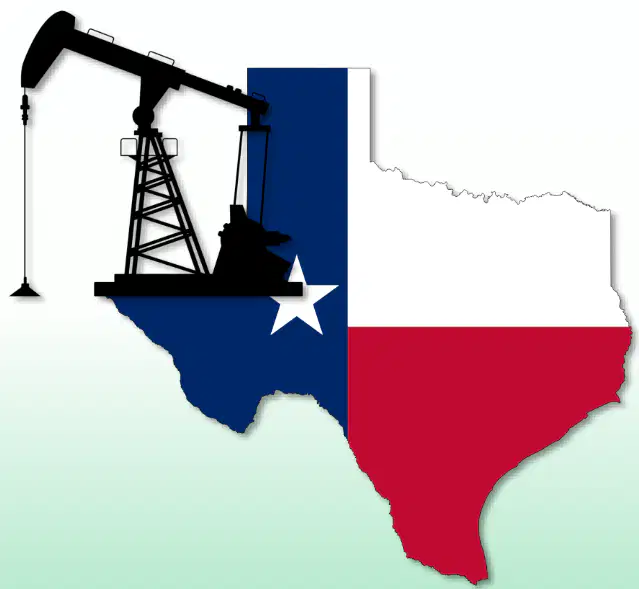
According to the US Department of Energy, Texas produces 43% of the crude oil in the country. It is by far the largest oil‑producing state in the US. Why is Texas able to produce such a large portion of this resource? Consider the land and rock types found in Texas and the formation of fossil fuels.
Texas has large sedimentary basins with organic‑rich rock layers from ancient seas where buried remains formed oil under heat and pressure.
Texas has many active volcanoes that make oil from lava quickly.
Texas’s cold climate turns water into oil in the ground.
Tall mountains in Texas store oil inside solid granite.
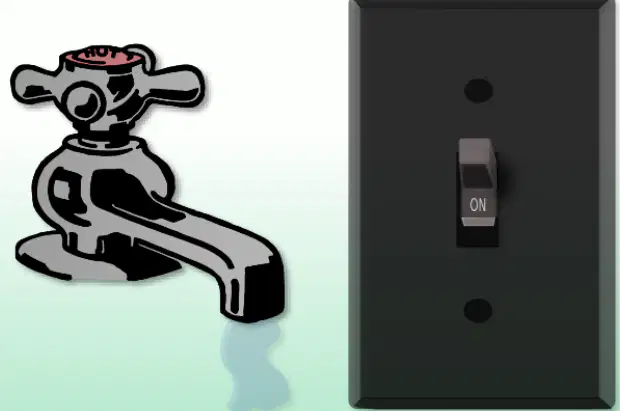
Many people easily access energy by flipping a light switch, turning on a hot water tap, or riding a bus. Has it always been so easy to access energy? Which statement best explains how energy access today compares with that of our ancestors?
Today it is much easier because infrastructure delivers electricity and fuel, while ancestors relied on fire, animal power, and manual labor.
Access was easier for ancestors because they had more natural gas stations than we do now.
Energy access has never changed; people have always used the same devices and fuels.
Modern access is harder because electricity and fuel are rare compared to the past.
Give your best answer to: What processes lead to the formation of sedimentary rocks and fossil fuels?
Weathering and erosion create sediments that are deposited, compacted, and cemented into rock; buried plant and animal remains change into oil, gas, and coal under heat and pressure.
Melting and cooling of magma directly makes sedimentary rocks and fossil fuels.
Sudden lightning and wind fuse sand into rock and produce gasoline.
Rocks form only by squeezing granite, and fossil fuels come from recent trash.
Give your best answer to: What are fossil fuels, and why are they important?
Energy‑rich substances such as oil, natural gas, and coal formed from ancient organisms; they are important because they power electricity, heating, and transportation.
Shiny minerals like gold and diamond; they are important because they make jewelry.
Renewable resources made from sunlight and wind; they are important because they grow quickly.
Fresh water and air; they are important because people need them to drink and breathe.

Coal is formed from (a) environments being (b) long, long ago. The decaying organisms were buried in layers of rock. Coal is formed through time, heat and (c) .
All of these are related to the formation of oil or natural gas EXCEPT (a)
Fossil fuels are (a) resources because they take a (b) time to form.
How were fossil fuels formed in the Earth? They were made from ancient (a) and organismal (b) that was put under intense (c) and heat to form (d) , Coal and oil.
Coal, petroleum (oil), and natural gas, formed by the remains of living organisms are (a)
Fossil fuels are formed over millions of years when (a) are compacted by heat and pressure. The heat that changes peat to coal is from (b)
Dead organisms that were buried may turn into (a) after millions of years. Carbon from this material reenters the atmosphere by (b)

F
G
H
J


The image shows dead plants and animals under a body of water, layers of sediments will cover the dead plant, and animals. What other processes would need to occur to form the fossil fuel(s)?
(a)


What is coal is formed from?
Ancient people
Ancient plants
Ancient animals
Ancient rocks

F
G
H
J

They were eaten by scavengers.
They became fossil fuels.
They were washed away by water.
They became an underground aquifer.

The diagram shows layers deposited under a body of water. This layering continued for millions of years.
What most likely happened to the dead plants and animals?
They were eaten by scavengers.
They became fossil fuels.
They were washed away by water.
They became an underground aquifer.

Oil and natural gas are formed from decayed what?
plants
animals and plants
animals
teeth

A large mass of wind-blown sand
Sand dune
Delta
Canyon
Island
Understanding Earth's Landforms
Landforms such as deltas, canyons, and sand dunes are the result of changes to Earth's surface by wind, water, or ice. These changes occur over long periods of time and are influenced by various natural forces.
For example, deltas are formed when rivers deposit sediment at their mouths, creating a fan-shaped landform. Canyons, on the other hand, are carved out by the erosive power of water, often resulting in steep cliffs and narrow valleys.
Sand dunes, which are found in deserts and coastal areas, are shaped by the movement of wind. As the wind blows, it picks up sand particles and deposits them in different locations, forming unique dune formations.
What is the main cause of landforms?
Volcanic activity
Erosion by wind, water, or ice
Tectonic plate movement
Human construction
What does 'erosive' mean?
Gradually building up
Causing gradual wearing away
Sudden impact
Stagnant
What shapes sand dunes?
Water erosion
Volcanic activity
Movement of wind
Glacial movement
What geological process results in the formation of canyons?
Volcanic activity
Glacial erosion
Wind erosion
Water erosion
What landform is created when rivers deposit sediment at their mouths?
Canyon
Delta
Plateau
Valley

What is a delta, and how is it formed?
a) A mountain created by volcanic activity.
b) A fan-shaped landform formed by river sediment deposition.
c) A deep valley carved out by the erosion of wind.

What natural force is primarily responsible for shaping canyons?
a) Ice melting and freezing.
b) The erosive power of water.
c) The impact of meteorites.

Where are sand dunes commonly found, and how are they shaped?
a) Mountain regions, shaped by volcanic activity.
b) Deserts and coastal areas, shaped by the movement of wind.
c) Polar regions, shaped by the freezing of ice.

Why do landforms such as deltas, canyons, and sand dunes take a long time to form?
a) They form instantly due to rapid geological changes.
b) Because they require the slow accumulation and shaping of materials over time.
c) They are created by human activities within a short period.

Name three natural forces mentioned in the passage that contribute to changes in Earth's surface.
a) Fire, lightning, and earthquakes.
b) Wind, water, and ice.
c) Human construction, deforestation, and pollution.
How does acid rain cause weathering?
through abrasion
though oxidation
by dissolving rock
by carrying rock away
Mechanical weathering breaks some limestone into pieces. What effect would this have on chemical weathering of the limestone?
Chemical weathering would stop occurring.
Chemical weathering would remain the same.
Chemical weathering would occur at a slower rate.
Chemical weathering would occur at a faster rate.
The process of (a) is an example of mechanical weathering in which rock splits through repeated freezing and thawing.
Which change occurs as a result of wind slowing down?
erosion
deposition
chemical weathering
mechanical weathering
How are erosion and deposition alike?
Both change Earth's surface over time
Both build up Earth's surface quickly
Both wear down Earth's surface slowly
Neither changes the Earth's surface
Deposition by (a) causes sand dunes to form.
Which landform develops as a result of river deposition?
Cave
Delta
Stalactite
waterfall
Which of the following processes causes sinkholes to form?
erosion of sediment by runoff
deposition of sediment by a river
deposition of calcite by groundwater
erosion of limestone by groundwater
Sediments get deposited in a(n) (a) because a stream flows out of a narrow valley.
A flood plain forms where the river's power of ______________ widens its valley rather than deepening it.
erosion
deposition
A (a) is a stream or river that flows into a larger river.
Wind causes erosion mainly by (a) , the process by which wind removes surface materials .
_____________ occurs where the agents of erosion lay down sediment
Deposition
Erosion
Deflation
Mass Movement
(a) is a dark colored substance that forms as plant and animal remains decay.

features on the earth's surface, changed by wind, water, and ice.
landforms
weathering
erosion
sediments

wind, water and ice
landforms
3 agents of change
deposition
sediments

the breaking down of rock into sediment by wind, water or ice
sand dune
depositon
erosion
weathering

the moving of sediment by wind, water or ice
weathering
erosion
depositon
sediments

the dropping off of sediment in a new location after being moved or eroded by wind, water or ice
deposiotion
landforms
3 agents of change
sediments

tiny pieces of rock and other inorganic matter, loose materials such as grain and rock fragments, ex: sand, mud, silt, sea shells
ice/frost wedging
sand dune
sediments
delta

weathering caused when water enters cracks in the rocks, freezes, expands and breaks rocks.
sand dune
delta
canyon
ice/frost wedging

hills formed by the wind blowing and depositing sand
sand dune
ice/frost wedging
sediments
canyon

a triangle shaped landform created by water depositing sediments at the mouth of a river
sand dune
delta
canyon
U-shaped valley

a long deep narrow gorge in the surface of the earth formed by erosion of sediments by water in a flowing river
U-shaped valley
delta
canyon
glacier

formed in between mountains by the erosion of a glacier (ice)
earthquake
U-shaped valley
glacier
glacier

a large (huge) mass of ice that moves slowly over land
glacier
earthquake
volcano
delta

a sudden shaking of the ground
island
earthquake
mountains
canyon

a mountain or hill with a crater or vent through which lava, water vapor and gas erupt from the earth's surface.
tsunami
island
volcano
earthquake

a giant wave usually caused by an earthquake beneath the ocean floor.
tsunami
island
volcano
earthquake

new land surrounded by water that is created by the deposition of rock from volcanic eruptions
island
earthquake
volcano
erosion

formed by two continental plates colliding and forcing each other upwards
island
weathering
canyon
mountain

a deep, hollowed-out area under ground caused by the erosion by water
sand dune
valley
cave
mountain

A teacher set up the model shown to represent the formation of a landform. What landform does this model most likely represent?
Delta
Cave
Canyon
Sand dune
Which of the following processes is not considered a rapid change to Earth’s surface?
Volcanic eruption
Earthquake
Landslide
Weathering

A canyon with tall, vertical sides is shown. Which of the following most likely led to the formation of this canyon?
Rapidly moving water
A hurricane
Burrowing animals
Volcanic activity

Wind, water, and ice change Earth’s surface. Which landform was most likely formed by the slow movement of glaciers?
Arch
River delta
V-shaped valley
U-shaped valley

What agent of change is most likely responsible for the formation of the land features labeled in the image?
Water
Wind
Glaciers
Mud
The process in which rock is broken down into smaller pieces is
Erosion
Weathering
Deposition
Compaction
When water enters the cracks in a large rock and freezes, the water expands. Over time, water freezing and thawing –
erodes the large rock through a river
weathers the rock into sediments
deposits lava in a new place
changes the rock into a glacier

A teacher built the model shown to explain how one type of landform is created. What landform does the model most likely represent?
Landslide
Sand dune
U-shaped valley
Canyon

The images show a river delta and sand dunes. Which statement best explains how the formation of deltas and sand dunes is similar?
Both are formed by the movement of glaciers.
Both are formed by water eroding sediments.
Both are formed by wind weathering rocks.
Both are formed be deposition of sediments.
Which pair of landforms are the result of the same agent of change?
Note: The agents are wind, water or ice.
A canyon and V-shaped valley
A U-shaped valley and delta
A sand dune and cave
A delta and sand dune

The characteristics of a valley are described.
This valley was most likely formed by –
a slow-moving glacier
a thunderstorm
heavy winds
moving water
The student created a model for his Science Class. Which model best represents the formation of a delta?
A student carefully placed pieces of gravel in a hill.
A student set up a tray of sand and blew through a straw to form a hill of sand.
A student poured water into a stream table filled with dirt and observed sediments get deposited at the end of the table in a triangular shape.
A student packed damp sand in a tray then scraped a large ice cube along the bottom.

A wide, round-bottom valley is shown below. This valley was most likely formed by –
Tornadoes
Glacial movement
Flash flooding
Deposition by the wind
Which of the following describes deposition due to water?
A river breaks rock into small pieces.
Strong waves crash against rock, breaking off sediments.
Wind blew sand and deposited them in the formation of a sand dune.
Water in a river slowed and dropped off sediments to form a delta.

While on a field trip, students observed sand dunes and wrote the following list of observations. This sand dune was most likely formed by –
Flooding
Massive glaciers
Wind
Volcanic activity

A diagram of a delta is shown. Which process best describes the formation of this delta?
The erosion of sediments in the ocean
The weathering of rock by glaciers
The deposition of sediments carried by the ocean
The deposition of sediments carried by the river

While on a field trip, students observed a canyon and wrote the following list of observations. This canyon was most likely formed by –
Flooding
Wind
Massive glaciers
Volcanic activity
Which image best shows the movement of sediments from one place to another?
Deposition at the mouth of a river
Deposition of sand in a sand dune
A river eroding sediments
A glacier weathering rocks
Which table correctly identifies the agents of
change for the corresponding landforms?


Which diagram best represents the process
of weathering?


Volcanoes create new land on the Earth’s surface when –
lava flows cool and harden to form rock.
an eruption destroys the side of a mountain.
magma forms giant underground chambers.
saltwater touches lava and changes into steam.
Where is one most likely to find rocks that have become smooth and rounded?
At the bottom of an ocean
Deep within Earth
C On the top of a hill
In a fast-moving river
Caves are large empty spaces below the surface of the earth. Which of the following processes forms caves over millions of years?
Rivers carry mud and silt and then deposit them.
Water flowing underground carries away sediment & minerals.
Volcanic eruptions leave behind hollow areas.
D Ocean currents move sediments along the beach.
A farmer notices that soil on the farm has been decreasing over the past few months. What environmental factor is most likely related to the loss of soil?
Recent heavy rains
Steady increase in temperatures
Abundant crop yields
Decrease in temperatures

This rock formation formed over many millions of years. What force most likely created it?
A glacier pushing rocks ahead of it
A river bringing rocks down a mountain
Wind-blown sand carving large rocks
A volcano blasting rocks great distances
Dunes are large piles of sand that shift slowly around in deserts and on beaches. What causes the dune to move from place to place?
Rushing rivers
Blowing winds
Freezing water
Weathering rock
Which of the following changes to the Earth is caused by moving water?
A new island forms in the middle of an ocean.
A plain becomes a deep canyon with steep walls.
A sand dune shifts from one location to another.
A mountain grows taller over a thousand years.
How can a glacier change a mountain? A glacier can -
generate a volcanic eruption
cause a powerful earthquake
make a mountain grow taller
change the shape of a valley
A delta is a large collection of sediments at the mouth of a river. The river deposits its sediment when -
the river slows down
the water gets salty
the sediment is small
D the temperature is cold

Over many years the bottom of a lake gets higher and higher. What could cause this slow change?
The climate in the area gets warmer.
Sediments are deposited in the lake
The Sun evaporates the water.
A hurricane brings heavy rains.
Rocks that are carried in a quickly moving river for a long time are most likely to be –
long and thin
large and flat
smooth and rounded
black and shiny

The rock layers pictured here have split and shifted.
What most likely caused this change?
River
Landslide
Volcano
Earthquake
Which of the following best describes how earthquakes change the Earth’s surface? Earthquakes –
throw rocks and ash into the air.
force lava through holes in the ground.
violently shift the surface of the earth.
cause clouds to form and rain to fall.

Which of these most likely caused the rapid change to the Earth’s surface illustrated here?
Landslide
Volcanic eruption
Mountain building
Sanstorm

Which of the following most likely caused the change to the Earth’s surface illustrated here?
Landslide
Thunderstorm
Volcano
Earthquake

Scientists measured the elevation (how high the land is above sea level) of a certain area every year for four years.
Which of the following best explains the change in elevation in this area?
Lava flows from a nearby volcano built up the land.
Heavy rains in this area washed away much of the soil.
Violent earthquakes opened large cracks in the earth.
Extreme hot weather made the ground very dry.
Volcanoes create new land on the Earth’s surface when –
lava flows cool and harden to form rock.
an eruption destroys the side of a mountain.
magma forms giant underground chambers.
saltwater touches lava and changes into steam.


Which experiment would best show how different methods of plowing fields on a hill affect erosion?


The prairie is ideal for the growth of grasses because it has rich topsoil. All of these processes help form topsoil EXCEPT —
decay of trees
weathering of rocks
erosion of hills
movement of oceans

Which thing near this house will erode (wash away) the MOST during a heavy rain?
The soil under the grass
The gravel in the driveway
The pile of dirt on the hillside
The stepping stones around the flower bed

