
 Worksheets
Personal Finance: Banking
Total questions: 15
Worksheet time: 27mins
Which of the following is a successful strategy for personal saving?
Wait until the end of the month and save whatever is left in your checking account.
Save a certain percentage of each paycheck and deposit it directly into a savings account.
Cover all your wants and needs and save whatever is left over.
Take out a payday loan so you can save before you receive your paycheck.
Which of the following is NOT a banking fee?
Overdraft fee
Monthly maintenance fee
Interest fee
ATM fee
Fill in the blank: ____________________________ is the cost paid or earned for the use of borrowing money.
a. Savings
b. Credit
c. Investing
d. Interest
Juan saved $1000 from his summer job cleaning pools. Which of these account types would work best for him if he doesn’t need access to the money for a number of years AND wants to earn the highest interest rate?
Regular savings account
Money market account
Certificate of Deposit
Checking account
All of the following are downsides to being unbanked EXCEPT?
Lack of access to credit
Lack of fees associated with checking accounts
Lost time paying bills
Difficulty making cashless purchases
Select all that apply: A Person-to-person payment app could be used in each of the following scenarios…
Tina pays her neighbor $200 for breaking his window with a softball.
Rafael writes a check to cover the entire month’s rent, and his roommates Valerie and Carlos pay Rafael for their share of the monthly rent.
Ahmed’s soccer coach pays the team’s registration fee for a big tournament, and each player then owes him $35 for their share of the registration fee.
Mia pays Cheesy Pizza Co. for a pizza she orders on their website.
All of the following are true about prepaid cards EXCEPT...
Prepaid cards typically include a lot of fees.
Prepaid cards are a useful option for someone who is unbanked to make online purchases.
Prepaid cards are a great way to build credit.
Prepaid cards are usually accepted anywhere that debit and credit cards are accepted.
Sometimes – Always – Never: Direct deposit gives faster access to money than a paper paycheck.
Sometimes
Always
Never
Fill in the blanks: If Inflation is __________ your savings account interest rate then you will be _____________ purchasing power.
a. Higher than, gaining
b. Higher than, losing
c. Equal to, gaining
d. Lower than, losing
When signing up for a new checking account, you answer “Yes” to receive overdraft coverage. On this day, you have $10 in your account and go out and use your debit card to buy lunch for $12, a movie ticket for $12, and dinner for $15. What is likely to be the outcome resulting from these transactions?
Your account will be closed.
You will likely be charged an overdraft fee for one or more of the transactions and you will also need to repay the bank for the amount overdrawn.
Since you requested overdraft coverage, the bank will not allow you to overdraw your account so your debit card will be denied.
The bank will provide you five days to add funds to your account to cover the overdraft and no fees will be assessed.
The following statements about bank accounts are true EXCEPT…
If the bank is FDIC-insured, your money, up to the FDIC limit is safe even if the bank fails.
Many banks pay interest on the money you deposit into your savings account.
Historically, savings accounts earn higher returns than investments in the stock market.
Money in a checking account is usually easy to access via ATM, debit card, or check.
Sometimes – Always – Never: Having overdraft protection is the best choice for every bank customer.
Sometimes
Always
Never
Joelle wants to have an emergency fund cover 6 months of her expenses. Her monthly gross pay is $4,000 and her monthly expenses are $2000. If she plans to save 10% of her gross pay each month, how long will it take her to build her emergency fund?
3 months
9 months
24 months
30 months
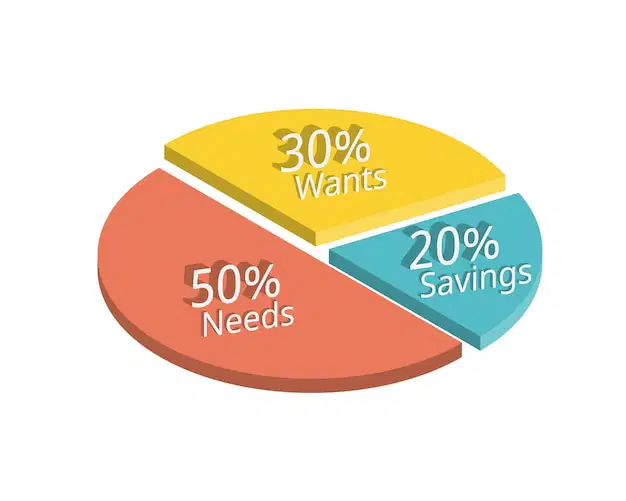
Fill in the blanks. You receive $2000 a month. Following the 50-30-20 Rule of budgeting, you would put _______________ towards bills or your needs, ________________ toward your wants/lifestyle, and _______________ towards your savings.
(a)
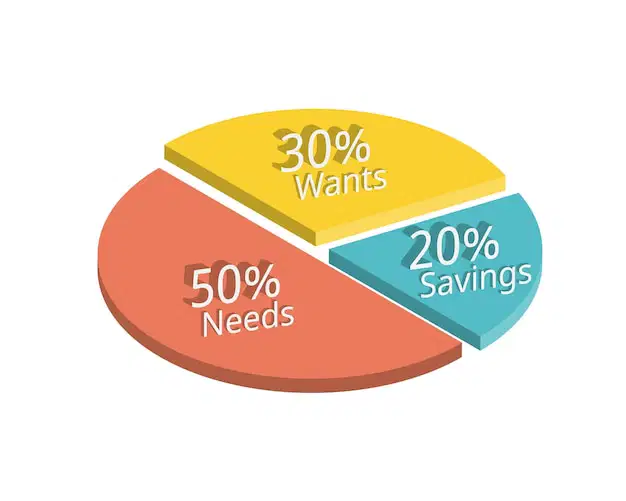
Using at least 2 banking or personal finance vocabulary or concepts, provide justification for how the 50-30-20 Rule supports responsible banking behaviors such as saving, spending, or avoiding fees.

