
 Worksheets
Chapter 2: Data Models - Title and Objectives
Total questions: 87
Worksheet time: 44mins
Which topic best describes the focus of Chapter 2 in Database Systems: Design, Implementation, and Management?
Network protocols and routing
File systems and storage media
User interface design principles
Data models and their evolution
Which statement captures why data models are emphasized in this chapter?
They replace physical storage devices
They automate network administration
They eliminate application programming
They guide database design decisions
Which item is identified as a basic data‑modeling building block to be learned in this chapter?
Entities, attributes, relationships
Caches, buffers, registers
Sockets, ports, packets
Screens, menus, dialogs
What concept explains constraints that shape database structure and operations?
Replication improving latency
Business rules influencing design
Compression reducing size
Visualization enhancing UX
What chapter goal addresses the historical progression of modeling approaches?
Configuring cloud autoscaling policies
Designing responsive web interfaces
Optimizing CPU scheduling algorithms
Exploring how major data models evolved
Which objective highlights examining new approaches beyond traditional models?
Classical waterfall project management
Standard OS kernel device drivers
Legacy hierarchical storage limitations
Emerging alternative data models and their need
Which classification theme is included in the chapter’s aims?
Sorting by vendor licensing costs
Grouping data models by level of abstraction
Ranking by GUI complexity
Organizing by programming language syntax
Which pair of learning targets together emphasizes both foundations and constraints?
Basic building blocks of data modeling
Physical server rack layouts
Business rules and their influence
Browser rendering pipelines
Which two chapter themes relate to time and change in modeling?
Evolution of major data models
Emerging alternatives and their need
Static memory allocation strategies
Fixed schema hard‑coding techniques
Which scope statement matches the slide titled 'Objectives (cont’d.)'?
Learn about alternate models and abstraction levels
Practice SQL window functions extensively
Implement RAID configurations in hardware
Master user interface wireframing
Which statement best captures why data modeling is used in database design?
To store raw data without any structure
To eliminate the need for application logic
To guarantee perfect data quality automatically
To reduce complexity and align user perspectives
Different stakeholders view the same data differently. What risk does this create during system design?
Misaligned designs that fail to reflect operations
Higher storage costs for archived backups
Slower network speeds in data centers
Automatic compliance with industry regulations
What role do varying degrees of data abstraction play in a project?
They ensure data is fully normalized
They help reconcile differing user views
They encrypt sensitive fields automatically
They replace all documentation processes
Which description fits a data model in practice?
A set of raw CSV files without schema
A compiled executable program artifact
A full production database implementation
A simple representation of complex structures
Data models are often graphical. Why is this useful for teams?
It improves shared understanding of structure
It guarantees referential integrity
It eliminates the need for testing
It increases query execution speed
In data modeling, a model is an abstraction of real-world objects or events. What benefit does this provide?
It replaces all runtime configurations
It removes the need for performance tuning
It directly stores transactional records
It helps understand environmental complexities
Which statement describes the nature of the data modeling process?
Iterative and progressive refinement
Ad-hoc changes without review
Fully automated with no human input
One-time specification then frozen
How do data models facilitate interaction among project roles?
They generate code for all features
They remove the need for meetings
They enforce UI design standards
They offer a common organization of data
End users typically have different views and needs for data. What should a robust data model accomplish?
Limit access to a single workflow
Organize data to serve various users
Focus solely on storage efficiency
Prioritize only developer requirements
Which statement reflects a common misconception about data models?
Required data can be drawn directly from the model
Modeling is refined through iterations
A model abstracts real-world objects and events
Models reduce structural complexity for teams
Select all statements that correctly describe data modeling.
It reconciles differing user perspectives
It is iterative and progressive
It is primarily a runtime optimization
It often uses graphical representations
Which combination of practices best reduces design complexity when stakeholders see data differently?
Adopt iterative modeling cycles
Use data abstraction levels
Rely only on raw data dumps
Ignore end-user perspectives
Which term refers to anything about which data are collected and stored in a data model?
Constraint
Relationship
Attribute
Entity
Which option best defines an attribute in a data model?
A collection of related tables
An association among entities
A rule restricting data
A characteristic of an entity
In a one-to-many (1:M) relationship, which statement is accurate?
One entity instance relates to many instances
Many entity instances relate to one instance
Each entity instance relates to exactly one
Entities do not relate to each other
Which relationship type allows multiple instances of both participating entities to associate with each other?
Unary relationship
One-to-many (1:M)
One-to-one (1:1)
Many-to-many (M:N)
Which statement correctly describes a constraint in data modeling?
A relationship between entities
A characteristic of an attribute
A grouping of related records
A restriction placed on the data
Choose all examples that represent relationship types used in data modeling.
One-to-one (1:1)
One-to-many (1:M)
Many-to-many (M:N)
Attribute-to-attribute (A:A)
Which pair correctly matches component to definition?
Constraint — association among entities
Entity — thing stored about
Attribute — restriction enforced
Relationship — characteristic value
A university stores data about Students, Courses, and Enrollments. Which is the best example of an entity?
Maximum credits
Registers for
GPA value
Student
Which scenario most likely represents a one-to-one (1:1) relationship?
Authors write many books
Students enroll in many courses
Each department has many employees
Each employee is assigned one locker
Which situation illustrates a constraint?
Order total cannot be negative
Customer has a phone number
Orders placed by customers
Products belong to categories
Business rules are best described as what within an organization?
Personal preferences of staff
Marketing slogans and taglines
Lists of hardware requirements
Descriptions of policies and principles
Which characteristics should business rules exhibit to be effective?
Optional and informal
Widely disseminated
Easy to understand
Written and up to date
Business rules typically describe which aspect of data from a company’s perspective?
Characteristics of data as viewed
Software vendor licensing terms
External market pricing trends
Physical storage device layout
Which are common sources for discovering business rules?
Department managers
Policy makers
Company managers
Direct interviews with end users
Which written documents are likely to contain business rules?
Press releases
Operations manuals
Standards
Procedures
When eliciting business rules, which approach targets end-user knowledge directly?
Review social media posts
Inspect server configurations
Study external market data
Conduct direct interviews
Which option connects data modeling with business rules most accurately?
Relationships replace documentation
Attributes define server speeds
Constraints implement business rules
Entities store hardware drivers
Which statement best describes a primary purpose of documenting business rules during data modeling?
Track system performance metrics
Replace the need for user interviews
Standardize the company’s view of data
Automate all customer interactions
In translating business rules, what do nouns typically become in a conceptual data model?
Attributes of keys
Entities in the model
Constraints on queries
Indexes for reports
When converting business rules, verbs most directly help identify which element of a data model?
Relationships among entities
Primary key selection
Physical storage pages
Cardinality of attributes
Which pair of questions is used to determine the relationship type between two entities A and B?
Which indexes speed up the join of A and B?
How many instances of A relate to one B?
What datatype is the foreign key in B?
How many instances of B relate to one A?
Relationships identified from business rules are bidirectional. What does this imply for analysis?
Direction determines key selection
Only one entity needs constraints
Joins are always optional
Each side’s participation must be considered
Why are business rules an effective communication tool between users and designers?
They eliminate testing activities
They define hardware procurement
They enforce network topologies
They provide a shared language for data
During discovery, business rules help designers understand which aspects of data?
Role the data plays in processes
Nature of the data involved
Scope and boundaries of data
Compression ratios for storage
Proper naming during translation of business rules should achieve which goals?
Be familiar to the organization’s users
Be descriptive of environment objects
Make objects unique and distinguishable
Use unfamiliar jargon to impress users
Which benefit is directly associated with proper naming in data models?
Facilitates communication between parties
Guarantees zero defects in code
Eliminates the need for backups
Improves network throughput
Which statement about self-documentation in naming conventions is accurate?
Documentation only comes from code comments
Clear names promote self-documentation
Self-documentation is unrelated to names
Self-documentation requires long identifiers
A misconception is that only one side of a relationship matters. What must actually be assessed?
Cardinality from both perspectives
Only foreign keys in child tables
File system folder hierarchy
Textual descriptions of entities
Which reason justifies developing relationship participation rules and constraints from business rules?
To allocate office seating
To select programming paradigms
To decide server operating systems
To ensure correct entity interactions
Which early data models were prominent in the 1970s for navigating records?
XML and hybrid DBMS
Relational and object models
Key–value and column stores
Hierarchical and network models
In a hierarchical database, how is the basic logical structure commonly visualized?
Upside-down tree
Circular graph
Star schema
Linear linked list
What characteristic best distinguishes the network model from the hierarchical model?
Supports only simple relationships
Records have exactly one parent
A record can have multiple parents
Eliminates database standards
Which generation introduced relational databases with ER modeling support?
First generation
Second generation
Fourth generation
Third generation
What were file systems primarily used for in the first generation of data models?
Handling records on IBM mainframes
Distributed storage with petabytes
Managing relationships between entities
Supporting web databases and XML
Which statement about network databases is accurate?
They improve database performance
They cannot resemble hierarchical models
They reduce performance significantly
They prohibit standards entirely
In hierarchical databases, what are the structural units called?
Tables or rows
Levels or segments
Documents or tags
Nodes or edges
Which evolution phase saw object-oriented and object–relational models emerge?
Late 2000s
Mid-1970s
Mid-1980s
1960s–1970s
Which examples are associated with relational systems in the mid-1970s?
SimpleDB and BigTable
IMS and IDMS
Versant and Objectivity/DB
DB2 and Oracle
Emerging NoSQL models are characterized by which pair?
Relational and ER modeling
Object and O/R databases
File systems and VSAM
Key–value and column stores
Which benefit is noted for object–relational databases?
Support very sparse data
Navigational access only
Support object data types
Managed records not relationships
Why was the network model introduced?
To replace ER modeling in full
To remove DDL and DML entirely
To handle complex relationships better
To simplify schemas drastically
Which comment aligns with web databases becoming common?
Fourth generation models
Third generation models
Second generation models
First generation models
Which statement about emerging NoSQL systems is correct?
Optimized for navigational access only
Typically support petabyte-scale storage
Highly scalable and fault tolerant
Use proprietary APIs in cases
In a network data model, what does a set typically include in a 1:M relationship?
Multiple tables linked by foreign keys
Three record types: parent, child, leaf
A single record type called tuple
Two record types: owner and member
Which statement best describes a schema in legacy network models?
Conceptual organization of the entire database
Physical storage of index files on disk
Executable code for application logic
User-specific view of selected tables
What is a subschema in the context of network model concepts?
Global structure maintained by administrators
Database portion seen by application programs
File system layout for database pages
Security policy for user authentication
Choose the correct characteristics of Data Management Language (DML).
Defines the environment to manage data
Manipulates data within the database
Is used only to create tables
Specifies physical storage structures
Data Definition Language (DDL) primarily enables which capability?
Backing up data files
Defining schema components
Tuning runtime query plans
Executing transactional queries
Who introduced the relational model and when?
Edgar Dijkstra at MIT in 1965
E. F. Codd at IBM in 1970
Michael Stonebraker at UC Berkeley
James Gray at Microsoft in 1988
In relational terminology, what is a relation?
A table formed by row-column intersections
A pointer linking hierarchical records
A graph of owners and members
A file containing unstructured blobs
In a relation, what is each row called?
Tuple
Member
Owner
Recordset
Why were early relational models considered impractical around 1970?
High computer overhead despite conceptual simplicity
Absence of schema or subschema concepts
Lack of clarity and complex semantics
No support for transactions or locks
Match legacy and relational terms to their closest counterparts.
Schema ↔ conceptual database organization
Subschema ↔ application program view
Tuple ↔ row in a relation
Owner ↔ parent in 1:M set
Select all statements that align with relational model basics.
A table is a matrix of rows and columns
Each tuple corresponds to one row
Relations were once seen as impractical
Relations are sets of owner-member pairs
Which pair correctly contrasts DML and DDL?
DML secures users; DDL encrypts files
DML handles backups; DDL tunes queries
DML defines schema; DDL runs transactions
DML manages and manipulates data; DDL defines schema
In a relational database, what is the primary purpose of a relational diagram as shown?
Show query execution steps visually
Represent entities, attributes, relationships
Display physical storage block layouts
Illustrate user interface navigation flows
Which statement best describes an RDBMS function highlighted in the slide?
Exposes internal complexity to the user
Eliminates need for primary keys entirely
Performs same functions as hierarchical model
Replaces indexes with file pointers
According to the slide, how does an RDBMS handle system complexity for users?
Outsources complexity to middleware
Displays complexity to administrators
Hides complexity from the user
Requires manual configuration by users
What does a relational table store, based on the slide content?
Collection of transient sessions
Collection of binary objects
Collection of unrelated records
Collection of related entities
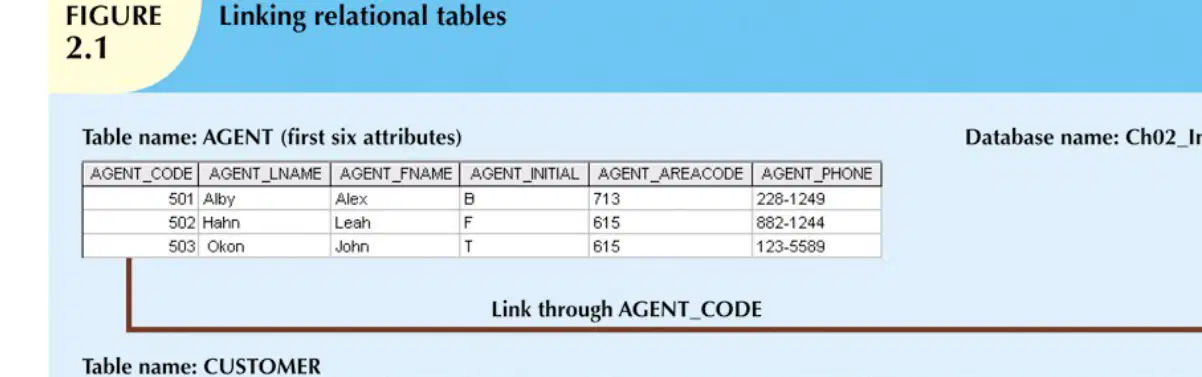
In the linking tables figure, which attribute serves as the link between AGENT and CUSTOMER?
AGENT_PHONE attribute
CUS_CODE attribute
CUS_PHONE attribute
AGENT_CODE attribute
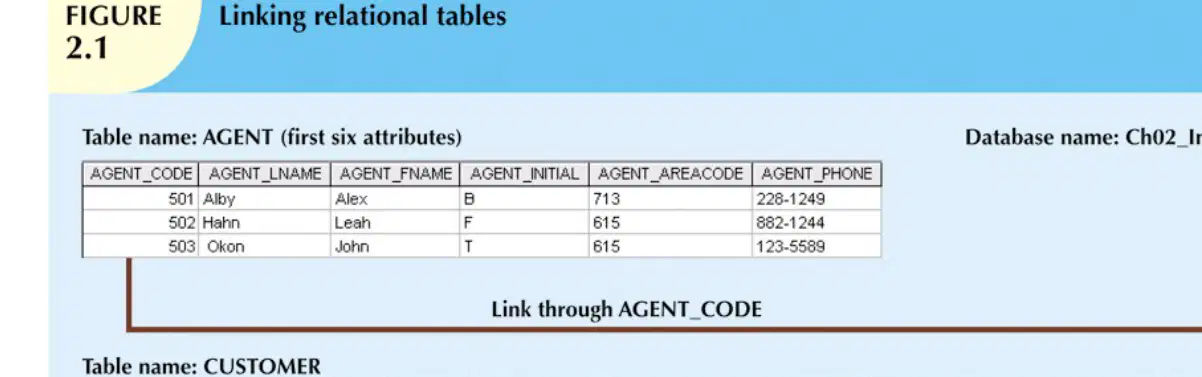
What kind of relationship is implied between AGENT and CUSTOMER when linked by AGENT_CODE?
One-to-one relationship
One-to-many relationship
Many-to-many relationship
Self-referencing relationship
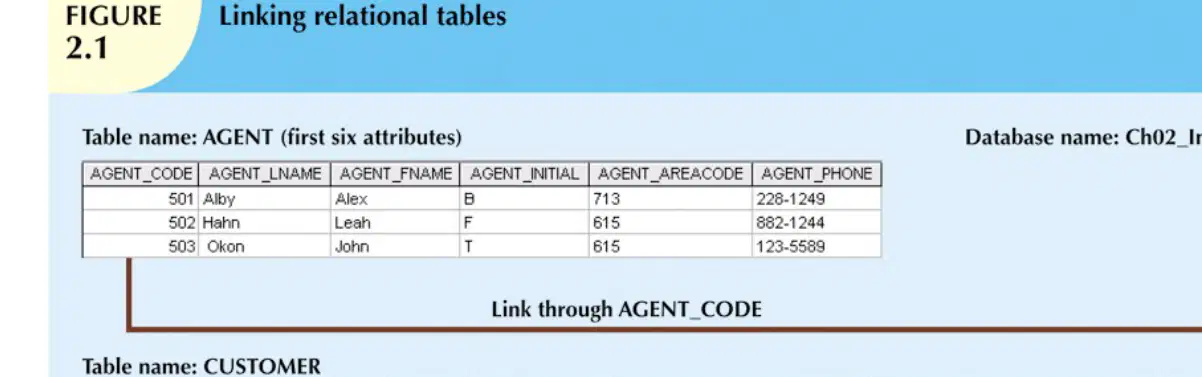
Which columns are most likely candidate keys in the tables shown?
AGENT_CODE in AGENT table
AGENT_PHONE in AGENT table
CUS_PHONE in CUSTOMER table
CUS_CODE in CUSTOMER table
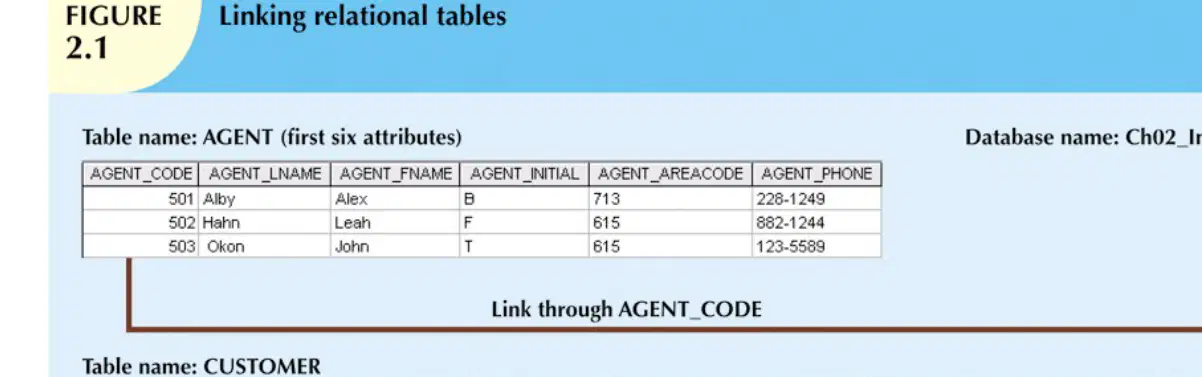
When linking tables via AGENT_CODE, what constraint ensures referential integrity?
AGENT_CODE referencing primary key
AGENT_CODE computed at runtime
AGENT_CODE as nullable foreign key
AGENT_CODE stored in a text file
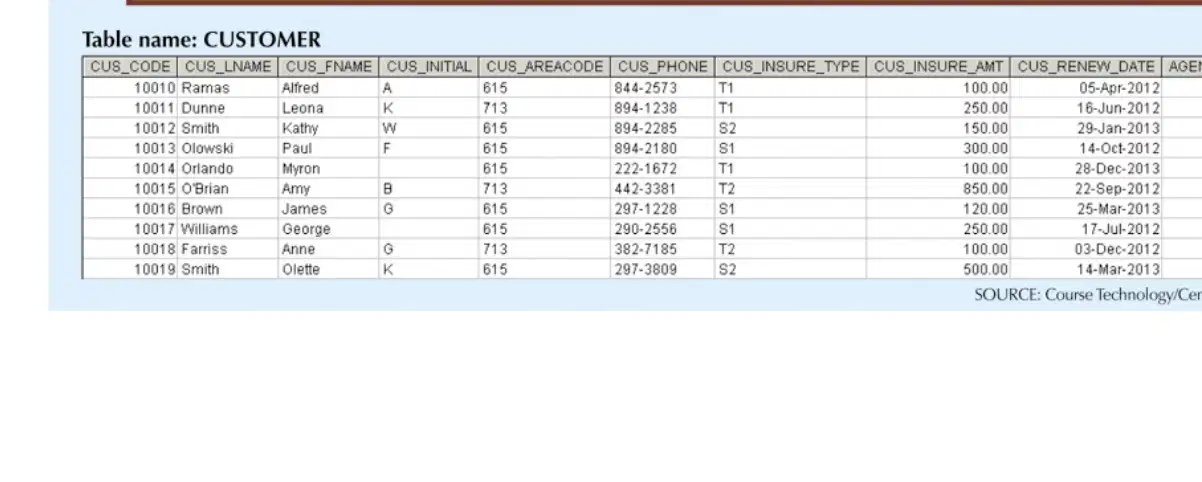
Which SQL operation would retrieve all customers served by agent with code 502?
JOIN AGENT ON CUSTOMER.AGENT_CODE = 502
UPDATE CUSTOMER SET AGENT_CODE = 502
SELECT * FROM CUSTOMER WHERE AGENT_CODE = 502
SELECT * FROM AGENT WHERE AGENT_CODE = 502
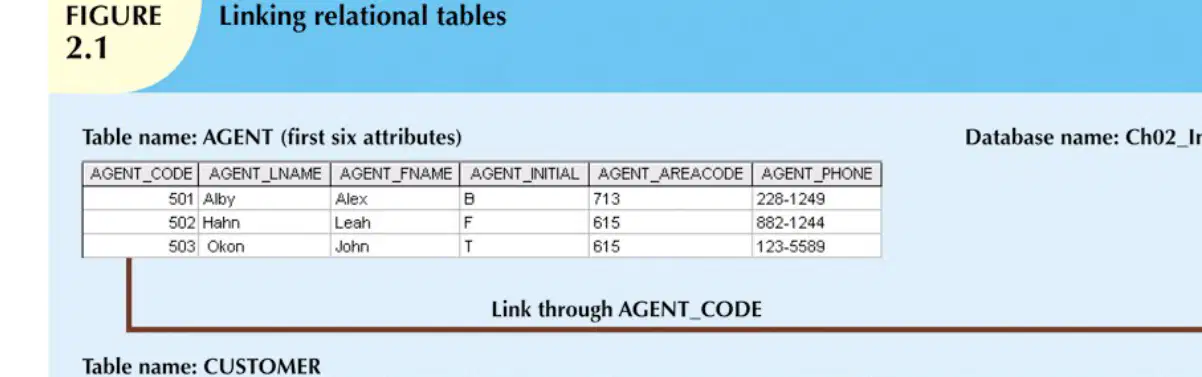
In the AGENT table excerpt, which attribute pair best represents agent identity and contact area?
AGENT_CODE and AGENT_AREACODE
AGENT_FNAME and CUS_AREACODE
AGENT_INITIAL and CUS_PHONE
CUS_CODE and AGENT_PHONE

