wayground logo

Free Printable Worksheets

NEW

Font size

S
M
L
XL
Worksheets

Unit 4 Review

Total questions: 37

Worksheet time: 19mins

Name
Class
Date
1.
The rate of change of velocity is called _________?
a)
acceleration
b)
velocity
c)
displacement
d)
force
2.
If gravity is the only force acting on an object, then we find the object will accelerate at a rate of 9.81 m/s^2 toward the center of the Earth (this is often rounded to 10 m/s^2).
a)
force
b)
gravitational acceleration
c)
displacement
d)
velocity
3.
The symbol that represents gravitational acceleration is ______.
a)
F
b)
G
c)
g
d)
v
4.
A push, pull, or any action that has the ability to change motion.
a)
velocity
b)
acceleration
c)
force
d)
displacement
5.
The amount of space between two things or places is called _________.
a)
Volume
b)
Mass
c)
Distance
d)
Speed
6.
The universal force that attracts all masses toward each other is called __________.
a)
Friction
b)
Air Resistance
c)
Strong Nuclear Force
d)
Gravitational Force
7.
___________ is the energy an object possesses because of its position in a gravitational field.
a)
Gravitational Potential Energy
b)
Kinetic Energy
c)
Nuclear Energy
d)
Thermal Energy
8.
As the distance gets larger, the gravitational force gets smaller by the square of the distance between the objects. This is a(n) _______________.
a)
Direct Proportion
b)
Squared Proportion
c)
Inverse-Square Proportion
d)
Inverse Proportion
9.
____________ is the energy a mass possesses by virtue of being in motion.
a)
Gravitational Potential Energy
b)
Kinetic Energy
c)
Nuclear Energy
d)
Thermal Energy
10.
_________ is the amount of matter in an object; a measure of the objects inertial.
a)
Weight
b)
Force
c)
Gravity
d)
Mass
11.
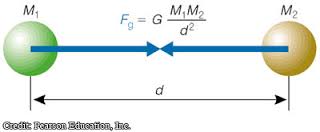
A particle attracts every other particle in the universe using a force that is directly proportional to the product of their masses and inversely proportional to the square of the distance between them. This is a statement of __________.
a)
Newton's Law of Inertia
b)
Newton's Law of Acceleration (forces)
c)
Newton's Law of Action Reaction Force Pairs
d)
Newton's Law of Universal Gravitation
12.
This is the rotary effect of a force around an axis of rotation.
a)
Torque
b)
Acceleration
c)
Force
d)
Weight
13.
The perpendicular distance from a force's line of action to the axis of rotation.
a)
Force
b)
Fulcrum
c)
Lever Arm
d)
Mass
14.
This is the equation for Torque __________.
a)
F = m*a
b)
p = m*v
c)
GPE = m*g*h
d)
T = (r)*F
15.
Counterclockwise rotations produce ________ torques.
a)
Negative
b)
Positive
c)
Neutral
d)
Zero
16.
Torque is always the greatest if the force vector and lever arm are at __________ degrees.
a)
0
b)
45
c)
60
d)
90
17.
A zero velocity state; no net force and no net torque acting on the system.
a)
Static Equilibrium
b)
Dynamic Equilibrium
c)
Quantum Equilibrium
d)
Negative Equilibrium
18.
A constant non-zero velocity state; no net force and no net torque acts on the system.
a)
Static Equilibrium
b)
Dynamic Equilibrium
c)
Quantum Equilibrium
d)
Negative Equilibrium
19.
The sum of all torques around the axis of rotation is zero.
a)
Thermal Equilibrium
b)
Nuclear Equilibrium
c)
Balanced Torque
d)
Unbalanced Torque
20.
The sum of all torques around the axis of rotation is not zero. The object is experiencing angular acceleration.
a)
Thermal Equilibrium
b)
Gravitational Equilibrium
c)
Balanced Torque
d)
Unbalanced Torque
21.

Which model has greater gravitational attraction (if any)

a)

Model A

b)

Model B

c)

Both Model A and Model B (same gravity)

22.
The easiest way to open a heavy door  is by applying the force
a)
Near the hinges
b)
In the middle of the door
c)
At the edge of the door far from the hinges
d)
At the top of the door
23.
What is the Unit for Torque
a)
Nm
b)
N
c)
W
d)
J
24.
Torque is the product of a force exerted on an object times the lever arm.
a)
True 
b)
False
25.
Does a bridge anchored resting on two pillars have any torque?
a)
No, it isn't moving
b)
Yes, but it is at equilibrium
c)
Yes, but it will soon break because of the torque
d)
No, Bridges can't have torque
26.
When an object is experiencing a net torque
a)
it is in dynamic equilibrium.
b)
it is in static equilibrium.
c)
it is rotating.
d)
it is translating.
27.
As the moon orbits the earth, what keeps the moon moving in a circular motion?
a)
Gravity
b)
Inertia
c)
Centripetal Force
d)
Friction
28.
Complete the following statement: The farther away two planets are the _______ the gravitational force between them.
a)
more
b)
same
c)
dosen't matter
d)
less
29.

If the two masses of two objects are doubled, the force of gravitational attraction between them ______.

a)

Doubles

b)

Quadruples

c)

Cut in Half

d)

4x Smaller

30.

Estimate the weight of a pencil.

a)

Approximately 5 grams

b)

Approximately 5 kilograms

31.

How many grams are in 1 kilogram?

a)

500

b)

2000

c)

1000

d)

750

32.

What unit of measurement is used for weighing small items like fruits and vegetables?

a)

liters

b)

grams

c)

pounds

d)

inches

33.
Which of the following is a unit of mass?
a)
kilogram
b)
liter
c)
meter
d)
pound
34.

A squirrel has a weight of 4.9 N. What is his Mass if he is running on the Ground?

a)

4.9 kg

b)

9.8 N/kg

c)

0.5 kg

d)

5.0 kg

35.

______ is the gravitational force exerted on an object

a)

Mass

b)

Gravity

c)

Force

d)

Weight

36.

What is the weight of a 0.456 kg object?

a)

456g

b)

0.456kg

c)

4.56N

d)

456N

37.

Find the weight of a 20g object

a)

200N

b)

20g

c)

0.2N

d)

0.02kg