
Font size
 Worksheets
DNA to Proteins p1 2025
Total questions: 69
Worksheet time: 35mins
ATG TGA CAG
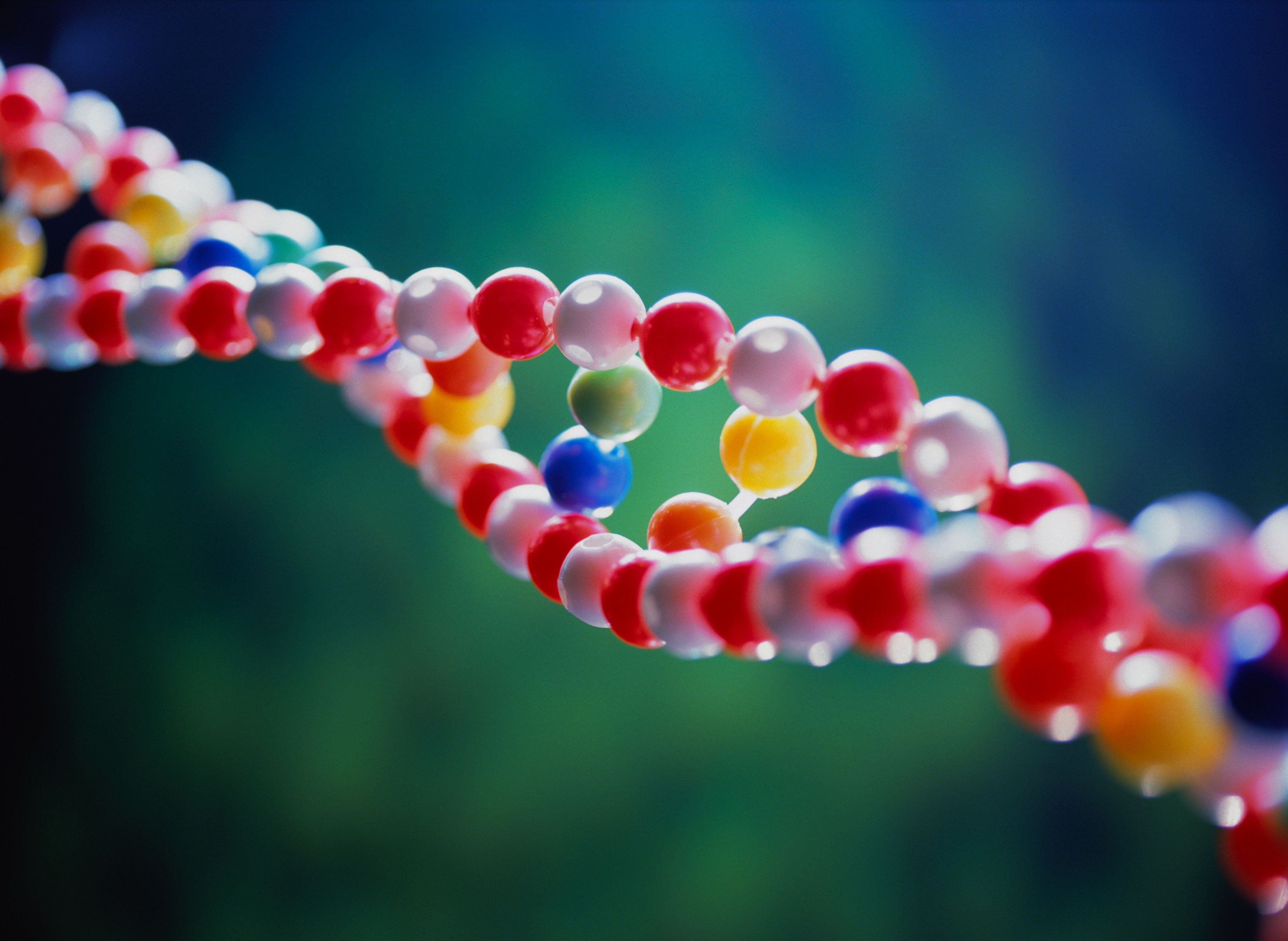

What is represented by letter C in this image of the nucleotide?
Deoxyribose sugar
Phosphate group
Nitrogenous base
What is represented by letter A in this image of the nucleotide?
Deoxyribose sugar
Phosphate group
Nitrogenous base
What is represented by letter B in this image of the nucleotide?
Deoxyribose sugar
Phosphate group
Nitrogenous base
Which of the following show correctly matched complimentary base pairs? (Select ALL that apply)
A=T
A=G
G=C
C=A
T=A
What is DNA's role, or job?
Storing genetic information
Producing proteins
Regulating cell functions
Transporting oxygen
What is a Nucleotide?
Energy molecule
Cell organelle
Type of protein
Building block of DNA
What does Complementary Base Pairing mean?
Specific pairing of A with T, and G with C
Pairing of A with C, and T with G
Random pairing of nucleotides
Pairing of A with G, and T with C

Identify what structure is outlined in the BLACK outline.
Base pair
deoxyribose sugar
phosphate group
hydrogen bonds
Nucleotide

Identify what structure is outlined in the BLACK outline.
Base pair
deoxyribose sugar
phosphate group
hydrogen bonds
Nucleotide

Identify what structure is outlined in the BLACK outline.
Base pair
deoxyribose sugar
phosphate group
hydrogen bonds
Nucleotide

Identify what structure is outlined in the BLACK outline.
Base pair
deoxyribose sugar
phosphate group
hydrogen bonds
Nucleotide
You can find DNA ONLY in...
animals
all living cells
plants
bacteria
A segment of DNA that has the ability to code for a specific trait.
gene
allele
chromosome
chromatid
A section of DNA molecule that contains the information to code for a specific protein.
Genes
Chromosomes
Ribosome
Messenger RNA
Transfer RNA
In what organelle does protein synthesis occur?
Chromosomes
Messenger RNA
Protein synthesis
Ribosome
Transfer RNA
Copies the coded message from the DNA in the nucleus, and carries the message to the ribosomes in the cytoplasm.
Genes
Protein synthesis
Ribosome
Messenger RNA
Transfer RNA
Making up your genetic traits by controlling the production of proteins in an organism’s cells is the main function of?:
Chromosomes
Genes
Messenger RNA
Ribosome
Transfer RNA
Differences between DNA and RNA:
The genetic messenger, ribonucleic acid
DNA molecules
RNA molecules
Differences between DNA and RNA:
Made up of a Double strand instead of Single strand
DNA molecules
RNA molecules
Differences between DNA and RNA:
Made up of the four bases :
Adenine (A), Uracil (U), Guanine (G), Cytosine (C)
DNA molecules
RNA molecules
Differences between DNA and RNA:
Made up of the four bases :
Adenine (A), Uracil (U), Guanine (G), Cytosine (C)
DNA molecules
RNA molecules
Differences between DNA and RNA:
Made up of the four bases :
Adenine (A), Thymine (T), Guanine (G), Cytosine (C)
DNA molecules
RNA molecules
When these bond together, they form a protein
Amino Acids
Peptide Bonds
Ribose
Nucleotides

What nucleotide does RNA have that DNA does NOT have?
Thymine
Uracil
Adenine
Cytosine
AAG CTT TGC
In RNA, the base Adenine (A) pairs with...
G
G or T
U
T


What is the function of RNA?
What nucleotides are the components of RNA?
A T G U
A C T U
A C G T
A C G U
What is the correct sequence of protein synthesis?
Where are proteins made?
ER
nucleus
cytoplasm
mitochondria
Where is DNA and RNA made?
nucleus
cytoplasm
mitochondria
ER
I travel outside of the nucleus.
DNA
RNA
I travel outside of the nucleus.
DNA
RNA
Why does DNA stay in the nucleus?
To protect it from becoming damaged.
It is lazy.
It is grounded.
It cannot move.
Why does DNA stay in the nucleus?
To protect it from becoming damaged.
It is lazy.
It is grounded.
It cannot move.
Why do we care so much about making proteins in our cells?
Almost everything in our cells is made of proteins
If a protein is made incorrectly it will not work
Proteins determine our physical traits
All of these are correct
Why do we care so much about making proteins in our cells?
Almost everything in our cells is made of proteins
If a protein is made incorrectly it will not work
Proteins determine our physical traits
All of these are correct
The RNA made directly from the DNA during transcription is:
tRNA
mRNA
rRna
all of these
Proteins are needed for:
build and repair tissues
make enzymes and hormones
build blood and bones
all of these
Reorder the following
DNA
mRNA
Ribosome
Protein
Traits
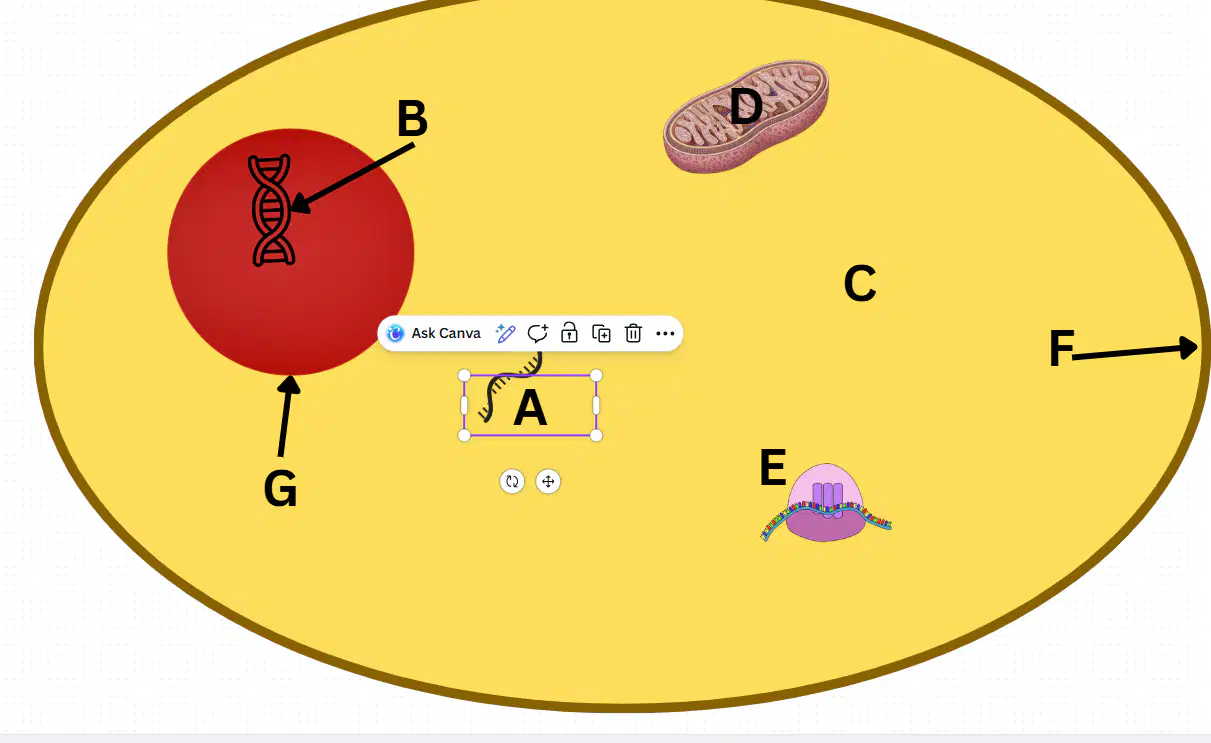
WHAT LETTER BEST REPRESENTS...
Mitochondria
(a)
WHAT LETTER BEST REPRESENTS...
Nucleus
(a)
WHAT LETTER BEST REPRESENTS...
DNA
(a)
WHAT LETTER BEST REPRESENTS...
mRNA
(a)
WHAT LETTER BEST REPRESENTS...
Ribosomes
(a)
WHAT LETTER BEST REPRESENTS...
Cytoplasm
(a)
WHAT LETTER BEST REPRESENTS...
Cell membrane
(a)

