wayground logo

Free Printable Worksheets

Font size

S
M
L
XL
Worksheets

Season 5 Finale: Imperialism Test

Total questions: 56

Worksheet time: 33mins
Name
Class
Date
1.
What happened because of the Berlin Conference of 1884-1885?
a)
France and Britain agreed to govern their African colonies jointly.
b)
There was less fighting between African leaders and European powers.
c)
African leaders voiced their suggestions for better relations with European powers.
d)
Europeans divided Africa into colonies without consulting African leaders.
2.
The sepoys were
a)
Indian soldiers.
b)
Bengal Hindus.
c)
Mughal princes.
d)
Sikh civil servants.
3.
Why was India called the "jewel in the crown"?
a)
It was the most valuable of all of Britain's colonies.
b)
It had a vast supply of diamonds, rubies, and sapphires.
c)
The sepoys were a perfect model of successful imperialism.
d)
The success of India's self-sufficient economy strengthened Britain.
4.
Which of the following is NOT TRUE about Imperialism?
a)
Sometimes spread religion / culture onto other peoples
b)
Conquering foreign territories
c)
Wanted natural resources and markets
d)
Was mostly seen in Asia
5.
Urbanization is
a)
Moving of people to country
b)
A type of economics
c)
Movement of people to cities
d)
A type of labor system
6.
What was the issue with the construction of most cities?
a)
There was poor planning
b)
No roads
c)
There was too much room for housing
d)
They had too much food for the people
7.
What is Pseudoscience
a)
Evidential Science
b)
Fake Science
c)
Investigative Science
d)
Proven Science
8.
What new technology allowed Europeans to conquer Africa easily?
a)
Nuclear Weapons
b)
Tanks
c)
Airplanes
d)
Automatic Weapons
9.
What African disease did the Europeans learn to fight off with medicine?
a)
Tuberculosis
b)
Covid
c)
Malaria
d)
Cholera
10.
What long term effect did the Berlin Conference have?
a)
United Africa
b)
Global Peace
c)
Divided Africa by the Europeans
d)
Brought common cultures together
11.
What was NOT a reason India was considered the "Crown Jewel in the British Crown"?
a)
Large population
b)
Raw materials
c)
Labor force
d)
Military expertise
12.
Which is the biggest reason the Sepoy Mutiny failed?
a)
British were too strong
b)
Hindu/Islam couldn't unite
c)
Lack of experience
d)
Didn't have weapons
13.
Before the Scramble for Africa, a new notion was spreading called _________, where you think your country is better than others.
a)
Patriotism
b)
Nationalism
c)
Industralization
d)
Urbanization
14.
Which of the following is NOT TRUE about "White Man's Burden?"
a)
White colonizers wanted to spread christianity
b)
White colonizers thought they were "civilizing" other countries/cultures
c)
White colonizers ended the slave trade
d)
White colonizers were openly accepted by other countries
15.
What did the US want to use Hawaii for?
a)
Sugar
b)
Land
c)
Labor Force
d)
Cocoa
16.
How did the US acquire the majority of it islands?
a)
Buying land from them
b)
Conquering thier land
c)
By winning the Spanish - American War
d)
Manipulating their people
17.
Why was Queen Liliuokalani overthrown?
a)
Tried to restore political powers to Hawaiians
b)
Declared war on the US
c)
Wanted the US to annex Hawaii
d)
Hawaiian's didn't want her in power
18.
What was the advantage of sugar being made in the US?
a)
Could sell for higher profits
b)
Didn't have to pay taxes
c)
Less profits
d)
Could make more baked goods
19.
Which of the following is NOT a form of Imperialism?
a)
Colony
b)
City-state
c)
Protectorate
d)
Sphere of Influence
20.
Which of the following is NOT TRUE of Imperialism in the Philippines
a)
Emilio Aguinaldo leads the bloody 3 year conflict
b)
US won control of the Philllipines until 1946
c)
Control over the Philippines started with the War of 1812
d)
US fought Spain for colonies such as the Phillipines
21.
Which of the following is TRUE about Imperialism in Asia?
a)
India fought England in the Opium Wars
b)
The Dutch East India Company controlled trade in South East Asia
c)
China agreed to trade with Britain peacefully
d)
Japan has always been an open country
22.
Which of the following is NOT TRUE about Imperialism in Congo?
a)
King Leopold of Belgium was in charge of the colonization
b)
He made treaties with local chiefs and kept his word with all of them
c)
He brutally exploited Africans to collect rubber
d)
Other European countries noticed Africa's natural resources from this
23.
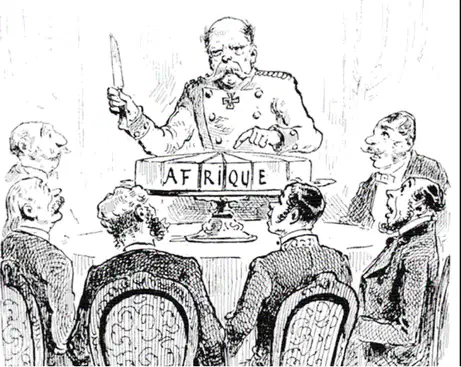
Which topic that we learned about does this image represent?
a)
British Colonization
b)
Berlin Conference
c)
White Man's Burden
d)
Congo: Crimes against Humanity
24.
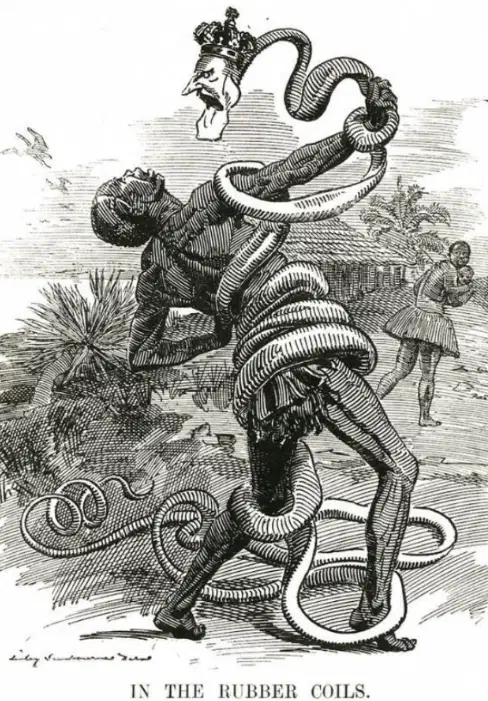
Which topic that we learned about does this image represent?
a)
British Colonization
b)
Berlin Conference
c)
White Man's Burden
d)
Congo: Crimes against Humanity
25.
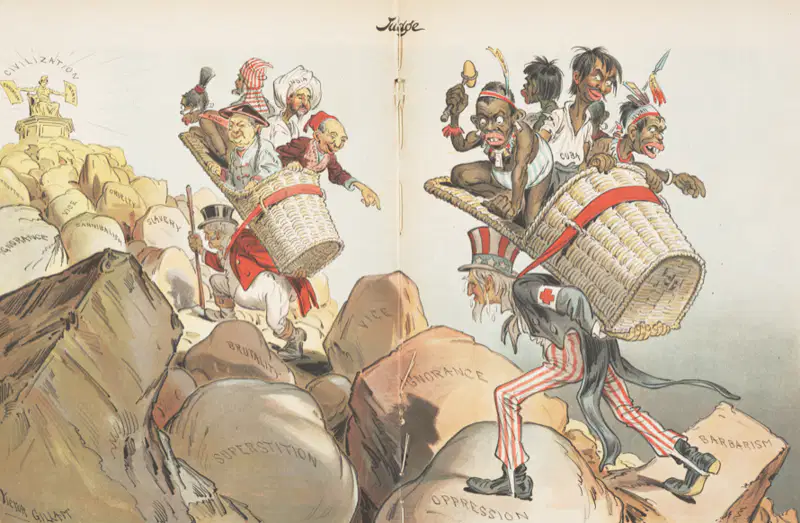
Which topic that we learned about does this image represent?
a)
British Colonization
b)
Berlin Conference
c)
White Man's Burden
d)
Congo: Crimes against Humanity
26.
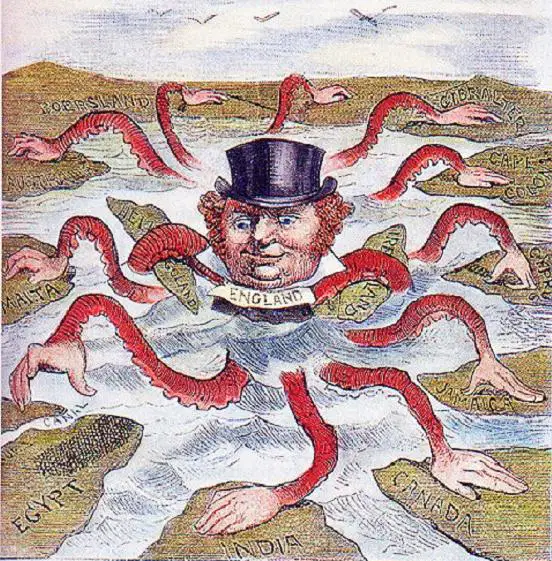
Which topic that we learned about does this image represent?
a)
British Colonization
b)
Berlin Conference
c)
White Man's Burden
d)
Congo: Crimes against Humanity
27.
Which of the following is NOT TRUE about Africa before imperialism?
a)
Africa had over 1,000 languages & groups
b)
Africa kept Europeans out for 400+ years
c)
Mostly only missionaries who explore the interior of Africa
d)
Africa was very poor and struggling before European imperialism came
28.
Imperialism is best defined as:
a)
Trade between equal nations
b)
The spread of democracy
c)
When a powerful country controls another country’s political, economic, and social life
d)
Peaceful cultural exchange
29.
European nations mainly pursued imperialism in the 1800s to:
a)
Spread democracy
b)
Gain natural resources and new markets
c)
End all wars
d)
Protect indigenous cultures
30.
Which continent was MOST affected by European imperialism in the late 1800s?
a)
South America
b)
Africa
c)
Australia
d)
Antarctica
31.
Europeans justified imperialism using the idea known as:
a)
Communism
b)
White Man’s Burden
c)
Isolationism
d)
Neutrality
32.
The MAIN resource King Leopold wanted from the Congo was:
a)
Gold
b)
Rubber
c)
Cotton
d)
Oil
33.
Who was Hawaii’s last queen?
a)
Queen Victoria
b)
Queen Isabella
c)
Queen Elizabeth
d)
Queen Liliuokalani
34.
Nationalism during the age of imperialism meant:
a)
Supporting global cooperation
b)
Believing one’s nation was superior
c)
Avoiding conflict
d)
Ending empires
35.
What country did the Platt Amendment give the US the right to protect?
a)
Cuba
b)
Phillipines
c)
Spain
d)
Hawaii
36.
What do these countries have in common? -Hawaii -India -Congo -Philippines
a)
These are all Asian countries
b)
These are all African countries
c)
These are all countries that were colonizers
d)
These are all countries that were colonized
37.
What do these countries have in common? -Germany -Britain -America -France
a)
These are all Asian countries
b)
These are all African countries
c)
These are all countries that were colonizers
d)
These are all countries that were colonized
38.
Based on the information in this graph, why did immigration increase rapidly between 1895 and 1905?
a)
Railroad construction created jobs for immigrants.
b)
Cheap land prices in the West attracted immigrant farmers.
c)
Industrial growth provided factory jobs for immigrants.
d)
World War I caused immigrants to flee Europe.
39.
Why did people move to cities during the Industrial Revolution?
a)
People were looking for work.
b)
People were looking for farms.
c)
People wanted to buy a house.
d)
People wanted to sell their crops.
40.

According to this image, what impacts did factories have on living conditions? Check ALL that apply

a)

better housing

b)

pollution

c)

disposal of waste

d)

lack of fresh water

41.

Which of the following was NOT true of poor urban neighborhoods?

a)

They were filled with overcrowded tenements.

b)

The living conditions were dirty and squalid.

c)

Most urbanites lived in factory-owned apartments.

d)

The incidence of diseases was increasing.

42.

Which trend of the late 1800s correctly replaces the question make in this cause-and-effect diagram?

a)

The number of immigrants from Europe declined

b)

The government passed laissez-faire laws

c)

People moved from rural to urban areas

d)

Settlement houses lost federal funding

43.

(2017)Which demographic change in the United States is most associated with this transformation?

a)

Increased property values in rural areas

b)

Increased life expectancies in urban areas

c)

Increased birth rates in rural areas

d)

Increased migration to urban areas

44.

What is Urbanization?

a)

Growth of Cities

b)

The Growth of Inventions

c)

The challenge of immigration

d)

The growth of farms

45.
Urbanization is the movement of people from ___ to ___
a)
Farms to cities
b)
Cities to farms
c)
Eastern America to the West
d)
Western America to the East
46.

What is NOT an accurate statement about the living conditions in cities?

a)

Workers lived in tenements, which were overcrowded apartments.

b)

Most city residents had access to clean water and indoor plumbing (toilets).

c)

People died from many diseases.

d)

Fires were a constant worry in the cramped conditions.

47.

This chart shows that urbanization is...

a)

Increasing

b)

Decreasing

48.

Which of the following can be described by these factors?

a)

INdustrialization

b)

Mercantilism

c)

Urbanization

d)

Free Enterprise

49.

Industrialization: an economy moving from agriculture to manufacturing goods

Industrialization often leads to a rapid population increase in cities, which is known as -

a)

colonization

b)

urbanization

c)

regionalization

d)

ruralization

50.

In which years did the Berlin Conference take place?

a)

1870-1871

b)

1884-1885

c)

1899-1900

d)

1914-1915

51.

What emotion is commonly associated with ethnocentrism?

a)

Empathy

b)

Pride

c)

Curiosity

52.

Imperialism means what?

a)

A system where a strong country takes wealth and raw materials from a weaker country to benefit the stronger country.

b)

A system of trade that benefits only one nation and not all.

c)

The process of forming alliances between many countries.

d)
The act of withdrawing from international affairs.
53.

Colonization means what?

a)

The practice of living among and controlling the people who have already lived there.

b)
A method of trade between countries.
c)
The act of forming alliances for mutual benefit.
d)
The process of sharing cultural practices between nations.
54.

Berlin Conference

a)
The Berlin Conference was a summit to discuss European unity.
b)

The Berlin Conference focused on the regulation of trade in Africa.

c)
The Berlin Conference was held to establish peace treaties in Europe.
d)

The Berlin Conference was a meeting with European nations to create rules on how to peacefully divide Africa among them for colonization.

55.

Where did the Industrial Revolution begin?

a)

Germany

b)

France

c)

Great Britain

d)

United States

56.
the belief that some societies are better than others
a)
Social Darwinism
b)
expansionism
c)
militarism
d)
colonialism