wayground logo

Free Printable Worksheets

Font size

S
M
L
XL
Worksheets

mitosis cancer stem cell review

Total questions: 56

Worksheet time: 2hrs 52mins

Name
Class
Date
1.
name first and last
4 lines
2.
*At the end of the cell cycle, how many chromosomes will each daughter cell?
a)
During DNA replication, the number of chromosomes is cut in half.
b)
During DNA replication, the number of chromosomes stays the same.
c)
During cell division, each daughter cell will get the same number of chromosomes/genes.
d)
During cell division, each daughter cell will get a random number of chromosomes/genes.
3.
* A multicellular organism begins life as a single cell — a fertilized egg with a complete set of chromosomes. The picture below shows how the cell divides to become two cells, then four cells, eight cells, and so on. Which of the following statements best describes what happens during this process?
a)
Chromosomes are duplicated before cell division so that each new daughter cell has a complete set.
b)
Chromosomes are divided evenly during cell division so that each new daughter cell has an equal share (half) of the original set.
c)
Chromosomes are stored in the original cell to direct the division of all daughter cells, which do not have their own chromosomes.
d)
Chromosomes are randomly distributed during cell division so that some new cells have partial sets while others have complete sets.
4.
* During which phase in the cell cycle does DNA replication happen?
a)
G1 phase
b)
G2 phase
c)
M phase
d)
S phase
5.
* If the spindle fibers do not form, which of the following would not take place?
a)
Chromosomes being separated
b)
Nuclear membrane being broken down
c)
DNA is duplicated
d)
Chromosomes are made visible
6.
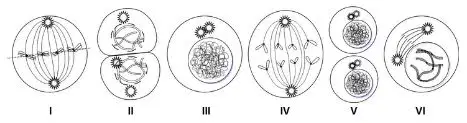
* Put the cells shown in the diagram below in the correct order that they occur during the cell cycle.
a)
II, III, I, IV, V, VI
b)
III, VI, I, IV, II, V
c)
III, V, VI, IV, I, II
d)
I, II, III, IV, V, VI
7.
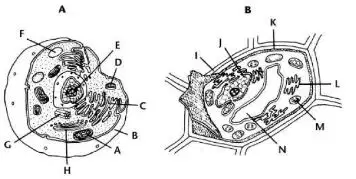
*Some cells form a cell plate during cytokinesis. Which of the following is true of the cells in the diagram below?
a)
Both cells form cell plates during cytokinesis.
b)
Neither cell forms a cell plate during cytokinesis.
c)
Only cell A forms a cell plate during cytokinesis.
d)
Only cell B forms a cell plate during cytokinesis.
8.
* Cyclins are a family of closely related proteins that...
a)
regulate the cell cycle.
b)
produce p53.
c)
cause cancer.
d)
work to heal wounds.
9.
* Which is NOT true of cancer cells?
a)
Cancer cells can migrate to other parts of the body through the process of metastasis
b)
Cancer cells fail to undergo apoptosis.
c)
Cancer cells exit the cell cycle and enter the G0 phase.
d)
Cancer cells ignore signals that should cause them to stop dividing.
10.
* During early development, all cells in the embryo of a multicellular organism are identical. Later on in development, the cells will become specialized through a process called...
a)
apoptosis
b)
cytokinesis
c)
differentiation
d)
interphase
11.
which is not a checkpoint of the Cell Cycle
a)
G1
b)
S
c)
G2
d)
M
12.
each chromosome consist of 2
a)
kineticores
b)
chromatids
c)
daughter cells
d)
centrioles
13.
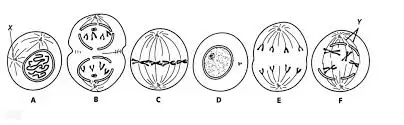
Put these images in order
a)
a,b,c,d,e,f
b)
d,a,c,e,b,f
c)
d,,a,f,e,c,b,
d)
d,a,f,c,e,b
14.
phases of G1, S, and G2 are collectively called _____.
a)
mitosis
b)
interphase
c)
cytokinesis
d)
meoisis
15.
All of the cells in this potato plant have the same DNA. Which of these would best describe why the cells differentiate into different parts of the plant, such as the roots, stems, and leaves?
a)
DNA gets deleted from specific cells.
b)
Certain cells add DNA to make them different.
c)
Different genes are expressed in different cells.
d)
The DNA nucleotides are switched and moved as the cells develop.
16.
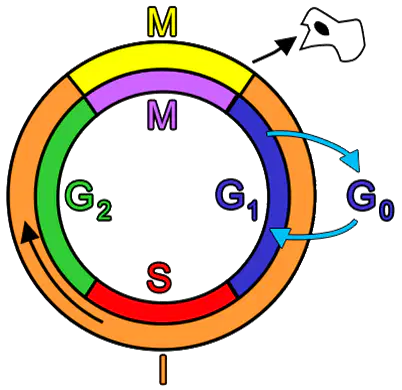
The above picture represents the different stages a cell goes through in its "lifetime." Specific genes within the DNA, called inhibitors, stop the cell cycle in G1 phase. This process helps to keep the DNA unaltered and the cells dividing at the correct rate. If cells continue through the cell cycle, uncontrolled, what may develop?
a)
A tumor
b)
HIV/AIDS
c)
Birth defects
d)
Sickle cell disease
17.
Which of the following enclose their DNA in a nucleus?
a)
prokaryotes
b)
bacteria
c)
eukaryotes
d)
viruses
18.
The process by which a cell grows and divides into two daughter cells is called
a)
the cell cycle.
b)
metaphase.
c)
interphase.
d)
cytokinesis.
19.
Choose the option that best describes how many chromosomes each daughter cell will get after the cell cycle (mitosis) is complete.
a)
During DNA replication, the number of chromosomes is cut in half.
b)
During DNA replication, the number of chromosomes stays the same.
c)
During cell division, each daughter cell will get the same number of chromosomes/genes.
d)
During cell division, each daughter cell will get a random number of chromosomes/genes.
20.
When during the cell cycle are chromosomes visible?
a)
only during anaphase
b)
only during Telophase
c)
only during metaphase
d)
only during the G1 phase of interphase
21.
During which phase in the cell cycle does DNA replication happen?
a)
G1 phase
b)
G2 phase
c)
M phase
d)
S phase
22.
Which of the following represents the phases of the cell cycle in the proper sequence?
a)
prophase, metaphase, anaphase, telophase
b)
interphase, prophase, metaphase, anaphase, telophase, cytokinesis
c)
anaphase, telophase, metaphase, prophase, cytokinesis,interphase
d)
prophase, anaphase, telophase, metaphase, interphase
23.
What is the role of the spindle fibers during mitosis?
a)
They help separate the chromosomes.
b)
They break down the nuclear membrane.
c)
They duplicate the DNA.
d)
They make the chromosomes visible.
24.
During normal mitotic cell division, a parent cell that has four chromosomes will produce two daughter cells, each containing
a)
two chromosomes.
b)
four chromosomes.
c)
eight chromosomes.
d)
sixteen chromosomes.
25.
Cancer is a disorder in which some cells have lost the ability to control their
a)
size.
b)
spindle fibers.
c)
growth (division) rate.
d)
surface area.
26.
Cancer cells form masses of cells called
a)
tumors.
b)
cyclins.
c)
growth factors.
d)
p53.
e)
27.
Choose the option that best explains the difference between embryonic stem cells and adult stem cells.
a)
Embryonic stem cells can become any cell type, while adult stem cells can only become the type of cell present in the tissue where they were obtained.
b)
Adult stem cells can become any cell type, while embryonic stem cells can only become the type of cell present in the tissue where they were obtained.
c)
Both embryonic stem cells and adult stem cells can become any cell type.
d)
Embryonic stem cells and adult stem cells can only become the type of cell present in the tissue where they were obtained.
28.
During early development, all cells in the embryo of a multicellular organism are identical. Later on in development, the cells will become specialized through a process called
a)
apoptosis.
b)
cytokinesis.
c)
differentiation.
d)
interphase.
29.
Why are stem cells important?
a)
They have specialized DNA.
b)
They are incapable of becoming cancer cells.
c)
They have the potential to undergo cell division.
d)
They have the potential to develop into other cell types.
30.

What phase of mitosis is shown in the picture?

a)

Metaphase

b)

Anaphase

c)

Prophase

d)

Telophase

31.
The following describes _________ during mitosis. The spindle fiber splits the centromere and the chromatids move to opposite sides of the cell.
a)
prophase
b)
metaphase
c)
anaphase
d)
telophase
32.

Which of the following is the correct order of the Cell Cycle?

a)

Interphase, Mitosis, Cytokinesis

b)

Mitosis, Cytokinesis, Mitosis, Interphase

c)

Prophase, Metaphase, Anaphase, Telophase

d)

Interphase, Prohase, Cytokinesis

33.

Identify the following stage of the life cycle of the cell in the picture.

a)

interphase

b)

prophase

c)

metaphase

d)

anaphase

e)

telophase

34.

Identify the following stage of the life cycle of the cell in the picture.

a)

interphase

b)

prophase

c)

metaphase

d)

anaphase

e)

telophase

35.

What phase is anaphase?

a)

b)

c)

d)

36.

What phase is metaphase?

a)
b)
c)
d)
37.

What phase is Telephase?

a)
b)
c)
d)
38.

What phase is Interphase?

a)
b)
c)
d)
39.
Structure B is pointing to the _____. 
a)
chromosome
b)
centromere
c)
DNA
d)
chromatid
40.
Fruit fly body cells have 8 chromosomes. After mitosis, you would expect a resulting fruit fly daughter cell to have ...
a)
16 chromosomes.
b)
46 chromosomes.
c)
8 chromosomes.
d)
4 chromosomes.
41.
What phase does DNA replication take place?
a)
G1 stage
b)
Synthesis stage
c)
G2 stage
42.
The organelle that helps in cell division and produces spindle fibers.
a)
Chromosome
b)
Centriole
c)
Cytoplasm
d)
Chloroplast
43.

What is the purpose of Mitosis?

a)

Growth of an organism and Repair of damaged tissue

b)

To help the body get rid of extra cells

c)

To increase the amount of classwork you have to do

d)

To get rid of the nucleus

44.

Any substance that is known to cause cancer is called a...

a)

Carcinogen

b)

metastasizer

c)

Pathogen

d)

Retrovirus

45.
________________________ is a process of recognizing defective cells, letting them die, and replacing with normal cells.
a)
Mitosis
b)
Apoptosis
c)
Interphase
d)
Metaphase
46.

What is the function of cyclins?

a)

They regulate tumor growth.

b)

They help regulate the cell cycle.

c)

They synthesize proteins.

d)

They regulate apoptosis.

47.

A ________________is a critical point where stop and go signals can regulate the cycle

a)

tumor

b)

checkpoint

c)

growth factor

d)

oncogene

48.
Non-cancerous tumors are called _____. Cancerous tumors are called _____.
a)
metastatic ; malignant
b)
malignant ; benign
c)
benign ; malignant
d)
benign ; metastatic
49.

Tumor suppressor genes like p53 help to

a)

accelerate the cell cycle

b)

Increase the spread of cancer cells

c)

Kill cancerous cells by apoptosis

d)

add more cells to a malignant tumor

50.

Which type of cell has the most medical potential for making tissues and organs for patients who need them?

a)

Specialized Cells

b)

Embryonic Stem Cells

c)

Adult Stem Cells

d)

Induced Stem Cells

51.

A few days after fertilization, cells in the embryo begin to turn on and off particular genes in order to become particular cell types. This process is called...

a)

Differentiation / Specialization

b)

Homeostasis

c)

The cell cycle

d)

Mitosis

52.
What is the difference between embryonic stem cells and adult stem cells?
a)
Embryonic stem cells can differentiate into more cell types than adult stem cells
b)
Adult stem cells are pluripotent, just like embryonic stem cells
c)
Adult stem cells can differentiate into more cell types than embryonic stem cells
d)
Adult stem cells grow bigger than embryonic stem cells
53.
Why are scientists interested in studying stem cells?
a)
They never die.
b)
They come from the brain stem. 
c)
They can be transplanted into monkeys.
d)
They can become any type of cell.
54.
Which is true about Adult Stem Cells.
a)
They no longer do mitosis, their cell type is set and can not change
b)
They are limited to the type of  cell they can become.
c)
They can become any cell type in the body
d)
They are found in embryos
55.

There are 3 ___________, which regulates whether the cell will progress through the cell cycle

a)

Checkpoints

b)

Platelets

c)

Proteins

d)

Enzymes

56.

The yellow curved lines in the image.

a)

chromosomes

b)

chromatids

c)

spindle fibers

d)

centrioles