
 Worksheets
Chapter 6 Review: The Periodic Table and The Periodic Law
Total questions: 38
Worksheet time: 19mins
Name
Class
Date
1.
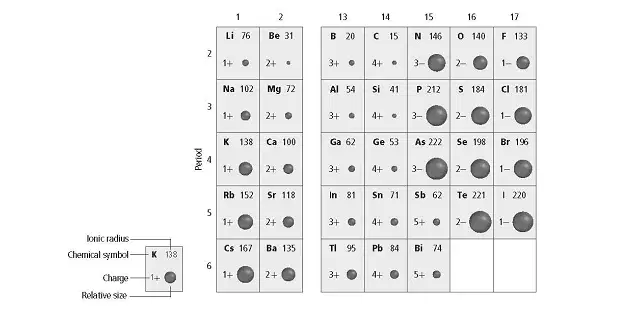
The size of a positive ion is generally ____________________ than the size of the neutral ____________________ from which it forms.
(a)
2.
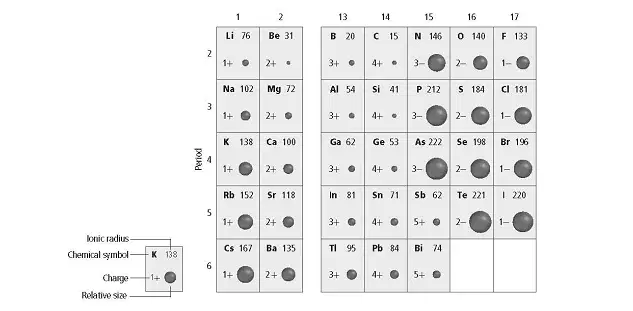
The size of a negative ion is generally __________ than the size of the neutral __________ from which it forms.
(a)
3.
Although chemical properties obey the periodic law, it is impossible to predict physical properties of elements based on their location in the periodic table.
a)
True
b)
False
4.
All of the nonmetals on the periodic table are gases.
a)
True
b)
False
5.
The transition elements consist only of those that are found in block d of the periodic table.
a)
True
b)
False
6.
The radius of an atom is defined as half the distance between the nuclei of two adjacent or bonded atoms of that element.
a)
True
b)
False
7.
The octet rule states that atoms will gain, lose, or share electrons to achieve a complete set of eight valence electrons.
a)
True
b)
False
8.
Elements in Group 17 are classified as halogens.
a)
True
b)
False
9.
Elements in Group 2 are classified as alkali metals.
a)
True
b)
False
10.
When an atom loses electrons, its radius gets smaller.
a)
True
b)
False
11.
The electronegativity of elements increases from left to right and from top to bottom on the periodic table.
a)
True
b)
False
12.
An atom that gains an electron will form a positive ion.
a)
True
b)
False
13.
The same amount of energy is required to remove each electron sequentially from an atom.
a)
True
b)
False
14.
Which category of elements have the property of being malleable and ductile?
a)
Gases
b)
Metals
c)
Metalloids
d)
Nonmetals
15.
Which category of elements have the properties that place them somewhere in-between metals and nonmetals?
a)
Gases
b)
Metals
c)
Metalloids
d)
Nonmetals
16.
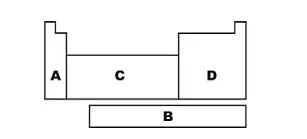
Which region is referred to as the p-block on the diagram?
a)
A
b)
B
c)
C
d)
D
17.
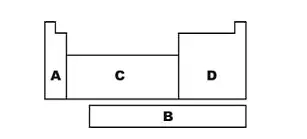
Which region is referred to as the f-block on the diagram?
a)
A
b)
B
c)
C
d)
D
18.
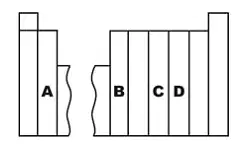
Which region contains elements with two valence electrons?
a)
A
b)
B
c)
C
d)
D
19.
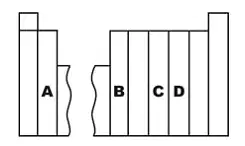
Which region contains elements with an electron configuration that ends with p3?
a)
A
b)
B
c)
C
d)
D
20.
Which block on the periodic table contains the actinide series of elements?
a)
S-Block
b)
P-Block
c)
D-Block
d)
F-Block
21.
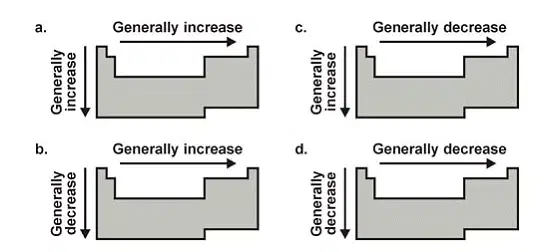
Which diagram correctly depicts the trend in electronegativity?
a)
a
b)
b
c)
c
d)
d
22.
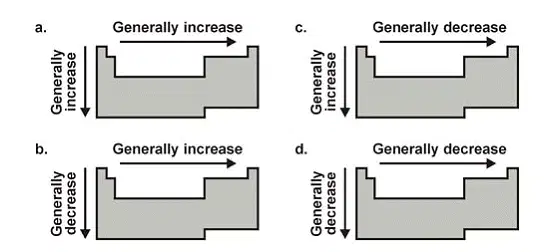
Which diagram correctly depicts the general trend in first ionization energy?
a)
a
b)
b
c)
c
d)
d
23.
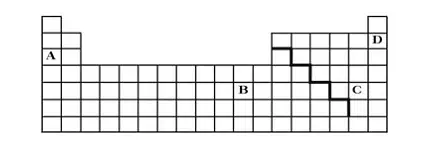
Which element has an electron configuration that ends in the fourth energy level?
a)
a
b)
b
c)
c
d)
d
24.
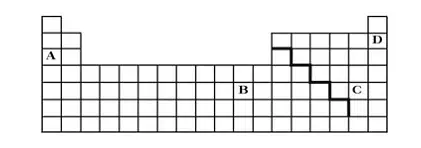
Which element is the most metallic?
a)
a
b)
c
c)
d
25.
Which is defined as the energy required to remove an electron from an atom of an element in the gaseous state?
a)
ionization energy
b)
electronegativity
c)
ionic radius
d)
law of octets
26.
In which pair is the one on the left larger than the one on the right?
a)
Na, Rb
b)
S, Mg
c)
Br, Br-
d)
K, K+
27.

Identify the period and group numbers of the element with the electron configuration.
a)
Period 2, Group 4
b)
Period 3, Group 4
c)
Period 3, Group 16
d)
Period 2, Group 16
28.
Which correctly describes elements in the same group?
a)
They have the same number of valence electrons.
b)
They have electrons in the same outermost energy level.
c)
They have the same atomic radius.
d)
They must be in the same state of matter.
29.
Which is a transition element with five d-block electrons in energy level 4?
a)
Niobium (Nb)
b)
Renium (Re)
c)
Manganese (Mn)
d)
Technetium (Tc)
30.
Which is the most important characteristic in determining an element’s chemical properties?
a)
the number of protons and neutrons in its nucleus
b)
which period it is found in
c)
the number of valence electrons it contains
d)
its outermost energy level
31.
Which group will have an electron configuration that ends in ns2?
a)
Alkali metals
b)
Alkaline Earth metals
c)
Halogens
d)
Actinides
32.
Which property describes how much energy must be added to an atom to remove an outermost electron?
a)
atomic radius
b)
ionic radius
c)
electronegativity
d)
ionization energy
33.
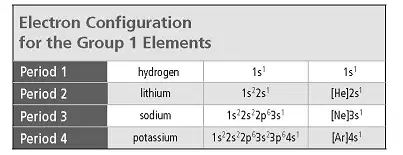
Based on the table below, atoms of which element have the greatest number of valence electrons?
a)
lithium
b)
potassium
c)
They all have the same number of valence electrons.
d)
The table does not show numbers of valence electrons.
34.
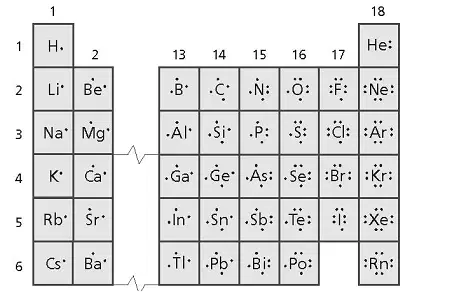
Based on the figure below, what do the elements of a group (family) have in common?
a)
They have the same atomic number.
b)
They have the same atomic mass.
c)
They have the same number of protons.
d)
They have the same number of valence electrons.
35.
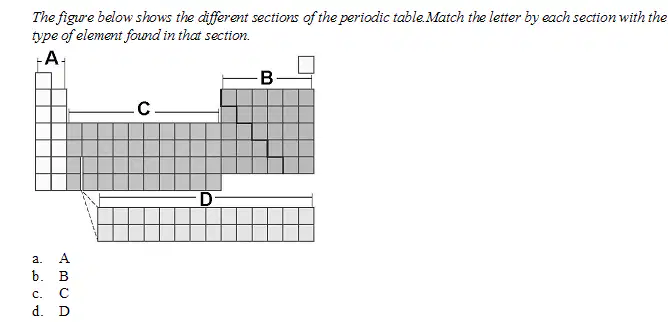
D-block Elements are indicated by which letter?
a)
A
b)
B
c)
C
d)
D
36.
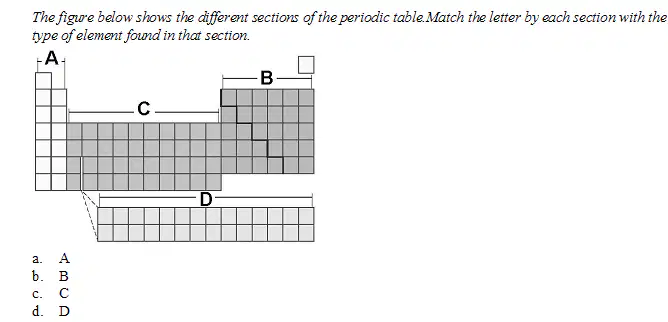
F-block Elements are indicated by which letter?
a)
A
b)
B
c)
C
d)
D
37.
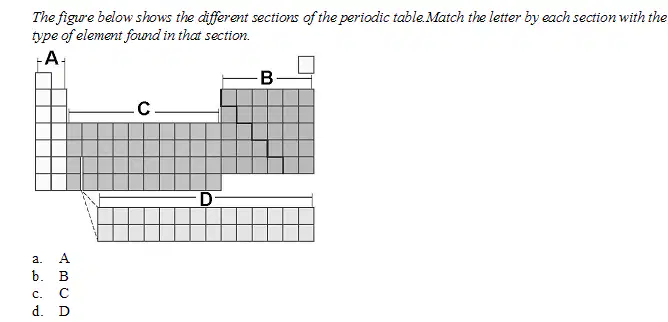
P-block Elements are indicated by which letter?
a)
A
b)
B
c)
C
d)
D
38.
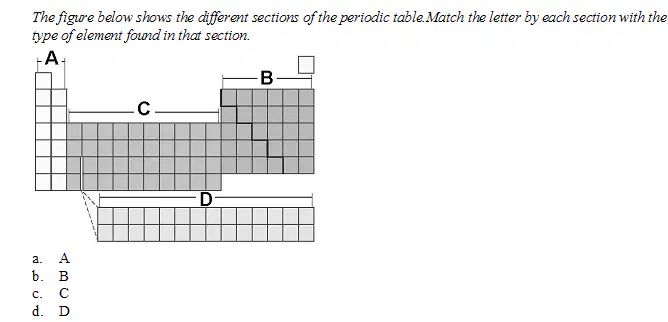
S-block Elements are indicated by which letter?
a)
A
b)
B
c)
C
d)
D
100 %

