
 Worksheets
World War I Review Sheet — Extracted Questions
Total questions: 50
Worksheet time: 28mins
Using the Causes of World War 1 table, match each cause to its definition as given in the worksheet.
Militarism
Build up of military in response to other nations
Alliances
Defense agreements among nations; "you're attacked — I got your back"
Nationalism
A feeling of intense loyalty to one's nation, group, or country
Imperialism
Desire of a nation to expand their empire, colonies, and resources
Which event is the spark that set the world toward war?
Assassination of Archduke Ferdinand of Austria-Hungary by a Bosnian in Serbia
German invasion of Belgium
Sinking of the Lusitania
Zimmermann Telegram
Match each nation to its wartime alliance.
France
Allied Powers
Russia
Allied Powers
Great Britain
Allied Powers
Austria-Hungary
Central Powers
Germany
Central Powers
What is trench warfare?
A complicated network of deep, long holes dug for protection
A rapid cavalry charge across open fields
A series of fortified castles connected by roads
A naval blockade using submarines
Why did the use of trenches prolong World War 1?
No one made any real progress
Trenches allowed rapid offensives to capture cities quickly
Trenches prevented artillery from being used
Trenches made supply lines shorter and faster
What is a stalemate in the context of World War 1 trench fighting?
No real movement on one side or the other; no winners
A decisive victory in a single day
A temporary ceasefire for medical evacuation
A retreat by both sides to avoid battle
Describe trenches and trench foot? Select all statements that are correct.
Trenches were wet, dirty, smelly, and rat infested
Trenches were kept clean by daily drainage and disinfectant
Trench foot is a disease from constant moisture on feet
Trench foot is a respiratory illness caused by gas exposure
Match each World War 1 weapon or technology shown to what it did.
Machine gun
Rapid fire, deadly weapon that made fighting more deadly
Tank (armored assault vehicle)
Could travel through the battlefield
U‑boat or submarines
Sank ships carrying supplies to Britain
Airplanes
Dogfights (aerial fights between planes) and dropped bombs
Poison gas / gas masks
Mustard gas burned the lungs; masks used for protection
At the beginning of the war, the U.S. practiced a policy of not supporting or helping either side in a conflict. Which term best describes this policy?
Neutrality
Imperialism
Militarism
Alliance with the Central Powers
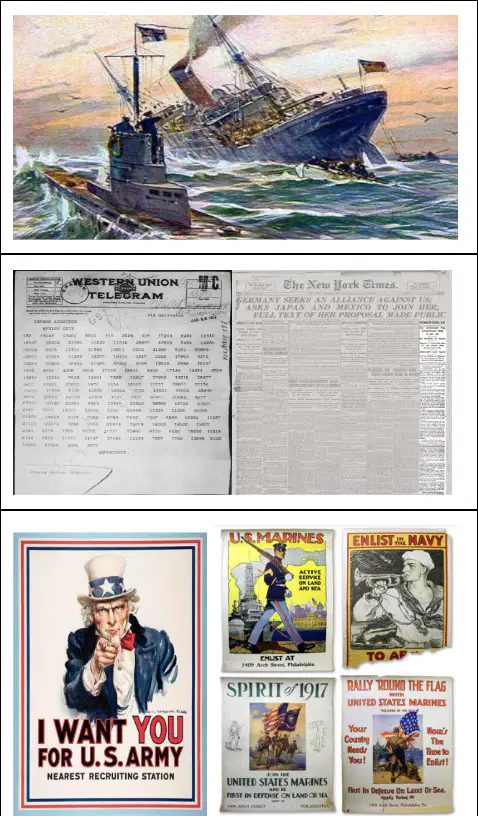
Why did the United States enter World War I? Select all factors described in the visuals and notes that pushed the U.S. toward war.
Germany resumed unrestricted submarine warfare
The Zimmerman Telegram proposed that Mexico attack the U.S.
Germany kept its promise to stop submarine attacks
The U.S. strengthened isolation by staying out of foreign affairs
What was the significance of the sinking of the Lusitania in May 1915 for the United States?
It immediately brought the U.S. into the war
It led Germany to promise to stop unrestricted submarine warfare
It caused the U.S. to ally with the Central Powers
It ended the war in Europe
What does propaganda refer to in the context of World War I posters?
Government-issued rations
Information used to and designed to influence opinion
Secret military plans
Formal peace treaties
Why shouldn’t the U.S. have entered World War I?
Loss of American lives
Making money by remaining neutral
War is inhumane
Some sympathize with the Central Powers
What were war or liberty bonds?
Volunteer military service commitments
A way for the government to raise money for the war
Coupons for rationed goods
International loans to Germany
What change in women’s work occurred during World War I ?
Women left factories and returned home
Women went to work in factories and other jobs because men were at war and fewer immigrants were arriving
Women were drafted into the army
Women primarily worked as overseas diplomats
What was the purpose of encouraging victory gardens?
To decorate public parks
To grow personal food so more could be kept for soldiers
To export produce to Europe for profit
To replace rationing programs
What was rationing intended to do on the home front?
Increase luxury consumption during wartime
Limit use of certain products so they are available for soldiers and conserve needed resources
Eliminate all civilian access to food
Encourage people to avoid work on Mondays and Wednesdays
What did the Sedition Act make illegal during World War I?
Joining labor unions
Saying, printing, or writing any criticism perceived as negative by the government
Buying liberty bonds
Serving in the military while underage
Treaty of Versailles: Which obligation did Germany accept under the Treaty of Versailles?
No responsibility for the war
Full responsibility for World War I
Joining the League of Nations immediately
Keeping all overseas colonies
The End of World War I — Treaty of Versailles: What are reparations in this context?
Military drafts required by the Allies
Territories returned to Germany
Payments to the Allies in the form of billions of dollars
New trade agreements with neutral nations
Treaty of Versailles: Which consequence did Germany face regarding its military and colonial holdings?
Expansion of its navy and colonies
Disarm completely and give up overseas colonies and some European territory
Occupation of France by German troops
Annexation of Mexico
Wilson’s 14 Points: Which proposal was included in President Wilson’s plan for a just and lasting peace after World War I? Select all that apply.
End to secret treaties or agreements among nations
Limits on arms
Permanent annexation of colonies by victorious nations
League of Nations

Which plan was proposed by President Wilson to create a just and lasting peace after World War I but was not accepted?
Treaty of Versailles
Zimmerman Telegram
Wilson’s 14 Points
Monroe Doctrine
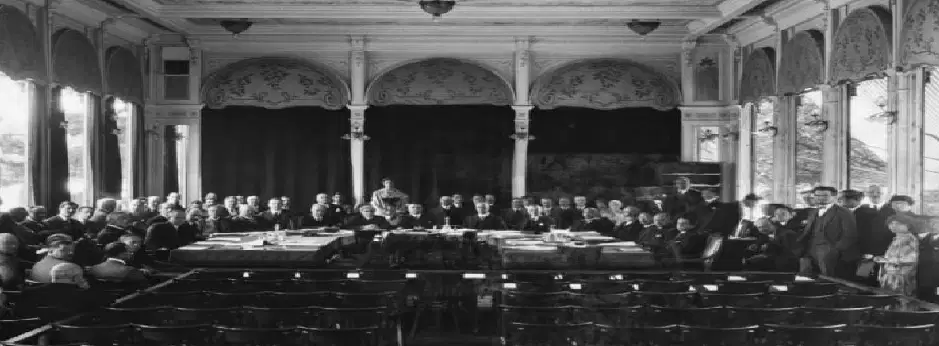
League of Nations: What was the purpose of the proposed League of Nations?
To preserve peace and prevent future wars by members respecting and protecting one another’s independence
To control global trade monopolies
To expand colonial empires
To enforce the U.S. Constitution abroad
League of Nations: Which were reasons some US people were against the League of Nations? Select all that apply.
U.S. troops and ships might be ordered into action by other countries’ governments
It would be a permanent commitment to international affairs
It might override the U.S. Constitution
It would guarantee immediate peace without any conflicts
Which propaganda poster from World War I was created to persuade Americans to grow their own gardens to save money and support the U.S. war effort?

By buying Liberty Bonds, Americans were
loaning the government money that would be repaid with interest in a specified number of years
forcing government to set aside future shares in construction of ships, planes, tanks, and weapons for safekeeping
sacrificing the ability to stay out of debt in order to win the war
able to justify the extravagant meals and comfortable clothes our soldiers were promised when they went to France.
Women did all the following during World War I EXCEPT:
answered telephones near the front lines and translated messages as "Hello Girls"
volunteered as nurses and ambulance drivers for the Red Cross
operated tanks and submarines as part of the American Expeditionary Force
Served as yeomen or non-commissioned officers in the Navy

I see (a) and know that (b) so I can infer the implication that (c)
United States
What is the League of Nations?

The main idea, the very main ideas of 14 points is to
Start WWIII
Kick Germany's out of Europe
Prevent future global conflicts

Woodrow Wilson's "Fourteen Points" were intended to create a lasting peace in Europe and in the world. Choose three items listed here that were part of Wilson's plan.
The end of international alliances.
The creation of a "League of Nations."
Freedom of the Seas
Punishment for German invasions in Europe.
Self-determination for nations.
What was one reason the United States Senate refused to ratify the Treaty of Versailles?
It demanded the U.S. pay war debts
It did not include reparations for France
It allowed Germany to keep its colonies
It required the U.S. to join the League of Nations
Which of the following best explains why the growth of European alliances during the early twentieth century contributed to the onset of a vast conflict?
Progress achieved by allies in weapons development led to an arms race.
The sense of security among allies distracted them from emerging threats.
Suspicions of disloyalty among allies caused international tensions to rise.
The responsibilities of allies drew them into taking sides in regional fights.
Which statement about the technology developed during World War I is correct?
The new technology led to fewer refugees being displaced from their homes during the conflict.
The new technology created deadlier weapons which led to increased military casualties in battles fought during the conflict.
The new technology led to smaller nations joining large empires following the conflict.
The new technology led to a reduced focus on transportation improvements following the conflict.
Read the excerpt below and answer the question that follows.
"To keep out the chill night winds the men had spread their shelter halves over the foxholes which had been dug into the side of the bank. When the enemy’s barrage opened it was directed particularly at this spot, where he believed the infantry was lying in readiness to go over. It was not surprising, then, that the entire vicinity was thoroughly bombarded. In quick succession the shells struck, many of them so near that they blew men to pieces less than ten feet from us and peppered our shelter halves with stones and lumps of mud, leaving many of them perforated like sieves."
— William L. Langer, Gas and Flame in World War I, Knopf/Borzoi
Which characteristic of warfare associated with World War I is described in the excerpt?
Trench warfare
Air Warfare
Submarine warfare
Armored warfare
Which countries were members of the Triple Alliance, later known as the Central Powers? Pick all below options that apply.
Great Britain
France
Russia
Austria-Hungary
Ottoman Empire
Which nations were members of the Triple Entente, later know as the Allies? Select all below options that apply.
Germany
Italy
Great Britain
Austria-Hungary
Russia
Which statement best describes militarism?
establishing a classless society through government force
the policy of maintaining a large armed force for the aggressive pursuit of national interests
the policy of requiring citizens to serve during a country crisis
restricting the activities of the army when maintaining public order
Nationalism means...
identification with one's own nation and support for its interests
hating your country
betraying your country
going to college
Imperialism is...
extending a country's power and influence through education
extending a country's power and influence through colonization and military force
extending a country's power and influence through industry and technology
extending a country's power and influence through science
What impact did rapid-fire machine guns have on the course of the war?
They gave Germany a strong technological advantage on the Eastern Front.
They contributed to high casualty rates by allowing troops to attack targets miles away.
They supported Allied offensives by allowing troops to move into "no-man's land."
They helped prolong the stalemate because they made it difficult for troops to advance.

What treaty is signed to end WWI?
Treaty of Versailles
Treaty of Paris
Geneva Convention
Paris Peace Accords

Which country takes the blame of WWI and has to pay reparations (war debt)?
Germany
Austria-Hungary
Russia
Ottoman Empire

What was the goal of the Zimmerman Telegram?
A German offer to Mexico to form an alliance against the US
An offer to split up colonized land in Africa
A letter declaring war between Germany and France
The telegram that spread news that WWI has begun

Poster were used as a part of the war machine. What does this World War I poster represent?
Imperialism
Prohibition
Neutrality
Propaganda
Explain what the Zimmerman Telegram was.
It was a secret message the U.S. intercepted from Germany telling Mexico to attack the U.S.
It was a message from Germany that admitted that they were losing the war.
It was a telegram that showed the Central Powers' war plans.

