
 Worksheets
Ancient Athens Democracy Quiz
Total questions: 51
Worksheet time: 2hrs 45mins
A citizen in Ancient Athens:
Was a child of parents who were born in Athens
What was the most important part of Athenian Democracy?
Ctizens were allowed to rule themselves
A giant agora was built for all of the people
Women, slaves, and Metics were not allowed to vote
All Athenian citizens could own their own property
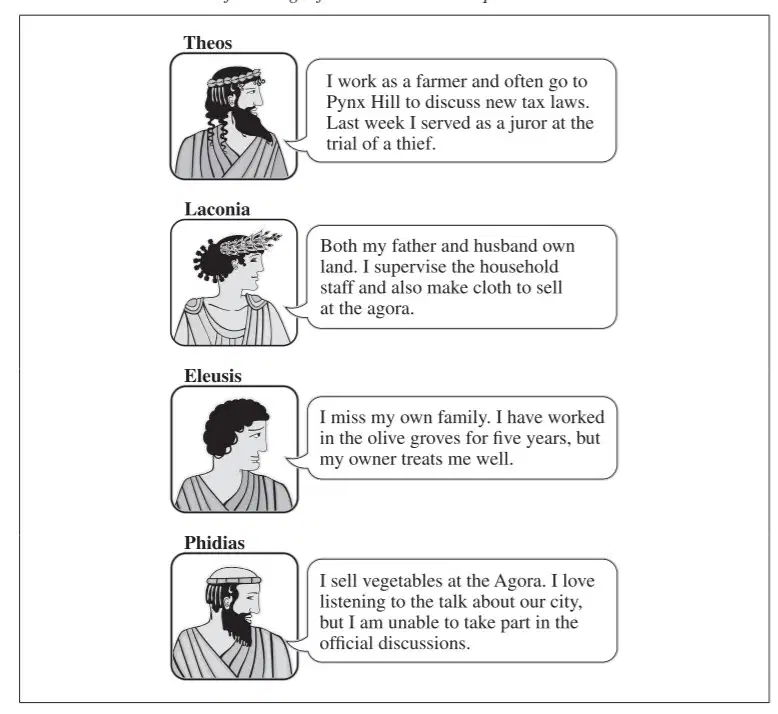
Which two speakers were most likely born outside of Athens?
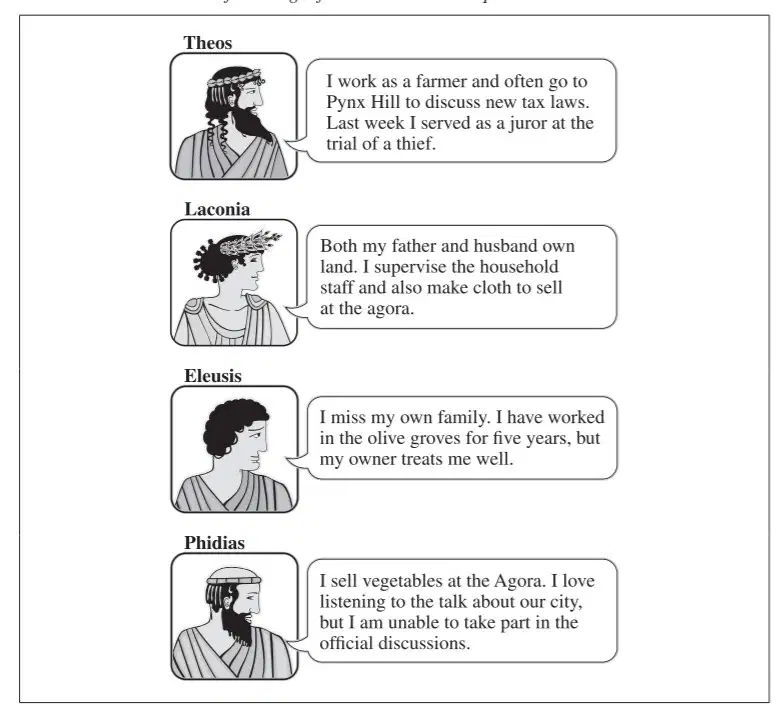
The speaker who is most likely a metic is:
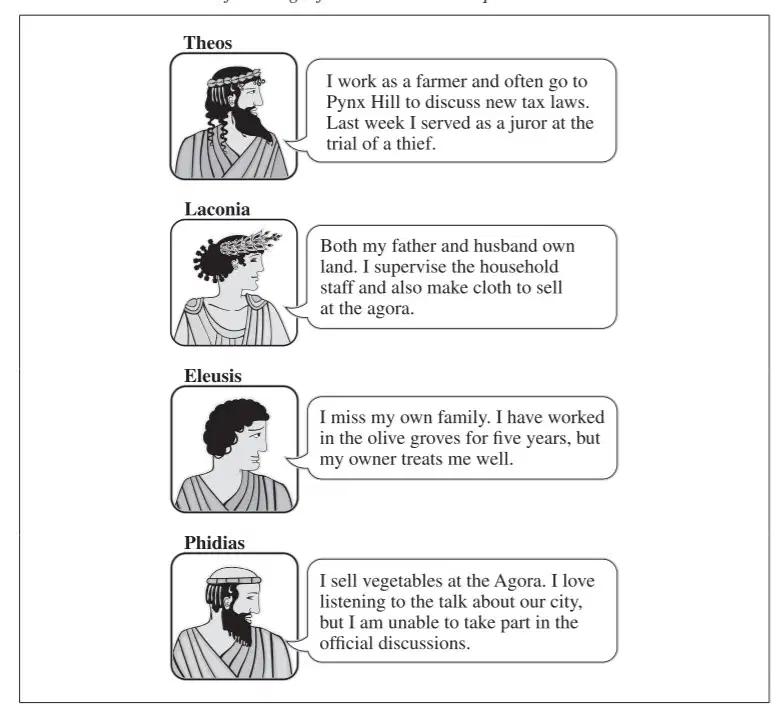
The speaker who had no rights in ancient Athenian democracy is:
If you were a male citizen who wanted to bring up an issue, you would speak at the:
If you were a female metic, you could have your opinions heard only if you:
Boys' education consisted of:
Direct Democracy is where:
People tell others what to do and only do what they want done
Everything happens in one town of the whole country
People vote directly to make decisions rather than having representatives elected to make decisions
The leader of the democracy directs everyone else to make decisions
When Athenians were drawn by lot (lottery) to discuss issues for a year, it was called:
Which of the following statements about Metics is TRUE?
The Assembly in ancient Athens was made up of:
How were people selected for jury duty in ancient Athens?
Which statement BEST describes the importance of the Agora?
Which of the following statements best describes direct democracy in ancient Athenian government?
Citizens debate and vote on every issue themselves in a…
Direct Democracy
Representative Democracy
Elected representatives create and vote on laws in a...
Direct Democracy
Representative Democracy
Canada is an example of a…
Direct Democracy
Representative Democracy
All students at IRIC voted to elect 1 stduent from each grade to pick an activity for sports day. This is an example of a.....
Direct Democracy
Representative Democracy
Every student will get to vote on the new mascot for the school. This is an example of a…
Direct Democracy
Representative Democracy
Students at an elementary school choose 2 students from the 3rd grade, 2 students from the 4th grade, and 2 students from the 5th grade to vote for a new playground design. This is an example of?
What does majority rule mean in a democracy?
Only individuals make decisions
Individuals have no rights
Only small groups of people rule the majority of the time
Decisions are made by the opinion of the majority of citizens
What is necessary for a democracy to work?
A single leader
No elections
Citizen participation
Restrictions on voting
Women could participate in Athenian democracy.
True
False
What was the name of the Athenian government body that all citizens could be apart of?
The Assembly
The Council
The Senate
The Jury
The council was made up of how many citizens?
250
300
1000
500

Select all that apply: Athenian Democracy was based on what 3 principles:
Citizenship
Citizen Participation
Power is inherited
Rule of Law
What is a metic?
- a person who lives in Athens but was not born there.
- can own land
- has a paying job
-cannot vote
- a person who was captured during war.
- is owned by a citizen or the city-state
- a person who cannot leave their house
- a person who can only do something if a man agree
- a person who is the leader of the Council of 500
- a person who can vote
What is a citizen?
- a man whose parents were born in Athens
- has served in the military for 2 years
- has to participate in government
- a woman whose parents were born in Athens
- has raised a family
- has to participate in government.
- a person who was captured during a war.
- a person who has no rights.
- a person who is the chairperson and magistrate
- who cannot vote
What is a slave?
- a person who was captured during a war.
- has no rights or freedoms
- a woman who has to stay inside her home unless a male family member takes her out.
- can own things but cannot sell them without a man's permission
- a person who is the leader of the market
- can participate in government
- a man whose parents were born in Athens
- has served in the military for 2 years
- can participate in government
In ancient Athens government what decided who could participate in making decisions?
How rich you were.
Your job
Your place in the class structure
Both your wealth and profession.
How did Athenians try to be fair?
Only rich citizens got the same chance of being picked for a job.
You could only be picked to be on the Council of 500 twice.
Both women and men could vote.
Everyone in Athens including men, women, metics and slaves could vote.
What is the same in Canadian (Alberta) democracy and ancient Athens?
People have slaves to do their work so that they could vote.
That you have to vote or you will be fined.
That you must be a citizen to vote.
That you can only vote if you are a rich person.
What is direct democracy?
Where every citizen gets to vote on every decision.
Where citizens vote for a representative to make decisions for them.
Where citizens vote for a King or Queen to lead the government.
Where citizens are not allowed to vote.
What is the Council of 500?
Every day government that would plan what the Assembly could discuss. Was made up of 500 citizens all over the age of 30.
The main government that all citizens attended to make all the important decisions.
The mini council only meet for emergencies.
The courts where the magistrate would listen to trials
How were citizens chosen to be on the Council of 500?
By lottery
By vote
By picking men and women randomly.
By voting for men and women.
What is a magistrate?
A person that was chosen by lottery to run the Athenian courts
A person that was chosen by lottery to run the Council of 500.
The meeting place of the Assembly was a flat open area.
A group of citizens who were the daily government and could suggest laws or changes
What was the Pnyx?
The meeting place of the Assembly that was a flat open area at the top of a hill.
The person in charge of running the Athenian Courts.
A mini council that was used for emergencies.
A person chosen by lottery to run Athens Council of 500.
What was the Executive Council?
A small group of citizens from the Council of 500 that made a mini council. Was only used for emergencies.
The main decision-making government that all male citizens needed to go to.
A group of citizens who were the daily government and could suggest laws or changes.
The market where people could meet and discuss issues.
Who was NOT allowed to participate in Ancient Athens government?
Aristocrats
slaves and women
men
priests
How was the council of 500 chosen?
Plaintiff.
Magistrate.
Lottery.
Klepsydra.
In order from lowest to highest name the athenian social classes?
Metics,slaves,citizens.
slave,metics,citizens.
citizens,slaves,spartans.
people,women,gods.
These were the children of parents who were born in Athens. Only males could participate in voting and governing the city after finishing his military service at age 20.
Metics
Slaves
Citizens
Canadians
These people were owned and had been taken prisoner when their city-state was attacked by the Athenians.
Metics
Citizens
Slaves
Canadians

