
Font size
 Worksheets
Ciuperci
Total questions: 30
Worksheet time: 15mins
Under certain unfavorable environmental conditions, yeasts enter a latent life form similar to bacteria. What is the specialized structure they form in this state called?
Chlamydospores
Conidia
Basidiospores
Zoospores
In multicellular fungi (molds), the vegetative apparatus (thallus) consists of long, branched filaments that collectively form the mycelium. What are these filaments called?
Hyphae
Rhizoids
Sporangia
Conidiophores
Which description best characterizes aseptate (non-septate) hyphae in multicellular fungi?
A single, highly branched giant cell with free cytoplasm and many nuclei
Elongated cells separated by transverse walls with pores
Short, unbranched cells with thick lignified walls
Cells containing chloroplasts for photosynthesis
Which feature is typical of septate hyphae in multicellular fungi?
Transverse walls with pores connecting cytoplasm between adjacent cells
A single continuous cytoplasm with no internal partitions
Presence of chloroplasts in each septum
Rigid walls made primarily of peptidoglycan
According to the text, which biochemical component chiefly contributes to the rigidity of the fungal cell wall?
Chitin
Cellulose
Lignin
Peptidoglycan
Fungi have an exclusively heterotrophic mode of nutrition and are equipped with hydrolytic enzymes. Which industrial process is highlighted as a principal enzymatic activity of fungi?
Fermentation of carbohydrates
Nitrogen fixation
Photosynthetic carbon assimilation
Calcium carbonate deposition
Which statement about fungal respiration is supported by the passage?
Fungi can respire both aerobically and anaerobically
Fungi rely exclusively on aerobic respiration
Fungi rely exclusively on anaerobic respiration
Fungi perform photosynthetic respiration
The passage classifies fungi into four groups based on their reproduction. Which set correctly lists these classes?
Phycomycetes, Ascomycetes, Basidiomycetes, Deuteromycetes
Zygomycetes, Oomycetes, Glomeromycetes, Microsporidia
Chytridiomycota, Mucorales, Agaricomycetes, Saccharomycetales
Euglenophyta, Chlorophyta, Rhodophyta, Phaeophyceae
In the classification of fungi, which criteria are explicitly mentioned: morphological structure, mode of life, or type of reproduction leading to four classes? Select all that apply.
Morphological structure: unicellular and multicellular
Mode of life: saprophytic and parasitic (strict and conditional)
Type of spore dispersal by wind
Type of reproduction leading to four classes
Habitat salinity tolerance
From the viewpoint of reproduction, which groups are listed as fungal classes? Select all that apply.
Phycomycetes
Ascomycetes
Basidiomycetes
Oomycetes
Deuteromycetes
The genus Saccharomyces belongs to which fungal class?
Ascomycetes
Basidiomycetes
Deuteromycetes
Zygomycetes
According to the text, Saccharomyces transforms sugars primarily by which process?
Alcoholic fermentation to ethanol and carbon dioxide
Lactic acid fermentation to lactic acid
Aerobic oxidation to acetic acid
Photosynthesis producing glucose and oxygen
Which species is the brewer’s and baker’s yeast widely used in the spirits, beer, and baking industries?
Saccharomyces cerevisiae
Saccharomyces ellipsoideus
Candida albicans
Mycoderma vini
Which species of Saccharomyces is used in vinification and can ferment up to approximately 18% alcohol?
Saccharomyces ellipsoideus
Saccharomyces cerevisiae
Candida albicans
Zygosaccharomyces rouxii
Which genus grows in sugar-rich media, carries out weak alcoholic fermentation, and can spoil jams, compotes, and syrups?
Zygosaccharomyces
Mycoderma
Candida
Saccharomyces
Which genus forms a surface film on alcoholic beverages (especially wines) and oxidizes ethanol to carbon dioxide and water, reducing the drink’s strength?
Mycoderma
Saccharomyces
Zygosaccharomyces
Candida
Which genus includes opportunistic pathogenic yeasts affecting humans and animals, with Candida albicans as the most important species?
Candida
Saccharomyces
Zygosaccharomyces
Mycoderma
In the provided micrograph of Candida albicans, what distinctive feature is evident?
Pseudomycelium
True septate hyphae
Bacterial endospores
Motile cilia
Candida (including Candida albicans) is placed in which fungal class in the text?
Deuteromycetes
Ascomycetes
Basidiomycetes
Phycomycetes
Asexual reproduction in the yeasts of the group Candida occurs by blastospores.
Budding
Blastospores
Binary fission
Zygospores
Under conditions of reduced resistance in animals, which factors favor excessive multiplication of Candida leading to candidiasis? Select all that apply.
Advanced age
Prolonged antibiotic or chemotherapy treatments
Balanced nutrition with adequate vitamins
Stress and intercurrent diseases
Severe disseminated candidiasis may produce metastases via the bloodstream. Which organs are specifically mentioned as sites of metastases? Select all that apply.
Kidneys
Heart
Nervous system
Bones
Which filamentous genus is highlighted among pluricellular molds and classified in Ascomycetes?
Aspergillus
Candida
Penicillium
Rhizopus
Within Aspergillus, which type of spore promotes easy spatial spread during asexual reproduction?
Endospores
Exospores (conidia)
Ascospores
Zygospores
Aspergillus niger is rich in enzymes and is used industrially. Which products or processes are associated with A. niger? Select all that apply.
Production of amylases
Production of citric acid
Production of aflatoxin
Production of penicillin
Aspergillus oryzae develops on starch-rich substrates and produces a light alcoholic fermentation. For what beverage is it traditionally used?
Sake
Kefir
Wine
Beer
Aspergillus flavus produces a strong toxin when growing on feed. Which statement is correct?
It produces aflatoxin, a hepatotoxic substance that can lead to liver cancer.
It produces penicillin, which inhibits bacterial growth.
It produces citric acid used as a food additive.
It produces ethanol for alcoholic beverages.
Aspergillus fumigatus commonly affects the respiratory system. Which environments or materials are typical sources of exposure mentioned for this species? Select all that apply.
Cereals and hay
Dry fodder and dust
Fresh fruit
Moldy bedding in animal housing
In humans, Aspergillus fumigatus most often presents with pulmonary localization, especially among which workers?
Office administrators
Agricultural and animal-care workers
Fishermen
Construction architects
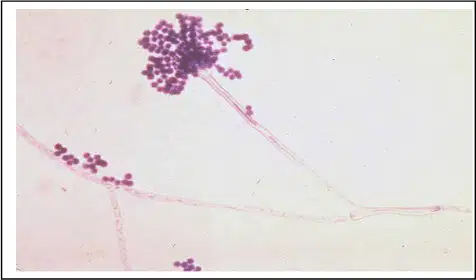
Identify the genus depicted in the micrograph labeled “Figure 27,” which shows microscopic aspects of pluricellular molds with conidial structures.
Aspergillus
Candida
Mucor
Saccharomyces

