
NEW
Font size
 Worksheets
Page 1
Total questions: 29
Worksheet time: 15mins
Place the components in order, from smallest to largest: Chromosome; DNA nucleotide; Codon; Gene.
1-2-4-3
2-3-4-1
3-4-2-1
4-3-2-1
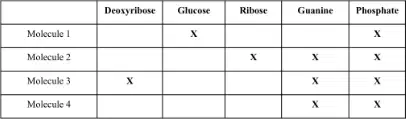
A scientist is purifying DNA from a bacterium. During the purification process, a preparation is obtained that contains only four molecules. Some components of these molecules are listed in the table. Which of the four molecules is the DNA, based on the table to the LEFT?
molecule 1
molecule 2
molecule 3
molecule 4
The main difference between the four nucleotides that make up DNA is that they have different
sugars
uracil
bonds
bases
In humans, where does DNA replication take place?
cytoplasm
nucleus
ribosome
vacuole
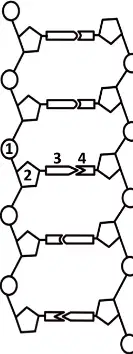
Based on the diagram shown to the LEFT and on your knowledge of biology, structures 3 and 4 are held together by
weak peptide bonds
strong hydrogen bonds
weak hydrogen bonds
strong peptide bonds
Inherited traits are passed down from our parents to us, their offspring, by the information that is coded in our parents'
RNA
phospholipids
chromosomes
blood
A portion of this DNA, known as a ________, is responsible for the inheritance of a trait, like eye color or blood type in humans.
allele
chromosome
gene
nucleotide
The cellular process of creating two new DNA molecules from one original copy is called replication. Which statement is the best description of this process?
DNA opens up and RNA copies it.
DNA opens up and completely unwinds to make two new molecules.
DNA opens up and each strand is used as a template for a new strand.
RNA opens up the DNA and uses each strand as a template for a new strand.
Before a cell can divide, it must copy its DNA one _________ at a time in a process called DNA replication.
base
sugar
nucleotide
gene
Which of the following statements about the leading strand is true?
It is synthesized discontinuously and uses 1 RNA primer.
It is synthesized discontinuously and uses multiple RNA primers.
It is synthesized continuously and uses multiple RNA primers.
It is synthesized continuously and uses 1 RNA primer.
Label a nucleotide.
phosphate, sugar, and nitrogenous base
two phosphates and a nitrogenous base
sugar and nitrogenous base only
phosphate and sugar only
Which of the following correctly compares and contrasts DNA and RNA?
DNA contains deoxyribose and thymine and is typically double-stranded; RNA contains ribose and uracil and is typically single-stranded.
DNA contains ribose and uracil and is typically single-stranded; RNA contains deoxyribose and thymine and is typically double-stranded.
DNA and RNA both contain uracil and are typically single-stranded.
DNA and RNA both contain thymine and are typically double-stranded.
Which of the following is the correct replication of the DNA strand ATT-CCG-GCA-TGC-CTA?
TAA-GGC-CGT-ACG-GAT
AUA-CCG-GCA-UGC-CUA
TTA-CGG-CGA-TCG-CTT
ATA-GCC-GCT-AGC-CTC
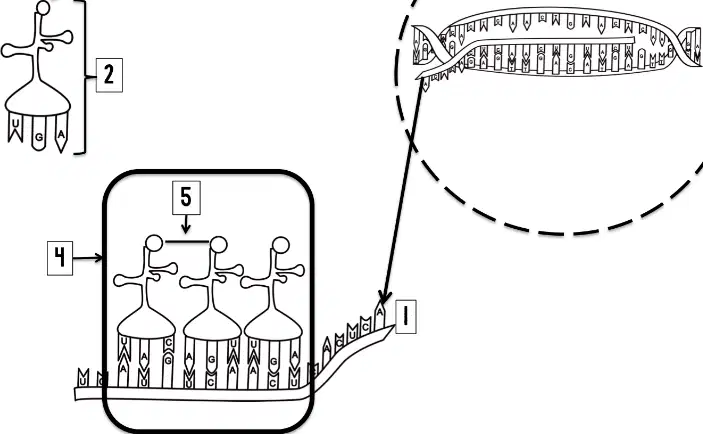
Base your answers to the following questions on the diagram of an important cellular process that shows a DNA segment in the nucleus connected to a ribosome where a labeled strand (1) runs through the ribosome, transfer molecules (2) bring amino acids (3), a growing chain (5) forms, and another label (4) marks a region beside the ribosome. What is an example of a molecule produced by the process shown above?
glucose
glycogen
a fatty acid
a protein
Which statement below BEST summarizes the role of the DNA molecule in cells?
guides cell division
protects cells from infection
provides the instructions for making proteins
regulates the chemical processes that provide the cell with energy
During transcription, what does mRNA do?
It delivers DNA's instructions for making proteins.
It constructs proteins out of random amino acids.
It strings together two complementary RNA strands.
It strings together two complementary DNA strands.
Which is an accurate description of the processes used to turn the DNA code of a gene into a protein?
Transfer RNA molecules carry the messenger RNA to the ribosome.
Ribosomes go into the nucleus to read off the genes in the DNA.
It takes one DNA base to code for three amino acids in a protein.
Transfer RNA delivers specific amino acids to the ribosome, matching messenger RNA codons.
The sequence of in a DNA molecule determines the protein that will be produced.
lipids
nucleotides
proteins
sugars
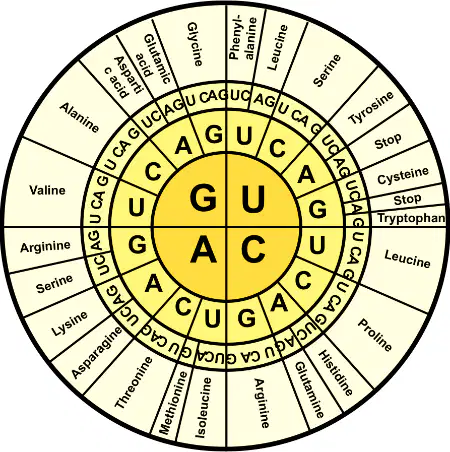
Transcribe and translate the sequence to form a protein: ATATACTTTGCGATGGCTATTCAGACT. Using the genetic code chart, which amino acid sequence begins at the first start codon and proceeds without a stop codon?
Met–Ala–Ile–Gln–Thr
Met–Gly–Tyr–Ser–Asp
Met–Arg–Leu–Glu–Val
Met–Ala–Leu–Gln–Thr
Two similar chromosomes that you inherit from your parents (one from your mother and one from your father) are called
sister chromatids
homologous chromosomes
autosomes
sex chromosomes
Which event takes place during anaphase II of meiosis?
nuclear membrane breaks down
sister chromatids separate
homologous chromosome pairs separate
cytoplasm divides
Which cells are NOT formed during meiosis?
Somatic cells
Gametes
Sex cells
Sperm cells
A gamete (sperm or egg) cell of an alligator has 16 chromosomes. What is the total number of chromosomes that should be present in a stomach cell of the same alligator?
8
16
32
48
Compared to the number of chromosomes contained in a body cell, how many chromosomes would normally be contained in a gamete?
the same number
twice as many
one-fourth as many
half as many
Both male and female gametes are created during the process of meiosis. The formation of male gametes or sperm is called spermatogenesis. After telophase II of spermatogenesis, there would be ____ male gametes created that are all genetically _____.
2; identical
2; different
4; identical
4; different/unique
In which phase of meiosis would certain gene segments of the homologous pairs of chromosomes "crossover" and exchange genetic information?
Prophase I
Metaphase I
Anaphase I
Telophase I
Somatic cells in humans contain ____ chromosomes and an example is ______
30; skin cells
23; heart cells
46; liver cells
46; sperm cells
Which event takes place during metaphase I of meiosis?
nuclear membrane breaks down
sister chromatids line up in middle of cell
cytoplasm divides
homologous chromosome pairs line up in middle of cell
Which does not contribute to genetic variation?
mitosis
crossing over
meiosis
random mating

