
 Worksheets
Page 1
Total questions: 150
Worksheet time: 1hrs 15mins
Which statement best describes the relationship of the Earth, Moon, and Sun?
The moon orbits Earth, Earth orbits the sun
The sun orbits Earth, Earth orbits the moon
Earth and sun both orbit the moon
The moon and sun both orbit Earth
What causes the day-and-night cycle on Earth?
The sun’s movement across the sky
The moon’s rotation every 24 hours
Earth’s revolution around the sun
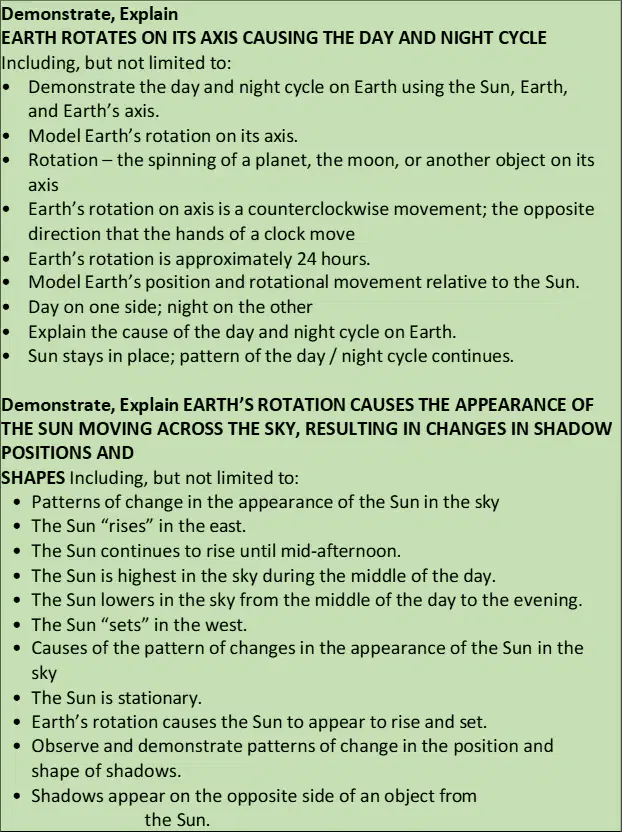
Earth’s rotation once every 24 hours
People often think the sun moves across the sky each day. What actually causes this apparent movement?
The sun spinning faster than Earth
The moon pulling the sun
Earth rotating on its axis
Earth orbiting farther from the sun
Which shape best describes Earth, the sun, and the moon?
Cylinders with flat ends
Irregular jagged polyhedra
Perfectly flat circular disks
Approximately spherical objects
How long does it take Earth to complete one rotation on its axis?
Approximately 24 hours
Approximately 12 hours
Approximately 365 days
Approximately 30 days
Why do we experience seasons on Earth?
Because Earth’s axis is tilted
Because the moon blocks sunlight
Because the sun changes size yearly
Because Earth speeds up each summer
Which statement would Grade 6 students most likely study next based on this unit plan?
Properties and movements of planets and comets
Weather patterns over one week
Only how plants grow in sunlight
History of ancient astronomers
If Earth stopped rotating but kept orbiting the sun, which change would be most immediate for people on Earth?
Day and night would no longer cycle
Sun would become spherical
Seasons would occur more often
Moon would stop orbiting Earth
Which idea is part of disciplinary literacy in science as shown in the unit plan icons?
Ignoring models during lessons
Memorizing every planet’s color
Avoiding communication of results
Analyzing and interpreting data
Which statement is supported by the unit narrative goals for 5th grade?
Students record observations and discuss data
Students believe sun orbits Earth daily
Students avoid comparing Earth’s motion
Students learn stars are flat objects
Which statement best describes Earth’s rotation and its effect?
Earth rotates once about every 24 hours causing day and night
Earth revolves once a day creating phases of the Moon
Earth spins weekly making seasons change every seven days
Earth rotates monthly leading to solar eclipses each month
What pattern can be predicted by collecting and analyzing data across seasons?
Instant changes in Earth’s orbit
Weekly positions of distant stars
Daily phases of the Moon
Changes in temperature and daylight length
Which tool is best for measuring temperature during an investigation?
Ruler for counting centimeters
Hand lens for viewing planets
Thermometer for measuring heat levels
Timer for weighing materials
What is a safe practice during classroom investigations?
Taste chemicals to identify materials
Ignore instructions when using glassware
Run in the lab to finish quickly
Use approved safety equipment and procedures
Which model use shows understanding of limitations?
Expect models to predict every error perfectly
Ignore scale when comparing model planets
Assume models are exact copies of real objects
Recognize that models simplify size, scale, or properties
What is the best way to represent collected measurements for patterns?
Use tables, graphs, maps, charts, and diagrams
Write only a paragraph description
Keep data only in memory
Share results without organization
Which calculation helps compare patterns and relationships in data?
Change numbers to fit expectations
Estimate without any numbers
Use mathematical calculations for comparisons
Avoid math to reduce mistakes
What pattern of the Moon can students identify from observations?
Constant full Moon every night
Random shapes with no regular sequence
Order of the planets in the solar system
Predictable changes in the Moon’s appearance
Which action shows using scientific practices to design solutions?
Ignore data collected from trials
Avoid evidence when choosing designs
Skip testing and guess outcomes
Plan and conduct simple experiments
How can cause-and-effect relationships be investigated in science?
Avoid measuring to save time
Assume effects without experiments or evidence
Identify variables and test how changes affect results
Choose outcomes first and fit data later
Which motion of Earth causes the day and night cycle?
Earth rotating on its axis every 24 hours
Earth orbiting the Sun once yearly
Earth wobbling due to ocean tides
Earth tilting toward the Sun seasonally
What is one observable effect of Earth’s rotation on its axis?
Changing distance between Earth and the Sun
Formation of mountains over millions of years
Apparent movement of the Sun across the sky
Creation of ocean basins by plate motion
Why do shadows change position and shape during the day?
Earth rotates causing changing Sun angles
The Sun moves closer and farther quickly
Clouds permanently fix light direction
The Moon blocks sunlight continuously
What is the main cause of Earth’s seasons?
Changing energy of the Sun each day
Daily rotation of Earth on its axis
Moon’s gravity pulling on oceans
Earth’s tilted axis during revolution
Which statement best describes weather and climate?
Weather and climate are the same thing
Weather is short-term, climate is long-term
Climate changes every hour like weather
Weather never changes while climate does
Students collect and analyze data to predict changes in temperature and daylight length. Which concept are they studying?
Seasonal patterns over months
Permanent climate at one location
Daily rotation of galaxies
Instant cooling by eclipses
Which body is the major source of energy in the Earth system mentioned in the material?
The Moon provides most energy
The Sun provides most energy
Earth’s core provides most energy
Ocean tides provide most energy
What causes spring and neap ocean tides?
Positions of Earth, Sun, and Moon
Rotation of Earth every 24 hours
Mountains blocking seawater flow
Wind patterns over the oceans
Grade 5 students model the orbits of Earth and Moon around the Sun. What pattern should they recognize from Earth?
Stars orbiting around the Moon daily
The Sun rising only once a year
Oceans freezing every full Moon
The Moon’s changing appearance phases
Which investigation practice is highlighted in the process standards?
Dismiss patterns found in evidence
Share conclusions without any analysis
Avoid collecting data to save time
Ask questions and plan safe investigations
Which direction do shadows point relative to the Sun’s position in the sky?
Same direction as the Sun’s light
Opposite direction from the Sun’s position
Random direction changing every minute
Directly toward the Sun’s center
How long does one full rotation of Earth take?
About 24 hours total
About 12 hours total
About 365 days total
About 30 days total
What causes day and night on Earth?
Earth’s revolution around the Sun
Earth’s rotation on its axis
Sun moving across the sky
Moon blocking sunlight daily
Which statement about the Moon’s light is correct?
Moon glows only during night
Moon reflects sunlight toward Earth
Moon produces its own light
Moon shines only during full phases
When observing a waxing Moon from Earth, which side appears illuminated?
Right side appears brighter
Left side appears brighter
Both sides equally bright
No side appears illuminated
Which process describes Earth going around the Sun?
Precession of the poles
Reflection of sunlight
Rotation of Earth’s axis
Revolution in an orbit
Which planet order starts correctly from the Sun?
Mercury, Earth, Venus, Mars
Venus, Mercury, Earth, Mars
Mercury, Venus, Earth, Mars
Earth, Venus, Mercury, Mars
Which misconception is incorrect about the solar system’s layout?
Planets orbit the Sun
Sun is near system center
Planets are stationary in space
Planets move in elliptical paths
What is the relationship between Earth’s revolution and the seasons?
Seasons caused by Sun’s motion
Seasons caused by Earth’s revolution
Seasons caused by Earth’s rotation
Seasons caused by Moon’s phases
When sequencing pictures of Moon phases, what approach avoids a common mistake?
Always start with random phase
Start with a clear known phase
Ignore left and right lighting
Assume phases are linear
Which motion of Earth causes the cycle of day and night to repeat about every 24 hours?
Earth rotating on its axis
Earth orbiting around the Sun
Moon orbiting around Earth
Sun rotating around the galaxy
Which pair of terms should be used consistently to describe Earth’s motions?
Tilt and glow
Spin and shine
Rotate and orbit
Drift and pulse
What classroom model best represents Earth’s rotation and revolution?
Sun spinning monthly, Earth tilting hourly
Earth orbiting daily, Earth spinning yearly
Earth spinning daily, Earth orbiting yearly
Moon spinning yearly, Sun orbiting daily
If shadows change length and direction during the day, what is the most likely cause?
Earth’s rotation on its axis
Moon’s phases each month
Earth’s revolution each year
Sun’s distance changing daily
Students notice longer daylight in summer than in winter. What pattern are they observing?
Random weather variations
Daily changes in Moon illumination
Galaxy movement effects
Seasonal changes in daylight length
Which observation helps place Earth’s position in its orbit during a season?
Daylight length and temperature patterns
Weekly rainfall totals
Daily lunch schedules
Nighttime streetlight timing
Which statement about the Moon’s appearance over a month is accurate?
Moon stops moving for several nights
Illumination changes randomly without pattern
Illumination increases and decreases in a cycle
Moon’s size physically grows and shrinks
When students create a sun dial, what are they practicing?
Tracking stars with telescopes
Testing plant growth with soil
Measuring rainfall with cups
Predicting time from Sun position
Which activity best supports identifying the recurring theme and concept of patterns in these standards?
Recording, analyzing, and predicting changes
Memorizing a list of planet names
Drawing animals from memory
Counting desks in the classroom
How can students build evidence about Moon phase patterns across a month?
Observe, record, and compare nightly images
Predict phases without any data
Assume phases based on a single photo
Ignore cloudy nights and skip notes
Which planet is closest to the Sun in our solar system?
Mars
Earth
Venus
Mercury
What is the correct order of the first four planets from the Sun?
Mars, Earth, Venus, Mercury
Earth, Mars, Mercury, Venus
Venus, Mercury, Earth, Mars
Mercury, Venus, Earth, Mars
Which planet comes after Jupiter when listing planets outward from the Sun?
Saturn
Uranus
Neptune
Mars
Which planet is farthest from the Sun among the listed planets?
Neptune
Jupiter
Saturn
Uranus
A mnemonic helps students remember information. Which phrase could help remember planet order?
Never Eat Soggy Waffles For Directions
Please Excuse My Dear Aunt Sally
Every Good Boy Deserves Fudge In Music
My Very Excellent Mother Just Served Us Nachos
Why might students build models of the solar system during science lessons?
To avoid using visuals in science
To explore benefits and limits of models
To replace the real solar system entirely
To memorize star names beyond the Sun
Which activity varies stimuli so students see a variety of visuals?
Showing diagrams, photos, and animations
Reading only long textbook chapters
Listening to a single lecture every day
Taking tests without any pictures
Students are not asked to learn the names of what, according to the note?
Moon phases
Dwarf planets
Constellations
Comets
What should students use to communicate positions of planets relative to the Sun?
Only memorized poems
Only mental math
Visuals or models
Only lengthy essays
Which pair of neighboring planets is in the correct order moving outward from the Sun?
Neptune then Uranus
Saturn then Jupiter
Mars then Earth
Uranus then Neptune
Which tool setup helps model day and night for the Earth–Moon system?
Globe with lamp nearby
Balance scale with weights
Magnet with iron filings
Microscope with slide
What is the main purpose of planning and carrying out investigations?
Replace observations
Find predictable patterns
Copy others’ results
Avoid collecting data
Which statement best describes analyzing and interpreting data?
Guessing based on opinions
Organizing observations to see trends
Picking only favorite results
Ignoring measurements collected
Evidence from investigations is used to do what?
Construct explanations of motions
Replace Earth’s rotation
Delete all recorded notes
Make tools spin faster
Using mathematics and computational thinking includes which action?
Measure and compare daylight time
Color pictures of the Moon
Write stories about seasons
Name constellations from memory
Communicating scientific explanations may involve what?
Secret answers with no sharing
Silent guessing without notes
Labeled diagrams and group discussion
Only personal stories without data
Connecting science, engineering, and society can include linking investigations to which application?
Board game rules
Cooking recipes only
Art museum tours
Satellite data uses
Which recurring theme focuses on cycles like seasons and Moon phases?
Patterns in predictable cycles
Random changes with no cause
Instant events without motion
Unrelated facts with no links
Cause and effect in Earth and Moon motions leads to what?
Observable changes
Invisible fantasies
Permanent stillness
Endless randomness
Which classroom activity best fits developing and using models?
Drawing only abstract shapes
Typing unrelated essays
Silent reading without models
Foam balls showing Moon phases
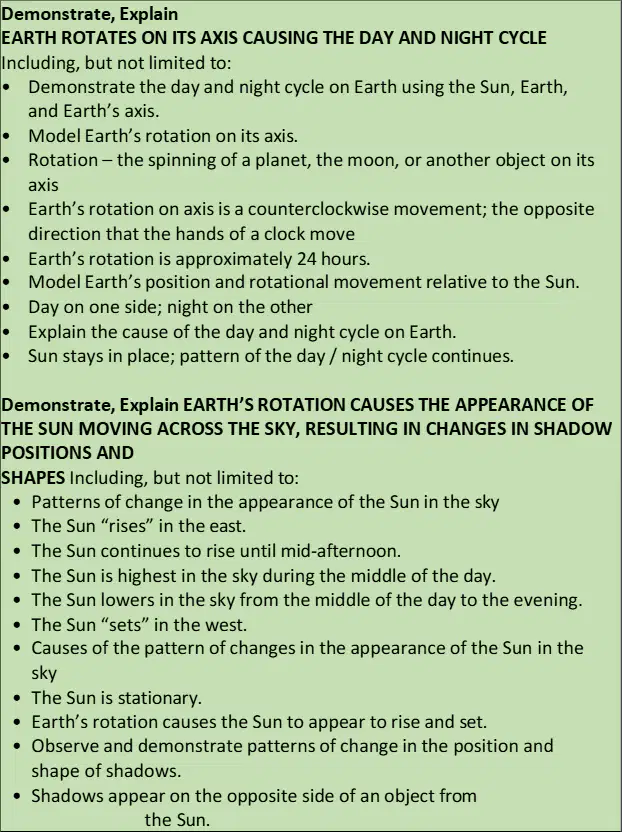
What causes the day and night cycle on Earth?
Earth orbiting the Sun once each year
Earth rotating on its axis once each day
The Moon blocking sunlight each evening
The Sun moving around Earth each day
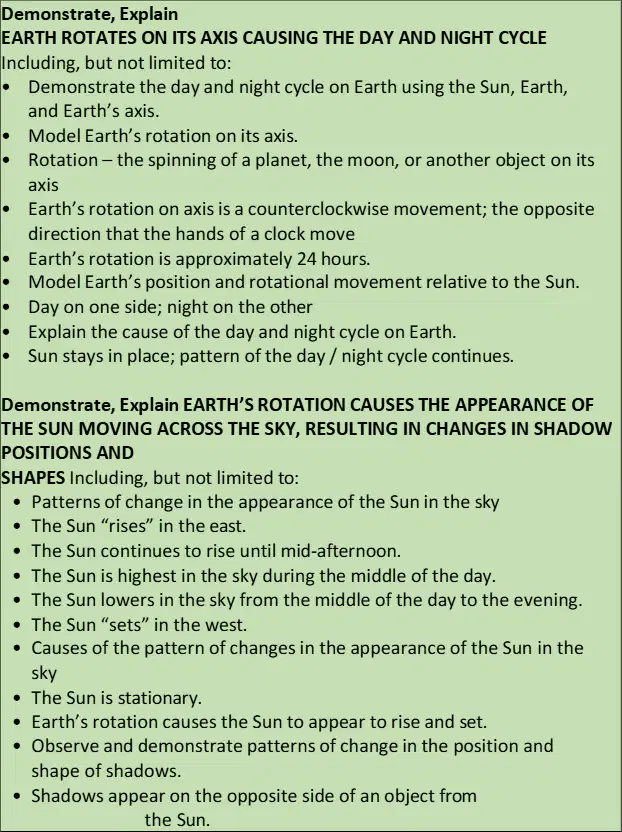
About how long does one full rotation of Earth on its axis take?
Approximately 12 hours
Approximately 365 hours
Approximately 48 hours
Approximately 24 hours
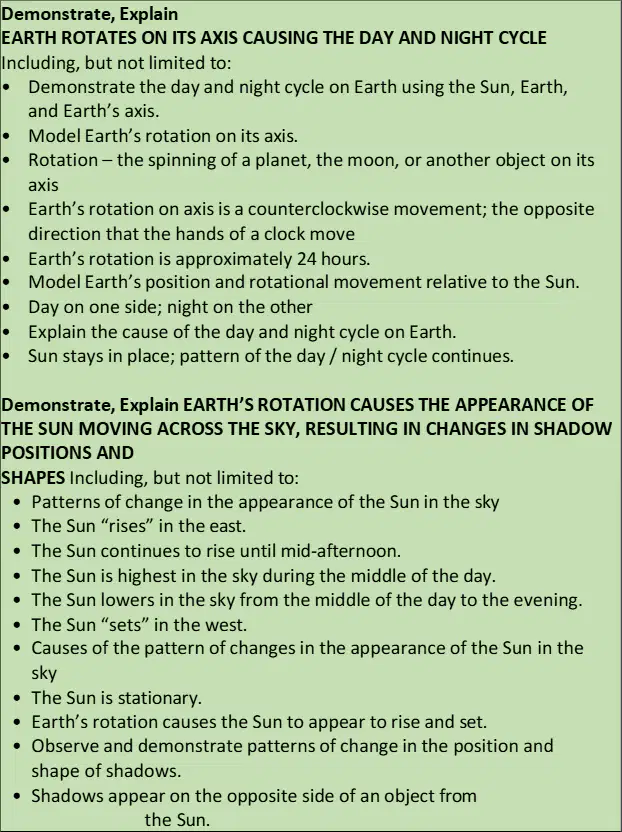
In which general direction does the Sun appear to rise and set?
Rises in the north, sets in the south
Rises in the west, sets in the east
Rises in the east, sets in the west
Rises overhead, sets underground
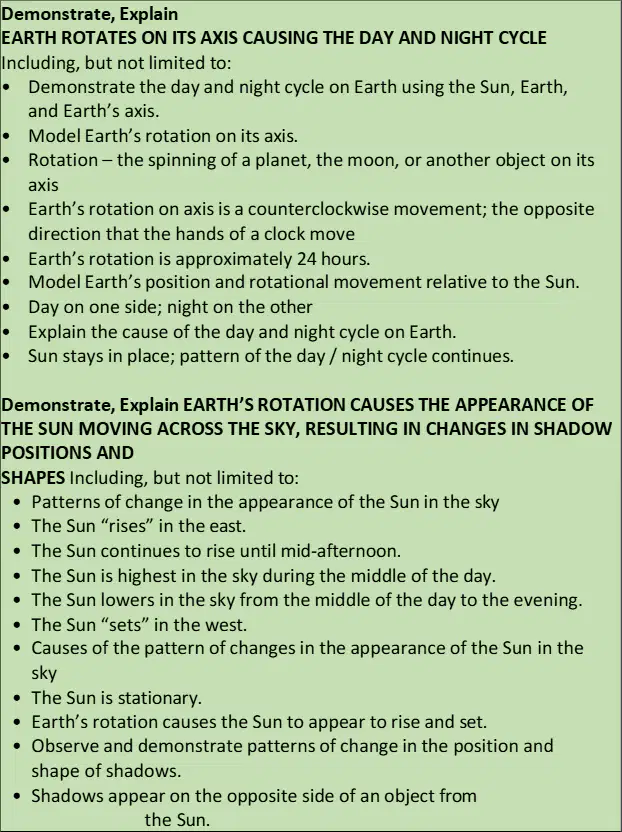
Why does the Sun appear to move across the sky during the day?
The Sun changes speed every hour
Earth rotates on its axis
Clouds drag the Sun along
The Moon pushes the Sun across
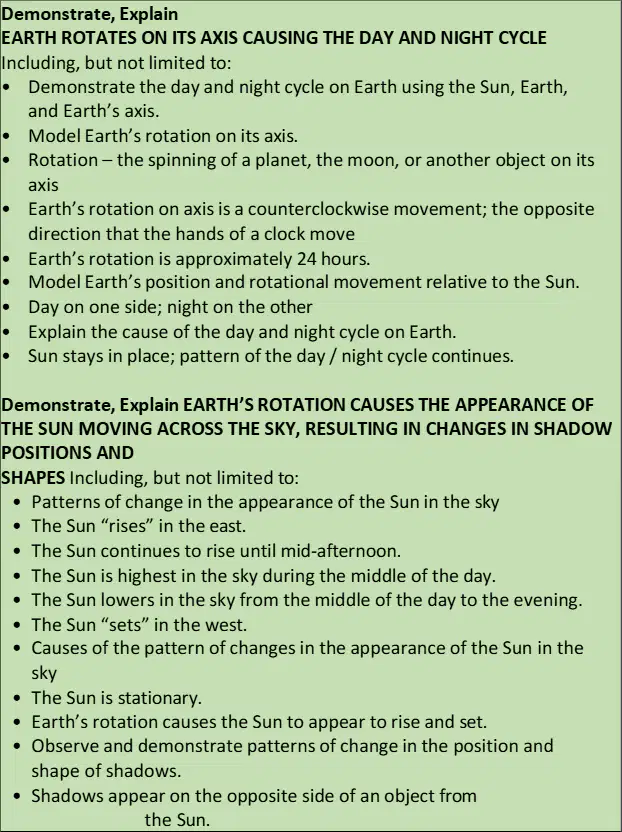
At what time of day is the Sun generally highest in the sky?
Near midnight
Late afternoon
Around midday
Early morning
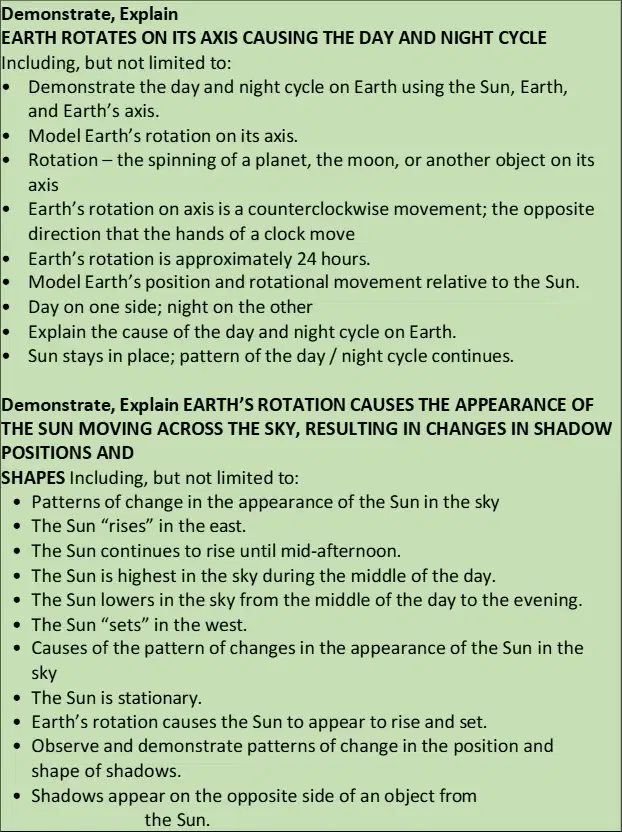
How do shadow lengths typically change from morning to midday to evening?
Long, shorter, long again
Shortest at sunrise, longest at noon
Short, longer, shortest
Constant length all day
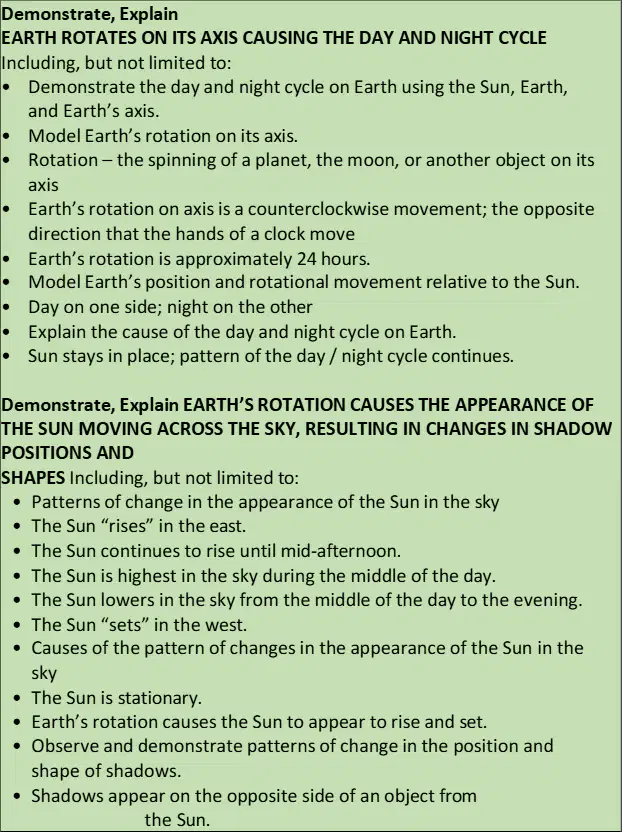
Which statement best describes Earth’s rotation direction when viewed from above the North Pole?
No rotation in polar regions
Counterclockwise opposite the clock
Clockwise like a clock’s hands
Alternates clockwise each season
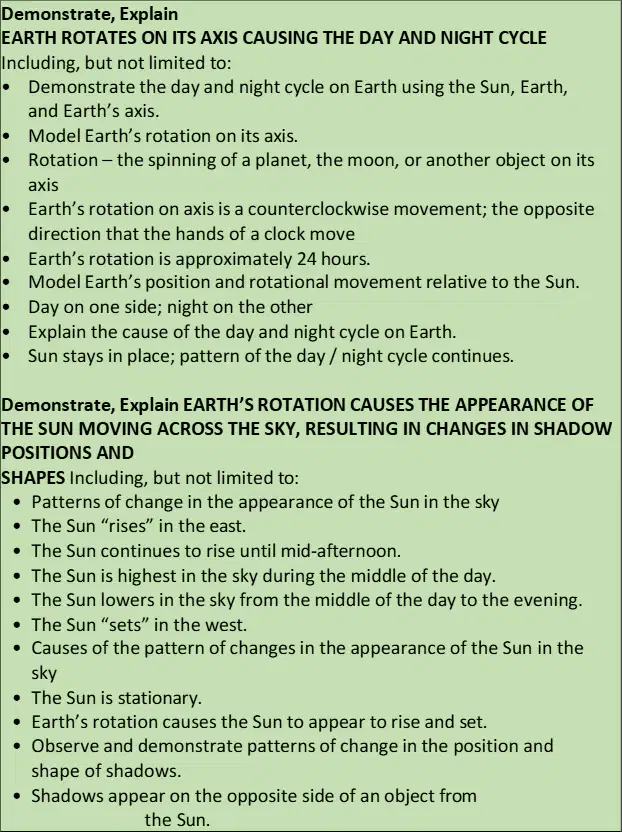
If a model shows the Sun stationary and Earth spinning, what pattern would you expect for daylight at a location on Earth?
Random daylight at unexpected times
Nighttime lasting longer than a week
Regular cycle of day followed by night
Constant daylight without any night

A student observes her shadow at three times: sunrise, noon, and sunset. Which observation best matches typical shadow changes?
Shortest at sunrise, longest at noon
Same length morning, noon, evening
No shadow at sunrise or sunset
Longest at sunrise, shortest at noon
Which concept explains why stars and planets seem to move across our night sky once each day?
The Moon pulling stars across the sky
Earth’s axis tilt changing monthly
The Sun orbiting Earth every day
Earth’s rotation causing apparent motion
Which sequence correctly orders the seasons in a typical year for many temperate regions?
summer → fall → winter → spring
spring → summer → fall → winter
fall → winter → spring → summer
winter → spring → summer → fall
During which part of the year are daylight hours generally the longest?
in winter months
around early spring
near late autumn
during summer months
What main factor causes changes in the amount of daylight during the year?
Clouds blocking sunlight
Earth’s spinning once a day
Earth’s tilt on its axis
Moon’s phases each month
From winter to summer, how do average temperatures usually change?
increase then stop
quickly drop
gradually increase
stay about the same
Which statement best describes daylight from summer to winter?
daylight steadily increases
daylight stays constant
daylight generally decreases
daylight changes randomly
Which pair is most likely to have the earliest sunrise time in a year?
early spring days
late autumn days
mid-summer days
mid-winter days
A student lists monthly high temperatures. Which simple analysis helps compare heat across months?
ordering months coldest to warmest
averaging weekly rainfall
counting cloudy days each month
measuring wind speed daily
If students chart daily sunrise and sunset, what can they calculate from those times?
direction of wind
strength of sunlight
amount of daylight hours
Moon phase length
Which season generally has the shortest average daylight hours?
spring season
summer season
fall season
winter season
Shadows change length through the year. Which explanation fits this pattern?
The Moon blocks sunlight more often
Mountains reflect extra sunshine
Earth tilts away or toward the Sun
Clouds increase during rainy seasons
Which phase is when the Moon appears unilluminated or barely visible from Earth?
Waning Crescent phase thin light
First Quarter phase with half lit
New Moon phase with no visible light
Full Moon phase fully illuminated
After a New Moon, what is the next phase that shows a small crescent of light?
Waning Gibbous with shrinking light
Waxing Crescent with growing light
Last Quarter with half illuminated
Full Moon with complete circle
During the Moon’s cycle, when does it appear as a complete circle of light?
First Quarter half illuminated
Waning Crescent small arc
Full Moon fully illuminated
New Moon not illuminated
Which statement best describes the pattern of the Moon’s illumination over time?
Only increases and never decreases
Repeating cycle about every 30 days
Random changes without repeating
Changes once each year only
Which sequence shows the general order of phases across one cycle?
New Moon → Last Quarter → First Quarter
Full Moon → New Moon → Full Moon
Waxing Crescent → New Moon → Full Moon
New Moon → Full Moon → New Moon
If tonight is a Full Moon, what can be predicted about the illumination in about 15 days?
It will be waxing with increasing light
It will be at First Quarter illumination
It will have no visible illumination
It will be fully illuminated again
Which phase shows the Moon half illuminated and occurs before the Full Moon during waxing?
Waning Gibbous mostly lit
New Moon not illuminated
First Quarter half illuminated
Last Quarter half illuminated
What happens to the illuminated portion of the Moon after the Full Moon?
Illumination continues increasing
Illumination disappears instantly
Illumination begins decreasing
Illumination stays the same
Which observation would best help identify the Moon’s phase on a given night?
Record the illuminated portion
Note the time of sunset
Measure the Moon’s temperature
Count visible stars nearby
Students tracked the Moon for 32 nights and saw a repeating pattern. What conclusion fits their data?
The cycle repeats every year
The Moon cycle is predictable
The phases change randomly
The phases stop after winter
Which planet is closest to the Sun in our solar system?
Mars is the closest to the Sun
Earth is the closest to the Sun
Mercury is the closest to the Sun
Venus is the closest to the Sun
What is the correct order of the first four planets starting from the Sun?
Mercury, Venus, Earth, Mars
Venus, Mercury, Earth, Mars
Earth, Mars, Venus, Mercury
Mars, Earth, Venus, Mercury
Which pair lists two gas giants in the outer solar system?
Uranus and Mercury are gas giants
Jupiter and Saturn are gas giants
Mercury and Venus are gas giants
Earth and Mars are gas giants
Which statement best describes the solar system?
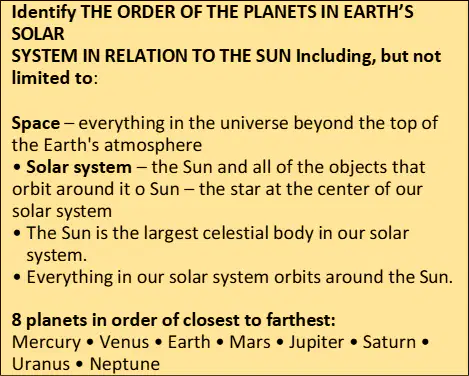
The Sun and objects orbiting it
Only planets without moons
Everything inside Earth’s atmosphere
Only stars beyond Earth
Which planet comes after Saturn when moving away from the Sun?
Jupiter comes after Saturn
Mars comes after Saturn
Uranus comes after Saturn
Neptune comes after Saturn
Which planet is farthest from the Sun?
Saturn is farthest from the Sun
Jupiter is farthest from the Sun
Neptune is farthest from the Sun
Uranus is farthest from the Sun
What is the Sun’s role in our solar system?
Comet passing by the planets
Moon that lights the planets
Star at the center of system
Largest planet orbiting Earth
Which sequence correctly lists all eight planets from closest to farthest?
Mercury, Venus, Earth, Mars, Jupiter, Saturn, Uranus, Neptune
Venus, Mercury, Earth, Mars, Saturn, Jupiter, Neptune, Uranus
Mercury, Earth, Venus, Mars, Jupiter, Uranus, Saturn, Neptune
Mercury, Venus, Mars, Earth, Jupiter, Saturn, Neptune, Uranus
Which idea explains why planets move around the Sun?
They orbit around the Sun
They float without moving
They spin around Earth instead
They follow the Moon’s path
Which statement compares inner and outer planets correctly?
Inner planets are Mercury through Mars
Outer planets include Mercury and Venus
Inner planets include Jupiter and Saturn
Outer planets are Earth through Mars
Which lesson introduces the Solar System in Unit 6?
Lesson 1 introduction topic
Lesson 3 introduction topic
Lesson 6 introduction topic
Lesson 7 introduction topic
What is the focus of Lesson 2 in Unit 6?
Planet characteristics and limitations
Earth’s rotation and day/night
Moon phases and changes
Shadows and light sources
Which lesson connects Earth’s rotation to day and night?
Lesson 3 rotation day night
Lesson 5 rotation day night
Lesson 4 rotation day night
Lesson 6 rotation day night
Which lesson introduces Earth’s revolution?
Lesson 4 revolution concept
Lesson 2 revolution concept
Lesson 6 revolution concept
Lesson 7 revolution concept
What is practiced in Lesson 5 of Unit 6?
Shadow investigation task
Rotation and revolution model
Solar system overview model
Moon phase observation
Which lesson explores shadows?
Lesson 4 shadows topic
Lesson 6 shadows topic
Lesson 7 shadows topic
Lesson 5 shadows topic
In Unit 6, which lesson covers Moon phases?
Flex day moon phases
Lesson 7 moon phases
Lesson 3 moon phases
Lesson 1 moon phases
What is the purpose of the Flex day in Unit 6?
Flex and review day
Field trip planning
Assessment and grading
Guest speaker session
Where is the Unit Exam administered?
Unit exam in Edcite
Unit exam in class
Unit exam at home
Unit exam on paper
Which TEKS are linked to Lesson 1?
TEKS 3.9B and 5.9A
TEKS 5.9A and 4.9B
TEKS 4.9A and 5.9B
TEKS 3.9A and 4.9A
Which object is at the center of our solar system?
The Moon
Earth
The Sun
Jupiter
How many planets orbit the Sun in our solar system?
Nine planets
Eight planets
Seven planets
Six planets
Which group are the inner planets?
Saturn to Uranus
Pluto and Ceres
Jupiter to Neptune
Mercury to Mars
Which description best matches the inner planets?
Rocky and smaller
Very far from Sun
Mostly rings and moons
Gas giants and icy
Which description best matches the outer planets?
Rocky and small
Gas giants and large
Closest to the Sun
No moons at all
What keeps planets in consistent orbits around the Sun?
Gravity pulls
Rings guide
Light heats
Solar wind pushes

Which statement about models of the solar system is accurate?
Models show perfect sizes
Models always exact distances
Models include all asteroids
Models show relative order
Which planet order from closest to farthest is correct?
Earth, Venus, Mercury, Mars
Mercury, Venus, Earth, Mars
Mars, Earth, Venus, Mercury
Venus, Mercury, Earth, Mars
Why do teachers use songs or acronyms like 'My Very Excellent Mother Just Served Us Nachos'?
To draw asteroid belts
To memorize planet order
To measure planet sizes
To identify moon phases
Which misconception might students have about the Sun?
The Sun is a planet
The Sun is a star
The Sun has no gravity
The Sun orbits Earth
Which statement best describes a benefit of using scientific models of the solar system?
They replace the need for real observations
They help visualize complex space systems
They make every planet look the same
They show exact sizes and true distances
What is one limitation of solar system models that students should watch for?
Models display precise gas composition data
Models guarantee perfect temperature values
Models always include every planet moon
Models can distort relative size of planets
Which practice involves creating representations of the solar system?
Testing Hypotheses
Analyzing Patterns
Communicating Information
Developing and Using Models
According to the lesson focus, planets differ in which characteristic pair?
Rocky vs gaseous composition
Liquid vs solid magnetism
Photosynthesis vs respiration
Rotation vs precipitation
What recurring theme highlights that each planet’s structure supports its function in space?
Forces—Motion and Balance
Patterns—Structure and Function
Energy—Transfer and Flow
Cycles—Matter and Change
Which standard asks students to identify the order of planets in relation to the Sun?
TEKS 3.9B
TEKS 5.9A
TEKS 4.2C
TEKS 6.1D
When comparing planets, which set of factors is emphasized in the lesson?
Orbit drawings and posters
Size, distance, and temperature
Color, mythology, and names
Class rules and homework
Why might students assume incorrectly that models show true scale?
Models change planet compositions
Models always include moving parts
Models are built from exact measurements
Models simplify features for understanding
Which classroom action demonstrates Communicating Information?
Watching a planet video silently
Sharing findings verbally and in writing
Coloring a diagram with markers
Measuring desk lengths with rulers
What is a teacher look-for during the model activity?
Students compare posters by color
Students ignore evidence in notes
Students memorize planet nicknames
Students discuss model limitations
Which planets are classified as inner planets in our solar system?
Mercury, Venus, Earth, Mars
Mercury, Earth, Jupiter, Saturn
Jupiter, Saturn, Uranus, Neptune
Venus, Mars, Uranus, Neptune
Which statement best describes outer planets compared to inner planets?
Outer planets are small rocky bodies
Outer planets have no atmospheres
Outer planets are large gas giants
Outer planets are closest to the Sun
What scientific term refers to a representation used to explain ideas we cannot directly observe?
Model
Orbit
Rotation
Scale
Which misconception is false according to the learning material?
The Sun is a planet, not a star
Planets vary in temperature and distance
Models have limitations in showing scale
Inner planets include Mercury and Venus
Which vocabulary word describes a planet made mostly of rock and metal?
Revolution
Gas giant
Rocky planet
Asteroid belt
When students sort planet cards into groups, what two categories should they use?
Inner planets and outer planets
Gas giants and rocky moons
Stars and moons
Orbits and rotations
Which action helps scientists compare distances in the solar system when true scale is not possible?
List planet names alphabetically
Measure rotation with a stopwatch
Observe planets glowing with their own light
Create a toilet paper distance model
Which statement about models is accurate for science learning?
Models identify the Sun as a planet
Models prove planets glow with their own light
Models always show exact true proportions
Models represent ideas but not perfect scale
Which characteristic is most likely recorded when analyzing planets from visuals?
Alphabetical order of names
Exact classroom distances
Favorite colors of scientists
Size, atmosphere, and temperature
Which task involves engaging in argument from evidence?
Draw a star without measuring
Evaluate which model best shows reality
Memorize the names of the planets
Count the number of classroom desks

