
 Worksheets
Third Quarter Examination in English 8 — Editorial Writing
Total questions: 50
Worksheet time: 33mins
Editorial writing has certain rules that help keep an article convincing and respectful. Think about the behaviors an editorial writer must avoid to remain credible. Which of the following is NOT acceptable for an editorial?
Keeping the tone impersonal
Attacking people through name-calling
Offering thoughtful and constructive solutions
Explaining complicated issues clearly and objectively
An editorial has a purpose that sets it apart from news reports. It does not simply recite facts but guides readers toward a specific point of view. Which option best describes what an editorial aims to do?
Entertains readers with imaginative scenarios.
Presents news information without adding personal views.
Provides schedules and announcements for daily activities.
Persuades readers by presenting a clear opinion on an issue.
Editors often begin their articles by connecting their topic to something that recently happened. This helps readers understand why the issue matters right now. Which choice best describes this kind of opening connection?
A short summary of the article’s conclusion
A link between the topic and a current event
A transition to move from one idea to another
A list of background facts unrelated to the issue
Imagine a student writes an editorial that spends most of its time insulting a public figure instead of explaining the real issue. This kind of writing weakens the message because it attacks people rather than ideas. Which essential principle of editorial writing was NOT followed?
Clarity
News peg
Professionalism
Relevance
A draft editorial uses plenty of heavy technical terms that ordinary readers might struggle to understand. This makes the message harder to follow and less effective. What important feature should the writer focus on improving?
Clarity
Conclusion
Impersonality
Alternative Solutions
The SPECS formula for editorial writing provides a clear structure: State the problem/situation, Position (your stand), Evidence (facts/logic supporting your stand, plus refuting opposition), Conclusion (summarize/restated position), and Solution (call to action/recommendations). It serves as a checklist for editorial writers to build a persuasive piece, guiding them from issue identification to a call for change. Which of the following best analyzes how the SPECS formula functions as a coherent structure in writing an editorial?
It presents a sequence that begins by providing evidence, then states the problem, follows with a conclusion, and ends by taking a position and offering a solution.
It ensures that the editorial focuses only on presenting a solution, with the problem, position, and evidence placed in optional sections that may or may not be included.
It requires the writer to discuss multiple unrelated problems, take several conflicting positions, and provide evidence only at the end before introducing a new problem in the conclusion.
It organizes the editorial by first identifying the issue, clearly asserting a stance on it, reinforcing that stance with supporting details, drawing a logical closing, and finally proposing a practical way to address the problem.
Which of the following statements is NOT true about editorials?
Editorials are typically very long, often exceeding 1,000 words.
Editorials include an objective explanation of the issue, especially a complex issue.
Editorials should engage issues, not personalities, and refrain from name calling and other petty tactics of persuasion.
Editorials are meant to influence public opinion, promote critical thinking, and sometimes cause people to take action on an issue.
When a writer chooses formal diction for an opinion editorial, what is the main reason for this choice?
The writer wants to sound casual and friendly to readers.
The writer wants to use as many slang expressions as possible.
The writer wants to match the seriousness of the topic and audience.
The writer wants the article to sound more like a personal diary entry.
A student is writing an editorial about plastic waste in schools. Which choice shows the best diction and style for a formal audience?
Plastic waste is a serious issue, and we need to address it responsibly.
This whole plastic situation is crazy and the school needs to fix it already.
Plastic trash is getting out of hand and it is totally stressing everyone out.
The growing problem of plastic waste in schools demands immediate and responsible action.
Editorials often use different sentence structures to sound clear and convincing. Which of the sentences below is a simple sentence that could appear in an editorial article?
Students need a quiet place to study.
Students want better study spaces, and teachers agree with them.
Students need a quiet place to study, but many homes today are noisy.
Although studying is important, many students struggle to stay focused.
Read this sentence that could appear in an editorial about school cleanliness: "Students must learn to take responsibility, and they should begin by keeping their classrooms clean." What sentence structure is used?
A. Many students rely on their phones, but this habit often distracts them from learning.
B. When the school sets clear rules, students become more disciplined.
Complex
Compound
Compound Complex
Simple
Read the two sentences from a short editorial about phone use in school: A. Many students rely on their phones, but this habit often distracts them from learning. B. When the school sets clear rules, students become more disciplined. Which statement correctly analyzes the two sentences?
Both sentences are complex.
Both sentences are compound.
Sentence A is complex, while sentence B is simple.
Sentence A is compound, while sentence B is complex.
Editorials usually avoid slang to sound formal and credible. Which word in the sentence below shows the use of slang that would NOT be appropriate in an editorial article? "If students want cleaner hallways, they gotta start throwing their trash in the proper bins."
Cleaner
Gotta
Hallways
Proper
"School clubs help students discover their talents. Although joining a club requires commitment, it teaches students responsibility." What best explains the sentence structure used in the second sentence?
It is a simple sentence because it has one idea only.
It is a compound sentence because it joins two equal ideas.
It is a compound complex sentence because it has many clauses.
It is a complex sentence because it has a dependent clause and an independent clause.
When studying editorial or political cartoons, you often encounter different tools used by cartoonists to express their messages. Which of the following correctly defines a caricature?
A funny remark added at the bottom of the cartoon
A comparison between two unrelated ideas to highlight a point
A drawing that uses familiar objects to represent deeper meanings
A drawing that exaggerates certain physical features of a public figure
Look at this situation: Your class is given an editorial cartoon that shows a dove carrying a broken olive branch while flying over a city in chaos. Based on what you know about the tools of editorial cartoons, which tool is the cartoonist most likely using to communicate the message?
Caricature
Humor
Stereotype
Symbolism
Imagine you are reading an editorial cartoon where a huge turtle labeled as slow progress is being pulled by students who look tired. Using what you learned, which idea best explains how analogies work in this cartoon?
The students are shown running quickly to highlight their athletic ability.
The cartoonist only wants to draw animals because they are easier to sketch.
The turtle is being compared to slow progress to show how difficult change can be.
The turtle is cute, so the cartoonist wants to make the topic feel very light and fun.
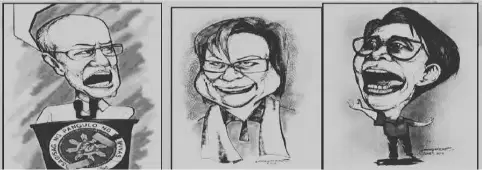
Identify the tool being used in the image. Choose the correct answer from the options: Analogy, Caricature, Humor, Symbolism.
Analogy
Caricature
Humor
Symbolism
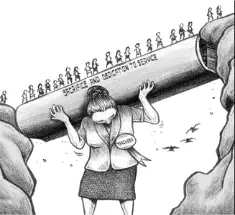
Identify the tool being used in the image. Choose the correct answer from the options: Analogy, Caricature, Humor, Symbolism.
Analogy
Caricature
Humor
Symbolism

Identify the tool being used in the image. Choose the correct answer from the options: Analogy, Caricature, Humor, Symbolism.
Analogy
Caricature
Humor
Symbolism

The editorial states that many jeepney drivers fear losing their livelihood because new units cost far more than they can afford. How can a student check the accuracy of this claim?
Ask a classmate if they agree with the opinion in the editorial.
Look for another article that uses stronger language about modernization.
Read a fictional story about jeepneys to understand the issue emotionally.
Compare the actual price range of modern jeepney units with the stated income of drivers.

In the editorial, the writer mentions that jeepneys are part of Filipino culture and history. What question helps determine if this information is relevant to the argument about modernization?
Does the paragraph make the article look longer?
Does the information make the article more entertaining?
Does their cultural value help explain resistance to modernization?
Does the information describe how jeepney art is created and modernized?

The editorial suggests that drivers are placed at a disadvantage because the financial burden of modernization falls heavily on them. How should a student check whether this statement is objective?
Check if the claim is supported by evidence.
Check if the wording tries to persuade emotionally.
Check if the writer cites both government and driver groups.
Check if the article favors one side without description and explanation.
Athena includes this sentence in her editorial about PUV modernization: According to the Department of Transportation, "the goal is to create safer and more efficient public utility vehicles that meet national standards." Which analysis best explains why she chose to quote this line directly?
Original: “Many drivers fear that modernization will push them into debt they cannot repay.”
Student Paraphrase: “Some drivers worry that buying new units might leave them with loans they cannot manage.”
She wants to avoid reading the rest of the source.
She thinks the quotation is easier to copy than paraphrase.
She wants to make her paragraph longer by adding an exact sentence.
She wants to rely on the authority of an official source to strengthen her argument.
A student paraphrased this original sentence from an editorial. Which statement best analyzes the student's paraphrase? Original: "Many drivers fear that modernization will push them into debt they cannot repay." Student Paraphrase: "Some drivers worry that buying new units might leave them with loans they cannot manage."
It adds new information that was not in the original.
It keeps the original meaning but expresses it in new wording.
It changes the idea completely and becomes extremely unrelated.
It copies the original wording and is no longer an exact paraphrase.
Summarizing involves putting the main ideas into your own words, including only the main points. Which of the following scenarios best demonstrates a correct understanding of summarizing?
Amihan rewrites every sentence of a two‑page article using synonyms to make it sound different but keeps all details intact.
Alena selects three key quotes from a news article and adds her own explanation for each one without mentioning where they came from.
Danaya condenses a lengthy report into a short paragraph that captures only the central ideas, using her own wording and clearly citing the original author.
Pirena copies the most interesting lines from an editorial, shortens a few of them, and removes the author’s name because it’s already obvious who made or wrote it.
What does brevity mean in the context of standard development principles?
Getting straight to the point and avoiding unnecessary details
Giving many examples and illustrations to support the main idea
Using a wide and varied vocabulary to express ideas more richly
Providing extensive background information and detailed context for full understanding
What does an opinion editorial demonstrate when it acknowledges the possible downsides of the author’s own viewpoint?
Fairness
Objectivity
Precision
Simplicity
In the context of writing editorials, what does precision in writing most clearly refer to?
Being brief in presenting ideas
Presenting facts without personal opinions
Explaining the writer’s viewpoint through examples
Offering detailed emotional reflections to persuade readers
In editorial writing, what does factuality primarily refer to as a principle of effective communication?
Adding emotional language to engage readers
Using vivid examples to illustrate personal views
Presenting information based on accurate and verified facts
Providing long explanations filled with detailed background context
Which situation best reflects fairness in an editorial?
The writer avoids bias.
The writer uses only verifiable facts.
The writer adds personal views that shape the discussion.
The writer provides detailed explanations mixing facts with unverified claims.
Which example shows the writer applying factuality correctly in an editorial?
The writer presents the idea briefly and directly.
The writer uses opinions that cannot be confirmed.
The writer adds long explanations with extra details.
The writer includes stories to make the article relatable.
When a student synthesizes information from different sources, what should they understand most clearly?
The main point
How the key ideas connect
Why every detail was included
What the writer’s entire background is
After reading two texts about the same issue, which action shows that a student is applying synthesis?
Picking one idea that sounds interesting
Copying the lines that are easiest to understand
Listing all details separately without relating them to each other
Combining important points from both sources to form a new insight

If you were tasked to write about the unfinished super health center in Marikina and explain why its condition should matter to ordinary citizens, which text type would be most appropriate to use for this purpose?
Editorial
Feature
News Report
Informative Essay

Considering how the editorial presents both the delay in the project and the disagreements between the DOH and the city government, why is an editorial the most suitable text type for discussing this public issue? Context: The editorial "Decaying Health Centers" (Philippine Star, October 17, 2025) describes an unfinished four-story super health center in Marikina, halted amid funding disputes between the DOH and the city government, and notes many similar facilities nationwide that remain incomplete.
It presents the situation while also urging readers to reflect on government accountability.
It gives a standby expressing a clear position on the matter and guiding the audience toward a particular viewpoint.
It persuades by using strong reasoning and evidence to influence how readers should view the actions of the agencies involved.
It argues by presenting well-reasoned points that examine the causes of the delay and highlight the conflicting positions of the involved government agencies.

When discussing who is responsible for the halted construction of the Marikina health center, which organizational technique would help you clearly arrange the details from the claims of both sides? Context: The editorial describes how the DOH and the city government of Marikina point to each other over funding and project delays.
Listing, which involves presenting each claim from both sides in a simple enumeration of ideas.
Sequencing, which involves arranging the events or statements in the order they happened to show how the issue developed over time.
Cause and effect, which involves explaining how certain actions or decisions from either side may have contributed to the delay in the project.
Comparing the statements of the DOH and the city government, which involve placing their explanations side by side to show how their claims differ or oppose each other.

Based on how the editorial explains the reasons behind the unfinished facility, which organizational method does it mainly use to help readers understand the issue more clearly? Context: The article recounts the project’s phases, funding releases, halts, and subsequent disagreements.
It names the key points or parties involved.
It groups related facts together for easier understanding.
It shows the flow of events to highlight why the project ended up in its current state.
It orders the information in a logical sequence to show how the situation developed.

What central idea does the editorial repeatedly communicate about the state of public health centers in the country, as shown through the example of the Marikina project?
They lack funds.
They are unfinished.
They need attention.
They must be completed for health.

Which statement best reflects the thesis of the editorial regarding how government agencies and local officials should handle health facility projects?
It is clearly and forcefully expressed.
It is somewhat stated but not fully detailed.
It is obviously ambiguous and not clearly explained.
It stresses careful use of public funds to avoid waste.

If you were to write your own article about the situation described, which thesis would best express a strong and clear position on the issue?
Funds matter.
Repairs are needed.
Projects must continue.
Health centers must serve communities.

When starting an informational text about the deteriorating super health center in Marikina, which main idea would serve as the most effective opening point for presenting factual details to the reader?
Its current condition and why it must be completed
Its overall cost and how funding affects its progress
Its importance to residents who rely on public health services
The reasons behind its delay and the factors slowing construction
Why do writers often add images to an opinion editorial posted online?
To distract the audience
To make the page colorful
To catch the reader’s attention
To replace the article’s introduction
Which multimodal element best supports a strong opening in a social media editorial?
A short clip
A long paragraph
A repeated phrase
A plain block of text
You are publishing an opinion editorial about climate change. Which combination of elements would make your post clearer and more engaging for your audience?
A strong title and a fitting image
A large text block and no visuals
A random photo and a long caption
A repeated sentence and no context
When revising an opinion editorial for cohesion, what are you mainly trying to improve?
The length of your opening section
The amount of evidence you include
The number of paragraphs you have
The clear connection between your ideas
Which revision makes this claim more cohesive? “Social media is important because it is useful and it helps people know things.”
Social media is helpful.
Social media is important and useful and helpful in many ways.
Social media helps people stay informed, so it plays an important role today.
Social media is very important because it is very helpful and useful to many people.
Which statement gives clearer direction for an opinion editorial?
Air pollution is bad.
Air pollution is kind of bad and does stuff to people.
Air pollution causes things that make a lot of things happen.
Evidence from recent studies shows that air pollution affects public health.
Which of the following is NOT typically included in an introduction of an opinion editorial?
A detailed history of the issue
A catchy anecdote related to the issue
A clear statement of the writer’s opinion
A statistic highlighting the global problem
Which conclusion is more cohesive and persuasive for an opinion editorial?
These changes can improve our community.
These changes can improve our community and things will be better.
These changes can improve our community, so we must begin acting now.
These changes can improve our community which is why something must be done so that things change.

