Worksheets
Newton's Laws of Motion Test
Total questions: 45
Worksheet time: 25mins
What do Newton's Laws of Motion describe?
The relationship between a body and the forces acting upon it
The chemical reactions in a body
The process of energy transfer in living organisms
The formation of stars in the universe
How many laws are included in Newton's Laws of Motion?
Two
Three
Four
Five
What is the primary focus of Newton's Laws of Motion?
Understanding chemical reactions
Explaining how objects move and interact with forces
Studying the growth of plants
Observing the behavior of animals
What is the significance of balanced and unbalanced forces?
They determine the color of an object
They determine whether an object will remain at rest or move
They determine the temperature of an object
They determine the size of an object
Why is friction important in everyday movement?
It helps objects move faster
It prevents objects from sliding uncontrollably
It reduces the weight of objects
It increases the size of objects
What is inertia directly related to ____?
Speed
Mass
Temperature
Volume
Which law of motion explains the relationship between force, motion and acceleration?
First Law
Second Law
Third Law
Fourth Law
What does the first law of motion state about an object at rest?
It will start moving on its own
It will remain at rest unless acted upon by an external force
It will change its shape
It will increase its mass
What is the relationship between balanced forces and motion?
Balanced forces cause objects to move
Balanced forces keep objects at rest
Balanced forces increase the speed of objects
Balanced forces decrease the size of objects
What happens when unbalanced forces act on an object?
The object remains at rest
The object changes its state of motion
The object decreases in size
The object becomes heavier
What is the significance of Newton's Laws in classical mechanics?
They describe the chemical composition of objects
They provide a foundation for understanding motion and forces
They explain the growth of living organisms
They measure the temperature of objects
What effect does heavier mass have on inertia?
Greater mass increases inertia
Greater mass decreases inertia
Mass has no effect on inertia
Mass changes the direction of inertia
What is the importance of understanding forces in sports?
To measure the temperature of players
To analyze the motion and performance of players
To change the size of sports equipment
To increase the weight of players
What is the role of balanced forces in building structures?
To increase the size of objects
To maintain stability in structures
To change the color of materials
To measure the temperature of objects
What is the relationship between force and acceleration in Newton's second law?
Force is directly related to acceleration
Force has no effect on acceleration
Force changes the direction of acceleration
What is the role of forces in studying vehicles?
To measure the temperature of vehicles
To study the motion and stability of vehicles
To change the color of vehicles
To increase the weight of vehicles
What are balanced forces?
Forces that cause a change in motion
Forces that are equal in size and opposite in direction, resulting in no change in motion
Forces that lead to acceleration or deceleration
Forces that act only on stationary objects
What is the formula for Newton's Second Law of Motion?
F = m + a
F = ma
F = m/a
F = m-a
What does Newton's Third Law of Motion state?
An object at rest will remain at rest
For every action, there is an equal and opposite reaction
Acceleration is proportional to force
Forces are always balanced
What is an example of Newton's First Law of Motion?
A swimmer pushing against water
A book on a table remaining at rest until pushed
Pushing a car requiring more force than pushing a bicycle
A ball accelerating when kicked
What does Newton's Second Law of Motion indicate about acceleration?
It is inversely proportional to the net force
It is directly proportional to the net force and inversely proportional to mass
It is directly proportional to mass and inversely proportional to force
It is independent of force and mass
What is an example of Newton's Third Law of Motion?
A book remaining at rest on a table
A swimmer pushing against water and being propelled forward
Pushing a car requiring more force than pushing a bicycle
A ball rolling down a hill
What does Newton's First Law of Motion emphasize?
The need for balanced forces
The concept of inertia and the need for a net force to change an object's state of motion
The relationship between force and acceleration
The equal and opposite reaction of forces
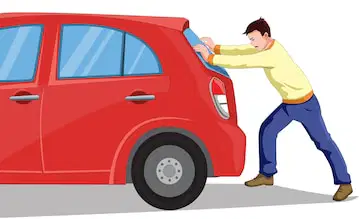
What is required to push a car compared to a bicycle according to Newton's Second Law?
Less force due to the car's mass
More force due to the car's mass
Equal force for both
No force is required
What is the main focus of Newton's Third Law of Motion?
Balanced forces
Inertia
Action and reaction forces
Acceleration
What happens to an object in motion according to Newton's First Law?
It will stop automatically
It will continue in motion at a constant velocity unless acted upon by an unbalanced force
It will accelerate without any external force
It will change direction automatically
What is inertia?
The tendency of an object to change its state of motion
The tendency of an object to resist changes in its state of motion
The force acting on an object
The acceleration of an object
What is the relationship between force and mass in Newton's Second Law?
Force is inversely proportional to mass
Force is directly proportional to mass
Force is independent of mass
Force is equal to mass
What is the effect of unbalanced forces on an object?
They result in no change in motion
They cause a change in the motion of an object
They act only on stationary objects
They act only on moving objects
What does Newton's Second Law of Motion mathematically express?
F = m + a
F = ma
F = m/a
F = a/m

What is the Net Force and the direction of the object's movement as a result of the net force?
5N, Right
5N, Left
9N, Right
9N, Left

What is the Net Force and the direction of the object's movement as a result of the net force?
9N, Right
9N, Left
3N, Right
3N, Left

What is the Net Force and the direction of the object's movement as a result of the net force?
1N, Right
1N, Left
9N, Left
9N, Right
A ball rolling across the floor with friction acting in the opposite direction will affect its motion. What is this an example of?
1st Law of Motion
2nd Law of Motion
3rd Law of Motion
Can you provide an example of unbalanced forces?
A book sitting on a table
A car accelerating forward while the brakes are applied
A person standing still
A car moving at a constant speed
What is any push or pull called?
Force
Energy
Speed
Acceleration

What conclusion can be made with the diagram?
An example of balanced forces
An example of unbalanced forces
The bigger person with the red shirt will win
The person with the green shirt will in the tug of war

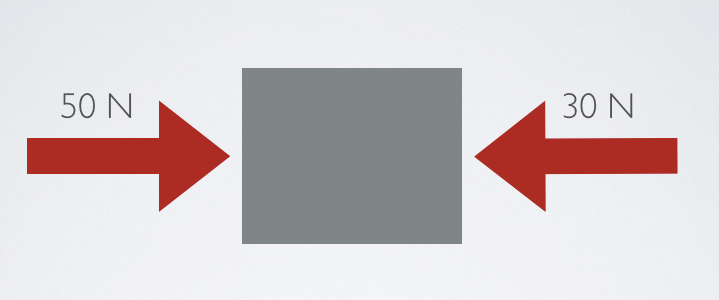
What is the Net Force acting on the box in this picture?
10 N to the Left
10 N to the Right
60 N to the Left
60 N to the Right
If the net force on an object at rest is zero Newtons. What can you conclude?
The object is in motion.
The object is not in motion.
There is an unbalanced force
There is acceleration

A card sliding across a table.
Unbalanced force
Balanced force
Which of the following is an example of an unbalanced force?