
NEW
Font size
 Worksheets
DNA Replication Classwork (Graded)
Total questions: 20
Worksheet time: 10mins
What is the compliment to the following DNA strand? TAT-TAG-ATT-ACA. In other words what is the other DNA strand.
TAT-TAG-ATT-ACA
UTU-UTC-TUU-TGT
ATA-ATC-TAA-TGT
AUA-AUC-UAA-UGU
Which enzyme unwinds the DNA double helix during replication?
Ligase
Polymerase
Helicase
Primase
Which enzyme adds nucleotides to a growing DNA strand during replication?
RNA polymerase
DNA polymerase
Helicase
Ligase
Which enzyme fills in gaps between Okazaki fragments during DNA replication?
Ligase
Primase
Helicase
Topoisomerase
DNA and RNA are composed of which macromolecule?
Nucleic Acids
Proteins
Carbohydrates
Lipids
DNA replication occurs during which phase of the cell cycle?
G1 phase
S phase
G2 phase
M phase
What is the role of DNA polymerase in DNA replication?
DNA polymerase replicates tRNA, mRNA & rRNA.
DNA polymerase adds primers to the DNA strands
DNA polymerase adds complimentary nucleotides to the original strand to make an identical copy.
DNA polymerase unzips the 2 strands of DNA
Which of the following holds complementary nitrogenous bases together in a DNA molecule?
ionic bonds
london dispersion
covalent bonds
hydrogen bonds
What is the role of primase in DNA replication?
It unwinds the DNA strands.
It adds primers
It seals gaps between DNA fragments
It proofreads newly synthesized DNA.
Why is DNA replication described as semi-conservative?
Only half of the original DNA is copied.
DNA replication happens only in one direction.
Each new DNA molecule has one old strand and one new strand.
Each new DNA strand is an exact duplicate of the original.
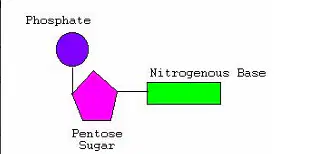
What is the function of the macromolecule subunit ?
energy
stores genetic information
composes the majority of the cell membrane
catalyst
Where does DNA replication take place?
ribosomes
nucleus
mitochondria
cell membrane
which nitrogenous bases pairs with adenine?
guanine
thymine
cytosine
adenine
which nitrogenous bases pairs with guanine?
guanine
thymine
cytosine
adenine
DNA strands are _______________
parallel
perpendicular
antiparallel
What is the first step in DNA replication?
DNA polymerase builds a new DNA strand with free nucleotides
helicase unzips DNA double helix
okazaki fragments are formed
DNA double helix zips up with hydrogen bonds
A process in which DNA has the unique ability to make an exact copy of itself.
Replication
Transcription
Translation
One limitation of DNA polymerase is it can only build in which direction
3' to 5'
5' to 3'
4' to 3'
What are the molecules that alternate between the backbone of DNA?
Amino acids and lipids
Carbohydrates and enzymes
Sugar (deoxyribose) and phosphate groups
Nucleotides and proteins
Why do cells need to replicate their DNA?
To create proteins for cellular activities.
To produce energy for the cell's function
To eliminate damaged DNA from the cell.
To ensure each daughter cell has an identical copy of genetic material during cell division.

