

wayground logo

Free Printable Worksheets

Font size

S
M
L
XL
Worksheets

Crask History Ch 7: L 5-6-7 Quiz

Total questions: 26

Worksheet time: 13mins
Name
Class
Date
1.
“The Constitution of the United States, in its fourth Article, provides as follows: ‘No person held to service or labor in one State, under the laws thereof, escaping into another, shall, in consequence of any law or regulation therein, be discharged from such service or labor, but shall be delivered up, on claim of the party to whom such service or labor may be due.’” —South Carolina’s Declaration of Secession *** Why does South Carolina’s Declaration of Secession most likely quote Article IV of the U.S. Constitution in this excerpt?
a)
It supports the idea that states have a right to leave the Union according to the Constitution.
b)
It shows that states were required by the Constitution to return escaped slaves even before the Fugitive Slave Act was passed.
c)
It shows that the Constitution required slavery to be permitted in every state and territory of the Union
d)
It proves that the Constitution prohibited the federal government from drafting soldiers to fight in the Civil War
2.
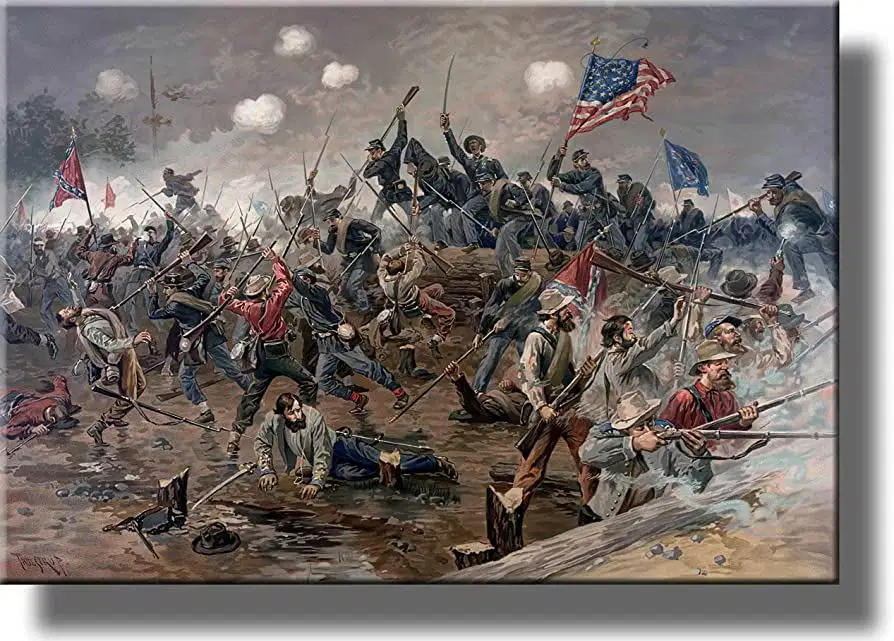
What can be inferred from this painting of a battle from the Civil War?
a)
Neither side in the Civil War could rely on soldiers with a high level of discipline.
b)
The officers who directed the fighting during the Civil War were poorly prepared for the conditions of battle that they would face.
c)
Confederate officers favored the kind of guerrilla tactics that had helped the Patriots win the Revolutionary War.
d)
Much of the fighting in the Civil War was done at close quarters and likely caused high numbers of deaths.
3.
With the capture of the Confederate city at __________________, the South was split in two. This permitted the Union Army to quickly advance its troops in the West.
a)
Antietam
b)
Vicksburg
c)
Gettysburg
d)
Atlanta
4.
The Confederate Army will not fight again on Union soil after Robert E. Lee's Army was defeated at
a)
Vicksburg.
b)
Antietam.
c)
Cold Harbor.
d)
Gettysburg.
5.
With so many men away fighting, women took over the running of _______________. Some actually fought in combat, but women mostly aided the military by _______________.
a)
farms, serving as nurses
b)
factories, becoming doctors and surgeons
c)
the shipping industries, joining the Navy
d)
the railroads, forming their own militias to fight against the Confederacy
6.
“Four score and seven years ago our fathers brought forth, upon this continent, a new nation, conceived in liberty, and dedicated to the proposition that all men are created equal. Now we are engaged in a great civil war, testing whether that nation, or any nation so conceived, and so dedicated, can long endure. We are met on a great battle field of that war. We have come to dedicate a portion of it, as a final resting place for those who died here, that the nation might live.” —President Abraham Lincoln, from the Gettysburg Address *** The primary reason President Abraham Lincoln gave the Gettysburg Address was to do which of the following?
a)
begin outlining his plans for Reconstruction after the war
b)
honor the soldiers who died for what he considered a noble cause
c)
celebrate a Union victory that turned the tide of the war
d)
restate the principles behind the Emancipation Proclamation
7.
“I hereby enjoin upon [strongly urge] the people so declared to be free to abstain from [avoid] all violence, unless in necessary self-defence; and I recommend to them that, in all cases when allowed, they labor faithfully for reasonable wages. And I further declare and make known, that such persons of suitable condition, will be received into the armed service of the United States to garrison forts, positions, stations, and other places, and to man vessels of all sorts in said service.” —Emancipation Proclamation *** This excerpt from the Emancipation Proclamation indicates that
a)
President Lincoln encouraged slaves in the South to fight for their freedom using any methods and resources available.
b)
the Union Army was going to start drafting newly freed African Americans.
c)
President Lincoln not only wanted to free slaves, but wanted to grant them the right to vote.
d)
the President Lincoln hoped that freed African Americans would join the Union Army.
8.
Which of the following did the U.S. Government NOT raise money for the war effort?
a)
Income Tax
b)
Print paper money
c)
Sell War Bond
d)
Increase property taxes
9.
Which of these events did the most to bring an end to the Civil War?
a)
Capture of Fort Sumter
b)
Union victories at Vicksburg and Gettysburg
c)
Union victory at Antietam
d)
North ability to secure an alliance with Britain
10.
With the capture of ___________________, Lincoln was able to win re-election in 1864.
a)
Atlanta
b)
Vicksburg
c)
Gettysburg
d)
Richmond
11.
In what way did women make particular advances during the Civil War?
a)
They performed supporting roles loading artillery in military campaigns.
b)
They gained the right to vote in elections throughout the North.
c)
They started home businesses making supplies for soldiers.
d)
They obtained employment as nurses for wounded soldiers.
12.
“With his grand army veterans, almost unopposed, he had overrun and desolated the fairest sections of the South, burning cities, towns, and country dwellings; had wantonly destroyed many millions of dollars worth of property, both public and private; had made thousands of women and children and aged men homeless and destitute by burning their homes and destroying their means of subsistence. And it was to glorify him for these deeds of barbarism that ‘Marching through Georgia’ was written, and it is for this that it is sung.” ---Written by a Confederate Veteran after the Civil War *** What event of the Civil War does this passage describe?
a)
General Grant's siege of Vicksburg
b)
General Sherman's March to the Sea using Total War
c)
Lincoln's Emancipation Proclamation's effect on the South
d)
General Pickett's campaign at the Battle of Gettysburg
13.
Which of the following describes "The Writ of Habeas Corpus"?
a)
Anyone caught committing a treasonous act will be executed immediately
b)
Confederate soldiers captured during war will lose their farms/homes/slaves
c)
The President of the United States is required by law to make public all military decisions
d)
Anyone arrested for a crime must be told the charges against them
14.
As General Grant was attempting to capture Vicksburg, Mississippi, General Meade (Union) was fighting General Lee (Confederate) at the Battle of
a)
Atlanta
b)
Antietam
c)
Richmond
d)
Gettysburg
15.
How long did it take for Union General W.T. Sherman to march his 62,000 men form Atlanta to Savanah, Georgia?
a)
25 Days
b)
37 Days
c)
42 Days
d)
53 Days
16.
Where was the fewest number of casualties reported?
a)
Sherman's March to the Sea
b)
Battle of Gettysburg
c)
Battle of Shiloh
17.
Absolute destruction, used by William T. Sherman as he marched from Atlanta to Savannah in 1864.
a)
Guerrilla Warfare
b)
Total War
c)
Blitzkrieg
d)
Lighting War
18.
Many historians agree that the Civil War officially ended when
a)
Union General Mead defeated Confederate General Lee at the Battle of Gettysburg.
b)
Union General Grant captured Vicksburg, MS in 1863.
c)
Confederate General Lee surrendered to Union General Grant at Appomattox Court House, VA in 1865.
d)
President Lincoln was assassinated by John Wilkes Boothe.
19.
The Morrill Land Grant Act set aside land for the creation of
a)
Hospitals.
b)
Roads.
c)
Bridges.
d)
Schools/Colleges.
20.
"Neither slavery nor involuntary servitude, except as a punishment for crime whereof the party shall have been duly convicted, shall exist within the United States, or any place subject to their jurisdiction."
a)
12th Amendment
b)
13th Amendment
c)
14th Amendment
d)
15th Amendment
21.

Which battle is considered the turning point of the Civil War, leading to a major Union victory?

a)

Battle of Antietam

b)

Battle of Gettysburg

c)

Battle of Shiloh

d)

Battle of Bull Run

22.

Who was the President of the Confederate States during the American Civil War?

a)

Ulysses S. Grant

b)

Robert E. Lee

c)

Jefferson Davis

d)

Abraham Lincoln

23.

What was the main purpose of the Emancipation Proclamation issued by President Lincoln?

a)

To establish new state governments

b)

To grant voting rights to women

c)

To free slaves in Confederate states

d)

To end the Civil War immediately

24.

Which of the following was a direct result of the Union victory at the Battle of Gettysburg?

a)

The Confederate Army retreated and never invaded the North again

b)

The Confederacy gained control of the Mississippi River

c)

The Emancipation Proclamation was repealed

d)

President Lincoln was forced to resign

25.

What was the main economic impact of the Morrill Land Grant Act during the Civil War?

a)

It created new military training camps

b)

It abolished property taxes in the North

c)

It established agricultural and mechanical colleges

d)

It provided funds for building new railroads

26.

During the Civil War, which amendment to the U.S. Constitution officially abolished slavery?

a)

12th Amendment

b)

13th Amendment

c)

14th Amendment

d)

15th Amendment
