
 Worksheets
Forensics Mid Term/Final Exam
Total questions: 70
Worksheet time: 52mins

Types of Fibers list: Synthetic—Rayon, Nylon, Acetate, Acrylic, Spandex, Polyester; Natural—Silk, Cotton, Wool, Mohair, Cashmere. Which of the following is a natural fiber?
Rayon
Acrylic
Cotton
Nylon

Types of Fibers list: Synthetic—Rayon, Nylon, Acetate, Acrylic, Spandex, Polyester; Natural—Silk, Cotton, Wool, Mohair, Cashmere. Select all that are synthetic fibers.
Rayon
Silk
Spandex
Wool
Polyester

Classification of natural fibers according to origin: Vegetable or cellulose; Animal or protein; Mineral. Which category below is not listed as an origin for natural fibers?
Mineral
Animal or protein
Synthetic polymer
Vegetable or cellulose

Classification of natural fibers according to origin: Vegetable or cellulose; Animal or protein; Mineral. Select all categories that are listed as origins for natural fibers.
Vegetable or cellulose
Animal or protein
Mineral
Petroleum-based

Cellulose Fibers descriptions: Cotton—vegetable fiber; strong, tough, flexible, moisture-absorbent, not shape-retentive. Which property is not associated with cotton according to this description?
Strong
Moisture-absorbent
Shape-retentive
Flexible

Cellulose Fibers descriptions: Cotton—vegetable fiber; strong, tough, flexible, moisture-absorbent, not shape-retentive. Select all properties that cotton is described as having.
Strong
Tough
Flexible
Moisture-absorbent
Shape-retentive
Cellulose Fibers descriptions: Rayon—chemically altered cellulose; soft, lustrous, versatile. Which statement best describes rayon?
A mineral-based filament with high rigidity
A protein fiber derived from animal sources
Chemically altered cellulose that is soft, lustrous, and versatile
Untreated plant cellulose with low luster
Cellulose Fibers descriptions: Cellulose acetate—cellulose that is chemically altered to create an entirely new compound not found in nature. Which option defines cellulose acetate?
Unchanged cellulose obtained directly from plants
Cellulose chemically altered to form a new compound not found in nature
A protein polymer created from animal hair
An inorganic mineral filament produced by heat treatment

Based on the micrographs, compare the cotton on the left with the rayon on the right by selecting the description that best matches the visual differences.
Cotton appears twisted and ribbon-like with irregular width, while rayon appears smooth, straight, and more uniform in width.
Cotton appears smooth and straight with a uniform width, while rayon appears twisted and ribbon-like with irregular width.
Both fibers appear smooth and featureless with no noticeable differences between them.
Cotton appears round and glassy with internal striations, while rayon appears scaly and highly convoluted.
Synthetic fibers are made of what type of substance?
Proteins formed by peptide bonds
Polymers that are long chains of repeating chemical units
Crystals composed of metallic lattices
Simple monatomic elements
What does the word polymer mean in this context?
Single unit
Few units
Many units
Cross-linked chain
The repeating units that make up a polymer are called what?
Isomers
Monomers
Dimers
Oligomers
By varying the chemical structure of monomers or the way they are joined together, what is the main result for the resulting polymers?
They become electrically neutral
They acquire different properties
They decompose faster in air
They all become insoluble
As a result of differences among polymers, how can they be used in forensic analysis?
They cannot be differentiated without DNA
They can be distinguished from one another forensically
They all produce identical spectra
They require combustion to analyze

The image shows several elongated strands viewed under magnification. Based on the content, these strands are most likely made of what?
Ionic crystals
Polymers composed of repeating monomer units
Pure metal filaments
Single-celled organisms
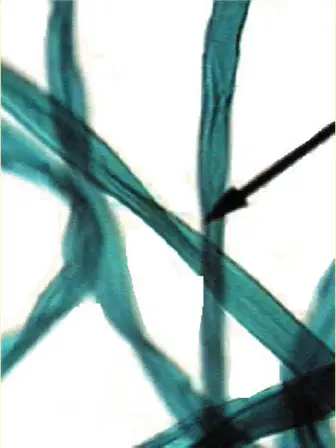
Using the provided micrographs, identify the differences between the cotton on the left image and the rayon on the right image.
Cotton fibers appear twisted and irregular, while rayon fibers appear straight and uniform.
Cotton shows parallel, smooth filaments, while rayon shows ribbon-like twists.
Cotton displays varying thickness with frayed edges, while rayon shows consistent thickness with smooth edges.
Cotton strands run mostly parallel in the field, while rayon strands are tangled and crossing.
Cotton shows more crossings and entanglement, while rayon shows mostly parallel alignment.
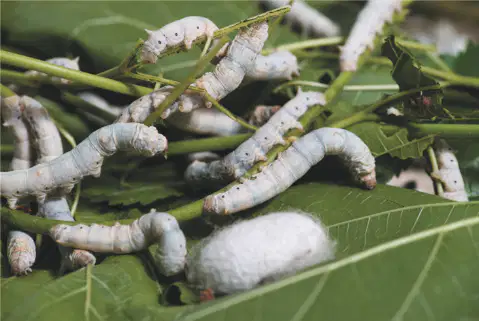
Protein fibers: An insect fiber is spun by a silkworm to make its cocoon; the fiber reflects light and has insulating properties. Which fiber fits this description?
Silk
Wool
Mohair
Angora
Protein fibers: Wool is an animal fiber coming most often from which source?
Sheep
Silkworm
Cotton plant
Petroleum derivatives
Mineral fibers: Which is identified as a natural fiber that has been used in fire‑resistant substances?
Asbestos
Rock wool
Fiberglass
Nylon
Synthetic fibers (made from derivatives of petroleum, coal, and natural gas): Which synthetic fiber is described as the most durable of man‑made fibers and extremely lightweight?
Nylon
Polyester
Acrylic
Spandex
Synthetic fibers: Which fiber is noted for extreme elastic properties?
Spandex
Acrylic
Nylon
Polyester
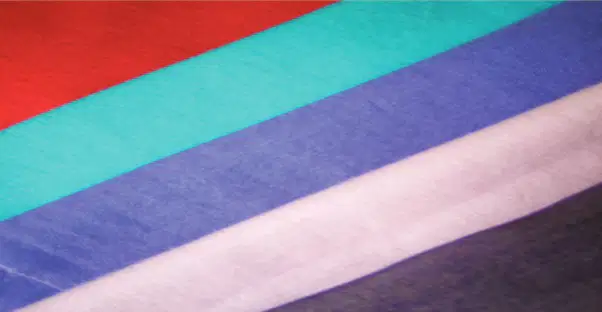
Fabric production: Most fabrics are composed of individual threads or yarns made of fibers and are constructed by many methods. According to the text, most fabrics are either which of the following?
Woven or knitted
Felted or laminated
Bonded or crocheted
Knotted or laminated
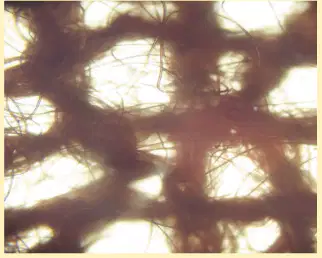
Weave terminology: Match each term to its description.
Yarn
A continuous strand of fibers or filaments that may be twisted together
Warp
Lengthwise yarn
Weft
Crosswise yarn
Blend
A fabric made up of two or more different types of fibers
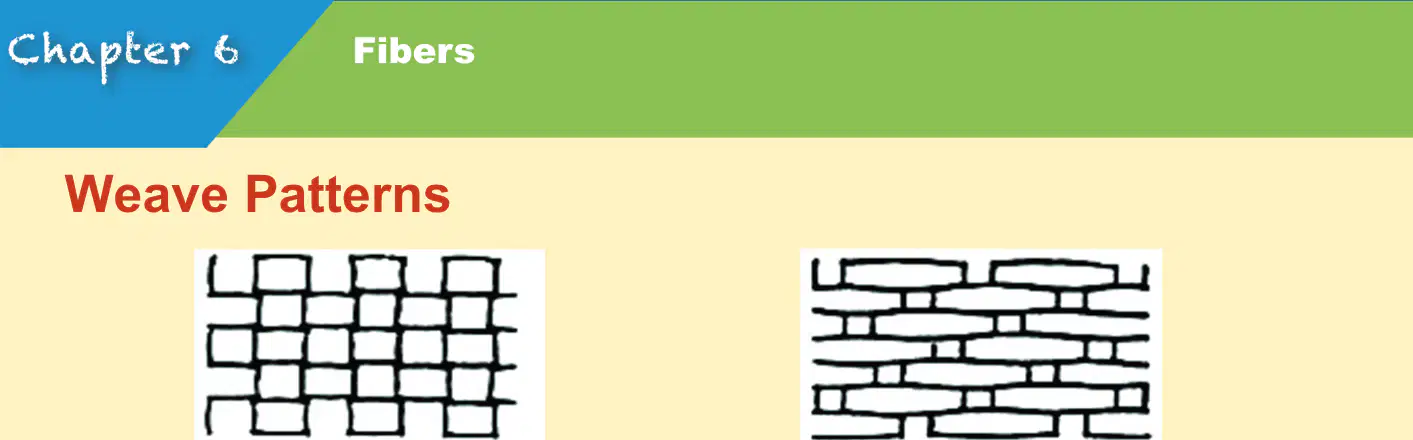
Match each weave pattern to the design it resembles, based on the illustrated weave diagrams of plain, twill, and satin.
plain
checkerboard
twill
stair steps
satin
long floats
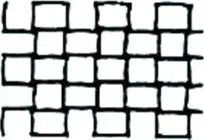
Which weave pattern is characterized by warp and weft yarns passing under and over each other alternately, creating a checkerboard design?
plain weave
twill weave
satin weave
knitted fabric
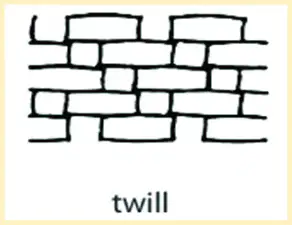
In a twill weave, how does the warp yarn pass over the weft yarns before going under one?
Over one to three weft yarns
Alternately under and over each weft yarn
Over four or more yarns
It does not interlace uniformly
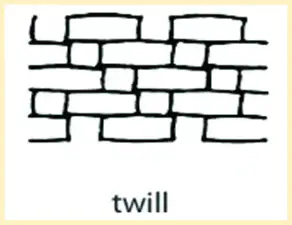
Which fabric is one of the most common examples of a twill weave?
Denim
Satin
Plain cotton sheeting
Knit jersey
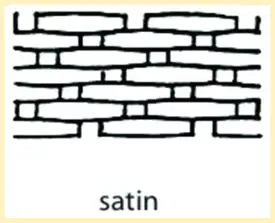
Which weave pattern has yarn interlacing that is not uniform and creates long floats?
Satin weave
Plain weave
Twill weave
Knitted fabric
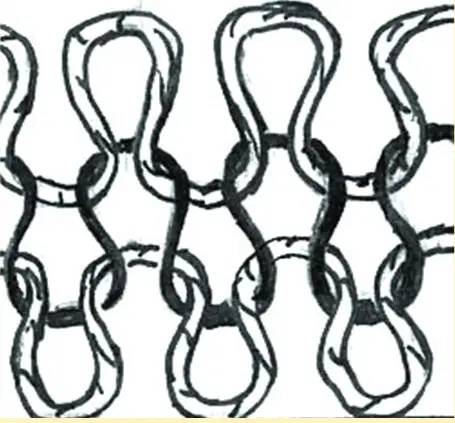
Which statement best describes how knitted fabrics are made?
By interlocking loops in successive rows and drawing them through another series of loops
By alternate over–under interlacing of warp and weft yarns
By passing warp yarns over one to three weft yarns to form diagonals
By passing yarns over four or more yarns to create long floats

Silk fibre is obtained from the _____ of the silk moth.
Cocooon
Hair
Fleece
Cocoons
Skin
Wool is obtained from the ____ of sheep.
Silk
Sheep
Fibre
Fleece
Skin
Fibres of _______ resemble that of silk and hence, it is popularly known as ‘artificial silk’.
acrylic
polyester
rayon
nylon
Which of the following do not provide wool?
Alpaca
Goat
Yak
Dog
Camel
Wool- yielding animals bear ____ on their body.
Clothes
Jeans
Rope
Hair
Feathers
What is the difference between a fibre and a fabric?
fibre is a collection of many fabrics
fabric is a collection of many fibres
fibre is hard and fabric soft
all of these
Polyester is a natural fibre.
true
false
Which of the following in natural Fibre? (Inme se konsa natural fibre hei?)
Rayon
Nylon
Silk
Polyester
Acrylic
Match the following
Natural Materials
Materials that are only found in nature.
Synthetic Materials
Materials that are created by humans.

Natural Material Image

Synthetic Material Image
Which among the following are synthetic fibres?
Nylon
Polyester
Rayon
Spandex
All of the above are synthetic fibres.
A natural material is (a) while a synthetic material is (b)
The (a) the borax solution the less cross-linking. Which gave the slime (b)

Choose the material you can stretch.


The most prevalent plant fiber is:
Hemp
Cotton
Mohair
Wool
In the examination of fibers, the first and most important step in the examination will be:
Determining whether the fiber is natural or manufactured
Microscopically comparing for color and diameter using a comparison microscope
Synthesizing long-chained molecules into a polymer
None of the above
Fibers are an excellent source of trace evidence because
they are easily transferred from a victim to a suspect
they are often overlooked by a suspect
they can be easily collected and stored
all of these choices
Natural fibers can be harvested from
plants and animals
only from plants
only from animals
None of these
A characteristic of natural fibers is that they
are stronger than synthetic fibers
will not break down when exposed to bright light
melt at a lower temperature that synthetic fibers
are affected by microscopic organisms
Which of the following observations are used to help identify a specific fiber?
smell of the burned fiber
on contact with flame, does the fiber coil or melt?
color and structure of the residue left after the fiber burns
all of these choices
Fibers are considered what kind of evidence?
What is Loccard's Exchange Principle?
Perpetrators always leave evidence behind.
Every contact leaves a trace.
All touches leave evidence.
Long, violent confrontations leave evidence.
Which of the following is NOT a natural fiber?
Silk
Bamboo
Wool
Nylon
the passing of evidence, such as fiber, from victim to suspect or vice versa.
polymer
monomer
secondary transfer
direct transfer
the transfer of evidence such as a fiber from a source to a person, and then to another person.
primary evidence
secondary evidence
primary transfer
secondary transfer
a flexible, flat material made by interlacing fibers.
yarn
textile
filaments
fibers
Which of the following are ways to collect fiber evidence?
vacuuming
adhesive tape
dusting
forceps
burning
Check all descriptions appropriate for: Cotton
Synthetic
Natural
Plant
Animal
Mineral
Fiber can be considered (a) evidence because they are often just tiny things that are left behind after direct or secondary transfer.
Match the following weaves to the correct pattern that shows them.

Plain

Twill

Basket
Fibers will always be considered (a) evidence and not (b) evidence because they only imply facts without directly proving or witnessing the crime.
Match the following term with definition
Trace evidence
small/minute evidence still measurable
Class evidence
narrows group of people or items
Individual evidence
single source linking person or object
Example of Class evidence
Fiber
Example of Individual evidence
DNA tested from hair ROOT
Which of the following can be used to analyze fibers?
Fourier Transform Infrared (FTIR)
Optical Microscopy
Pyrolysis gas chromatography
all of these
none of these
Which of the following properties should be examined when comparing two fibers?
birefringence
diameter
color
all of these

