
Font size
 Worksheets
Unit 2 Test: Digestion and Major Nutrients
Total questions: 50
Worksheet time: 28mins
Jake’s mouth starts watering right before he is about to eat an extra cheesy slice of pizza. This is part of the first phase of the digestive process known as what?
Ingestion
Digestion
Absorption
Elimination
The large intestine is responsible for what?
Absorbing nutrients
Breaking down proteins
Producing good bacteria
Absorbing water and creating feces
Absorption is considered what phase of the digestive system?
The first
The second
The third
The last
Identify the correct order of the flow of the digestive process:
Large intestine, small intestine, stomach, rectum, mouth
Mouth, large intestine, small intestine, rectum, esophagus
Mouth, esophagus, stomach, small intestine, large intestine
Esophagus, large intestine, small intestine, rectum
The starches and sugars found in foods are:
Fats
Proteins
Cholesterol
Carbohydrates
Fiber is important because it:
Can be used for energy
Helps move waste products
Is easily digested
Is a good source of protein
Nutrients made from amino acids are called:
Carbohydrates
Lipids
Proteins
Micronutrients
An avocado is an example of which type of fat?
Saturated
Unsaturated
Trans Fat
The nutrient that makes up the greatest percentage of your body is:
Water
Bone
Muscle
Skin and connective tissue
Water soluble vitamins:
Are stored in fat
Must be replenished regularly
Can build up to toxic levels
Are made by the body
Sodium and Potassium are essential minerals for what?
Hydration
Hunger satisfaction
Muscle restoration
Energy
An example of food that contains complete proteins is:
Fruit
Vegetables
Potatoes
Pork
One major function of protein is:
Transporting vitamins
Carrying waste from cells
Producing nerve tissue
Making new cells
Brown rice is an example of:
A great source of protein
Refined carbohydrate
Unrefined carbohydrate
A great source of fat
Fats are emulsified in the:
Stomach
Gallbladder
Small Intestine
Liver
A major source of energy for your body comes from electrolytes.
True
False
An increased risk of heart disease is associated with a high intake of saturated fats.
True
False
Calories are units of heat that measure the energy used by the body.
True
False
In addition to helping us swallow, digest, and absorb our food, water also helps our bodies to eliminate waste and cool down.
True
False
Taking a large dose of fat-soluble vitamins can be toxic.
True
False
Write M for mineral, W for water soluble, and F for fat soluble. Calcium
(a)
Write M for mineral, W for water soluble, and F for fat soluble. Vitamin K
(a)
Write M for mineral, W for water soluble, and F for fat soluble. Folate
(a)
Write M for mineral, W for water soluble, and F for fat soluble. Iron
(a)
Write M for mineral, W for water soluble, and F for fat soluble. Vitamin C
(a)
Write M for mineral, W for water soluble, and F for fat soluble. Vitamin D
(a)
Write M for mineral, W for water soluble, and F for fat soluble. Vitamin A
(a)
Write M for mineral, W for water soluble, and F for fat soluble. Sodium
(a)
Write M for mineral, W for water soluble, and F for fat soluble. Vitamin E
(a)
Write M for mineral, W for water soluble, and F for fat soluble. Riboflavin
(a)
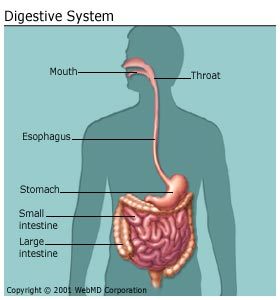
In the provided diagram of the digestive tract with arrows pointing to structures, identify the organ labeled at the mouth area.
Mouth
Esophagus
Stomach
Liver
In the provided diagram of the digestive tract with an arrow to the long tube connecting the throat to the stomach, identify the organ.
Pancreas
Esophagus
Small intestine
Rectum
\In the provided diagram, identify the organ shown as a sac beneath the ribcage on the left side of the abdomen.
Liver
Stomach
Gallbladder
Large intestine
In the provided diagram, identify the large organ above the stomach.
Liver
Pancreas
Small intestine
Esophagus
In the provided diagram, identify the small pouch located under the liver.
Gallbladder
Rectum
Pancreas
Anus
In the provided diagram, identify the gland behind the stomach.
Pancreas
Esophagus
Mouth
Large intestine
In the provided diagram, identify the coiled organ in the central abdomen where most nutrient absorption occurs.
Small intestine
Large intestine
Rectum
Esophagus
In the provided diagram, identify the wider tubing that frames the small intestine.
Large intestine
Esophagus
Pancreas
Liver
. In the provided diagram, identify the final straight section of the large intestine that stores feces before elimination.
Rectum
Anus
Esophagus
Gallbladder
Identify the external opening where digestive waste exits the body.
Anus
Mouth
Small intestine
Pancreas




An organ that stores bile after it is produced by the liver.
Pancreas
Small intestine
Gallbladder
Large intestine

