
 Worksheets
Chapter 2
Total questions: 30
Worksheet time: 15mins
Which statement best defines the primary safety goal when lifting and moving patients in prehospital care?
Use the most advanced device available every time
Follow organizational policy above all other considerations
Prevent patient and rescuer injury through safe technique
Move the patient to definitive care fastest possible
Protect rescuers from musculoskeletal injury first
Match each topic to the best description.
Body mechanics
Using posture and leverage to reduce strain
Proper timing to move
Deciding if movement now is safer than staying
Immobilization devices
Tools that limit motion to protect alignment
Carrying devices
Equipment that allows transport over distances
Which device category best fits a long spine board used to protect alignment during extrication?
Transfer device for lateral sliding moves
Monitoring device for physiological signs
Immobilization device to limit spinal motion
Restraint device for behavioral control
Carrying device for long-distance transport
You must move a patient down a short flight of stairs from a residence to the ambulance. Which equipment choice is most appropriate?
Scoop stretcher with wheeled carriage
Wheeled stretcher in high position
Stair chair with safety restraints
Vacuum mattress on rolling cart
Long spine board with traction splint
A provider with back pain history is assigned to lift the head of a heavy stretcher. Which plan demonstrates strategic risk reduction for the team and patient?
Reduce communication to avoid confusion
Assign more rescuers and redistribute load
Skip lifting devices to minimize steps
Have the provider lift faster than usual
Proceed with planned roles to maintain speed
Match each consideration to the correct description of moving patients.
Emergent move
Immediate danger at scene requires rapid move
Urgent move
Time-sensitive condition requires quick but careful move
Nonurgent move
Stable patient allows methodical packaging
Suspected spine injury move
Spinal protection prioritized during movement
No suspected spine injury move
Greater flexibility in technique selection
Which action helps prevent compensating with one hand during a carry?
Bend at the waist for momentum
Lean to the stronger side slightly
Hold your breath during the lift
Keep your back straight and locked
When moving a patient on stairs, which device and body mechanics are most appropriate?
Use a wheeled cot; pull backward by shoulders
Use a stair chair; knees flexed, lean from hips
Use a backboard; bend at the waist only
Use a stretcher; arms fully extended down
You and a partner must carry a patient down stairs. One rescuer will walk backward. Which additional step improves safety?
Lean backward to counterbalance
Rotate your torso to see each step
Hold the patient at arm’s length
Ask a helper to steady you from behind
Which reaching guideline is recommended for preventing injury during patient care?
Reach as far as needed if effort is low
Keep back rounded to absorb force
Twist the torso to extend reach safely
Avoid reaching more than 20 inches forward
Which precaution is emphasized for emergency and urgent moves regarding spinal care?
Avoid all immobilization during rapid moves
Prevent additional injury despite limited assessment
Perform full spinal assessment before any move
Delay transport until imaging confirms stability
When performing a foot drag on a supine patient, what is the priority precaution?
Do not bump the patient’s head
Keep the knees fully extended
Pull only by the patient’s ankles
Rotate the shoulders with each pull
Which statement best describes the clothes drag technique?
Rescuer pulls by grasping clothing behind head
Rescuer rolls patient onto a blanket to pull
Rescuer lifts under both armpits and walks
Rescuer ties hands and crawls forward low
Key goal shared by the firefighter’s drag and blanket drag is to:
Rotate the patient onto the injured side
Lead with the patient’s feet at all times
Maintain the patient in a seated position
Keep the patient’s head as low as possible
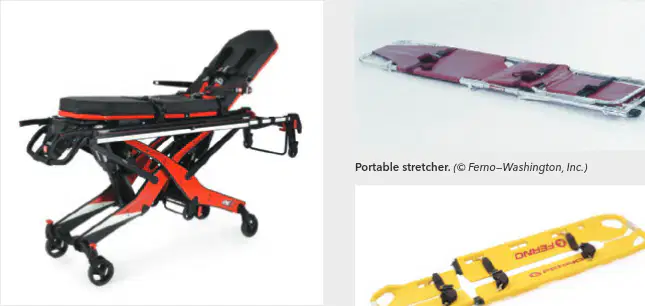
Match each scenario to the best device choice.
Confined bathroom, need minimal log roll
Scoop (orthopedic) stretcher
Long carry over narrow stairs
Portable stretcher
Single crew needs mechanical lift assist
Power stretcher
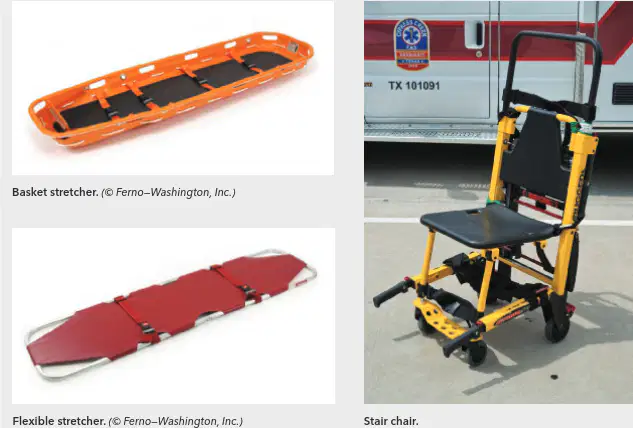
Match each patient-carrying device with its best-use scenario.
Basket stretcher
Rough terrain transport with lateral protection
Flexible stretcher
Tight spaces where device must conform
Stair chair
Ambulating, seated patient on stairways
Power stretcher
Raising and loading heavy supine patients
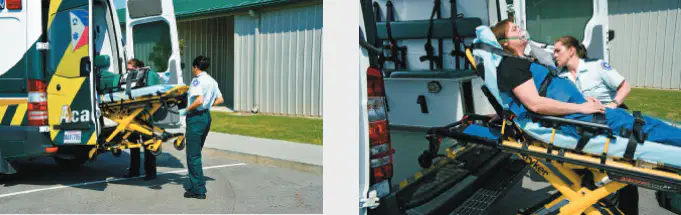
A crew is transporting a 680‑pound patient from the ground into the ambulance. Which device selection and rationale best demonstrates sound judgment?
Use a stair chair to minimize lifting height
Use a power stretcher rated for heavy loads
Use a flexible stretcher to contour shape
Use a manual stretcher to reduce battery strain
Use a basket stretcher to limit movement
A gloved provider presses a red 'X' power button on the stretcher hand control. What skill does this action best represent?
Operating powered controls safely
Assessing circulation and sensation
Preparing intravenous equipment
Applying spinal motion restriction
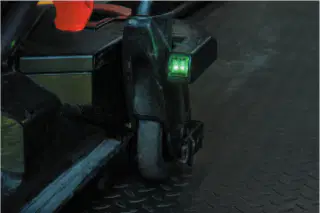
What visual cue indicates that the stretcher is properly engaged with the ambulance mounting system?
The stretcher wheels fully retract
A red light is illuminated on the rail
A green light is illuminated on the mount
An audible double chirp is heard
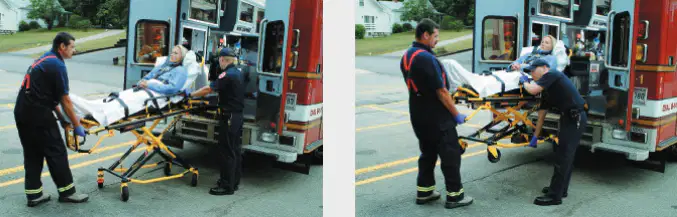
Match each action to its correct stage of loading a self-loading stretcher.
Position head wheels on floor
Initial placement
Activate rear lever to release wheels
Wheel transition
Guide collapsing carriage into ambulance
Carriage management
Secure stretcher front and rear
Final securing
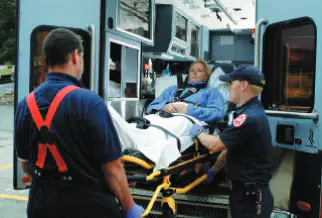
A student pushes the stretcher fully into the ambulance without checking engagement. What is the most appropriate immediate corrective step?
Reopen doors and start over from the curb
Pull stretcher out and re-strap the patient
Confirm green light, then secure front and rear
Lower the head of bed to a flat position
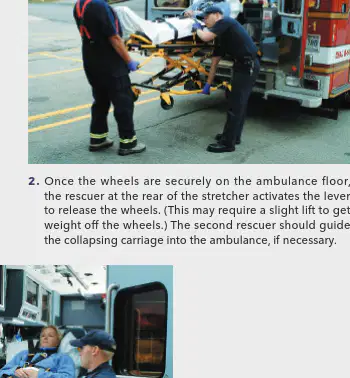
Match each indicator or device with its function during ambulance loading.
Green indicator light
Confirms engagement with ambulance
Rear lever mechanism
Releases wheels for transition
Securing device mounts
Locks stretcher at front and rear
Collapsing carriage
Guides frame into vehicle
Which scenario most justifies using a hydraulic lift in the emergency department?
Lifting a child after minor injury
Transporting supplies from storage
Transferring an obese patient to a hospital cot
Moving a stable patient to a wheelchair
Many stair chairs have wheels and a track system. What is the main purpose of the track on stairs?
Increase friction to control descent speed
Reduce friction to increase descent speed
Lift the patient higher above each step
Lock the chair to each stair tread
Identify a patient condition that makes the stair chair inappropriate and potentially unsafe.
Severely altered mental status needing supine transport
Mild dyspnea preferring to sit upright
Stable chest pain able to follow directions
Minor ankle sprain requiring non–weight bearing
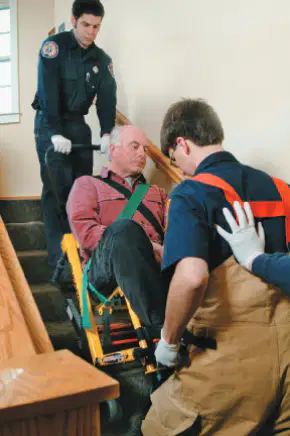
Which rescuer positioning best maintains control during stair descent using tracks?
Two rescuers below lift while hopping steps
One rescuer below pushes while facing downward
One rescuer above pulls while facing upward
Two rescuers above guide while chair tracks slide
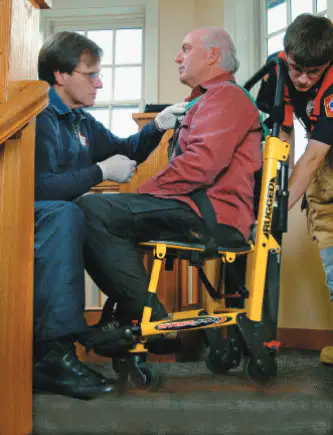
Which patient is most appropriate for a stair chair rather than a long backboard or stretcher?
Seizing patient requiring lateral positioning and suction
Unresponsive trauma patient with suspected spinal injury
Ambulatory medical patient with mild weakness on stairs
Multi-system trauma patient with pelvic instability
Which preparatory step is recommended before placing a patient in a basket stretcher?
Inflate mattress compartments
Line the basket with a blanket
Attach a cervical collar first
Lock the two halves together

A patient in severe respiratory distress is in an upstairs back bedroom and needs transport to the stretcher. Which carrying device should be used first?
Long backboard with head blocks
Soft stretcher with four handles
Stair chair with safety restraints
Basket stretcher with rail guards
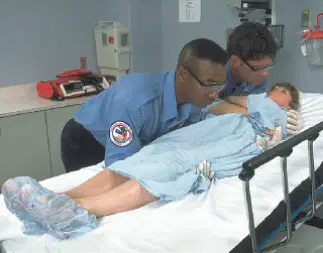
Why are bed rails lowered and straps unbuckled before the transfer in a direct carry?
To shorten the carry distance across the room
To reduce stretcher weight for easier lifting
To clear obstructions for a smooth slide path
To immobilize the cervical spine in neutral

