
 Worksheets
Chapter 10
Total questions: 30
Worksheet time: 15mins
Which statement best distinguishes oxygenation from ventilation in airway management?
Ventilation is purely passive in all patients
Oxygenation is oxygen transfer at alveoli
Oxygenation is air movement into lungs only
Ventilation is oxygen transfer into bloodstream
Oxygenation measures chest wall motion alone
Which statement best defines alveolar ventilation during normal breathing?
Total air moved per minute including dead space
Maximum voluntary ventilation during exercise
Air reaching alveoli per minute after dead space
Air remaining in conducting airways each breath
Match each respiratory term to its description.
Tidal volume
Air per breath moved in and out
Minute volume
Total air per minute (TV × rate)
Dead space
Conducting airways without gas exchange
Pulmonary respiration
Gas exchange between alveoli and blood
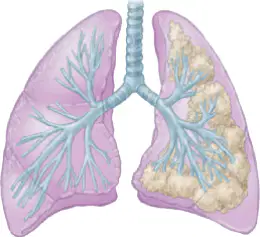
A patient’s respiratory rate is 16 breaths per minute. During an asthma attack, tidal volume drops to 300 mL and dead space is 150 mL. What is the patient’s alveolar ventilation per minute?
5,600 mL per minute
4,800 mL per minute
8,000 mL per minute
2,400 mL per minute
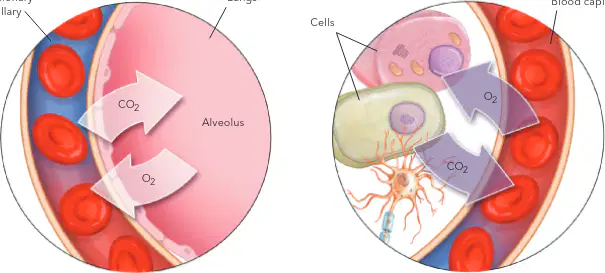
In the lower-left diagram showing an alveolus next to a pulmonary capillary, which statement best describes the direction of gas diffusion under normal pulmonary respiration?
Oxygen moves into blood, carbon dioxide moves into alveolus
Oxygen and carbon dioxide both move into alveolus
Oxygen moves into alveolus, carbon dioxide moves into blood
Oxygen and carbon dioxide both move into blood
Match each concept to its correct description based on the labeled structures and processes in the diagrams and text.
Pulmonary respiration
Exchange of gases between alveoli and blood
Cellular respiration
Exchange of gases between blood and body cells
Ventilation
Mechanical movement of air in and out of lungs
V/Q match
Alignment of airflow with perfusion in alveoli
A patient with anemia and severe acidosis shows adequate ventilation but low oxygen delivery to tissues. Which mechanism most directly explains the impaired oxygen transport in this scenario?
Increased carbon dioxide production at the cellular level
Reduced hemoglobin capacity and decreased oxygen affinity
Decreased diffusion surface area in alveoli only
Airway obstruction reducing alveolar oxygen content
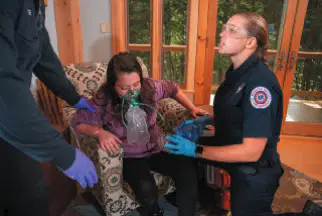
Which finding best differentiates respiratory failure from adequate breathing in a conscious patient?
Air moving in and out of the chest adequately
Normal mental status and normal oxygen saturation
Breathing may be challenged but remains compensating
Shallow ventilations with diminished breath sounds
Match each respiratory condition to the most appropriate immediate intervention.
Adequate breathing
Consider supplemental oxygen via nonrebreather or nasal cannula
Respiratory failure (inadequate breathing)
Assisted ventilations using pocket face mask or bag-valve mask
Respiratory arrest (not breathing)
Artificial ventilations at 10–12/min adult or 12–20/min child
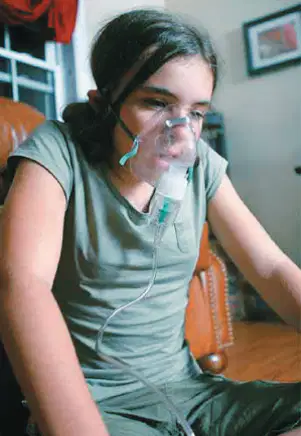
A patient with asthma has bronchospasm reducing alveolar ventilation. What physiologic change primarily triggers increased drive to breathe?
Stable minute volume maintaining oxygen saturation
Rising carbon dioxide detected by the brain
Decreased sympathetic tone causing airway dilation
Falling serum bicarbonate improving buffering
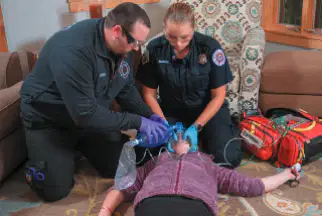
An apneic adult shows no chest rise and no breath sounds. What is the most appropriate initial management rate for artificial ventilations?
20–24 breaths per minute with nonrebreather
6–8 breaths per minute using nasal cannula
10–12 breaths per minute with pocket mask
12–20 breaths per minute using oxygen-powered device
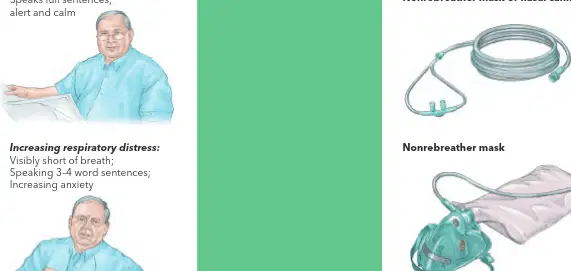
In the diagram, which patient presentation warrants a nonrebreather mask rather than assisted ventilations?
Apneic with no visible chest rise
Speaking full sentences, normal mentation
Short of breath, speaking 3–4 word sentences
Sleepy with head-bobbing, unarousable
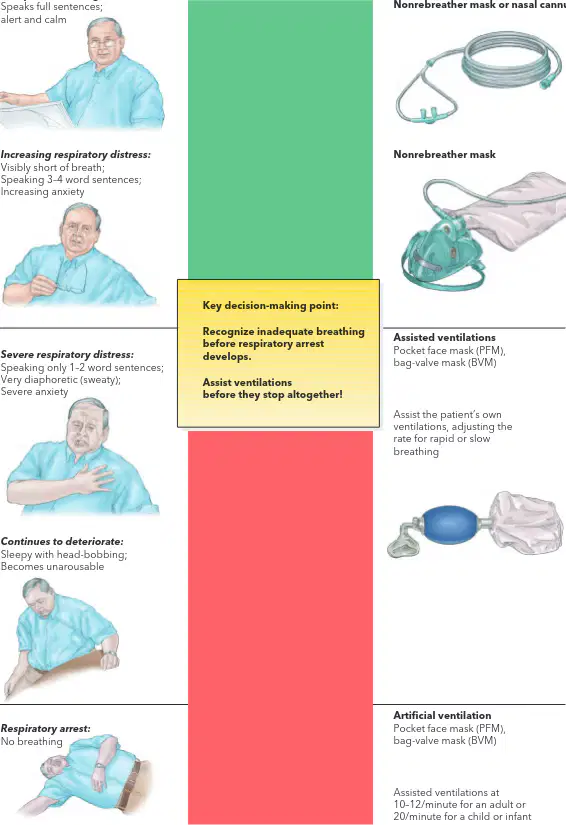
Match each patient condition to the recommended intervention shown in the diagram.
Adequate breathing
Nasal cannula or nonrebreather mask
Severe respiratory distress
Assisted ventilations with pocket face mask or BVM
Continues to deteriorate
Assisted ventilations, adjust rate for rapid/slow breathing
Respiratory arrest
Artificial ventilation with pocket face mask or BVM
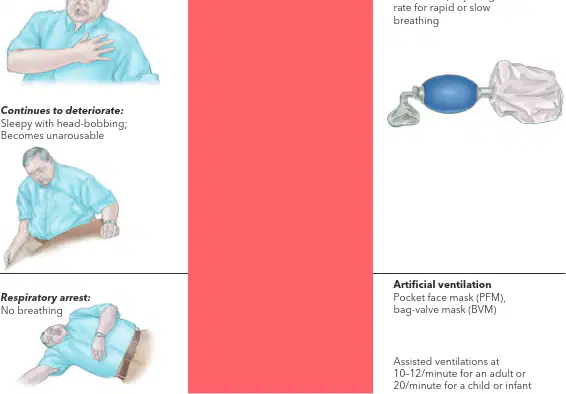
A patient with rapid, shallow breathing remains conscious but can speak only 1–2 word sentences and is very diaphoretic. Based on the diagram, what is the most appropriate immediate action?
Apply a nasal cannula for comfort oxygen
Place a nonrebreather mask at high flow
Begin assisted ventilations with a pocket face mask
Wait and reassess after two minutes
Which finding most strongly indicates inadequate breathing during a primary assessment?
Regular rhythm with adequate depth
Altered mental status with cyanotic skin
Quiet breathing without unusual sounds
Chest expansion present and equal bilaterally
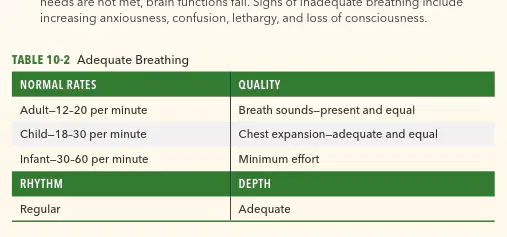
Match each age group to its typical normal respiratory rate at rest.
Adult
12–20 breaths per minute
Child
18–30 breaths per minute
Infant
30–60 breaths per minute
During the Look, Listen, Feel technique, which observation best supports adequate breathing?
Audible gurgling or stridor on inspiration
Paradoxical abdominal–thoracic motion
Air movement felt at nose or mouth
Skin color pale or blue-gray
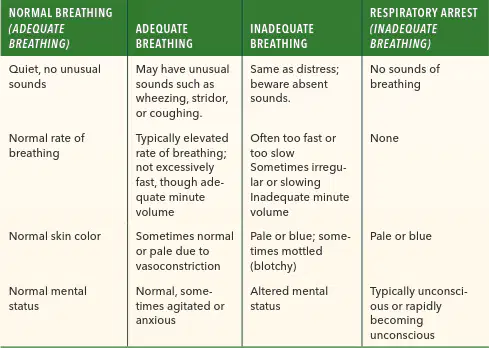
A pediatric patient shows nasal flaring, intercostal retractions, and a slow pulse. What is the most appropriate immediate clinical interpretation?
Normal variations seen during quiet rest
Signs suggest adequate ventilation in children
Findings are typical of mild anxiety only
Indicators of increased work of breathing and hypoxia
Which statement best describes positive pressure ventilation compared with normal breathing?
It increases venous return by enhancing chest recoil
It pushes air in from outside using external positive pressure
It pulls air in by creating intrathoracic negative pressure
It relies on passive diffusion without pressure gradients
Match each negative side effect of positive pressure ventilation to its primary mechanism.
Decreased cardiac output
Eliminates normal negative pressure, reducing venous return
Gastric distention
Air forced into esophagus inflates stomach, limiting diaphragm
Hyperventilation
Ventilating too fast lowers CO2, causing cerebral vasoconstriction

During mouth-to-mask ventilation for an adult, which action helps minimize the risk of gastric distention while ensuring adequate ventilation?
Apply continuous positive airway pressure at high levels
Deliver rapid breaths exceeding twenty per minute
Use slow ventilations with just enough volume to see chest rise
Seal the mask loosely to allow air to escape
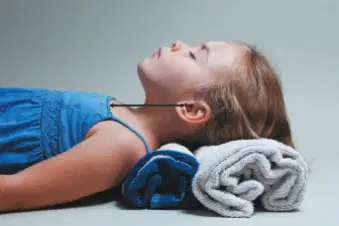
In the head-elevated, sniffing position, what visual alignment confirms proper positioning?
Eyes level with eyebrows, face tilted toward floor
Ear aligned with suprasternal notch, face parallel to ceiling
Ear aligned with mandible angle, face rotated laterally
Chin touching chest, face perpendicular to ceiling
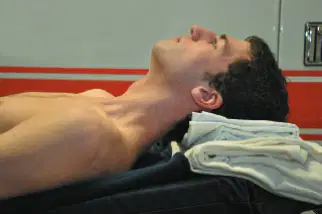
Match each patient scenario to the optimal positioning strategy to achieve a patent airway for face-mask ventilation.
Obese adult supine on stretcher
Ramp position using towels under torso and head
Preschool child with large occiput
Minimal or no shoulder padding due to natural flexion
Infant requiring sniffing position
Padding under shoulders to align ear-to-notch
Adult with normal BMI
Standard head-elevated, sniffing without ramp
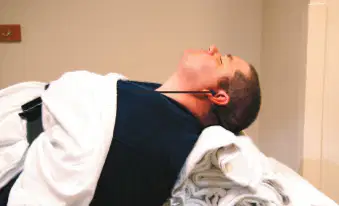
To optimize a face mask seal during ventilation, which action most directly prevents air leaks?
Select proper mask size and seal from bridge to chin
Elevate shoulders without adjusting head flexion
Increase ventilation rate above patient’s own rate
Place excessive downward pressure on the mask rim
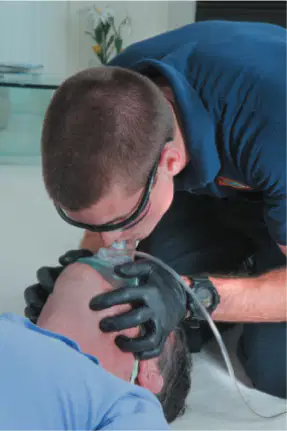
When providing mouth-to-mask ventilation with a pocket face mask that has a one-way valve, what is the primary infection-control benefit of the valve?
It prevents ambient air from entering the lungs
It blocks the patient’s exhaled air from reaching the rescuer
It seals the mask to the face more effectively
It increases oxygen concentration without an inlet
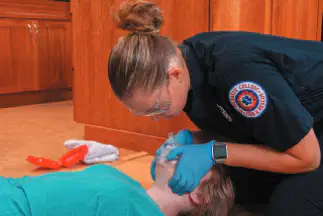
A patient has suspected spine injury and requires pocket mask ventilation. Which hand positioning best maintains airway control while avoiding neck movement?
Single-hand seal while tilting the head backward
Head tilt with thumbs over mask and fingers under jaw
Jaw lift using thumbs to secure mask, avoid head tilt
Two-handed C-E clamp with vigorous head extension
A patient is a stoma breather after a laryngectomy. Which action best ensures effective ventilation during an arrest?
Apply high-flow nasal cannula at maximum settings
Attach a BVM directly to the tracheal stoma opening
Insert an oral airway and ventilate through the mouth
Seal a standard face mask over the mouth and nose
You are providing supplemental oxygen to a spontaneously breathing adult with mild hypoxemia. Which plan balances benefit and risk of oxygen toxicity?
Deliver 100 percent oxygen continuously for several hours
Maintain fixed 15 liters per minute regardless of saturation
Use the lowest flow achieving target SpO2 94 to 98 percent
Switch between room air and high-flow oxygen every few minutes
Which size oxygen cylinder is typically considered portable for short transport and commonly used with regulators in prehospital care?
D cylinder for short transport use
E cylinder for wall-mount systems
M cylinder for handheld units
K cylinder for pediatric-only use
An E-cylinder shows 1,800 psi. Using the duration of flow concept, which factor most directly reduces the usable minutes at a set flow rate?
Cylinder material composition
Regulator-safe residual pressure
Patient’s oxygen saturation level
Color of the cylinder shoulder

