
Font size
 Worksheets
The Election of 1824 and the Corrupt Bargain
Total questions: 84
Worksheet time: 2hrs 5mins
Who ultimately decided the winner of the Election of 1824 when no candidate won a majority of Electoral College votes?
The Supreme Court justices
The House of Representatives
The Electoral College committee
The state governors
Andrew Jackson won more popular votes than his rivals in 1824 but did not become president. Which candidate became president after the House voted?
Martin Van Buren
John Quincy Adams
Henry Clay
William H. Crawford
Why did Jackson’s supporters call the outcome of 1824 a “Corrupt Bargain”?
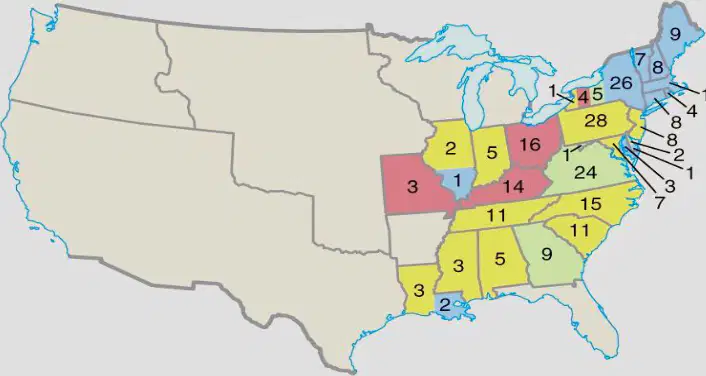
Use the map and vote table: Which candidate led the Electoral College before the House vote, yet lacked a majority?
Henry Clay led with thirty-seven
John Quincy Adams led with eighty-four
W.H. Crawford led with forty-one
Andrew Jackson led with ninety-nine
After the disputed election, the Democratic-Republican Party split. Supporters of Andrew Jackson adopted which party name?
Federalists
Whigs
Democrats
Know-Nothings
Who was appointed Secretary of State by President John Quincy Adams after the 1824 election?
John C. Calhoun
Daniel Webster
Andrew Jackson
Henry Clay
Compare the emerging parties: Which statement best contrasts Whigs and Democrats in this era?
Whigs favored strong central government; Democrats preferred weaker central authority
Whigs backed states’ rights; Democrats pushed national bank expansion
Whigs wanted universal suffrage; Democrats restricted voting widely
Whigs supported Jacksonian populism; Democrats opposed it strongly
Explain how the events of 1824 helped shape the Second Party System in the United States.
Which early-life detail best describes Andrew Jackson’s social background?
Born into great plantation wealth
Raised in modest, frontier conditions
Educated in elite Eastern academies
Adopted by influential political patrons
What military event most boosted Andrew Jackson’s national fame?
Siege of Yorktown victory
Battle of New Orleans success
Mexican–American War triumph
Naval battle on Lake Erie
Explain how Jackson’s supporters changed presidential campaigning between 1824 and 1828. Provide two specific tactics and why they mattered.
After losing in 1824, what did Jackson’s political movement do leading up to 1828?
Focused only on congressional lobbying
Spent years organizing a presidential campaign
Withdrew from national politics entirely
Sought a military appointment instead
Why might Jackson’s frontier origins and war-hero image have appealed to many voters in 1828?
Which tactic is most closely associated with the rise of modern mass politics in Jackson’s era?
Elite salon debates only
Public rallies and parades
Quiet newspaper notices
Secret caucus selections only
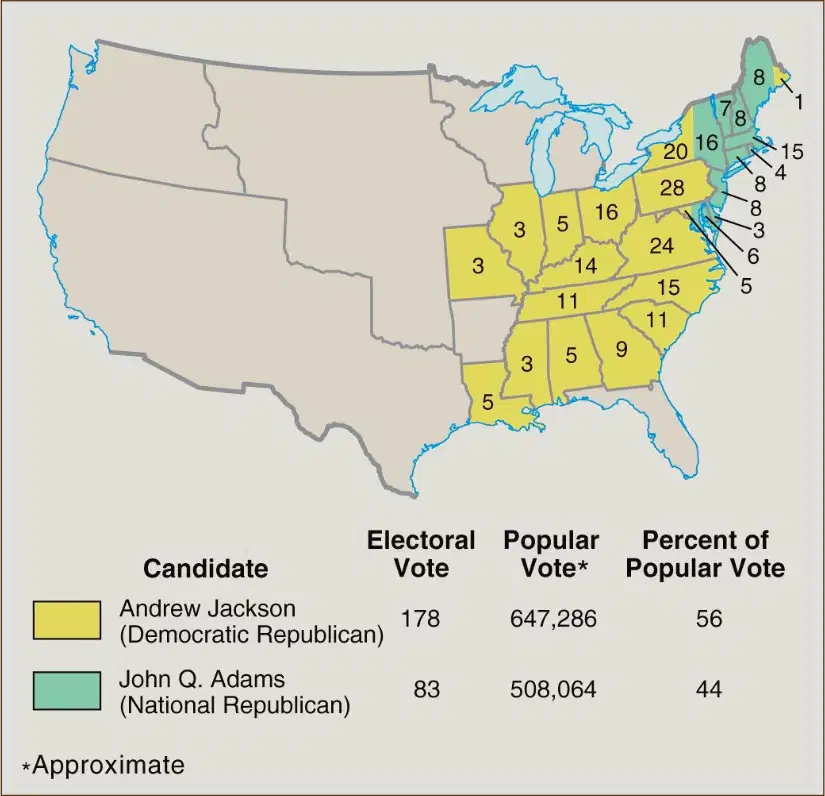
Identify which candidate won the 1828 election based on the electoral map and totals shown in the diagram.
John Q. Adams won with 178 electoral votes
Andrew Jackson won with 83 electoral votes
John Q. Adams won with 83 electoral votes
Andrew Jackson won with 178 electoral votes
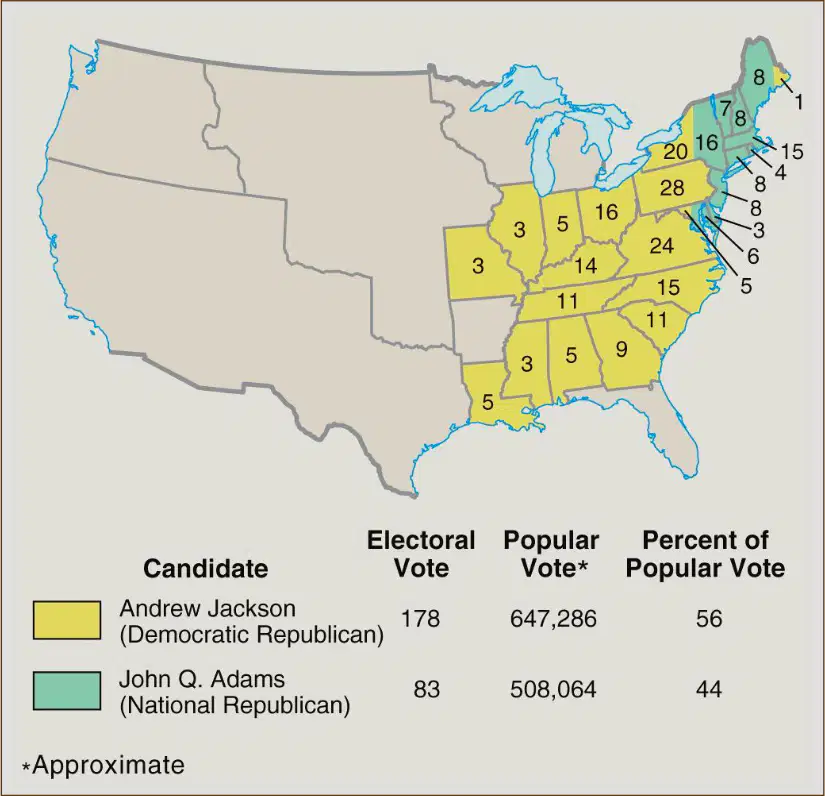
Using the diagram, calculate the margin by which the winner led in the popular vote.
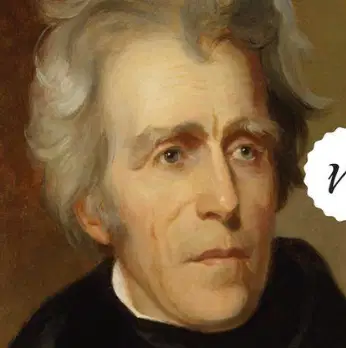
Which statement best explains Jackson’s campaign message toward voters shown in the slide?
He promised to champion the common man’s interests
He promised to expand privileges for the wealthy elite
He pledged to avoid any personal attacks in campaigning
He focused solely on winning support from New England
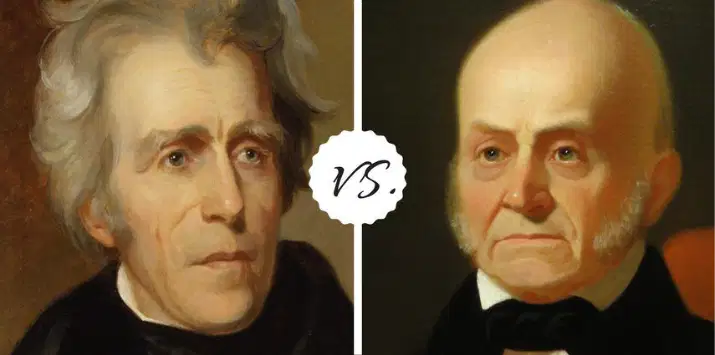
Describe one feature that made the 1828 contest the first modern political campaign, as highlighted on the slide.
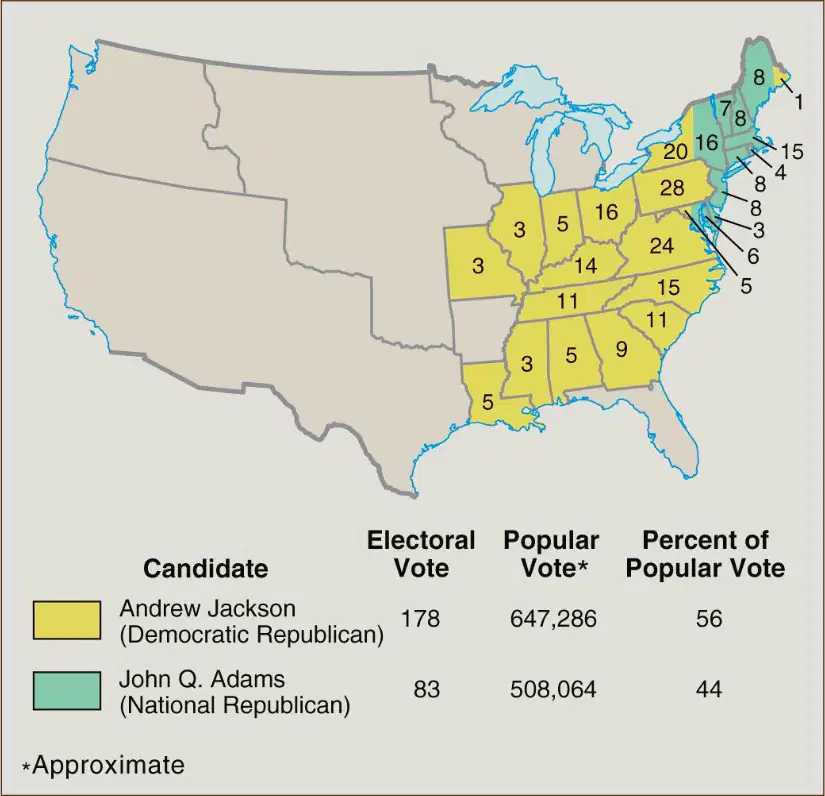
Based on sectional voting patterns visible on the map, which general region provided the strongest support for the winner?
The Northeast coastal states in green
The Great Plains and Far West in green
The South and West states in yellow
The Pacific Northwest territories in green
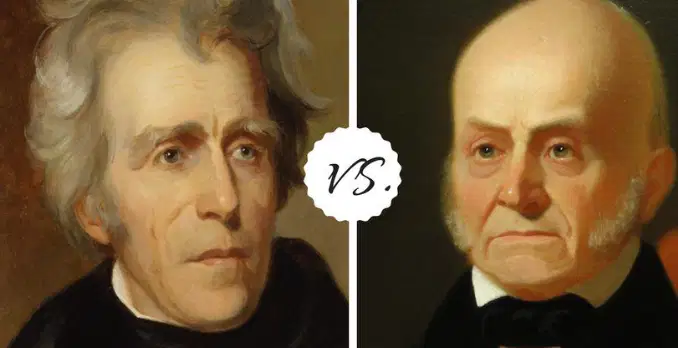
Evaluate how portraying himself as the spokesman of the “common man” could have influenced the electoral results shown.
Which action made Andrew Jackson’s inauguration unusually open to ordinary people?
He held a private banquet for elites only
He invited the public into the White House
He limited entry to ticket holders only
He moved the ceremony to a distant venue

About how many people crowded into and around the White House during Jackson’s inauguration?
About five thousand attendees
Around ten thousand visitors
Roughly twenty thousand people
More than fifty thousand guests

Explain how public participation at Jackson’s inauguration reflected changing social class dynamics in the 1820s.

Which outcome best illustrates the chaotic nature of the event inside the White House?
Guests quietly filed in and out
Speeches proceeded with perfect order
Glassware and china were broken
Security kept all rooms empty
Which change in voting rules occurred during Andrew Jackson’s era?
Property ownership requirement was removed
Only landowners could vote in elections
Voting was limited to taxpayers only
Women gained full national suffrage
What does suffrage mean in United States history?
The right to vote in elections
Serving in public office
A political party’s platform
A tax paid at polling places
In the early 1800s, why did more white men participate in elections?
States reduced property qualifications
States added stricter literacy tests
Congress raised poll tax amounts
Presidents appointed new voters
Explain how lifting property qualifications changed American democracy in the 1820s.
Which statement best describes the spoils system used by Jackson?
Supporters received government jobs
Opponents were jailed after elections
Military officers ran federal agencies
Civil service exams decided positions
Identify one potential drawback of the spoils system.
What change in restrictions helped Jackson win the election of 1828?
Lowered age requirement to sixteen
Creation of new western states
Expanded presidential term length
Reduced voting qualifications
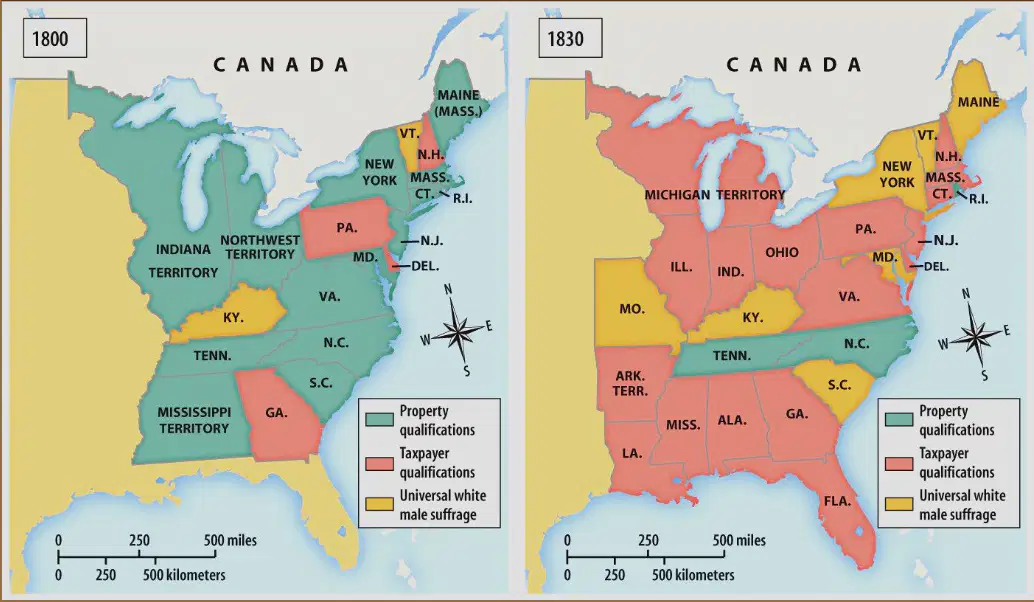
Compare the two maps labeled 1800 and 1830: what major trend do they illustrate?
Which group benefited most directly from expanded suffrage in the 1820s?
Foreign-born noncitizens
Women across all states
Enslaved African Americans
White men without property
A candidate promises government jobs to campaign helpers after winning. What historical term best fits this practice?
Judicial review
Popular sovereignty
Spoils system
Protective tariff
Who won the Election of 1824, and how did this person ultimately secure the presidency?
Which two political parties emerged from the aftermath of the Election of 1824, and which one supported Andrew Jackson?
Who won the Election of 1828?
Henry Clay
John Quincy Adams
William Crawford
Andrew Jackson
Andrew Jackson promised to look out for which group?
Foreign investors and merchants
Common white male voters
Wealthy eastern bankers
State governors and judges
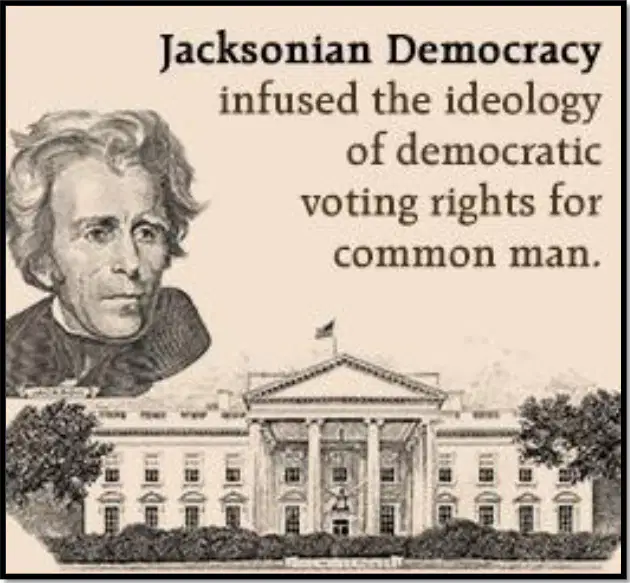
Which statement best captures the core idea of Jacksonian Democracy shown in the title slide?
Preserving traditional campaigning practices and social hierarchy
Limiting voting to property owners for stable governance
Expanding political power and majority rule to common people
Strengthening congressional elites over the executive branch
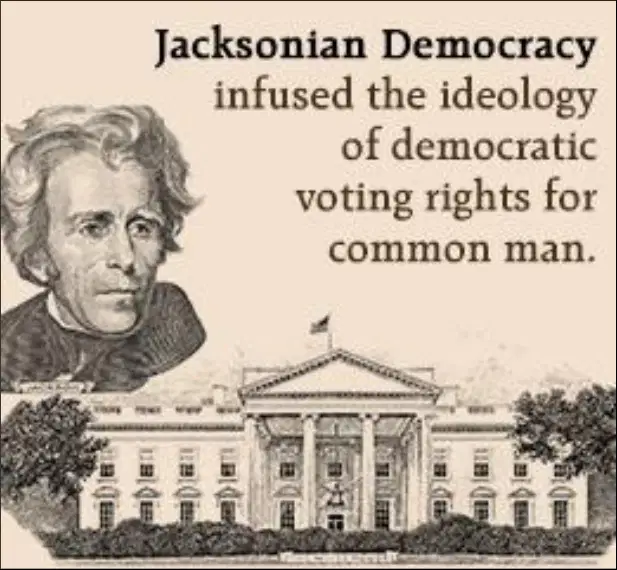
According to the slide, which change is linked to the era of Jacksonian Democracy?
Creation of a national church for civic education
Introduction of literacy tests for national elections
End of property qualifications and new campaigning forms
Expansion of lifetime appointments for federal posts
Identify a viewpoint attributed to Andrew Jackson in the slide.
Belief in hereditary political positions for stability
Distrust of wealthy bankers, investors, and merchants
Support for property-based voting restrictions nationwide
Preference for aristocratic leadership and social elites
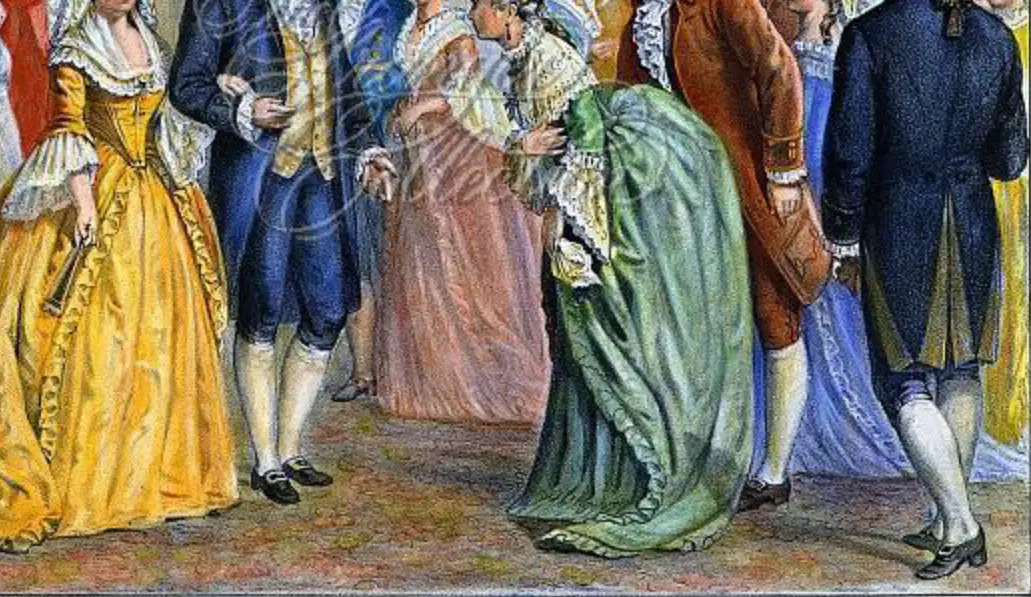
Compare the reception scene in 1789 to the public gathering scene later. What shift in political participation is suggested by these images?
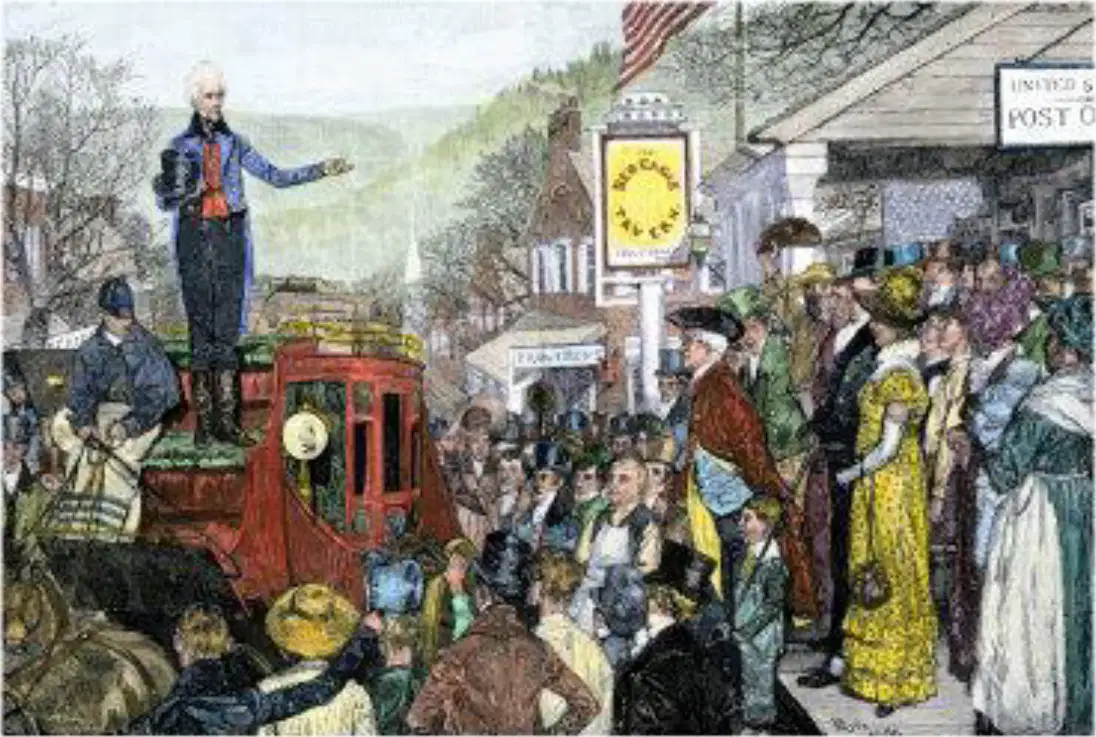
Which visual detail in the crowd scene supports the idea that politics became an activity of ordinary citizens?
Military officers forming ranks in a guarded courtyard
A small council of dignitaries meeting in private chambers
Formal ball gowns and powdered wigs in a grand hall
A diverse crowd gathered outdoors near everyday places
Explain how ending property qualifications influenced majority rule during Jackson’s era.
Which law proposed removing Native American tribes from lands east of the Mississippi River?
Northwest Ordinance of 1787
Homestead Act of 1862
Missouri Compromise of 1820
Indian Removal Act of 1830
Name two tribes specifically mentioned as affected by Jackson’s removal proposal.
Why did Jackson argue that Native American tribes posed a danger to the nation?
Under Jackson’s plan, where were tribes expected to relocate?
East of the Appalachian Mountains
Coastal areas along the Atlantic
Territories north of the Great Lakes
Lands west of the Mississippi River
What support did the federal government promise to provide to relocating tribes?
Free farmland and gold payments
Money, rifles, and one year of provisions
Railroad transport and new statehood
Permanent citizenship and voting rights
Which statement best describes the Cherokee response to Jackson’s proposal?
They signed immediately without conditions
They rejected and sought court protection
They negotiated for coastal reservations
They moved voluntarily before any law
Identify the two Supreme Court cases led by Chief Justice John Marshall that addressed Cherokee rights.
Explain the conflict between state and federal authority highlighted by the Cherokee legal battles.

In an image showing a formal presidential reception with elites, what contrasting political style is suggested when compared to a scene of a leader addressing a large crowd outdoors?
How did most tribes respond to the new treaties offered by the federal government under the removal policy?
Most tribes sued individual states
Most tribes refused all treaties
Most tribes migrated northward
Most tribes signed the new treaties
In Cherokee Nation v. Georgia (1831), how did the Supreme Court classify the Cherokee Nation?
An independent state subject to Georgia laws
A domestic, dependent nation under federal authority
A territory governed by local county officials
A foreign sovereign nation under treaty rights
Which statement best describes the ruling in Worcester v. Georgia (1832)?
Georgia’s laws applied within Cherokee territory
Missionaries needed state licenses on tribal lands
Federal courts lacked power over state Indian policies
Cherokee nation was a distinct community with self-government
What question about state power was at issue in Worcester v. Georgia?
Do states have authority to pass laws over sovereign Indian nations?
Can states tax federal military bases?
May states regulate interstate commerce alone?
Can states appoint federal judges without Congress?
Explain how the decisions in Cherokee Nation v. Georgia and Worcester v. Georgia limited Georgia’s authority over Cherokee lands.
Georgia passed a law requiring white residents on Indian territory to obtain a state license. What happened to missionary Samuel Worcester for refusing?
He was deported by the Cherokee Council
He was jailed under Georgia state law
He was pardoned by the governor immediately
He was fined by a federal magistrate
Predict the constitutional conflict highlighted by the image showing the President versus the Chief Justice. What branches are in dispute and over what issue?
Which quote captures President Jackson’s reaction to the Supreme Court’s decision?
“The Court has spoken; I will ensure compliance.”
“The judiciary controls all matters of Indian policy.”
“John Marshall has made his decision; now let him enforce it.”
“Georgia must yield to federal treaties immediately.”
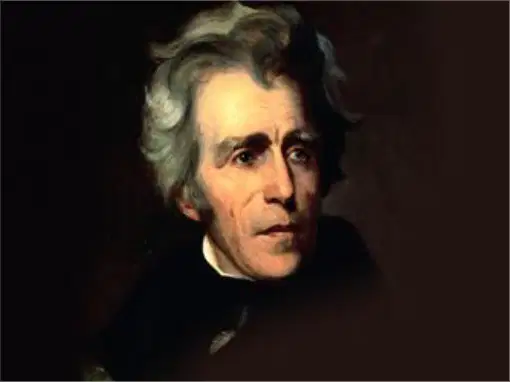
Evaluate how Jackson’s reaction influenced events leading to the Trail of Tears.
Which law sparked South Carolina’s confrontation with the federal government in the late 1820s?
Tariff of 1828 on raw materials
Alien and Sedition Acts of 1798
Compromise of 1850 trade rules
Missouri Compromise of 1820
Who emerged as the leading critic of the Tariff of 1828, arguing it was unconstitutional?
Representative Daniel Webster
Senator Henry Clay
President Andrew Jackson
Vice President John C. Calhoun
Define nullification in the context of the crisis.
Explain why some members of Congress adjusted tariff rates in 1828 and what unexpected outcome followed.
What nickname did opponents give to the Tariff of 1828 and why?
Which region was most displeased by the tariff changes that raised duties on raw materials while lowering them on manufactured textiles?
Southern states reliant on imports
Western frontier territories
New England fishing communities
Mid-Atlantic mining districts
How did the nullification theory challenge the balance between federal authority and states’ rights?
During Andrew Jackson’s presidency, what broader issue did the tariff debate highlight?
Foreign policy with Europe
Expansion of suffrage rights
Bank regulation and currency
States’ rights versus federal power
If South Carolina nullified the Tariff of 1828 while other states complied, predict a likely consequence and justify your reasoning.
Which event triggered South Carolina’s move toward nullification in 1832?
A tariff lowered duties by 10 percent
A federal income tax was introduced
An embargo ended on foreign goods
A new trade deal with Britain
What did South Carolina’s Ordinance of Nullification declare?
Tariff collection was banned in the state
Federal courts lost all authority
The governor could veto Congress
State militias would replace the army
Identify the main power granted by the Force Bill (1832).
Use military force to enforce federal law
Suspend tariffs during economic crises
Create new federal courts in states
Appoint naval commanders without Congress
Explain how President Jackson responded to South Carolina’s resistance and why he used that approach.
Who proposed the compromise that reduced tariffs over the next decade, and what was its effect?
How did the combination of the Force Bill and the Compromise Tariff resolve the Nullification Crisis?
Which statement best describes Jackson’s stance revealed by the crisis outcome?
Supported states’ rights but prioritized preserving the Union
Favored immediate secession to protect state sovereignty
Believed tariffs should never be changed
Relied only on Congress and avoided using force
Which earlier president is noted for introducing a National Bank as part of a financial plan?
John Adams advanced navy-focused fiscal policies
James Madison designed postwar economic protections
George Washington supported Hamilton’s financial plan
Thomas Jefferson is linked to agrarian reforms
Why did Andrew Jackson oppose the Second Bank of the United States?
He feared it would increase tariffs nationwide
He thought it violated states’ slave codes
He believed it favored wealthy Northerners
He believed it weakened the U.S. military
Despite the Supreme Court’s ruling in McCulloch v. Maryland upholding the Bank, what action did Jackson take?
He sought to eliminate the Bank entirely
He transferred control to state legislatures
He expanded the Bank’s western branches
He proposed stricter gold reserve rules
Explain how Jackson used the veto regarding the Bank and how voters responded in the 1832 election.
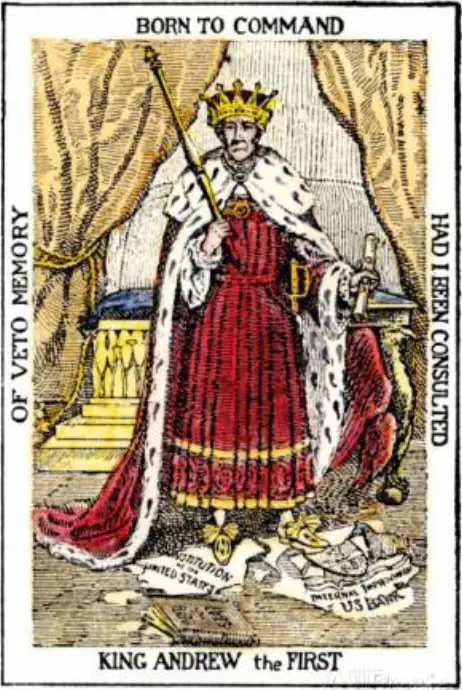
In the cartoon titled “King Andrew the First,” what idea about presidential power is being suggested?
Jackson acted with near-monarchical authority
Jackson strictly followed congressional compromises
Jackson deferred to the Supreme Court consistently
Jackson weakened executive power deliberately
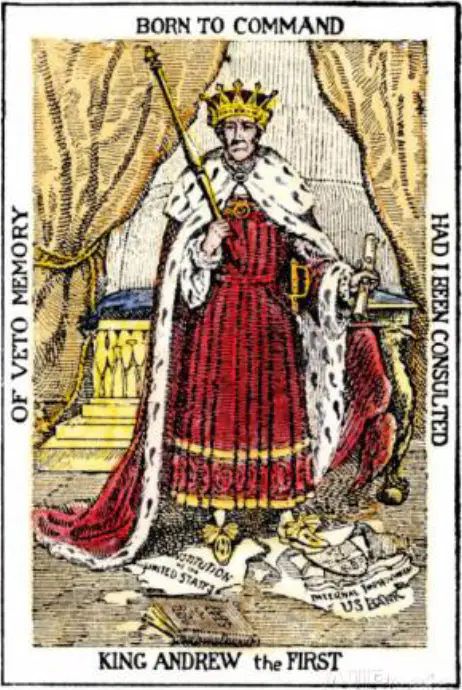
Evaluate whether Jackson’s actions toward the Bank reflected economic democracy or dictatorial tendencies, citing two pieces of evidence from the slide.

