
 Worksheets
8202 PP pp5
Total questions: 57
Worksheet time: 29mins
Which mark indicates that a plumbing product meets British standards through third‑party certification?
WRAS approval logo for water fittings
BBA Agrément certificate number
BRE advisory approval statement
British Standard Kitemark certification symbol
A valve for potable water needs assurance it will not contaminate the supply. Which body’s approval is most directly relevant?
BBA British Board of Agrément
WRAS Water Regulations Advisory Scheme
IOPHE professional guidance body
BRE Building Research Establishment
You are comparing two new pipe insulation products. One carries a BBA certificate; the other only cites guidance from IOPHE. Which choice shows stronger product performance evidence?
BRE advisory documents instead
Neither, both provide equal assurance
The BBA Agrément certification
The IOPHE guidance citation only
Which organisation primarily provides advice and information rather than product certification for plumbing components?
British Standard Kitemark
BBA Agrément certification body
BRE Building Research Establishment
WRAS Water Regulations scheme
A supplier claims compliance with the plumbing lead body’s guidance but lacks WRAS approval for a tap. What risk remains for installation in a drinking water system?
No confirmation of BRE research availability
No evidence of structural performance testing
No proof of British Standard Kitemark use
No evidence of water fittings regulations compliance
Which British Standard specifies copper tubes for water, gas, and sanitation installations?
BS EN 1057
BS EN 607
BS EN 2010
BS EN 1200
A job needs copper tube that is fully annealed, supplied in coils, and suited to underground water services. Which temper should be selected?
R290 hard thin-wall grade
R220 annealed coil grade
R150 light-duty mixed grade
R250 half-hard stick grade
Which description best matches R250 copper tube?
Hard tempered, thin walled, not for bending
Half-hard, straight lengths, common in plumbing
Fully annealed, thicker wall, supplied in coils
Soft coil, microbore only, rarely specified
Why is R290 generally unsuitable for typical UK plumbing tasks requiring bends?
It is hard tempered and thin walled
It is only sold in microbore sizes
It is too soft and easily kinks
It is plastic coated by default
You are planning a microbore central heating run using 6–10 mm tube. Which copper temper most appropriately matches this use?
R220 for microbore heating
R250 for microbore heating
R290 for microbore heating
Either R250 or R290 equally
A copper pipe will pass through a concrete floor and emerge into a plant room. What protection strategy is most appropriate?
Paint ends to mark the route
Apply Densotape or plastic coating
Leave bare copper for heat loss
Use only thin-wall hard temper
Which situation makes copper most vulnerable and therefore most in need of protective wrapping or coating?
Laid in concrete and at floor exit
Clipped to timber stud walls
Run in ceiling voids with air
Installed within insulated duct
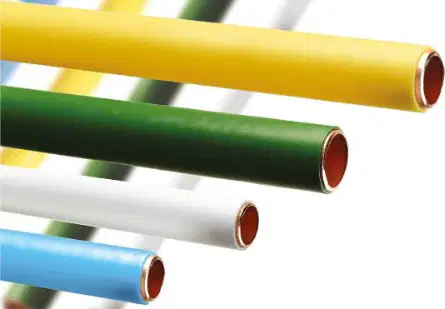
Colored pipe identification helps distinguish services. Which pairing is most appropriate for typical practice shown: yellow for gas and blue for wholesome water?
Blue gas, green wholesome water
Yellow gas, blue wholesome water
Green gas, white wholesome water
White gas, yellow wholesome water

Which manual tool is most appropriate for bending an already-installed copper pipe section without causing a crease?
Machine floor standing bender
Powered hydraulic ram bender
Heat-and-pack sand bending
Internal or external bending spring
When would a machine floor-standing bender be preferred over a hand bender in plumbing work?
When correcting a slight kink in an existing tube
When bending larger diameter tube up to about 42 mm
When bending plastic conduit during wiring
When making a single gentle curve by eye
Which is a key advantage of forming a bend instead of installing an elbow fitting in a copper run?
Reduced frictional resistance through the bend
Higher turbulence to improve mixing
More joints to allow easy disassembly
Greater material cost on each run
Which statement best explains why bending can reduce overall job cost compared with fittings?
Increased risk of creasing requiring rework
Extra time required for measuring each bend
Higher tooling expense on every small project
Fewer purchased fittings and fewer soldered joints
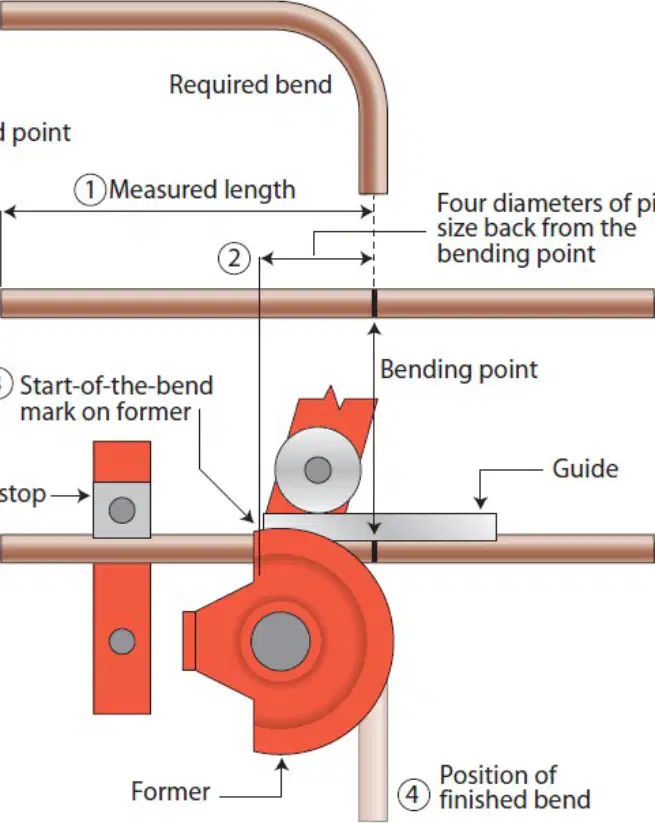
A 15 mm copper tube needs a 90° bend at a point you have marked as the required bend. Using the 4d rule, where should you place the start-of-the-bend mark on the tube before loading it into the bender?
60 mm back from the required bend point
30 mm back from the required bend point
45 mm forward from the required bend point
15 mm back from the required bend point
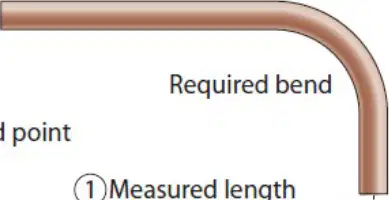
A 22 mm copper tube must be bent to 90°. Using the 4d method, what distance do you measure back from the required bend point to place the 4d mark?
66 mm back from the required bend point
88 mm back from the required bend point
22 mm back from the required bend point
44 mm back from the required bend point
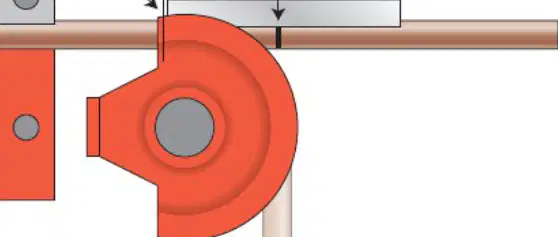
While bending, the tube wrinkled near the bend. Which setup change most directly addresses this issue when using a hand bender?
Start the bend ahead of the start-of-bend mark
Use a larger former regardless of tube size
Reduce the 4d measurement distance by half
Ensure the guide is seated and the tube is fully supported
Which statement best describes how capillary fittings create a sealed joint when heated?
Molten solder expands to force pipes apart
Solder is drawn into the gap by capillary action
Flux evaporates to create a vacuum seal
Mechanical threads compress a rubber washer
A key difference between integral solder ring and end feed fittings is that the integral solder ring fitting
contains solder within a raised ring socket
has no solder present before heating
requires external solder to be fed in
is generally preferred for lower material cost
When choosing between integral solder ring and end feed fittings for visible pipework, which factor often leads to selecting end feed?
Ability to join plastic to copper
Elimination of flux requirement
Greater tolerance to dirty tube
Aesthetics and lower overall cost
Which list correctly names the four common methods of jointing copper tube for domestic work?
Fusion, solvent, stapled, clamped
Crimped, riveted, nailed, taped
Welded, brazed, threaded, glued
Capillary, compression, push-fit, press-fit
During an end feed joint, where should the solder be introduced after heating with a blowtorch?
At the mouth of the fitting to be drawn in
Inside the pipe bore before assembly
Directly onto the flame to melt faster
Only at the far side away from heat
Which workshop bend would you use to change direction by a right angle in one smooth curve?
90° bend
Back to back
Half pass over
Offset pair
Planning a neat visible run with minimal excess solder, which fitting and reason pair is most appropriate?
End feed, cleaner appearance when wiped correctly
Integral ring, always leaves a perfect fillet
Compression, no heat so joints are invisible
Push-fit, internal grab ring polishes copper
A technician must avoid carrying separate solder to a roof space. Which fitting choice reduces the need to bring extra solder?
Press-fit coupling
Compression tee fitting
End feed elbow fitting
Integral solder ring fitting
Which step best explains the role of flux when preparing copper pipe joints?
It seals the joint before heating begins
It cools the metal to avoid annealing
It removes oxides and promotes solder flow
It replaces the need for mechanical cleaning
A solder ring fitting already contains solder. What must be done differently when making an end feed joint?
Heat only the fitting without the pipe
Add solder to the heated joint manually
Wipe off flux before any heating starts
Use a lower temperature than ring joints
You are joining pipework for a domestic hot and cold water system. Which solder choice meets the requirement?
Aluminum solder for rapid heat transfer
Silver solder exclusively for gas lines
Lead-bearing solder for stronger joints
Lead-free solder for potable water use
Place these actions in the most effective order for a solder ring joint: cleaning, heating, cooling, wiping, fluxing.
Flux, clean, heat, wipe, cool
Clean, flux, heat, cool, wipe
Clean, heat, flux, cool, wipe
Heat, clean, flux, cool, wipe
During heating of a solder ring fitting, what indicates correct temperature and technique?
Solder forms beads on the outside surface
Flux turns solid and crusty immediately
Pipe discolors to a dull black uniformly
Solder flows by capillary action into the joint
After heating, why should the joint be allowed to cool before wiping clean?
To avoid overheating adjacent pipe sections
To prevent disturbing molten solder alignment
To allow flux to evaporate completely
To reduce oxidation from residual flux
A technician cleaned inside the joint but skipped cleaning the pipe’s exterior. What defect is most likely?
Excess solder causing internal blockage
Overheating that anneals the copper
Poor wetting leading to a weak seal
Flux boiling and removing too much metal

In the diagram, which statement best distinguishes Type A from Type B compression fittings when preparing the pipe end?
Type A only requires a square cut and deburring
Type A requires flaring the tube with a swaging tool
Type A demands a swaged bell end and adaptor
Type A needs the tube end heated and forged
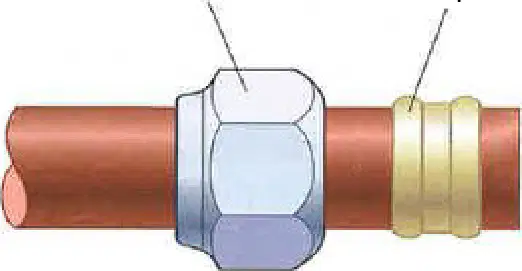
Looking at the Type A assembly in the diagram, which component compresses onto the tube to create the seal when the backnut is tightened?
Compression ring (olive) between nut and body
Backnut threads inside the fitting body
Adaptor shoulder against the swaged end
Tube wall expanding into the fitting body
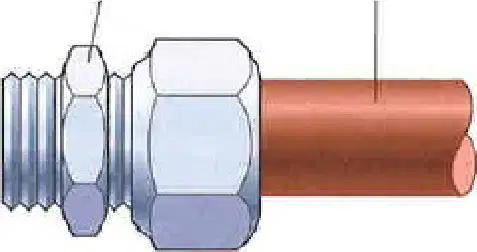
Which scenario most appropriately calls for the Type B compression fitting shown?
Plastic pressure pipe with push-fit ends
Low pressure temporary test rigs
High pressure or below-ground pipe work
Soft copper requiring minimal manipulation

According to the diagrams, what tool is specifically required to form the tube end for a Type B fitting?
A swaging tool to create a swaged end
A threading die for external threads
An adjustable spanner for nut tightening
A pipe cutter with reamer only
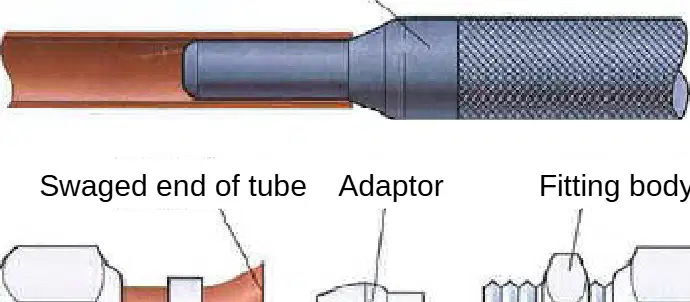
When comparing sealing methods, how does Type B resist being pulled apart compared with Type A?
Swaged tube and adaptor lock mechanically
Olive alone grips with surface friction
Thread sealant bonds the metal threads
Backnut clamps a plastic insert tightly
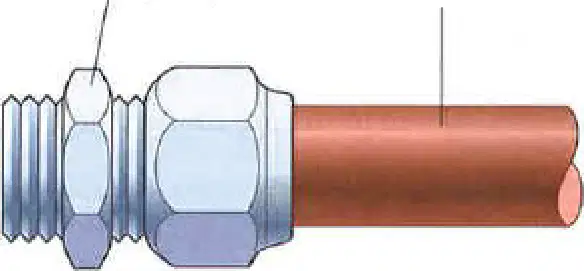
You must join half-hard copper quickly with minimal tooling. Based on the diagrams, which fitting type is most suitable and why?
Type B, needs heating and forging work
Type B, requires swaging and adaptor use
Type A, needs tube threading operation
Type A, assembled with olive and spanner
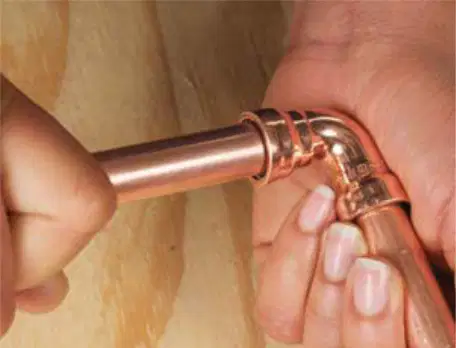
Which material property makes DZR brass suitable for push-fit fittings in potable water systems?
Superior magnetic response for leak detection
Higher electrical conductivity for tool connections
Lower density allowing lighter pipe supports
Resistance to dezincification in aggressive waters

A contractor must join copper tubes quickly without heat in a finished kitchen. Which jointing method best fits this scenario?
Press-fit using an electrical press tool
Soft solder capillary with a blowtorch
Threaded joints with hemp and paste
Brazed joints using silver solder
Select the most accurate statement about size ranges for modern fittings.
Both systems 15–67 mm standard
Both systems 10–28 mm only
Push-fit 12–108 mm, press-fit 10–54 mm
Push-fit 10–54 mm, press-fit 12–108 mm
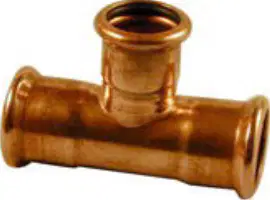
A chilled water line operates at −20°C and 16 bar during testing. Which fitting specification meets these extremes?
Press-fit rated to 16 bar at −20°C
Soldered joints to 10 bar at −10°C
Threaded steel fittings to 25 bar at 0°C
Push-fit approved to 20 bar at −30°C
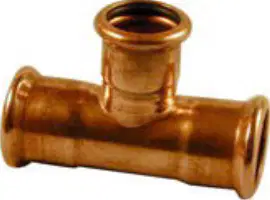
Why do press-fit systems rely on an O-ring inside the fitting?
To create the watertight seal when crimped
To lock the fitting mechanically without tools
To prevent galvanic corrosion between metals
To reduce pipe vibration under flow

Where are copper push-fit fittings commonly applied according to standard practice?
Above-ground hot and cold services and heating
Underground gas mains and fuel oil pipelines
Compressed air systems exceeding 20 bar
High-pressure steam mains in plant rooms
Which statement best describes engaged length in the context of soldered or compression fittings?
The portion of pipe inserted into the fitting socket
The exposed length between two adjacent fittings
The distance from wall surface to fitting face
The amount of pipe removed during deburring
A centre-to-centre distance is 1200 mm. Each fitting has an X dimension of 28 mm. What is the copper cut length required?
1172 mm by subtracting one X dimension
1240 mm by adding two X dimensions
1200 mm because X does not affect length
1144 mm after subtracting two X dimensions
Why do manufacturers publish X dimensions for their fittings?
To identify alloy composition of the fittings
To standardize pipe thread profiles across brands
To let installers calculate cut lengths consistently
To specify maximum permissible water pressure
Which LCS grade matches the brown color code on pipe ends?
Heavy grade pipe identification
Light grade pipe identification
Medium grade pipe identification
Galvanized grade pipe identification
A blue color band on an LCS pipe indicates which grade?
Non-standard grade specification
Heavy grade specification
Medium grade specification
Light grade specification
Red color coding on LCS pipe corresponds to which grade?
Thin-wall classification of pipe
Heavy classification of pipe
Medium classification of pipe
Light classification of pipe
Where is LCS pipe acceptable for use in building services?
Wet central heating circuits
Domestic cold water supply
Domestic hot water supply
Potable drinking water mains
Which application is specifically restricted and must not use LCS pipe?
Supplying domestic hot water
Carrying oil line services
Serving wet heating systems
Feeding gas installations
Identify the two service types where LCS pipe may be used occasionally in practice.
Compressed air and vacuum lines
Rainwater downpipes and gutters
Gas installations and oil lines
Domestic hot and cold water
A technician has an imperial nominal bore of 1 inch. Which metric size is the closest nominal equivalent?
Approximately 20 mm bore
Approximately 25 mm bore
Approximately 32 mm bore
Approximately 15 mm bore

