
Font size
 Worksheets
Unit 7: 7.1 & 7.2
Total questions: 150
Worksheet time: 1hrs 15mins
Which statement best captures Nicholas II’s stance on representative government in 1905?
He favored local councils but rejected national parliament
He opposed representative institutions as harmful
He accepted reforms under strict noble supervision
He welcomed elected assemblies to share power
Which countries were noted as surpassing Russia in wealth by the early 20th century?
Germany, Austria, and the Balkans
Britain, Spain, and Portugal
United States, Japan, and most of Europe
China, Mexico, and the Ottoman Empire
Which internal policy failure most hindered Russia’s economic growth in the 19th century?
Expansion of education and infrastructure
Active promotion of economic development
Rapid industrial subsidies for factories
Loans and contracts for entrepreneurs
What political pattern characterized the early 1900s across Russia, China, and Mexico?
Rebellions unseating authoritarian governments
Consolidation of long-standing monarchies
Federalization of regional provinces
Peaceful transitions through elections
Which external defeats reflected Russia’s weakened international position?
Franco-Prussian War and Balkan Wars
Crimean War and Russo-Japanese War losses
Waterloo and the Boer War losses
Spanish-American War and Boxer Rebellion
Why did Russia’s internal problems lead to external weakness in the early 20th century?
Peasant reforms destabilized foreign alliances
A weak economic base undermined military support
Civil liberties increased military spending
A strong economy enabled overextension abroad
Which reform did the tsarist government most resist, worsening domestic tensions?
Recognizing civil liberties for citizens
Nationalizing private industry
Creating universal military conscription
Promoting maritime imperial expansion
What broader global trend occurred by the end of the 20th century’s first two decades?
Restoration of land-based empires
Emergence of a new global order
Return to absolutist monarchies
Collapse of maritime empires under pressure
In the Russo-Japanese War (1904–1905), what was the central strategic contest?
Influence in the Balkans
Control of the Black Sea
Dominance in East Asia
Access to African colonies
What essential question frames the section titled “Shifting Power”?
Which leaders established representative governments?
Why did monarchies expand after 1900?
How did internal and external factors drive change?
What caused global economic decline after 1900?
Which group seized power in Russia in the fall of 1917 under Vladimir Lenin?
Mensheviks led by Kerensky
Social Democrats under Trotsky
Bolsheviks led by Lenin
Tsarists loyal to Nicholas II
Communists in Russia argued that workers should eventually own which of the following?
National treasury funds
Private retail markets
The means of production
Foreign trade routes
Which policy change accompanied the Soviet long-term goal of collective ownership?
Abolishing private trade entirely
Restoring peasant land titles
Introducing hereditary rule
Expanding church authority
What event on January 22, 1905, involved peaceful marches and ended with troops firing on protesters?
October Manifesto Riots
Bloody Sunday in St. Petersburg
February Revolution uprising
Kronstadt sailors’ revolt
During the Revolution of 1905, around how many workers refused to work in strikes?
4,000,000 workers
40,000 workers
400,000 workers
1,400,000 workers
Which external conflict demonstrated an East Asian state defeating a European power for the first time in modern history?
Sino-French War victory
Opium War triumph
Russo-Japanese War victory
Boxer Rebellion victory
What immediate consequence followed Germany’s declaration of war on Russia in 1914?
Tsarist reforms succeeding
Civilians facing food shortages
Troop training improvements
Rapid industrial expansion
Why did the Bolsheviks’ success alarm many countries across the capitalist world?
It proved monarchy was superior
It showed communists could run a large country
It ended global trade networks
It eliminated parliamentary systems
Which leader briefly headed the new Chinese republic after the 1911 revolution?
Chiang Kai-shek
Li Hongzhang
Mao Zedong
Sun Yat-sen
Which ethnic dynamic weakened Qing support in the 19th century?
Mongol elites denied Han citizenship
Manchu rulers seen as outsiders by many Han
Han rulers oppressed Manchus
Uyghurs dominated imperial court politics
Which problem contributed to frequent famines in China between the mid-1700s and mid-1800s?
Industrial pollution destroying crop yields
Over-taxation reducing peasant purchasing power
Rapid population growth outpacing farmland expansion
European blockades stopping grain imports
What was a consequence of China’s outdated tax system in the 18th–19th centuries?
Low government revenues for infrastructure
Hyperinflation across rural markets
Mass privatization of canals and roads
High tariffs protecting domestic artisans
In the late 18th century, Europeans could trade in China only through which city?
Nanjing river exchange centers
Beijing imperial warehouse entry
Shanghai treaty port system wide
Canton (Guangzhou) port access exclusively
Which goods were commonly bought by Europeans from China during this period?
Tea, rhubarb, porcelain, silk
Cotton, coal, iron, wheat
Sugar, tobacco, coffee, spices
Opium, silver, timber, furs
How did many Chinese perceive European products and behavior in the late 18th century?
Undesired goods and Europeans seen as violent
Superior goods and Europeans as civilized
Equal goods and Europeans as respectful
Essential goods and Europeans as peaceful
What movement led to the overthrow of the Qing dynasty in 1911?
A revolutionary movement led by Sun Yat-sen
A peasant uprising led by Hong Xiuquan
A military coup led by Yuan Shikai
A foreign intervention led by Japan
Sun Yat-sen’s Three People’s Principles included which idea of governance?
Democracy based on sovereignty of the able
Monarchy guided by Confucian scholars
Anarchy rejecting centralized authority
Theocracy under Christian leadership
In Sun’s view, expelling foreign capitalists would primarily enable what outcome?
Reduce the role of Confucian ethics overall
Increase missionary influence nationwide
Expand European trade concessions quickly
Redistribute land tax revenues more fairly
Which principle emphasized patriotism and loyalty to central authority?
Livelihood within the Three Principles
Democracy within the Three Principles
Mercantilism within the Three Principles
Nationalism within the Three Principles
What limitation prevented Sun Yat-sen from ruling all of China after 1911?
Lack of popular support among peasants
Economic collapse due to hyperinflation
Opposition from European governments
Insufficient military strength against warlords
Which reformist group in the late Ottoman Empire advocated a constitution like European states and promoted Turkification?
Young Ottomans seeking federal autonomy
Committee of Union and Progress elites
Young Turks pushing constitutionalism
Pan-Islamists favoring Sharia supremacy
What was a primary economic weakness of the Ottoman Empire by the early 20th century?
Industrial overproduction crisis
A waning agricultural economy
Overreliance on oil exports
Dependence on silver mining
Turkification aimed to achieve which cultural objective within the empire?
Restore Armenian local autonomies
Replace Arabic with Persian language
Unify all citizens under Turkish culture
Strengthen Greek Orthodox institutions
Which minority was scapegoated by some Young Turks for economic problems, leading to severe assimilation pressures?
Jews concentrated in coastal cities
Assyrians in northern Mesopotamia
Armenians who were mostly Christians
Kurds living in eastern Anatolia
Why did many Turks resent European involvement before World War I?
British naval support limited German trade
European tariffs favored Ottoman exports
Foreign investments reduced Ottoman control
Allied loans boosted Turkish industry
During World War I, with whom did the Ottoman Empire secretly ally, intensifying resentment toward Europeans?
United States and Japan
Russia and Serbia together
Italy and Austria-Hungary
Germany in the Central Powers
What political outcome followed Germany’s defeat in World War I for the Ottoman Empire?
Annexation by the British Crown
Restoration of sultanic absolutism
Partition by victorious powers
Immediate federal reform within the empire
After the war, occupying forces placed the sultan in what position within Anatolia?
Autonomous monarch with limited parliament
Exiled claimant without any authority
Military governor controlling provinces
Puppet ruler serving British interests
Which leader organized the Turkish National Movement and later became the first president of the Republic of Turkey?
Mehmed VI directing royal loyalists
Enver Pasha commanding CUP units
Mustafa Kemal heading nationalists
Ismet Inönü leading Anatolian forces
Why was Mustafa Kemal awarded the surname Atatürk by the national assembly?
For negotiating with Allied powers
For expanding Ottoman trade routes
For founding the modern Turkish state
For codifying civil law reforms
Which reform aligned with Kemal’s goal of creating a secular, Western-style nation?
Reviving millet-based legal autonomy
Restoring polygyny in rural communities
Strengthening sharia courts across regions
Expanding public education for both genders
Which leader’s imprisonment by Porfirio Díaz in 1910 helped spark the Mexican Revolution?
Sun Yat-sen, a revolutionary thinker
Francisco “Pancho” Villa, a cavalry commander
Francisco Madero, an opposition candidate
Emiliano Zapata, a peasant organizer
What policy of Díaz most directly fueled opposition leading to the Mexican Revolution?
Promotion of universal suffrage nationwide
Accommodation to foreign investors’ control
Rapid land redistribution to peasants
Immediate resignation from power in 1910
Which revolutionary figure led efforts to begin land redistribution to impoverished peasants around 1911–1912?
Francisco “Pancho” Villa, northern commander
Kemal Atatürk, Turkish reformer
Emiliano Zapata, agrarian leader
Francisco Madero, interim president
What was a major outcome of the conflicts between 1910 and 1930 for Mexico’s political structure?
Establishment of a monarchy under Díaz
Immediate end to political violence by 1918
Adoption of the 1917 constitution and PRI’s formation
Creation of the Bolshevik Party in Mexico
Which statement best characterizes the Institutional Revolutionary Party (PRI) during the 20th century?
Served only as a military junta in wartime
Dominated politics, all presidents until 2000 were members
Focused solely on foreign affairs with the United States
Briefly ruled before losing power in 1930
Approximately how many deaths occurred in Mexico between 1910 and 1920 due to conflict?
Roughly one hundred thousand out of five million
Nearly ten million out of twenty million
Around two million out of fifteen million
About half a million out of 10 million
Which city became a base for Madero’s revolutionary offices after his escape?
Veracruz on the Gulf coast
Mexico City in central Mexico
El Paso in Texas across the border
Guadalajara in western Mexico
Who defeated Díaz’s troops, forcing him into exile in 1911?
Francisco “Pancho” Villa leading Madero’s troops
Emiliano Zapata commanding southern militias
Porfirio Díaz’s loyalists in the capital
Kemal Atatürk reorganizing Mexican forces
Which goals were included in Mexico’s 1917 constitution?
Industrialization, naval expansion, tariff reduction
Religious uniformity, monarchy restoration, censorship
Isolationism, gold standard, fixed exchange rates
Land reform, universal suffrage, public education
Before 1938, which leader symbolically adopted Western attire while expanding suffrage to include women, yet ruled as a dictator?
Porfirio Díaz maintaining political control
Kemal Atatürk implementing Turkish reforms
Sun Yat-sen guiding Chinese nationalism
Francisco Madero during revolutionary years
"China is now suffering from poverty, not from unequal distribution of wealth. Where there are inequalities of wealth, the methods of Marx can, of course, be used; a class war can be advocated to destroy the inequalities. But in China, where industry is not yet developed, Marx’s class war and dictatorship of the proletariat are impracticable." — Sun Yat-sen, Capital and State, 1924. Which leader would be most likely to argue that his country faced the same problems Sun identified in China?
Vladimir Lenin of Russia
Cecil Rhodes of Rhodesia
Emiliano Zapata of Mexico
King Leopold II of Belgium
"China is now suffering from poverty, not from unequal distribution of wealth..." How did Sun Yat-sen’s ideas compare to those of Karl Marx?
They agreed dictatorship of the proletariat was practical everywhere
They agreed class war was the most effective path to progress
They disagreed on whether unequal distribution of wealth was a problem
They disagreed on whether countries should industrialize
"China is now suffering from poverty, not from unequal distribution of wealth..." Sun’s relationship with Confucianism is best summarized by which statement?
Sun was less supportive of democracy than Confucius
Sun was less concerned about economic inequality than Confucius
Sun thought the Chinese should reject the teachings of Confucius
Sun thought the Chinese should continue studying Confucius
In the passage, Sun Yat-sen calls Marx’s class war impracticable in China. What key condition does he cite to justify that judgment?
Underdeveloped industry in China
Absence of urban proletariat
Peasant dominance in society
Foreign imperial control
Which inference best captures Sun Yat-sen’s critique of applying Marxist methods in early 20th-century China?
Economic structure determines viable political strategies
Industrialization follows political revolution automatically
Ideology must be universally applied without exception
Class conflict is the only driver of modernization
Which option identifies a major difference between Sun Yat-sen’s emphasis and Marx’s emphasis?
Sun: poverty; Marx: inequality
Sun: religion; Marx: atheism
Sun: monarchy; Marx: republic
Sun: nationalism; Marx: internationalism
The passage suggests a conditional approach to Marxist methods. Which condition would make class war more practicable, according to Sun’s logic?
Agrarian self-sufficiency
Absolute monarchy
Cultural homogeneity
Widespread industrial development
Which leader listed would least likely share Sun Yat-sen’s diagnosis of China’s primary problem as poverty rather than inequality?
Vladimir Lenin of Russia
Emiliano Zapata of Mexico
Cecil Rhodes of Rhodesia
King Leopold II of Belgium
If a historian argues that proletarian dictatorship requires a mature industrial base, which statement from the passage most directly supports that claim?
"A class war can be advocated to destroy inequalities"
"Where industry is not yet developed... impracticable"
"China is now suffering from poverty"
"Where there are inequalities... methods of Marx can be used"
A policy-maker inspired by Sun Yat-sen’s passage would most likely prioritize which action in early 20th-century China?
Rapid industrial development programs
Immediate proletarian dictatorship
Comprehensive land redistribution
Export-led trade liberalization
Which phrase from Kipling’s poem best reflects the paternalistic justification used by imperial powers?
Send forth the best ye breed to rule
To wait in heavy harness for empire
Your new-caught, sullen peoples need guidance
Go bind your sons to exile for duty
Edward Morel argues modern exploitation succeeds through what primary means?
Religious conversion of colonized peoples
Direct settlement by European farmers
Scientific application of destructive technology
Traditional slave raiding across the seas
Which contrast best captures the difference between Kipling and Morel?
Kipling praises civilizing mission; Morel condemns capitalist destruction
Kipling critiques technology; Morel celebrates modern engines
Kipling opposes empire; Morel supports paternal rule
Kipling focuses on Europe; Morel centers Latin America
Which thinker from Eurasia would most likely challenge Morel’s critique by defending capitalism’s progress narrative?
Karl Marx emphasizing class exploitation
Vladimir Lenin promoting imperial finance capital
Adam Smith advocating market-led development
Mao Zedong urging peasant revolution
A Latin American leader likely to echo Morel’s concerns about foreign exploitation is best represented by which stance?
Promoting dependency theory against core domination
Encouraging open-door imperial spheres of influence
Celebrating mercantilist extraction of silver
Defending plantation economies under colonial law
Which historical situation after 1900 fits the prompt of a new, less diverse state replacing an older, more diverse empire?
Qing Empire replaced by multinational federation
Ottoman Empire replaced by nation-states
British Empire consolidated into imperial provinces
Habsburg Empire expanded into larger union
A long-term effect of the Russian Empire’s collapse after 1900 included which outcome?
Unification of Russia with Ottoman lands
Expansion of Romanov dynastic influence
Reaffirmation of tsarist autocracy
Creation of independent Baltic states
Which example shows states challenging existing social order after 1900?
Meiji Japan restoring feudal hierarchies
Fascist Italy defending liberal democracy
Bolshevik Russia abolishing aristocratic privilege
Qing China reinforcing Confucian examinations
In Morel’s description, which effect of imperial capitalism most directly targets African social fabric?
Training local elites for administration
Mapping spheres of influence for diplomacy
Introducing smallpox vaccines to villages
Uprooting polities and invading family life
Interpreting Kipling’s language, “Half-devil and half-child” most likely served which ideological function for empire?
Advocating equal citizenship across the empire
Condemning racial hierarchies and prejudice
Celebrating cultural pluralism within colonies
Justifying tutelage over supposedly inferior peoples
Which work outlined similarities among four modern revolutions and proposed a four-stage pattern?
The Anatomy of Revolution, published in 1938
Reflections on Revolution, published in 1920
Theories of Upheaval, published in 1950
Patterns of Protest, published in 1945
Which set lists the four revolutions analyzed together in Crane Brinton’s study?
English 1640s, American 1776, French 1789, Russian 1917
Glorious 1688, American 1812, French 1830, Russian 1905
English 1603, American 1861, French 1871, Russian 1905
English 1707, American 1783, French 1799, Russian 1922
According to the proposed pattern, what typically happens first in a revolution?
Citizens become dissatisfied with government
Radicals seize control using terror
Moderates consolidate limited authority
Society returns to calm and acceptance
In the four-stage model, which phase is associated with radical dominance?
An initial phase of public discontent
A terminal phase of broad acceptance
A conciliatory phase of moderate reforms
A "terror" phase led by radical factions
What outcome marks the culmination of revolutions in Brinton’s schema?
A period of relative calm and acceptance
An era of permanent radical terror
Immediate restoration of monarchical rule
Endless cycles of insurgent violence
Which revolution is noted as lacking a distinct "terror" phase in Brinton’s assessment?
The English Revolution of the 1640s
The American Revolution of 1776
The Russian Revolution of 1917
The French Revolution of 1789
What broader insight did Brinton offer about reforms and social change?
Top-down reforms sometimes produced more lasting social change
Grassroots revolts always ensured deeper social transformation
Foreign interventions were the main driver of lasting change
Economic crises invariably overrode political reform efforts
Which sequence correctly orders Brinton’s four stages?
Dissatisfaction, moderates rise, radicals terrorize, calm acceptance
Radicals terrorize, moderates rise, calm acceptance, dissatisfaction
Moderates rise, calm acceptance, dissatisfaction, radicals terrorize
Calm acceptance, radicals terrorize, moderates rise, dissatisfaction
Choose the option that best captures the role of moderates in the proposed pattern.
Moderates are absent from successful revolutions
Moderates lead the final reconciliation phase
Moderates initiate terror to consolidate rule
Moderates gain more power after initial discontent
Which prompt reflects the reflective task suggested to students at the end of the page?
Explain how internal and external factors caused change after 1900
Summarize causes of medieval uprisings before 1300
Evaluate naval strategies in early modern empires
Analyze migration patterns in prehistory across continents
Which factor most directly escalated tensions among European powers before World War I?
Religious schisms within empires
Isolationist policies by all nations
Mutual defense alliances across Europe
Decline of industrialization in cities
What prediction about a European war is attributed to Otto von Bismarck in 1888?
It would arise from economic depression
It would follow a German civil conflict
It would be triggered by colonial reforms
It would start over a foolish Balkan incident
Which countries were explicitly identified as participants in prewar arms races?
Germany, Great Britain, Russia
Austria-Hungary, Serbia, Belgium
Spain, Netherlands, Portugal
France, Italy, Ottoman Empire
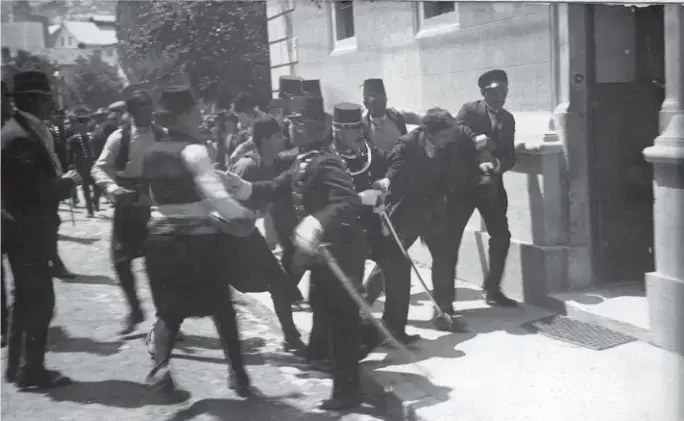
What immediate event sparked World War I?
Annexation of Bosnia by Serbia
Russian invasion of Galicia
Bombing of Sarajevo military depot
Assassination of Archduke Franz Ferdinand
Who carried out the assassination of Archduke Franz Ferdinand on June 28, 1914?
Aleksandar Karađorđević, a diplomat
Gavrilo Princip, a Serbian nationalist
Nedeljko Čabrinović, a Bosnian mayor
Dragutin Dimitrijević, a local merchant
What organization was Gavrilo Princip affiliated with?
The Pan-German League
The Fabian Society network
The Young Turks movement
The Black Hand nationalist group
Why was World War I often called the Great War at the time?
Its positive outcomes for colonized peoples
Its immense scale and devastating fighting
Its short duration compared to past wars
Its limited involvement of civilians
How did World War I affect Western European powers?
It unified them and suppressed independence movements
It weakened them and encouraged colonial nationalism
It isolated them from African and Asian affairs
It strengthened monarchies and reduced unrest
Which region is highlighted as the flashpoint for rising nationalism before World War I?
The Balkans in southeastern Europe
Benelux in western Europe
Scandinavia in northern Europe
The Iberian Peninsula
What broader competition intensified European rivalries leading up to the war?
Competition for transatlantic immigration
Imperial expansion for raw materials
Rivalry over Renaissance art markets
Struggles over medieval trade fairs
Which event directly triggered the July Crisis that escalated into World War I?
Assassination of Archduke Franz Ferdinand
German invasion of Belgium
Sinking of the Lusitania passenger ship
Russian mobilization on the eastern front
Austria-Hungary issued an ultimatum to which government following the Sarajevo assassinations?
Italy’s government in Rome
Serbia’s government in Belgrade
Russia’s government in St. Petersburg
France’s government in Paris
After Serbia rejected the ultimatum, which ally did Austria-Hungary rely on for military support?
Germany’s stronger military power
Britain’s expeditionary forces
Ottoman naval blockade
Italy’s Alpine defenses
Which sequence best represents declarations of war in early August 1914?
Italy on Serbia, then on Britain
Britain on Russia, then on Germany
France on Austria, then on Italy
Germany on Russia, then on France
Serbia sought support primarily from which Slavic-major power during the crisis?
Ottoman Empire for regional stability
Britain for naval supremacy
Italy for Balkan solidarity
Russia as protector of Slavs
Which country declared war on Germany the day after Germany declared war on France?
Japan joined the Allies
Britain entered the war
Italy broke the Triple Alliance
United States mobilized troops
By the end of August 1914, which East Asian power’s entrance helped globalize the conflict?
Siam joining the Central Powers
Korea declaring neutrality
China mobilizing armies
Japan entering the war
What does the acronym MAIN summarize regarding long-term causes of World War I?
Markets, Agriculture, Industry, Navy
Militarism, Alliances, Imperialism, Nationalism
Monarchies, Anarchy, Isolationism, Neutrality
Mandates, Armistice, Inflation, Negotiations
In the context of MAIN, how is militarism defined?
Aggressive military preparedness
Pacifist diplomatic restraint
Civilian control over armies
Limited conscription policies
Why did European powers invest heavily in their militaries before 1914?
To prove strength amid competition
To reduce defense budgets annually
To prepare solely for colonial policing
To comply with international disarmament
Which factor enabled European powers to mass-produce weapons before World War I?
Renaissance revival of classical learning
Agricultural Revolution mechanization of farms
Industrial Revolution advances in manufacturing
Scientific Revolution innovations in chemistry
In the context of pre–World War I Europe, what were secret alliances intended to do?
Secure colonial resources for rivals
Limit naval armament across empires
Hide troop movements from the public
Provide mutual protection among members
Which nations formed the Triple Entente before World War I?
Germany Austria-Hungary Italy
Britain France Russia
France Germany Ottoman Empire
Britain Germany Italy
Which alliance became known as the Allies after more countries joined during the war?
Central Powers including Ottoman Empire
Triple Alliance of Germany-led states
Triple Entente of Britain France Russia
Neutral States of Scandinavia
Which country switched sides in 1915, leaving the Triple Alliance and joining the Allies?
Romania
Italy
Bulgaria
Serbia
Which states joined the former Triple Alliance at the outbreak of the war, forming the Central Powers?
Spain and Norway
Ottoman Empire and Bulgaria
Romania and Greece
Portugal and Serbia
Why did France view Germany as a rival prior to World War I?
Competition for colonies in Africa alone
Defeat in Franco-Prussian War and loss of Alsace-Lorraine
Naval arms race in the North Sea only
Religious conflicts dating to the Reformation
Which statement best explains how alliances increased the risk of a wider war?
They limited conflicts to colonial territories
They discouraged nations from mobilizing quickly
They required members to defend attacked partners
They forced all members to remain neutral
Identify two Allied Powers.
Ottoman Empire and Bulgaria
France and Great Britain
Spain and Norway
Germany and Austria-Hungary
Which countries are Neutral States?
France Great Britain Russia
Germany Ottoman Empire Bulgaria
Italy Romania Serbia
Denmark Switzerland Albania
Which statement best explains how imperialism intensified tensions among Western European powers before World War I?
Religious conflicts replaced political disputes
Trade tariffs reduced economic interdependence
Isolationist policies limited overseas expansion
Competition for African colonies escalated rivalries
In the context of early 20th-century Europe, what immediate event exemplified nationalism as a cause of war?
Assassination of the archduke in June 1914
British naval blockade of German ports
Signing of the Treaty of Versailles in 1919
Formation of the League of Nations in 1920
Self-determination in the Ottoman Empire era referred to which principle?
Peoples of shared identity should form nation-states
Colonies should be governed by appointed viceroys
Empires must retain control over diverse provinces
Monarchs should rule by hereditary succession
Which groups sought independence from imperial rule partly due to limitations imposed by the Ottoman and Austro-Hungarian Empires?
Serbs and Arabs pursued nationhood
Russians and Poles favored monarchies
Germans and Italians expanded empires
British and French resisted alliances
Which long-term cause of the Great War is highlighted alongside imperialism and nationalism?
Alliance system created rival blocs
Mercantilism transformed markets
Pacifism weakened armed forces
Isolationism reduced foreign ties
Which statement describes a major geopolitical outcome of World War I?
Maps of Europe and the Middle East were redrawn
Colonial empires expanded across Africa
Monarchies gained renewed legitimacy
Ottoman power unified the Arab provinces
Which empires collapsed as a result of World War I?
Denmark, Norway, Sweden, Finland
Russia, Austria-Hungary, Germany, Ottoman
Britain, France, Belgium, Netherlands
Spain, Portugal, Italy, Switzerland
Which consequence reflects the global power shift following the Great War?
Power shifted from Europe to the United States
Authority centralized in the German Reich
Leadership transferred to colonial governors
Influence moved from America to Asia
Why did imperial rivalries in Africa contribute to pre-war hostility among European states?
Scramble for land created overlapping claims
Common markets reduced competitive pressure
Religious unity eased diplomatic tensions
Shared governance eliminated border disputes
Which development made World War I uniquely devastating compared to prior conflicts?
Naval battles replaced land engagements
Strict truces prevented civilian involvement
New technologies increased destructive power
Short campaigns limited battlefield casualties
Which alliance comprised Britain, France, and Russia prior to World War I?
Triple Alliance of Central Europe
Triple Entente of major powers
Black Hand military society
Allies formed after 1917
Which term refers to Germany, Austria-Hungary, and their partners during World War I?
Triple Entente states
Allies defensive pact
Central Powers coalition
Secret alliances network
Who assassinated Archduke Franz Ferdinand in Sarajevo in 1914?
A Black Hand leader
Gavrilo Princip assassin
A militarism advocate
An Allied intelligence agent
What immediate effect did the assassination of Archduke Franz Ferdinand have on European politics?
It dissolved secret alliances
It triggered alliance mobilizations
It ended militarism debates
It advanced self-determination
Which concept describes the belief that military strength should dominate national policy?
Allied collective security
Militarism guiding policy
Self-determination ideology
Black Hand nationalism

In the photograph of New Zealand Rifle Brigade soldiers near Gommecourt, what feature illustrates trench warfare conditions?
Mobile armored vehicles
Cramped covered dugouts
Expansive command tents
Open-field artillery positions
After World War I, why did Germany feel furious about the peace settlement?
It accepted sole war guilt
It gained territory from Allies
It lost colonies without reparations
It avoided paying indemnities
What were reparations in the postwar context described?
Payments for war damages
Allied troop withdrawals
Secret diplomatic pledges
Military disarmament clauses
Which unintended consequence followed efforts to make the world safe for democracy after the war?
Strengthened liberal institutions
Immediate global disarmament
Rise of authoritarian regimes
Unified self-determination movements
Which organization is associated with South Slavic nationalism and the Sarajevo assassination?
Black Hand secret society
Triple Alliance committee
Central Powers council
Allies coordinating office
Which characteristic of Germany’s military culture emphasized extreme action by officers to bridge the gap between risk and reality?
Focus on operative over strategic
Disregard of logistics
Minutely technical planning
Romantic ruthlessness and actionism
What belief within Germany’s military culture framed the ultimate objective of warfare?
Limited war to reduce casualties
Negotiated settlements preferred
Annihilation as the sole goal
Defensive stalemate as strategy
Which prescription for correct fighting is specifically mentioned as increasing casualties?
Slow and deliberate maneuvers
Prolonged siege warfare
Offensive with concentration of force
Avoidance of reserves deployment
According to the excerpt, what was often disregarded, contributing to growing unrealism in planning?
Logistics and supply chains
Diplomatic constraints
Civilian morale metrics
Naval blockade effects
Which focus did German military culture prioritize at the expense of broader aims?
Tactical and operative levels
Economic mobilization
Colonial governance
Naval supremacy strategies
Which conviction reinforced willingness to destroy opponents through perceived superiority?
Qualitative superiority over enemies
Moral restraint in engagement
Numerical superiority in manpower
Technological parity with rivals
What extreme acceptance within the culture indicates readiness for mutual destruction?
Endless negotiations and truces
Strict adherence to international law
Sustained attrition without offense
Self-destruction and destroying others
Which element best illustrates minute attention to procedures within the culture?
Minutely technical planning
Grand strategic realignment
Socioeconomic reform plans
Cultural propaganda campaigns
Identify the factor that, combined with imperial competition, contributed to escalating global conflict after 1900.
Alliance systems intensifying commitments
Demobilization across Europe
Isolationism in major powers
Free trade reducing tensions
Which historical dynamic describes how territorial or regional disputes could ignite World War I?
Neutral mediation resolving all disputes
Local crises triggering great-power mobilizations
Colonial autonomy preventing escalation
Trade agreements eliminating rivalries
Which term best describes a formal agreement between states to mutually support one another in peace and war?
Protectorate arrangement among empires
Neutrality pact without obligations
Alliance binding high contracting parties
Mandate system under international law
According to the excerpt, what do the High Contracting Parties promise regarding joining other agreements against a member?
They may join rival coalitions when necessary
They will not enter engagements against any member state
They will permit informal understandings with outsiders
They can sign temporary truces with adversaries
In Article 4, how are the two non-threatened Allies expected to act when a Great Power menaces one Ally?
Conclude a separate armistice to halt escalation
Withdraw from the treaty to avoid entanglement
Observe benevolent neutrality toward the threatened Ally
Declare immediate war on the Great Power
What common procedure is specified in Article 5 when a member’s peace is threatened?
Hold counsel to plan timely military measures
Appeal directly to neutral international courts
Mobilize independently without consultation
Seek separate mediation with the adversary
Which action is explicitly restricted by the final clause of the excerpt?
Negotiating peace with external powers individually
Sharing intelligence among allied ministries
Conducting economic talks with friendly nations
Drafting domestic laws on conscription
Which statement best captures the intended balance of interests within the alliance?
Absolute military integration across all states
Autonomy with mutual support within limits
Complete neutrality regardless of threats
Trade union focused solely on economics
Evaluate why the alliance might deter a Great Power from attacking one member.
Permission for separate armistices during conflict
Obligation for allies to remain benevolently neutral
Requirement to consult and present united decisions
Guaranteed immediate collective invasion response
Which clause most likely aimed to prevent splinter agreements that could weaken the alliance?
Right of each state to join war if it sees fit
Commitment to avoid armistice, peace, or treaty without common agreement
Promise to exchange political and economic ideas
Obligation to observe benevolent neutrality
If one Ally judged it necessary to enter the war, what right does Article 4 reserve?
To dictate terms to neutral states
To resign from the treaty without penalty
To take part in war and make common cause
To impose tariffs on the other allies

