
 Worksheets
Unit 4 Review
Total questions: 96
Worksheet time: 51mins
A state is a synonym for a
territory
country
unit
member
The Kurdish people are examples of which of the following?
A people with a sovereign state.
A nation.
A stateless nation.
A nation-state.
What four states does Kurdistan exist within?
Syria, Lebanon, Jordan, and Armenia
Turkey, Armenia, Iran, and Georgia
Syria, Turkey, Iran, and Iraq
Iran, Iraq, Saudi Arabia, and Israel
What is the largest multinational state?
USA
Indonesia
Russia
China
What two states does the Basque nation exist within?
Northern Spain and France
Southern Spain and Morocco
Catalonia and Spain
Western Spain and Portugal
What is the definition of nation?
People who think of themselves as one based on a shared sense of culture and history and who desire political autonomy.
a state with a single nation
a group of people (a nation) with a common culture occupying a particular territory, but they do not have their own independent state
a state with two or more nations
What is the definition of nation-state?
people who think of themselves as one based on a shared sense of culture and history and who desire political autonomy
a state with a single nation
a group of people (a nation) with a common culture occupying a particular territory, but they do not have their own independent state
a state with two or more nations
What is the definition of a stateless nation?
people who think of themselves as one based on a shared sense of culture and history and who desire political autonomy
a state with a single nation
a group of people (a nation) with a common culture occupying a particular territory, but they do not have their own independent state
a state with two or more nations
What is the definition of a multination state?
people who think of themselves as one based on a shared sense of culture and history and who desire political autonomy
a state with a single nation
a group of people (a nation) with a common culture occupying a particular territory, but they do not have their own independent state
a state with two or more nations
(Unit 4) Eastern Europe during the 1940's through the early 1990's can be identified as a
region dominated by theocracies
region with no political conflicts
homogeneous region
shatterbelt
According to the UN’s Convention on the Law of the Seas (UNCLOS), commercial and military ships of foreign countries must refrain from traveling within how many miles of a country’s coast?
5 nautical miles
12 nautical miles
24 nautical miles
100 nautical miles
200 nautical miles
When a sign is at a border it is a
administered boundary
delimited boundary
demarcated boundary
militarized boundary
superimposed boundary
A state is a synonym for a
territory
country
unit
member
A _________________________ is a state whose territory corresponds to that occupied by one particular ethnicity which has been transformed into a nationality.
nation-state
state
multinational state
trinational state
According to the UN, terrorism is considered to have all but which of the following traits?
Cause death or bodily harm to civilians or noncombatants
Intimidate a population
All violent acts committed against another group of people
Intended to compel a government or an international organization to do or abstain from doing any act
Apartheid
superimposed boundary
a political boundary placed by powerful outsiders on a developed human landscape
a boundary where crossing is unimpeded
a boundary that is heavily guarded and discourages movement; N & S Korea example
a political boundary which dictates territory regained that was once yours previously
demarcated boundary
a political boundary placed by powerful outsiders on a developed human landscape
a boundary identified by a physical object or feature
a boundary that is heavily guarded and discourages movement; N & S Korea example
a political boundary which dictates territory regained that was once yours previously
European Union
an association of European nations formed in 1993 for the purpose of achieving political and economic integration.
a traditionally European desire to create and have a state of ones own
provinces that have been granted a certain degree of political and cultural autonomy, or freedom from centralized authority by the government
a group of people with a common political identity who do not have a territorially defined, sovereign country of their own located in central Europe
balkanization
Process by which a state breaks down through conflicts among its ethnicities
a group of people with a common culture living in a territory and having a strong sense of unity
the shape of a state
The meeting of European imperialist powers to divide Africa among them
subsequent boundary
a political boundary placed by powerful outsiders on a developed human landscape
a boundary identified by a physical object or feature
A boundary drawn after a cultural landscape is already in place
a former boundary line that is still discernible and marked by some cultural landscape features
fragmented state
a state whose territory contains isolated parts, separated and discontinuous
a state that completely surrounds another
provinces that have been granted a certain degree of political and cultural autonomy, or freedom from centralized authority by the government
Conflict over the location or place of a boundary
U.N.
international organization formed in 1945 to increase political and economic cooperation among 193 member countries.
An internal organization of a state that allocates most powers to units of local government.
an association of European nations formed in 1993 for the purpose of achieving political and economic integration.
the parts of the ocean in which no government has sovereignty
antecedent boundary
a boundary line established before the area in question is well populated such as a physical feature
a boundary identified by placing a physical object or feature to denote the boundary
A boundary drawn after a cultural landscape is already in place
a former boundary line that is still discernible and marked by some cultural landscape features
prorupted state
a state whose territory contains isolated parts, separated and discontinuous
a state that completely surrounds another
an otherwise compact state with a large projecting extension
Conflict over the location or place of a boundary
compact state
a state whose territory contains isolated parts, separated and discontinuous
a state that completely surrounds another
an otherwise compact state with a large projecting extension
a state that possesses a roughly circular, oval, or rectangular territory in which the distance from the geometric center is relatively equal in all directions
Organic Theory
Created by Friedrich Ratzel. The view that states resemble biological organisms with life cycles that include stages of youth, maturity, and old age.
Created by Halford MacKinder. Hypothesis proposed by Halford MacKinder that held that any political power based in the heart of Eurasia could gain enough strength to eventually dominate the world.
Created by Nicholas Spykman. The theory that the domination of the coastal fringes of Eurasia would provided the base for world conquest.
Proposed by Harry Truman. The political theory that if one nation comes under Communist control then neighboring nations will also come under Communist control
Heartland Theory
Created by Friedrich Ratzel. The view that states resemble biological organisms with life cycles that include stages of youth, maturity, and old age.
Created by Halford MacKinder. Hypothesis proposed by Halford MacKinder that held that any political power based in the heart of Eurasia could gain enough strength to eventually dominate the world.
Created by Nicholas Spykman. The theory that the domination of the coastal fringes of Eurasia would provided the base for world conquest.
Proposed by Harry Truman. The political theory that if one nation comes under Communist control then neighboring nations will also come under Communist control
Rimland Theory
Created by Friedrich Ratzel. The view that states resemble biological organisms with life cycles that include stages of youth, maturity, and old age.
Created by Halford MacKinder. Hypothesis proposed by Halford MacKinder that held that any political power based in the heart of Eurasia could gain enough strength to eventually dominate the world.
Created by Nicholas Spykman. The theory that the domination of the coastal fringes of Eurasia would provided the base for world conquest.
Proposed by Harry Truman. The political theory that if one nation comes under Communist control then neighboring nations will also come under Communist control
Multistate nation
a group of people with a common culture living in a territory and having a strong sense of unity
A state whose territory corresponds to that occupied by a particular ethnicity that has been transformed into a nationality
nation that transcends the borders of two or more states
An area organized into a political unit and ruled by an established government with control over its internal and foreign affairs.
State
a group of people with a common culture living in a territory and having a strong sense of unity
A state whose territory corresponds to that occupied by a particular ethnicity that has been transformed into a nationality
nation that transcends the borders of two or more states
An area organized into a political unit and ruled by an established government with control over its internal and foreign affairs.
exclusive economic zone EEZ
the seazone extending 200 nautical miles from the coast over which a state has special rights as to the exploration and use of marine resources
Between 12 and 24 nautical miles from shore, a state may enforce laws concerning pollution, taxation, customs, and immigration
A boundary that follows the distribution of cultural characteristics.
Attempt by one country to establish settlements and to impose its political, economic, and cultural principles in another territory.
territorial sea
the seazone extending 200 nautical miles from the coast over which a state has special rights as to the exploration and use of marine resources
Between 12 and 24 nautical miles from shore, a state may enforce laws concerning pollution, taxation, customs, and immigration
up to 12 nautical miles of sovereignty; commercial vessels may pass, but non-commercial vessels may be challenged
water beyond 200 nautical miles open to all states
The motives of European states in establishing colonies can be summarized in all but which of the following?
guilt
gold
glory
god

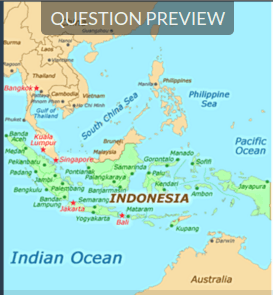
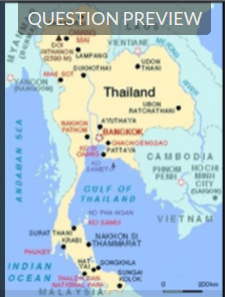

ASEAN [Association of Southeast Asian Nations] is a collective group of states that seeks to create a collaborative group to promote the goals and aims of countries in Southeast Asia. This is an example of...
a supernational organization
a supranational organization
devolution states
sanctuary states
unitary states
A small state such as Switzerland might benefit from a _____ system of government, whereas a large state such as Russia might benefit from a ______ system of government
unitary / federal
democratic / autocratic
federal / unitary
autocratic / democratic
city-state / nation-state

Albania seeks to unify the lands that many Albanians consider to form their national homeland, based on claims on the present-day or historical presence of Albanian populations in those areas. This is an example of...
anocracy
a unitary system
fragmented state
irredentism
devolution

Nation State
Japan; Iceland
Nation
The Irish; the Cherokee
Stateless Nation
Palestinians; Kurds
Multistate Nation
Korea
Multination State
The United States; Canada
Nations are a group of (a) bound together by some sense of a (b) (c) , ethnicity, language, shared (d) , and attachment to a (e) .
These areas take up a specific (a) on Earth’s surface and contains a (b) population.

Name the correct region.
United States
Brazil
Mexico
Canada

What country is in red?
Panama
Costa Rica
Nicaragua
Mexico

What country is in yellow?
Panama
Bahamas
Jamaica
Cuba

What country is in blue?
Bahamas
Jamaica
Bermuda
Puerto Rico

What country is in green?
Belize
El Salvador
Guatemala
Honduras

Based on the map, which of the following can be identified as a true statement about Northern Ireland?
It forms its own sovereign nation-state predominately made up of the Irish ethnic group.
It is physically separate from the rest of the United Kingdom, a multinational state.
It is a frontier that is not formally part of a state, but the United Kingdom claims the area.
It is a stateless nation, as the entire island of Ireland is under the control of the United Kingdom.
It is united with the rest of the island to form a sovereign nation-state.

Not subject to or bound by religious rule is
secular
inhumane
atheist
When a state has __________________, it means it had control over its internal affairs without interference from other states. It is independent.
self-determination
sovereignty
immunity
diplomacy

