
NEW
Font size
 Worksheets
Cell Communication Quiz
Total questions: 15
Worksheet time: 22mins
A particular cell signaling pathway requires a hormone that is released into the bloodstream and travels to target cells. Scientists learned that not all cells respond to the hormone. Which of the following best explains why some cells do not respond to the hormone?
Some cells lack regulators
Some cells lack cholesterol
Some cells lack hormone receptors
Some cells lack embedded proteins
Insulin is a protein hormone that is secreted in response to elevated blood glucose levels. When insulin binds to its receptors on liver cells, the activated receptors stimulate phosphorylation cascades that cause the translocation of glucose transporters to the plasma membrane. Based on the information provided, which of the following best describes the role of insulin in this liver cell signal transduction pathway?
It acts as a ligand
It acts as a receptor
It acts as a second messenger
It acts as a protein kinase
Which of the following steps in a signaling pathway typically occurs first once a chemical messenger reaches a target cell?
Specific genes are activated
A second messenger molecule is produced
A ligand binds to a receptor
Specific proteins are synthesized
When protein membrane receptors are activated, what usually happens?
A change occurs on only one membrane surface: exterior or interior
The receptor changes conformation after binding with signal polypeptides
A change occurs in intracellular ion concentration
The receptor preferentially binds with lipid or glycolipid signal molecules
The receptors open and close in response to protein signals
During a fight-or-flight response, epinephrine is released into the body’s circulatory system and transported through the body. Some cells exhibit a response to the epinephrine while other cells do not. Which of the following justifies the claim that differences in components of cell signaling pathways explain the different response to epinephrine?
Cell signaling depends on the transduction of a received signal by the nervous system. Not all cells are close enough to a synapse to receive the signaling and response
Cell signaling depends on the signal being able to diffuse through the cell membrane. Epinephrine is incapable of diffusing through some plasma membranes because of the membrane’s phospholipid composition
Cell signaling requires reception, transduction, and response. All cells can receive epinephrine, all cells respond with a pathway, but only select cells have the proper coding in their DNA to respond
Cell signaling depends on the ability to detect a signal molecule. Not all cells have receptors for epinephrine. Only cells with such receptors are capable of responding
Type 1 diabetes results from the destruction of insulin-producing cells in the pancreas. Individuals with type 1 diabetes produce insufficient amounts of insulin, a hormone that regulates the concentration of glucose in the blood. Which of the following best explains how treatment with a drug that stimulates the production of insulin receptors on target cells will affect the insulin signaling pathway in an individual with type 1 diabetes?
The drug will have little or no effect on the signaling pathway because the receptors will not be activated in the absence of insulin
The drug will have little or no effect on the signaling pathway because insulin receptors will not be allowed to enter the cell
The drug will restore the function of signaling pathway because insulin levels will return to normal
The drug will restore the function of the signaling pathway because nonpancreatic cells will begin to produce insulin receptors
When a neuron responds to a particular neurotransmitter by opening gated ion channels, the neurotransmitter is serving as which part of the signaling pathway?
Relay molecule
Receptor
Endocrine molecule
Transducer
Signal molecule
The function of a phosphatases in signal transduction is best described as
Amplify the transduction signal so it affects multiple transducers
Move the phosphate group of the transduction pathway to the next molecule of a series
Prevent a protein kinase from being reused when there is another extracellular signal
Amplify the second messengers such as cAMP
Inactivate protein kinases and turn off the signal transduction
Which of the following is the greatest advantage of having multiple steps in a transduction pathway?
Having multiple steps provides for greater possible amplification of a signal
Each step can be activated by several G proteins simultaneously
Having multiple steps in a pathway requires the least amount of ATP
Many of the steps can be used in multiple pathways
Each individual step can remove excess phosphate groups from the cytoplasm
Which of the following is true of steroid receptors?
The concentration of steroid receptors must be relatively high in most cells
The unbound steroid receptors are quickly recycled by lysosomes
The receptor may be inside the nuclear membrane
The receptor molecules are themselves lipids or glycolipids
The receptor molecules are free to move in and out of most organelles

tyrosine kinase receptor
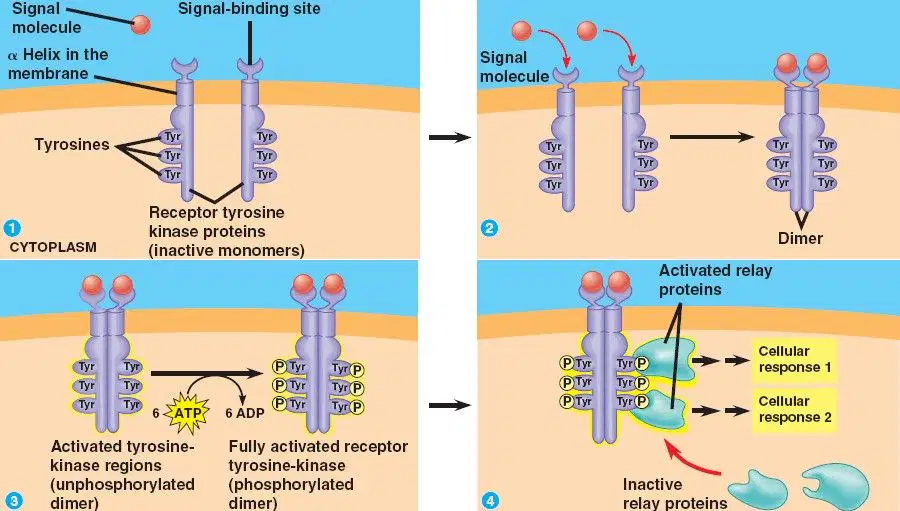
tyrosine kinase receptor

What is the correct order of the steps shown in the diagram?
transduction, reception, response
reception, transduction, response
response, reception, transduction
reception, response, transduction
When protein membrane receptors are activated, what usually happens?
A change occurs on only one membrane surface: exterior or interior
A change occurs in intracellular ion concentration
The receptor changes conformation after binding with signal polypeptides
The receptors open and close in response to protein signals
The receptor preferentially binds with lipid or glycolipid signal molecules
Which of the following best describes a signal transduction pathway?
Binding of a signal molecule to a cell protein
Catalysis mediated by an enzyme
Sequence of changes in a series of molecules resulting in a response
Binding of a ligand on one side of a membrane that results in a change on the other side
The cell’s detection of a chemical or mechanical stimulus

