
 Worksheets
IoT Architecture Layers
Total questions: 70
Worksheet time: 43mins
Which IoT layer primarily gathers real-world data using sensors and actuators?
Perception layer at the physical edge
Application layer user interfaces
Transport layer networking backbone
Processing layer middleware services
What is the main role of the transport layer in a five-layer IoT architecture?
Stores and analyzes incoming data
Delivers services through interfaces
Designs business profit strategies
Transfers sensor data between layers
Which set lists technologies commonly used in the transport layer?
ERP, CRM, analytics suites
React, Flutter, mobile SDKs
Wi‑Fi, GSM, LoRa, Zigbee
SQL, NoSQL, MapReduce tools
In the architecture pyramid, which layer manages the whole IoT system including profit models?
Business management and strategy layer
Perception physical sensing layer
Transport networking communication layer
Processing data analytics middleware
Which statement best describes the processing layer’s responsibility?
Displays services via user interfaces
Stores, analyzes, and processes data
Transfers packets to cloud gateways
Collects field data through sensors
A soil moisture sensor measuring field water content belongs to which layer?
Application delivery interfaces layer
Transport network communication layer
Perception physical sensing layer
Processing analytics middleware layer
Which pair correctly matches layer to function?
Application layer—data packet routing
Transport layer—system profit modeling
Processing layer—data storage and analysis
Perception layer—business dashboards
If moisture data must reach cloud analytics, which sequence is logically correct?
Transport → Perception → Application
Processing → Transport → Business
Perception → Business → Transport
Perception → Transport → Processing
Selecting between GSM and Wi‑Fi to send sensor readings is a decision at which layer?
Transport network communication layer
Processing analytics middleware layer
Business strategy modeling layer
Application service delivery layer
Which component would most likely reside at the perception layer in smart irrigation?
Enterprise billing reports
Water valve actuator device
Mobile app user interface
Cloud data warehouse cluster
Which layer is primarily responsible for delivering application services to users via interfaces?
Application layer with UI services
Perception physical sensing layer
Transport network communication layer
Business strategy management layer
An engineer needs to analyze incoming sensor streams and trigger rules. Which layer should host this middleware?
Business layer managerial tools
Transport layer radio links
Perception layer field sensors
Processing layer data middleware
Which layer in an IoT system is also referred to as the middleware and focuses on storing, analyzing, and processing data from the network layer?
Application layer handling user interfaces
Processing layer serving as middleware
Business layer managing profit models
Network layer routing sensor packets
What is the primary function of the application layer in an IoT architecture?
Aggregate sensor data at gateways
Optimize enterprise billing and reporting
Deliver user interaction and control services
Store raw telemetry and make decisions
Which component best fits the processing layer in the given IoT example?
Mobile app used by the farmer
Cloud server performing analysis
Edge sensor measuring moisture
Web dashboard for visualization
In the irrigation scenario, which action exemplifies the processing layer’s role?
Checking soil moisture threshold to decide irrigation
Generating quarterly business reports
Routing packets through the network
Displaying moisture on a mobile app
Which two components are listed for the application layer?
Data analytics and billing tools
Sensors and actuators
Cloud server and gateway
Mobile app and web dashboard
Which statement best describes the business layer’s responsibility?
Provide direct sensor-to-cloud connectivity
Offer user interface controls for operators
Perform packet switching and addressing
Manage entire IoT system decisions and optimization
Which output is most associated with the business layer in the farming use case?
Moisture sensing at the field nodes
Reports on water usage and cost savings
Real-time mobile notifications
Threshold-based irrigation commands
If the farmer needs to view irrigation status, which layer provides this capability?
Processing layer running cloud logic
Network layer handling transmission
Application layer through user interfaces
Business layer optimizing resources
Which sequence correctly orders responsibilities from data analysis to organizational decision-making across the upper IoT layers?
Network → Processing → Application
Application → Business → Processing
Business → Processing → Application
Processing → Application → Business
Which statement best defines Machine-to-Machine (M2M) communication?
Devices exchange data automatically without humans
Servers store data and operators analyze it later
Humans remotely control devices using dashboards
Machines communicate only through physical connectors
In M2M systems, what is the primary role of the Device/Machine Layer?
Routing packets across wide networks
Long-term data archiving in cloud
User interface rendering for operators
Data generation and sensing at the edge
Which component belongs to the Device/Machine Layer in an M2M architecture?
Temperature sensor measuring process heat
Wi‑Fi router providing local connectivity
Ethernet switch aggregating traffic flows
Remote server performing analytics tasks
A temperature threshold is exceeded in an industrial machine. What happens next in a typical M2M setup?
Server requests calibration from field technicians
Network layer immediately shuts down all links
Data is prepared for transmission by the device
Operator manually logs the event in a ledger
What is the core function of the Communication/Network Layer in M2M?
Compute control algorithms for actuators
Render graphics for monitoring dashboards
Transfer data between machines and servers
Generate sensor readings from processes
Which set lists technologies used by the Communication/Network Layer?
PLC, MCU, thermal relays
Ethernet, RS‑485, GSM/GPRS
CAD tools, digital twins suites
SCADA HMI, OPC UA servers
Choose the best wireless option for sending sensor data to a remote server in an M2M system.
GSM or Wi‑Fi for wireless transfer
PLC or MCU for embedded logic
RS‑485 or CAN for serial links
Ethernet switch for wired backbone
An engineer must schedule periodic uploads of temperature readings. Which approach aligns with M2M communication behavior?
Batch once per month during maintenance
Send only when operators request data
Transmit at fixed intervals or continuously
Store locally and never transmit externally
Which statement best describes the role of the Gateway layer in an M2M system?
Provides user dashboards and control panels
Acts as a bridge between devices and core network
Implements rule engines for alert generation
Stores historical data for long-term analysis
A gateway converts sensor protocols to IP-based protocols. What function does this illustrate?
Alert generation using threshold rules
Database storage for received measurements
User notification through mobile applications
Protocol conversion within data aggregation
Which task is NOT a gateway function?
Collects data from multiple machines
Connects local devices to internet or cloud
Provides security and authentication
Runs dashboards for user interaction
The Data Management/Service layer primarily handles which set of operations?
Edge filtering and sensor calibration procedures
User dashboards, mobile apps, control panels
Local device connectivity and protocol conversion
Database storage, analysis, rules, alerts
A server stores temperature values and triggers alerts when a rule is met. What rule suits this scenario?
If mobile app opens then collect location
If temperature exceeds safe limit then alert
If device connects to gateway then authenticate
If dashboard loads successfully then notify
Which component belongs to the Application layer?
Sensor protocol conversion to IP-based formats
Central database archiving raw measurements
Rule engine executing threshold evaluations
Web dashboards for monitoring and control
A factory manager receives an SMS during overheating and can remotely shut down the machine. Which layers are directly involved?
Application for authentication, Gateway for data analysis
Data Management for protocol conversion, Gateway for rules
Gateway for dashboards, Application for storage
Application for interaction, Data Management for alerts
Which sequence correctly describes data flow from sensors to user action in this M2M example?
Sensors → Gateway → Data Management → Application
Sensors → Application → Gateway → Data Management
Gateway → Sensors → Application → Data Management
Data Management → Sensors → Gateway → Application
If a gateway aggregates temperature data from many machines and forwards summarized data to a local server, what advantage does this provide?
Ensures users can design mobile interfaces
Reduced bandwidth and centralized processing
Guarantees alerts never occur in operation
Eliminates need for security authentication
Which statement best characterizes M2M compared to IoT?
Cloud-centric with web services
Device-centric with local control
User-centric with mobile apps
Network-centric with edge gateways
What is the typical connectivity model used in IoT systems?
Serial bus over RS-485
Internet and cloud networks
Point-to-point local links
Private non-IP radio
Which architecture description aligns with IoT rather than M2M?
Application specific and fixed layers
Peer-to-peer isolated nodes
Layered and scalable design
Single-tier on local server
In M2M deployments, human interaction is generally
Continuous operator supervision
Minimal or none typically
Moderate through web portals
High via apps and dashboards
Which data processing approach is most associated with IoT?
Manual batch reporting
On-device rule engines
Local server processing
Cloud-based analytics
A factory wants remote monitoring, multi-site scaling, and user dashboards. Which approach fits best?
IoT with cloud integration
Traditional M2M local links
Proprietary fieldbus only
Standalone PLC networks
Which statement correctly contrasts IP usage in M2M versus IoT?
Both rely on proprietary non-IP
M2M often non-IP proprietary
IoT avoids IP for security
M2M strictly public internet
Which statement best describes the Web of Things?
A model using bespoke IoT protocols for control
A cloud-only platform for virtualized device twins
A framework using standard web technologies for devices
A database storing sensor logs for analytics only
What problem does WoT primarily address in IoT ecosystems?
Absence of encryption in wireless networks
Limited battery capacity across devices
Inconsistent device interoperability across protocols
Lack of onboard storage in edge sensors
Which pair correctly matches WoT with its enabling web standards?
HTTP with REST-style APIs
SSH with SFTP tunnels
RPC with FTP file transfers
SMTP with IMAP mail endpoints
In WoT, how are physical devices commonly exposed?
As binary blobs in message queues
As web resources accessible via URLs
As firmware images downloadable over TFTP
As spreadsheet rows in online tables
Which protocol set illustrates heterogeneity that complicates IoT interoperability?
TLS, SSL, DTLS
SMTP, POP3, IMAP
HTTP, HTTPS, REST
MQTT, CoAP, ZigBee
Select the most accurate equation expressing the WoT concept.
IoT times cloud services equals WoT
IoT minus network layers equals WoT
IoT plus web standards equals WoT
IoT plus proprietary gateways equals WoT
A thermostat is reachable at https://home.example/thermostat. What WoT idea does this illustrate?
Sensor data encoded as raw binary only
Firmware updates delivered via email attachments
Devices modeled as URL-addressable resources
Control limited to vendor mobile applications
Why do REST APIs help with device interoperability in WoT?
They eliminate the need for authentication
They replace all wireless radios with Ethernet
They provide uniform resource access patterns
They enforce vendor-specific packet formats
If two devices speak MQTT and CoAP respectively, how can WoT help them interoperate with the same web app?
Require identical firmware on both devices
Disable protocol features to match capabilities
Translate both to standardized web interfaces
Force migration to a single radio technology
Which item best represents the "Things" component in a Web of Things architecture?
HTTP routers and REST gateways
Web browsers and client interfaces
Cloud dashboards and analytics tools
Sensors, actuators, smart devices
Which HTTP method is most appropriate for creating a new resource in a RESTful Web API?
POST when submitting new data
DELETE when updating a resource
GET when retrieving resource state
PUT when deleting existing data
In WoT, which element typically exposes device capabilities for remote access?
Firmware binaries on endpoints
Web APIs using REST interfaces
Peer-to-peer radio bridges
Native mobile driver libraries
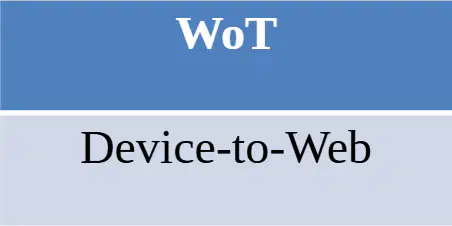
Which comparison accurately distinguishes WoT connectivity from IoT connectivity?
Both use device-to-web connectivity exclusively
IoT uses device-to-device, WoT uses device-to-web
IoT uses device-to-web, WoT uses device-to-device
Both use device-to-device connectivity primarily
Which protocol stack aligns with WoT rather than traditional IoT?
MQTT and Zigbee transport layers
HTTP and REST application layer
CoAP and LoRaWAN gateways
Bluetooth LE mesh profiles
Why might WoT offer higher interoperability compared to typical IoT deployments?
It relies on proprietary vendor ecosystems
It standardizes on web technologies
It eliminates browser-based interfaces
It restricts access to specialized apps
Which statement best describes an IP address in computer networks?
A human-friendly device nickname
A unique numerical label for each device
A reusable session token for browsers
A physical serial number on hardware
What are the two main purposes of an IP address?
Encrypt data and compress packets
Identify a device and locate it
Allocate RAM and schedule CPU time
Authenticate users and store passwords
At which OSI layer does IP addressing primarily operate?
Transport layer for end-to-end control
Data link layer for frame formatting
Application layer for user services
Network layer for routing and delivery
Which pairing correctly matches the IP version to its address size?
IPv6 uses 24-bit addresses
IPv4 uses 32-bit addresses
IPv6 uses 32-bit addresses
IPv4 uses 16-bit addresses
A router must forward a packet to the correct destination. Which IP addressing purpose enables this action?
Device authentication on login
Physical port enumeration
Logical location for routing
Session persistence for apps
Which scenario best illustrates logical addressing in practice?
A MAC address burned into a NIC
A hostname stored in local DNS cache
An IP address used to reach a remote server
A QR code labeling a rack-mounted switch
What is the primary function of the Application layer in an IoT architecture?
Data routing and packet management
User interface and interaction management
Data storage and historical analysis
Device connectivity and communication
Which technology is commonly used for low-power, long-range communication in IoT devices?
Bluetooth Low Energy
Zigbee
LoRaWAN
Wi-Fi
In an IoT system, what is the role of the Data Management layer?
To facilitate device-to-device communication
To manage data storage, processing, and analytics
To ensure security and authentication protocols
To provide user interfaces for data visualization
Which layer is responsible for ensuring data integrity during transmission in an IoT system?
Transport layer
Application layer
Network layer
Perception layer

