
NEW
Font size
 Worksheets
Age of Jackson
Total questions: 45
Worksheet time: 23mins
Which statement describes the outcome of the Nullification crisis of 1832?
The power of the federal government was challenged by the states.
The federal government used the military to enforce the laws.
Northern states protested price increases of imported goods.
Congress passed the Tariff of Abominations.
Which statement describes the outcome of the Nullification crisis of 1832?
The power of the federal government was challenged by the states.
The federal government used the military to enforce the laws.
Northern states protested price increases of imported goods.
Congress passed the Tariff of Abominations.

Use the information below to answer the question that follows. In 1828, the South Carolina legislature issued a protest against a tariff passed by the United States Congress. The protest stated:
"The good people of this Commonwealth believe that the powers of Congress were delegated to it . . . for the accomplishment of certain specified objects which limit and control them, and that every exercise of them, for any other purposes, is a violation of the Constitution."
What principle did the South Carolina legislature use in support of its protest?
laissez-faire
states’ rights
judicial review
separate but equal
Use the information below to answer the question that follows. In 1832, President Andrew Jackson issued a proclamation after South Carolina rejected a tariff enacted by the United States Congress. In his proclamation, President Jackson wrote that South Carolina’s act was based "on the strange position that any one State may not only declare an act of Congress void, but prohibit its execution . . . [and that the Constitution] permits a State to retain its place in the Union, and yet be bound by no other of its laws than those it may choose to consider as constitutional." Which statement BEST describes how Andrew Jackson viewed South Carolina’s action?
He thought that it was only justified if other states did the same thing.
He disagreed with its claim that states had the right to nullify federal laws.
He saw it as a threat to the government’s effort to create a command economy.
He believed that it gave the Supreme Court’s power of judicial review to the states.
What argument was used by those in the United States who opposed the use of protective tariffs in the 1800s?
The use of protective tariffs was unconstitutional.
Tariffs made it more expensive to use slave labor.
Tariffs benefitted manufacturers but not farmers.
The use of tariffs reduced the price of manufactured goods.
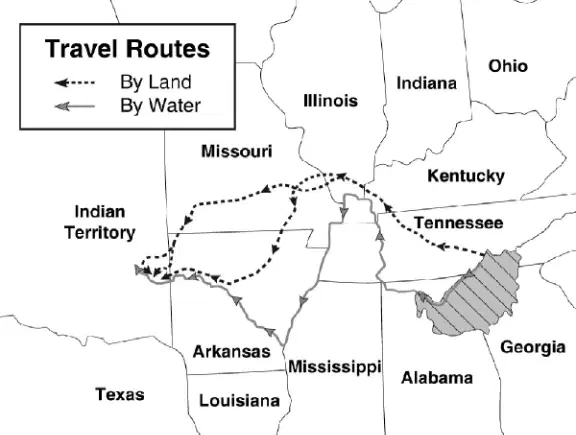
Use the map to answer the question. The travel routes on the map indicate the travel paths of which group?
Mormons on their trek westward
Cherokees on the Trail of Tears
African Americans on the Great Migration
Lewis and Clark on their exploration of the Louisiana Territory
Although the Supreme Court ruled against the state of Georgia in Worcester v. Georgia, why were the Cherokee relocated to the Indian Territory?
Georgia landowners seized their land and forced them to migrate westward.
State representatives refused to enforce the Supreme Court ruling.
The federal government forced them out under the Indian Removal Act.
They sold their land to Georgia developers to escape persecution.

Use the information below to answer the question. Timeline: 1828 — Georgia enacts laws to strip Cherokee of their rights under the laws of the state; Georgia legislature annuls Cherokee constitution. 1830 — Indian Removal Act authorizes the federal government to negotiate treaties with eastern tribes where eastern lands are exchanged for western lands. 1831 — Cherokee Nation v. Georgia declares tribes are “domestic dependent nations.” 1832 — Worcester v. Georgia rules the federal government, and not the states, has jurisdiction over Indian territories. 1838 — Trail of Tears begins when President Martin Van Buren orders the army to remove remaining tribal members to Indian Territory. What conclusion can be drawn about the federal government’s role in Indian removal?
The federal government gave states power to remove Cherokee tribes.
The federal government refused to protect Cherokee lands from white settlers.
The legislature supported Cherokee leaders’ lawsuits against the state of Georgia.
The legislature continued supporting a policy of Cherokee assimilation.

Use the charts below to answer the question. Which conclusion is BEST supported by the information in the charts?
Women secured the right to vote in federal elections after 1824.
The repeal of property restrictions allowed more adult men to vote by 1828.
Many states began extending voting rights to free blacks after 1828.
The influence of political parties diminished during the 1820s.
What was one significant factor that contributed to the election of Andrew Jackson as president in 1828?
the removal of property qualifications for voting
the extension of voting rights to free blacks
the passage of woman suffrage laws in numerous states
the collapse of the two party political system

Use the excerpt below to answer the question. “I consider, then, the power to annul a law of the United States, assumed by one State, incompatible with the existence of the Union, contradicted expressly by the letter of the Constitution, unauthorized by its spirit, inconsistent with every principle on which it was founded, and destructive of the great object for which it was formed.” —President Andrew Jackson, 1832 President Andrew Jackson’s defense of the Union in the above statement placed him in opposition to which group?
those wishing to protect Cherokee lands from seizure by Georgia
those arguing for the nullification of the Tariff of 1828
those wishing to secede in order to protect slavery
those arguing to extend voting rights to women

Use the excerpt below to answer the question. “Should its [the National Bank’s] influence become concerted [concentrated] . . . in the hands of a self-elected directory whose interests are identified with those of the foreign stockholders, will there not be cause to tremble for the purity of our elections in peace and for the independence of our country in war?” —Andrew Jackson, Veto of the Bank of the United States Recharter Bill, 1832 Based upon the quote, what was one reason President Andrew Jackson opposed the existence of the National Bank?
He argued that the bank’s power might inflict harm on the country.
He believed that the bank limited economic growth in the northern states.
He saw the bank as an extension of British politics into the new nation.
He determined that the bank enabled the expansion of slavery in the South.
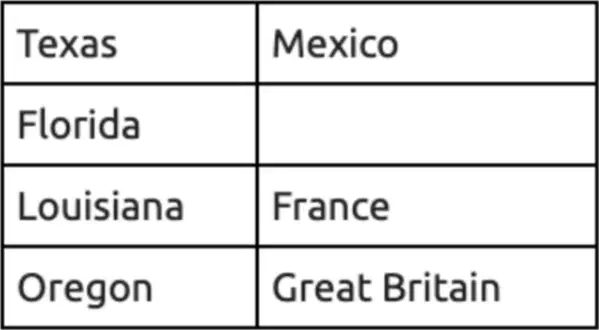
Which of the following completes the table above? Table shows pairs: Texas — Mexico; Florida — [blank]; Louisiana — France; Oregon — Great Britain.
Spain
Portugal
Russia
Netherlands
Which of the following completes the table above? Table shows pairs: Texas — Mexico; Florida — [blank]; Louisiana — France; Oregon — Great Britain.
Spain
Portugal
Russia
Netherlands
Use the information below to answer the question that follows. • It benefited the rich more than it helped the common people • It centralized financial power in a single institution • It favored commercial centers in the Northeast more than the agrarian South and West Which title BEST describes the information listed above?
Reasons for the Decision in the Gibbons v. Ogden
Reasons for Establishing the Department of the Treasury
Reasons Why Andrew Jackson Opposed a National Bank
Reasons Why Henry Clay Supported the American System
Choose the name that completes the sequence of U.S. presidents: Washington; Adams; Jefferson; Maddison; Monroe; J Q Adams; ______.
Jackson
Tyler
Harrison
Van Buren
The right to vote
Sectionalism
Voterism
Suffrage
Nationalism
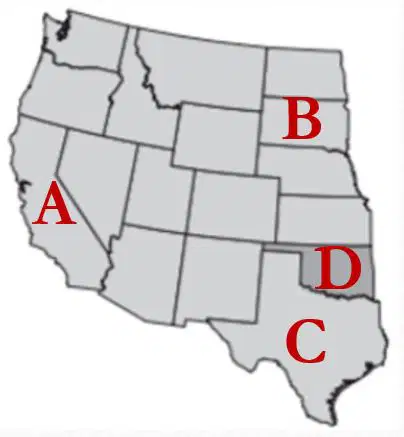
What shaded area is the final destination of the natives during "the trail of tears"
a
b
c
d
What was the primary question surrounding the 1832 Nullification Crisis?
Can the federal Government regulate interstate commerce
Can a state regulate a federal agency
Can a state overturn a federal law
Can the federal government levy taxes
What was the issue in Worcester v. Georgia?
Taxation of Cherokee
the Cherokee farming
Cherokee Culture
Cherokee a sovereign nation
Which is not a nickname of Andrew Jackson? (supporters and opposition)
Common Man
Old Hickory
His Rotundity
King Andrew
Select one of the following that does not relate to Andrew Jackson’s presidency.
Nullification Crisis
Indian Removal
Destroying National Bank
Adding Texas to United States
Which of the following was not part of the Early Republic (first five presidents)?
George Washington
John Adams
Thomas Jefferson
Andrew Jackson
Use the information below to answer the question. Economic Activities in the United States between 1833 and 1837: National Bank Charter expired; State banks issued many loans; Speculation in western lands increased; President Jackson announced that the government would only accept hard currency for land payments; British banks called in American loans. What effect did these activities have on the American economy?
The United States experienced a devastating economic panic.
The United States began establishing a sphere of influence in Asia.
The United States began favoring paper money over gold.
The United States economy became dependent on Europe for loans.
In 1832, a convention in South Carolina issued an "Ordinance of Nullification" in reaction against tariffs enacted by the United States Congress. What principle did advocates of nullification use to support their cause?
due process
states’ rights
judicial review
separate but equal
Why was the Northwest Ordinance of 1787 important to an expanding United States?
It allowed southern states to maintain their land claims west of the Mississippi River.
It gave the federal government the right to remove Native American tribes from the region.
It provided a peaceful and orderly way to add states to the nation.
It maintained the balance between slave and free states.
Use the information below to answer the question. Northwest Ordinance of 1787 • Appointed governor, secretary, and judges for the territory • When population reached 5,000 free males of age, territory would be allowed one non‑voting member in Congress • When population reached 60,000, a state constitution should be drafted What conclusion can be drawn about the impact of the Northwest Ordinance of 1787 on the expansion of the United States?
It protected the expansion of slavery into the states.
It provided an orderly process for accepting new states into the Union.
It provided options for setting up state governments.
It established guidelines for trade with neighboring states.
In what way did the Northwest Ordinance of 1787 contribute to growing sectionalism within the United States?
It allowed states in the territory to vote on slavery.
It outlawed slavery within the new territories.
It protected Native American land claims within territorial boundaries.
It granted women voting rights within the territories.
Jamestown was established in
1607
1608
1807
1776
What was the Native American tribe in Florida that fought removal for 10 years
Cherokee
Seminole
Chickasaw
Creek

Which President is associated with the Indian
Removal Act?
Andrew Johnson
Andrew Jackson
Abraham Lincoln
George Washington

Under this Act signed by Andrew Jackson, Native Americans were forced to leave their homes.
The Homestead Act
Kansas-Nebraska Act
The Indian Removal Act of 1830
Indian Reorganization Act
What kind of document was needed to force American Indians to go away from their homelands?
a lawsuit
a newspaper
a treaty
no documents were needed.
When the US forced the Cherokee to march across America (the Trail of Tears),
more than half of the US troops died in the process
Bit strengthened America's relationship with the British
nearly a quarter of the Cherokee population died
it brought the Cherokee to newer, better lands
Why was the Indian Removal Act passed by Congress?
To allow Native Americans to vote
To make room for settlers to live on the land
To protect the buffalo
To create national parks
How many miles long was the Trail of Tears?
1
10
100
1000
What general rounded up the Native Americans for their journey?
General Jordon Ballinger
General Winfield Scott
General George Washington
The Supreme Court ruled that the U.S. should protect the Cherokee and their lands in
Which region felt the tariffs imposed during the presidency of Andrew Jackson were unfair and should be nullified?
North
South
Northwest Territory
West

Which of the following correctly completes this graphic organizer?
President Jackson annexes land west of the Mississippi River.
President Jackson ignores a Supreme Court ruling.
President Jackson introduces a bill to Congress.
President Jackson vetoes an act passed by Congress.

The account above is told from the point of view of-
a southern slave
a Native American
an indentured servant
a Chinese immigrant

