
 Worksheets
Final
Total questions: 58
Worksheet time: 29mins
Name
Class
Date
1.
Write your first and last name.
4 lines
2.
What did the French want to establish in the Americas?
a)
a fishing and fur trade
b)
new communities
c)
gold and silver mines
d)
defeat the Spanish
3.
Which explorer's crew was the first to sail around the world?
a)
Ferdinand Magellan's
b)
Bartholomeu Dias's
c)
Henrey Cabot
d)
Christopher Columbus
4.
Which of these events did the Indian Removal Act cause?
a)
Trail of Tears
b)
French and Indian War
c)
Missouri Compromise
d)
Civil War
5.
The Jamestown settlers found a way to make a profit for their investors by planting
a)
corn
b)
tobacco
c)
rice
d)
cotton
6.
How many United States Senators are there?
a)
50
b)
100
c)
200
d)
1,000
7.
People who refuse to use force or fight in wars are called
a)
pacifist
b)
loyolist
c)
patroons
d)
regular
8.
Who wrote Pennsylvania's first constitution?
a)
Oliver Cromwell
b)
King George
c)
William Penn
d)
Patrick Henry
9.
Which colony was created so debtors and poor people could start over?
a)
North Carolina
b)
South Carolina
c)
Georgia
d)
New Jersey
10.
The House of Representatives contains how many members?
a)
135
b)
235
c)
335
d)
435
11.
Which of the following was a reason that caused Shays's Rebellion?
a)
Americans were forced to allow soldiers to live in their homes
b)
Shays wanted America to return to Britain's rule
c)
Southern States were not allowed to participate in the Constitutional Convention
d)
Farmers had their lands seized and were jailed for being unable to pay debt
12.
Which branch of government carries out the laws?
a)
Legislative Branch
b)
Executive Branch
c)
Judicial Branch
d)
Media Branch
13.
To what colony did the English send a fleet to attack and acquire in 1664?
a)
New York
b)
New Hampshire
c)
Pennsylvania
d)
Maryland
14.
What was the Winter of 1609-1610 in Jamestown known as?
a)
The Dying Time
b)
The Desperate Time
c)
The Starving Time
d)
The Forgotten Time
15.
A group of civilians trained to fight in emergencies is called
a)
Milita
b)
Army
c)
Navy
d)
a confederacy
16.
What proposal sought to unite the American colonies against the French?
a)
Albany Plan of Union
b)
Bill of Rights
c)
United States Constitution
d)
Treaty of Paris
17.
The Seven Years' War was a war between (French and Indian war)
a)
France and Native Americans.
b)
France and Britain.
c)
France and Spain.
d)
France and Ireland
18.
Labor for the Southern rice fields was provided by
a)
Children
b)
enslaved Africans
c)
Natives
d)
paid workers
19.
Which of the following states was acquired by the United States from Mexico after the Mexican-American War?
a)
Maine
b)
Vermont
c)
New Hampshire
d)
California
20.
What plan called for one general government for all the American colonies?
a)
the Albany Plan
b)
Treaty of Paris
c)
Unionism
d)
Articles of confederation
21.
How many justices are on the Supreme Court?
a)
9
b)
6
c)
3
d)
8
22.
Which of the following is NOT a strength of the Articles of Confederation?
a)
Could pass laws that affected all states
b)
Congress had the power to deal with foreign affairs, declare war, make peace and sign treaties
c)
Could coin money
d)
Only one vote per state, regardless of size.
23.
The Proclamation of 1763 prohibited colonists from moving west of the
a)
Mississippi River
b)
Appalachian Mountains
c)
Great Lakes
d)
Louisiana Territory
24.
The leg of the triangular trade route in which enslaved Africans were shipped to the West Indies and the America's was known as the
a)
Last passage
b)
Middle Passage
c)
slave passage
d)
final leg
25.
What branch of government creates the laws?
a)
Executive Branch
b)
Judicial Branch
c)
Media Branch
d)
Legislative Branch
26.
What is the Bill of Rights?
a)
The first ten amendments of the Constitution
b)
The third paragraph of the Declaration of Independence
c)
The first ten paragraphs of the Olive Branch Petition
d)
The table of contents in Common Sense
27.
What act taxed almost all printed material in the colonies?
a)
Hatch Act
b)
Sugar Act
c)
Declaratory Act
d)
Stamp Act
28.
Who led the Green Mountain Boys?
a)
Ben Franklin
b)
Ethan Allen
c)
George Washington
d)
Henry Knox
29.
Which of the following was a point of the Monroe Doctrine?
a)
All world affairs are the responsibility of the U.S.
b)
Britain had to pay reparations from the War of 1812
c)
U.S. would eventually conquer all of Europe
d)
Europe was not to get involved in the Western Hemisphere
30.
Who refused to receive the Olive Branch Petition?
a)
King George III
b)
Ben Franklin
c)
Thomas Gage
d)
William Howe
31.
What was the Olive Branch Petition?
a)
Peace letter sent to the King
b)
Letter demanding war to the King
c)
Letter written to the 13 colonies from the king
32.
The man who wrote the Declaration of Independence was
a)
Patrick Henry
b)
James Madison
c)
Thomas Jefferson
d)
John Jay
33.
Who ran the first post office established by the Second Continental Congress?
a)
John Adams
b)
Harry Truman
c)
Ben Franklin
d)
Richard Henry Lee
34.
Who wrote Common Sense?
a)
Thomas Paine
b)
Thomas Jefferson
c)
Samuel Adams
d)
John Hancock
35.
Which of the following is NOT a platform that the Federalists had?
a)
Strong federal government
b)
State representation in government proportional to population
c)
Central banking system
d)
Strong state governments
36.
To search a colonist's house, a British customs officer presented
a)
an arrest warrant.
b)
a letter from the king.
c)
a writ of assistance.
d)
a charter.
37.
The Missouri Compromise drew a line between slave states and what other kind of states?
a)
Free State
b)
Liberated State
c)
Patriot State
d)
Citizen State
38.
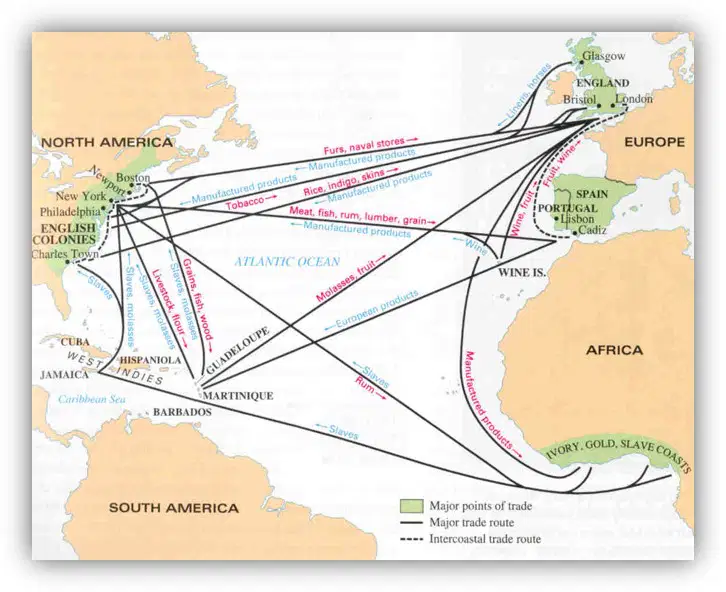
What was the name of the type of trade between Europe, Africa, and the Americas? This trade involved slaves, finished products and natural resources.
a)
Mercantilism
b)
Expropriation
c)
Triangular
d)
Commercial
39.
Which act gave the British Parliament the right to tax and make decisions for the colonies "in all cases"?
a)
Declaratory Act
b)
Townshed Act
c)
Coercive Act
d)
Sugar Act
40.
New York, New Jersey, Pennsylvania and Delaware are all:
a)
New England colonies
b)
Middle colonies
c)
Southern colonies
41.
Massachusetts, New Hampshire, Rhode Island and Connecticut are all:
a)
New England colonies
b)
Middle colonies
c)
Southern colonies
42.
Which type of government is ruled by a king or queen?
a)
Theocracy
b)
Monarchy
c)
Democracy
d)
Oligarchy
43.
Virginia, Maryland, N. Carolina, S. Carolina and Georgia are all:
a)
New England colonies
b)
Middle colonies
c)
Southern colonies
44.
Which of the following countries did Texas fight for its independence?
a)
United States of America
b)
Mexico
c)
Canada
d)
England
45.
Colonial leaders used the Boston Massacre killings as
a)
a call for peace with England
b)
propaganda
c)
a reason to go home and start
d)
way to punish soldiers
46.
The shot heard 'round the world" refers to the actions of the minutemen at
a)
Trenton
b)
Princeton
c)
Lexington
d)
Bunker Hill
47.
Which colonists did not consider unfair taxes a good reason for rebellion?
a)
Loyalist
b)
Patriot
c)
Pacifist
d)
Neutral
48.
What is the name of the idea that Americans had a divine right to expand throughout the continent?
a)
Divine Patriotism
b)
Manifest Destiny
c)
Liberty's Fate
d)
Continental Dominion
49.
Which colonists wanted to fight the British for American independence?
a)
Patriots
b)
Loyalist
c)
Pacifist
d)
Neutral
50.
The colonists expressed their desire for peace in the
a)
Olive Branch Petition.
b)
Boston Massacre.
c)
Tea Party
d)
Continental Colors.
51.
The French announced support for the United States after the American victory at
a)
Trenton
b)
Montreal
c)
Monmouth Courthouse
d)
Saratoga
52.
Which of the following is NOT a reason that caused the War of 1812?
a)
Impressment
b)
Trade
c)
U.S. desiring Mexican land
d)
U.S. desiring Canadian land
53.
After the arrival of Europeans, many Native Americans died because of
a)
War
b)
overcrowded condtions
c)
disease
d)
old age
54.
Who signed the Indian Removal Act?
a)
James Madison
b)
James Monroe
c)
Andrew Jackson
d)
James K. Polk
55.
What is the name of the first college founded in North America?
a)
Princeton
b)
Standford
c)
Yale
d)
Harvard
56.
The Second Continental Congress put who in charge of the Army?
a)
John Hancock
b)
George Washington
c)
Patrick Henry
d)
Sam Adams
57.
The First Continental Congress met where?
a)
New York City
b)
Savannah, Georgia
c)
Trenton, NJ
d)
Philadelphia
58.
Where did the Pilgrims Land?
a)
Charleston, South Carolina
b)
Roanoke, North Carolina
c)
Plymouth, Massachusetts
d)
Jamestown, Virgina
100 %

