
 Worksheets
AVOP DA YYZ
Total questions: 138
Worksheet time: 1hrs 14mins
1.2 - Airside Surfaces
What is the movement area?
Runways and Taxiways only.
The portion of the airside used for the movement of aircraft. This portion is further divided into the Apron and Maneuvering Areas.
1.2 Airside Surfaces -
What is the Apron Area?
Accommodates the loading and unloading of passengers and cargo, the refueling, servicing, maintenance, and parking of aircraft, and any movement of aircraft, vehicles, and pedestrians necessary for such purposes.
1.2 Airside Surfaces -
What is the maneuvering area?
Service Roads and ENT/EXTs where AVOP holders operate and maneuver with their vehicles.
Used for the takeoff, landing, and taxiing of aircraft. It includes runways, taxiways, high speed exits (taxiways enabling aircraft at high speeds to safely exit from runways), and apron entrances/exits (apron and taxiway intersections).
Used for takeoff, landing of aircraft, limited to runways, taxiways, and aprons only.
It is the same as the apron.
What are additional airside areas at Toronto Pearson? (Choose all correct)
Infield Tunnel
General Aviation North Area
Security Booths
Central Deicing Facility
FedEx Apron
What are additional airside areas at Toronto Pearson? (Part 2)
Runway Threshold
Bombardier Facility
Construction Sites
3 Bay/Sky Service and Cargo locations (East, West)
2.3 Red and White pavement markings pertain to
Aircraft only
Pedestrians only
Vehicles, equipment, and pedestrians
GSE (Ground Service Equipment) only.
2.3 - Passenger Path Lines are:
Yellow solid lines identifying a crosswalk for passengers between the terminal building and aircraft. Used for commuter airplanes only when there's no bridge available.
White or Green markings identifying a safe path for passengers walking between the terminal and an aircraft parked on the apron
White only markings identifying a safe path for passengers walking between the terminal and an aircraft parked on the apron.
Green crosswalks identifying a safe path for passengers on the apron between the terminal building and designated aircraft parking areas.
2.3 When driving on Passenger path lines:
Driving over these lines when aircraft are on the associated gate and passengers and/or crew are present is prohibited. Parking on these lines at any time is strictly prohibited.
Driving over these lines are always prohibited. Passengers can be present on these lines even when an aircraft hasn't parked yet and it is very dangerous to approach these lines at any time.
You can always drive and park on these lines as you have the right of way as a staff over passengers at any time. Just notify passengers to stand out of the way.
You can't access these lines as an AVOP DA permit holder, so it doesn't matter.
2.3 Apron Safety Lines are:
Identifying a safe area for loading and unloading passengers in case there isn't a bridge associated with the gate area.
Designated area for parking GSE equipment for a maximum of 45 minutes turnaround time.
White markings indicating an adequate area for safe staging (short-term parking) locations for equipment and vehicles only. Equipment staging areas are located to the right of the aircraft (R1/R2 doors) or right side of the gate when entering from the tail of stand corridor.
Red hatched markings indicating an adequate area for safe staging (short-term parking) locations for equipment and vehicles only. Equipment staging areas are located to the right of the aircraft (R1/R2 doors) or right side of the gate when entering from the tail of stand corridor.
2.3 Red Hatched Markings -
Indicating areas where Aircraft needs to stop and ask for clearance from ATC before proceeding. Solid red lines at intersections. Prohibited to drive through or near them as an AVOP DA holder.
Indicating areas that may be driven upon but not parked on. Exercise caution when driving on these markings.
Indicating areas that may be driven and parked on in case there's no sky bridges above them.
Adequate area for short-term staging. Only GSE can be parked on these areas.
2.3 - White Boxes are:
Markers defining designated parking spaces for vehicles and equipment in the gate area.
Markers defining designated parking spaces for GSE only.
Markers defining designated parking spaces for aircraft
Markers defining designated parking spaces for emergency vehicles only.
2.3 Rules for white boxes:
Only designated vehicles or equipment may park in these locations. The area outside these boxes but within the Apron Safety Lines is reserved for staging (short-term parking) vehicles and equipment exclusively.
It is for long-term parking. Anybody can park in these locations as long as they are a valid AVOP permit holders and turn-off their engines, lights and beacons prior to leaving the vehicle in the white parking boxes.
White parking boxes are for aircraft parking only. They mark the area in front of the terminal where clearance must be given to aircraft upon approaching the gate area.
Only designated GSE may park in these locations. The area outside these boxes but within the Apron Safety Lines is reserved for staging (short-term parking) vehicles and equipment exclusively.
2.3 - Rolling Stock Staging Lines are:
White in color. Inside safety lines. No parking. For the purpose of baggage staging/operations.
Red in color. Inside safety lines. Short-Term parking. For the purpose of baggage staging/operations.
White in color. Outside safety lines. No parking. For the purpose of baggage staging/operations.
Yellow broken in color. Inside safety lines. No parking. For the purpose of baggage staging/operations.
2.3 Equipment Restraint Lines:
White single lines identifying aircraft gating areas.
Equipment restraint lines are painted at the head and sides of aircraft stands only.
Red single lines identifying aircraft gating areas.
Equipment restraint lines are painted at the head and sides of aircraft stands only.
Red single lines identifying aircraft gating areas.
Equipment restraint lines are painted at the tail and sides of aircraft stands only.
Red hatched lines identifying aircraft gating areas.
Equipment restraint lines are painted at the head and sides of aircraft stands only.
2.3 Equipment Restraint Lines rules are:
Drivers may drive through these areas when aircraft are entering or exiting the gate or being pushed back from the gate.
Drivers may not drive through these areas at all times.
Equipment is not to be left unattended in these areas.
Drivers may not drive through these areas, but equipment can be left inside the restraint lines as long as they're attended.
Drivers may not drive through these areas when aircraft are entering or exiting the gate or being pushed back from the gate.
Equipment is not to be left unattended in these areas.
2.3 Ground Service Equipment (GSE) Parking Boxes
Yellow solid lines for GSE parking only.
White dashed markings within Apron Safety Lines identifying designated, tenant-specific parking areas for that tenant’s vehicles and GSE.
Red solid lines marking outside the apron safety lines. Only for GSE, no tenant parking is allowed.
White dashed markings within Apron Safety Lines identifying designated for GSE only.
2.3.1 - Pavement Markings for aircraft on the apron are all:
White and Yellow
Yellow only
Red and Yellow
Lights only for better visibility and winter conditions. Be careful since there's no specific pavement marking for aircraft at all. Only lights for guidance.
2.3.1 Aircraft Stand Markings are:
Identifying designated taxiing positions for aircraft to approach gates or designated parking position. (Aircraft stands are usually located at aircraft gates but can be located anywhere on the apron that aircraft park and, in some instances, for enplaning and deplaning passengers.
Identifying designated parking positions for aircraft. (Aircraft stands are usually located at aircraft gates but can be located anywhere on the apron that aircraft park and, in some instances, for enplaning and deplaning passengers.)
2.3.1 Aircraft lead-in lines are marked by:
solid or broken yellow lines guiding aircraft to aircraft gates.
solid or dotted red lines guiding aircraft to aircraft gates.
dotted or dashed yellow lines guiding aircraft to aircraft gates.
dashed or solid white lines guiding aircraft to aircraft gates.
2.3.1. What is the Aircraft Stand Taxilane?
A portion of the apron designated as a taxilane that provides access to aircraft stands.
2.3.1. How are Aircraft Stand Taxilanes marked?
A single yellow line identifying the center of an aircraft stand taxilane. Low visibility routes are outlined in black
2.3.1.1. How are vehicle corridors marked?
by parallel solid white lines.
by single solid white lines.
by parallel solid yellow lines.
by parallel checkered white and black lines (where the corridor crosses an apron entrance or aircraft stand taxilane).
2.3.1.1 - Checkered Corridors are...
Checkered corridor markings are a visual reminder to be extra vigilant for aircraft traffic crossing your path.
Checkered corridor markings are for AVOP D permit holders only.
Checkered corridor markings are only present in the Infield Tunnel.
There's no checkered corridors at Toronto Pearson.
2.3.1.1. - In both cases of corridor markings the lines are...
spaced 1.5 m apart
spaced 7.5m apart
divided by a broken line
divided by a solid line
2.3.1.1 - Non-standard vehicle corridors are single-lane corridors that connect to a main corridor and are marked by two solid white lines; however, these lines:
are spaced 4m apart. have no dividing broken lines.
are spaced 8 m apart and have no dividing broken lines.
are spaced 2m apart.
are spaced 6m apart. divided by broken white lines.
2.3.1.1 - Vehicle corridors at Toronto Pearson are identified as:
Tail of stand corridor, which:
a corridor that runs parallel to a terminal or cargo facility, at the outer boundary of the aircraft stands where the tail of aircraft ends.
that runs perpendicular to the terminal building, used primarily for fueling vehicles and ground support equipment.
located inside the terminal, connecting departure gates to baggage claim areas.
positioned between aircraft stands, designed to allow aircraft to maneuver independently without pushback assistance.
2.3.1.1. - Vehicle corridors at Toronto Pearson are identified as:
Outer perimeter corridor:
the corridor that runs between apron entrances DP and DV along the outer edge of the apron.
the corridor that runs between apron entrances AK and AM along the outer edge of the apron.
the corridor that runs between apron entrances AD and AM along the outer edge of the apron.
the corridor that runs between apron entrances AD and DV along the outer edge of the apron.
2.3.1.1. - Vehicle corridors at Toronto Pearson are identified as:
Connecting corridors:
any corridor that crosses an aircraft stand taxilane marking and connects to a main corridor (i.e., Tail of Stand or Outer Perimeter Corridor). Connecting corridors are marked by parallel checkered black and white lines.
any corridor that crosses emergency standby points on the airside
any corridor between AD and DP
as an AVOP DA holder you will not be allowed to use connecting corridors as these might be crossed by airplanes and you're only allowed to drive on the aprons without nearing any aircraft that isn't safely parked and docked.
2.3.1.1 -Vehicle corridors at Toronto Pearson are identified as:
Terminal Access Corridors:
road above gating areas with a 10km h limitation
road where aircraft tails might overhang drive with caution and with no more than 40km h
connecting Tail of Stand corridors to terminal building head of stand roads.
connecting all corridors with stop and yield signs proceed with caution only when driving on the access corridors.
2.3.1.1 -Vehicle corridors at Toronto Pearson are identified as:
Aircraft Tail Overhang Markings:
are indicated by single broken orange line, bordered by solid white. They indicate a vehicle corridor that may be affected by the tail of an aircraft while gated. Although the speed limit in these areas remains 20 km/h, drivers encountering such vehicle corridors are to proceed with caution.
are indicated by red broken and three orange lines, bordered by solid white
are indicated by three broken orange lines, bordered by solid white. They indicate a vehicle corridor that may be affected by the tail of an aircraft while gated. Although the speed limit in these areas remains 40 km/h, drivers encountering such vehicle corridors are to proceed with caution.
are indicated by two broken orange lines, bordered by solid white. They indicate a vehicle corridor that may be affected by the tail of an aircraft while gated
2.3.1.1 -Vehicle corridors at Toronto Pearson are identified as:
Head of Stand Roads:
Roads following the front of the terminal buildings along heads of stands. With the exception of airside busses, some Emergency Service and maintenance vehicles, large vehicles and trucks are prohibited from using head of stand roads. Use of Head of Stand roads is strictly limited to vehicles with an operational requirement.
A roadway located within a terminal building used for accessing inbound and outbound baggage belts.
These roads have a height restriction of 4 metres due to overhead structures.
These roads have a height restriction of 4.5 metres due to overhead structures.
2.3.1.1 -Vehicle corridors at Toronto Pearson are identified as:
Terminal Service Road:
A roadway located near a terminal building used for accessing safe staging areas. Use of a Terminal Service Road is strictly limited to vehicles with an operational requirement.
A roadway located within a terminal building used for accessing inbound and outbound areas for emergency purposes only. Use of Terminal Service Road is strictly limited to emergency vehicles.
A roadway located within a terminal building used for accessing inbound and outbound baggage belts. Use of a Terminal Service Road is strictly limited to vehicles with an operational requirement.
You cannot use a terminal service road as an AVOP DA holder.
2.3.1.1- Yield lines on the pavement are marked by:
Dashed yellow lines, but they're also marked with triangle signs on left and right sides of the corridors.
single white line, 45cm wide, spanning one lane of a vehicle corridor identifying where drivers must yield to oncoming traffic.
Dotted red lines and yield signs on the left of the corridor.
Solid blue lines and no actual road signs on either side of the corridors.
2.3.1.1 - Stop signs are marked with:
A Yield Line that has a standing stop sign to signal drivers to stop.
2.3.1.1 - Closed Corridors:
Either a broken white line spanning an entire vehicle corridor, or the word CLOSED painted in large white letters may be used to indicate that a corridor section is closed. Safety cones and/or barriers or signage may be used to indicate a temporary corridor section closure.
Either a single yellow line spanning an entire vehicle corridor, or the word RESTRICTED painted in large white letters may be used to indicate that a corridor section is closed. Safety cones and/or barriers or signage may be used to indicate a temporary corridor section closure.
Either a single white line spanning an entire vehicle corridor, or the word CLOSED painted in large white letters may be used to indicate that a corridor section is closed. Safety cones and/or barriers or signage may be used to indicate a temporary corridor section closure.
Either a double white line spanning an entire vehicle corridor, or the word CLOSED painted in large white letters may be used to indicate that a corridor section is closed. Safety cones and/or barriers or signage may be used to indicate a temporary corridor section closure.
2.3.1.1 Universal Load Devices (ULD) parked in lower deck ULD boxes must comply with the .............. clearance requirement.
7 ft
2 m
14 f
4 m
2.3.1.1 - Intermediate Holding Position Marking:
Single broken yellow lines indicating the intersection of two taxiways where designating a specific holding limit is desired. These markings are also used to identify apron entrances.
Intermediate Holding Position Marking is marked by double amber lines and upon crossing over them clearance from the ATC is mandatory.
Intermediate Holding Position Marking is a signal for takeoff. They aren't marked.
Double yellow lines indicating the intersection of two taxiways where designating a specific holding limit is desired. These markings are also used to identify apron entrances.
2.3.1.1 - Taxi side strip markings are
Two broken yellow lines 15 cm wide and spaced 15 cm apart, indicating the edge of aircraft load- bearing surfaces
Two solid yellow lines 15 cm wide and spaced 15 cm apart, indicating the edge of aircraft load- bearing surfaces
One single solid yellow line 25 cm wide.
Three solid yellow lines 15 cm wide and spaced 25 cm apart, indicating the edge of aircraft load- bearing surfaces
2.3.1.1. - Taxiway Centreline Marking is:
The taxiway centreline is a single continuous yellow line. This provides a visual cue to permit taxiing along a designated path.
The taxiway centreline is a single continuous green line. This provides a visual cue to permit taxiing along a designated path.
The taxiway centreline is a double continuous yellow line. This provides a visual cue to permit taxiing along a designated path.
The taxiway centreline is a double continuous red and green line. This provides a visual cue to permit taxiing along a designated path.
2.3.2.1 Airside Lighting:
Apron Edge Lights are:
Apron Edge Lights are used for runway illumination with blue flashing lights.
Apron Edge Lights indicate taxiway boundaries and they're yellow.
Blue lights identifying the edge of the apron.
Apron Edge Lights serve as parking guidance for vehicles. Flashing amber lights.
2.3.2.1 Airside Lighting:
Aircraft Stand Taxilane Centreline Lights:
Blue lights on the aircraft stand taxilane centreline extending from the apron entrances to the point where the aircraft manoeuver for parking on the aircraft stand.
Yellow lights on the aircraft stand taxilane centreline extending from the apron entrances to the point where the aircraft manoeuver for parking on the aircraft stand.
White flashing lights on the aircraft stand taxilane centreline extending from the apron entrances to the point where the aircraft manoeuver for parking on the aircraft stand.
Green lights on the aircraft stand taxilane centreline extending from the apron entrances to the point where the aircraft manoeuver for parking on the aircraft stand.
2.3.2.1 Airside Lighting:
Taxiway and an Apron Intersection light colours are:
Double Yellow lights.
Blue Lights.
Pair of Red lights.
Double Amber lights.
2.3.2.1 Airside Lighting:
Service Road Position Lights:
Identified by a pair of single red lights on each side of the road and used to identify a service road intersecting a taxiway, apron or runway.
Identified by a single red lights on the left side of the road and used to identify a service road intersecting a taxiway, apron or runway.
Identified by a pair of blue red lights on each side of the road and used to identify a service road intersecting a taxiway, apron or runway.
Identified by a pair of single magenta lights on each side of the road and used to identify a service road intersecting a taxiway, apron or runway.
BONUS: Wig-Wags are what colour?
Double Flashing Amber
2.3.2.2 - Other Lights:
Obsturction Lights:
An amber light(s) showing an area of construction or marking an obstruction.
A red light(s) showing an area of construction or marking an obstruction.
A blue light(s) showing an area of construction or marking an obstruction.
A double amber light(s) showing an area of construction or marking an obstruction.
2.3.3 - Signs:
Can a person mark or erect any traffic sign or device at the airport?
No, a person cannot mark or erect any traffic sign or device.

2.3.3.1 - Traffic and No Smoking Signs:
Vehicle Stop Markings
Vehicle Stop Markings at the intersection of horseshoe corridors.
Vehicle Stop Markings at the beginning of Runways.
Vehicle Stop Markings at the beginning of gating areas.
Vehicle Stop Markings at the end of the tail.
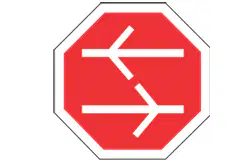
2.3.3.1 - What is this sign?
Aircraft Manuevering signs are placed in connecting corridors to alert drivers that they are about to cross an aircraft stand taxilane and to give right of way to aircraft.
This sign is only for AVOP D permit holders.
These signs are usually placed in front of active runways and alert drivers to proceed with caution as aircraft might be approaching from sides marked on the sign. as an AVOP DA holder you need to ask for clearance before proceeding if you see this sign anywhere.
Aircraft Warning Signs are placed in vehicle corridors to alert drivers that they are about to cross a live aircraft stand taxilane and to be extra vigilant. All vehicles must give way, stopping well clear if aircraft are approaching, otherwise drivers may continue to cross. Symbol indicates direction of aircraft travel.
2.3.3.2 - Sign Placement
Traffic signs are not necessarily posted to the right of vehicle corridors. For example, stop signs may be posted on the left-hand side to accommodate aircraft clearance requirements. Approach all intersections with caution.
Traffic signs are only posted to the right of vehicle corridors. For example, stop signs may be posted on both the pavement and on the right-hand side to accommodate aircraft clearance requirements. Approach all intersections with caution.
There's no signs at the airport, only pavement markings.
All signs are placed on the left-hand side only.
Where are no smoking signs placed?
All around the airport
Near the terminal buildings only
T1, T3, Hangars and IFT only
Airside Locations
As an AVOP DA permit holder, you accidentally pass one of these signs:
Apron Entrance off to the taxiway,
Location signs on the taxiway,
or Location and Mandatory Hold signs beyond the apron, which marks entering or crossing a runway.
What do you do in any of these unfortunate situations?
Stop immidiately and call Airport Emergency Line at 416-776-3033.
Report the incident to your supervisor after quickly leaving the area by safely managing a U-Turn.
Speed up to avoid any potential conflict with other vehicles and/or aircraft.
You see the following sign: Black background, and two yellow letters, for ex: AD
What is it?
Apron Entrance, located at taxiway and aprons intersections.
Apron Exit only
Aircraft Stand Marking
Aircraft Taxiway sign
You see the following sign: Black background, and a single yellow letter, for ex: A
What is it?
Location sign, on taxiways.
Terminal marking signs
Outer Perimeter Road Marking Sign
Runway Location sign
You see the following sign: Red background, white letters, for ex: 33R-15L
What is it?
Location, Mandatory Hold. On taxiways at runway intersections.
2.3.4 Infield Tunnel:
The Infield Tunnel links the...
The Infield Tunnel links T1 and T3 underground for easier baggage running.
The Infield Tunnel links the main terminal aprons on the east side of the airport and infield areas on the west side.
The Infield Tunnel links the main terminal aprons on the north side of the airport and infield areas on the south side.
The Infield Tunnel links the main terminal aprons on the west side of the airport and infield areas on the north side.
2.3.4 - The Infield Tunnel is divided into two sections...
the North Cell containing two westbound lanes.
the Southeast cell containing two eastbound lanes.
the South Cell containing two eastbound lanes.
the West Cell containing two northbound lanes.
TRUE OR FALSE:
The West and East portals identify, respectively, the West and East entrances to the Tunnel. The Tunnel has a maximum height clearance of 4.65 m.
True, but the maximum height clearance is only 4 m.
False, all above is incorrect.
True, all above is correct.
True, but the entrances are South and East.
2.3.4 - Infield Tunnel
Vehicles strictly prohibited from using the Tunnel are those carrying:
More than 3 passengers
Slow vehicles
Dangerous or volatile cargo that is not properly packaged for delivery to an aircraft.
More than 480 litres of fuel.
More than 400 litres of fuel.
The left lane of each Tunnel cell is a passing lane reserved for the use of .................. . Busses are prohibited from passing in the Infield Tunnel.
emergency vehicles and for general vehicle passing
baggage handling vehicles
tankers
bikes
2.3.4 - Infield Tunnel.
Can you stop in the infield tunnel?
No, never. If there's a FOD you should call 416-776-3055.
Except in emergencies and for the purpose of removing Foreign Object Debris (FOD)
Only in emergencies, if there's a FOD you should call 416-776-3055.
Only with a D permit, otherwise you cannot stop.
What is the following safety feature in the Infield Tunnel:
Embedded Vehicle Sensors:
These control automatic traffic signals at the entry to each portal.
What is the following safety feature in the Infield Tunnel:
Lane Usage Signs:
Located above each of the four travel lanes, these signs indicate lane availability. A green arrow indicates an open lane. A red X indicates a lane closure. If both lanes in a cell are closed, the open cell shall accommodate two-way traffic.
What is the following safety feature in the Infield Tunnel:
Tunnel Cell Crossover
Seven alarmed red emergency crossover doors are available for pedestrian use between the North and South Cells. Each emergency crossover door is identified by a blue light. These doors shall be used during emergencies only.
What is the following safety feature in the Infield Tunnel?
Fire Telephone Cabinets
There's no fire telephone cabinets since there's no signal in the tunnel.
Located at each crossover door, fire telephone cabinets contain an intercom and a pull station
Located one on each side of the tunnel.
6 in total in the infield tunnel for emergency calls.
True or False:
Normal two-way radio and cell phones may not function within the Tunnel. In the event of a vehicle failure, contact Airport Operations Control (AOC) via the intercom at the nearest emergency crossover door.
True
False
2.4.1. Central Deicing Facility
True or False
Central Deicing Facility Vehicles operating on the Central Deicing Facility (CDF) apron may access Pads 2, 3, and 4 via the vehicle corridors. Access to all other areas must be coordinated through Pad Control––especially vehicles entering the CDF from the Manoeuvring Area.
True
False
2.4.1. What are Deicing pads?
Surfaces upon which aircraft are deiced.
2.4.1. Deicing Facility, Safety Zones:
5m to 15m wide strips of pavement separating pads and providing clearance for deicing vehicles, light posts, and glycol refilling stations.
15m to 20m wide strips of pavement separating pads and providing clearance for deicing vehicles, light posts, and glycol refilling stations.
10m to 15m wide strips of pavement separating pads and providing clearance for deicing vehicles, light posts, and glycol refilling stations.
7m to 20m wide strips of pavement separating pads and providing clearance for deicing vehicles, light posts, and glycol refilling stations.
3.2 Accessing the Airside.
How to access?
Pass through security, pick up your vehicle at a designated gate by your manager, and leave the terminal are using the corridors.
You can only access the airside at Vista Cargo.
Drivers access the airside at one access point by Fedex facilities, contracted security guards are stationed in a guard booth at this access point and verify each driver’s Restricted Area Identity Card (RAIC), Airside Vehicle Operator’s Permit (AVOP), and need and right of entry.
Drivers access the airside at airside access points. Contracted security guards are stationed in guard booths at these access points and verify each driver’s Restricted Area Identity Card (RAIC), Airside Vehicle Operator’s Permit (AVOP), and need and right of entry.
3.3 - What is NPS-V?
Non-Passenger Screening for Vehicles
Non-Permanent Screening for Vehicles holding a temporary permit only
NPS-V is a security booth where all staff has to undergo security checks before entering the restricted area such as passengers in the terminal building.
Is the following true for NPS-V?
Drivers will first approach the verification booth and come to a full stop at the stop sign. A driver’s RAIC will then be verified as well as all occupants in the vehicle by security personnel before being given directions via the electronic display located below each stop sign at the booth.
True
False
Is the following true for NPS-V?
Even if the green arrow is illuminated, drivers must stop first before proceeding. When driving in these areas, be aware of increased pedestrian activity as well as merging traffic. Failing to stop for screening when directed to do so is a violation of the Canadian Aviation Security Regulations and may result in enforcement action against the driver.
True
False
What should vehicle operators use to reach field locations when these roads are available?
Terminal Access Roads
Inner Perimeter Road
South Service Road
Service and Outer Perimeter Roads
3.5 Speed Limits:
Airside Service Roads limit is...?
25/12
15/5
50/25
30/15
3.5 Speed Limits:
Infield Tunnel limit is...?
50/25
30/15
40/20
50, since in the tunnel there's no low visibility speed requirment.
3.5 Speed Limits:
Within vehicle corridors limit is...?
40/20
50/25
10/5
25/12
3.5 Speed Limits:
Head of Stand Road limit is...?
25/12
50/25
10/5
20/10
3.5 Speed Limits:
Terminal Access Corridors limit is...?
20/10
15/5
10/10
25/12
3.5 Speed Limits:
General Aviation North Area Apron/ Outside vehicle corridors (open apron) limit is...?
50/25
20/10
25/12
25/10
3.5 Speed Limits:
Within 6m of a parked aircraft/congested area limit is...?
10/5
25/12
20/10
40/20
Speed limit on Terminal service roads is...?
10/5
10/10
5/5
25/12
True or False:
DA permit holders driving on aprons and other uncontrolled areas are not required to operate VHF radios while driving airside. However, if a vehicle is equipped with a VHF radio, drivers shall listen continuously to the appropriate radio frequency while on the Movement Area.
True
False
True or False:
If a vehicle corridor is obscured for any reason, conform to the designated roadway as closely as possible, and exercise caution.
True
False
True or False:
On aprons where vehicle corridors are non-existent, be aware of equipment, pedestrians, aircraft, and all other vehicles and proceed within the solid white line located at the tail of an aircraft when it is clearly safe to do so.
True
False
3.6.1.1. Entry and Exit.
At what angle should you enter and exit vehicle corridors?
at Right angles (90 degrees)
45 degrees
doesn't matter
25 degrees
What should vehicle operators use when transiting more than one gate?
Aprons
Connecting Corridors
Vehicle Corridors
Flashers
Can you cut through gates to access the head of stand roadway?
Yes
No
Vehicle operators transiting between terminal areas shall use the ..................... Using the ....................... minimizes traffic around the terminals, thereby providing safer transit for airside busses and baggage operations.
Service Roads
Connecting Corridors
Aprons
Outer Perimeter Corridor
Are there one-way corridors?
Yes
No
3.6.1.4. - Passing
•Passing any moving vehicles on the Head of Stand Roads is ............ at any time.
Allowed
Prohibited for busses
Prohibited
Allowed for baggage runners
3.6.1.4 - Passing
............ are prohibited from passing other vehicles.
Tractors
Emergency Vehicles
Busses
Ramp Agents
3.6.1.4. Passing
Passing ....... is always prohibited.
Moving Airside Busses
Slow moving Tractors
Police Cars
Other Ramp Agent's car
Passing other vehicles within all vehicle corridors is permitted under the following conditions:
The vehicle being passed is travelling at a speed of 15 km/h or slower.
Only one vehicle at a time is passed (multiple vehicles passing is prohibited).
The section of vehicle corridor immediately in front of the vehicle being passed is clear (watch for vehicles approaching from connecting corridors).
The applicable speed limit is not exceeded during the pass.
The passing driver exercises caution—vehicles may turn unexpectedly.
3.6.1.5. - Driving Outside Vehicle Corridors
Authorized vehicles may operate outside the vehicle corridors in the performance of their duties. These vehicles include but are not limited to:
Ramp Agents
Snow Removal Equipment
GTAA vehicles
Emergency Response Vehicles
True or False:
Before beginning operations that require driving outside vehicle corridors, vehicle operators shall contact the Apron Management Unit (AMU) for authorization.
True
False
True or False?
3.6.2. -
Vehicle operators shall use terminal service roads (Terminal 1 Baggage Road and Terminal 3 Rainbow Road) for operational requirements only. These roads shall not be used as throughways or shortcuts. When entering terminal service roads operators shall use the closest exit/entrance point to destination required in order to reduce congestion. Laterals should not be used as a shortcut.
True
False
3.6.2.1. - U Turns
Where can you perform U-Turns in the Terminal 1 baggage roadway?
Anywhere
At U-Turn Signs
White Dashed Boxes with U-TURN PERMITTED written in the middle of another white box
White dashed boxes
3.6.2.1. -
AVOP holder vehicle operators will be restricted to a combination of HOW MANY? of the following: cargo pallet dollies, baggage carts, or baggage dollies, when performing the U-turn action.
4
6
2
8
3.6.2.1. -
Any additional towed items beyond four (4) must be left in....
Apron Areas
Behind the entrance
designated staging or parking areas only
parking areas only
3.7 Right of way.
Who has the right of way?
Aircraft
Baggage dollies
Wing Walkers
Busses
3.7.1. Failure to Yield occurs when....?
Air aircraft or an aircraft tow crew must deviate from their planned course or adjust the aircraft or tow speed to:
Maintain a safe distance from a vehicle.
Avoid a collision with a vehicle or
Avoid the possibility of a collision with a vehicle.
Apply the brakes because of any of the above or similar reasons.
The actions of a vehicle operator had the potential for negative consequences, but nothing occurred or there were no resulting issues from those driver’s actions. (Examples below) o Vehicle operator drives behind an aircraft on pushback, but the aircraft/tow does not deviate in speed or direction. o Poor judgement or situational awareness shown by the driver.
The vehicle operator caused a minor incident during pushback and shall notify their supervisor immediately.
Vehicle operators involved in an aircraft cut-off shall advise the Airport Operations Control (AOC) at (416) 776-3055.
Negative consequences were reported from the driver's actions by the pilots or towing crews.
Incidents happen and nothing has to be done if no injuries happened.
3.7.2 Right of Way Priority...
Aircraft, Marshallers, Mechanics, Emergency Vehicles
Emergency Vehicles, Aircraft, Maintenance Vehicles, ANY OTHER TRAFFIC
Aircraft, Emergency Vehicles, Maintenance Vehicles, Any other vehicles
Marshallers, Aircraft, Emergency Vehicles, Any other vehicles
True or False?
Fueling vehicles, when servicing aircraft, should have a clear egress for fuelers operating under wings, etc. to allow access in the event of an emergency.
True
False
Vehicle Corridor Right of Way...
Vehicles travelling in a connecting corridor that crosses an aircraft stand taxilane have right-of-way over vehicles that are established in the main corridor. The aircraft stand taxilane must be kept clear for the movement of aircraft.
Vehicles travelling in the main corridor have the right of way.
Whoever has the yield sign must give right of way regardless of the corridor.
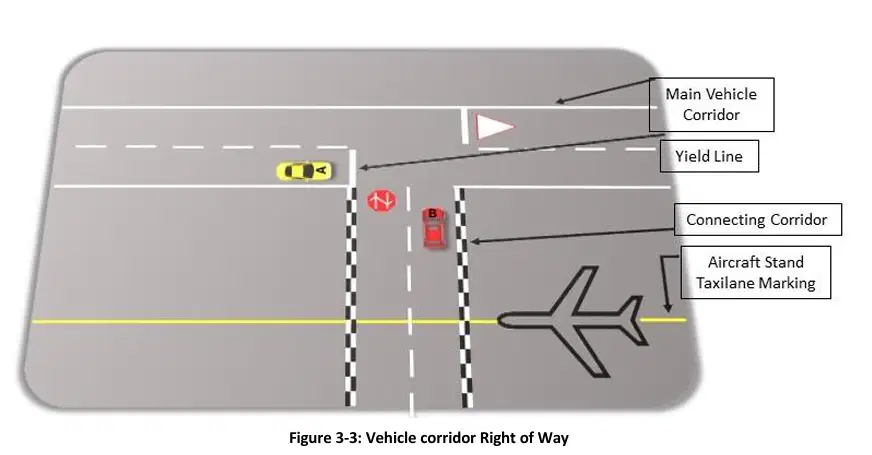
Who has the right of way?
As vehicles A and B approach intersection, vehicle A has right-of-way. If A is turning right, A gives way to aircraft as reminded by Aircraft Warning sign.
As vehicles A and B approach intersection, vehicle A has right-of-way only if vehicle A isn't turning. If vehicle A turns, B has right of way.
As vehicles A and B approach intersection, vehicle B has right-of-way. If A is turning right, A gives way to aircraft as reminded by Aircraft Warning sign.
Neither vehicles have right of way.

Which vehicles have right of way?
Whoever got there first, it has to be treated as a four way stop.
As vehicles A, B and C approach intersection, Vehicle C” has right-of-way as Vehicle A is in the connecting corridor. Vehicle C has the next priority and the last one is Vehicle B.
As vehicles A, B and C approach intersection, Vehicle B” has right-of-way as Vehicle A is in the connecting corridor. Vehicle A has the next priority and the last one is Vehicle C. Vehicles B & C are at the intersection of two main corridors, but vehicle C has a Stop sign painted on the corridor which gives this vehicle last priority.
As vehicles A, B and C approach intersection, Vehicle A” has right-of-way as Vehicle A is in the connecting corridor. Vehicle B has the next priority and the last one is Vehicle C. Vehicles B & C are at the intersection of two main corridors, but vehicle C has a Stop sign painted on the corridor which gives this vehicle last priority.
What should drivers do when a responding emergency vehicle is approaching?
Slow down and come to a safe stop
Pull to the right
Leave the corridor
Break hard and stop right away.
What should drivers do on narrow roads when a responding emergency vehicle is approaching?
Slow down and stop
Nothing, in this case drivers can continue driving as the road is narrow and it's unsafe to stop
Drivers operating vehicles on narrow roads and corridors shall pull off to the side if required to give room for oversized emergency response vehicles.
Leave the corridor completely.
3.7.4. What distance should you leave from the tail of an aircraft with engines on idle or low trust?
At least one plane
At least one and a half to two planes
At least three planes
At least 45m
Once an aircraft arrives at the gate, what should drivers look out for before proceeding?
aircraft anti-collision beacons and engines are OFF before driving behind the aircraft.
bridge is connected
engines are on idle only
marshaling crew returned to the aircraft
3.7.4.1. - Signs of a departing aircraft could be...
the bridge is retracted.
aircraft doors and hatches are secured.
a tug or towbar-less tractor is attached to the aircraft.
marshallers and wingwalkers may be in position
the chocks are removed.
Aircraft may move without activating anti-collision beacon(s) or wingtip navigation lights when they are being towed by a towbar-less tractor during daylight hours only. In such instances....
a wingman is required to use illuminated wands, or a double-sided stop sign in the vehicle corridor to signal drivers to stop.
When drivers see any push back indicators, they shall comply with the following directives that govern vehicular movement in the vicinity of departing aircraft:
Yield right-of-way to the marshalling crew when the crew is marshalling the aircraft and when they are returning to the gate after the aircraft is released
Proceed safely behind the aircraft if there's no marshaller present
Neither drive between a marshaller or wingwalker(s) and the aircraft nor proceed around, in front of, or behind the aircraft unless authorized by the marshaller.
Prior to pushback, proceed behind the aircraft only when the marshaller signals permission to continue.
Do not deviate from vehicle corridors to drive around an aircraft on pushback. Remain within the corridor until the ground crew and tug have cleared the apron side of the corridor.
3.7.4.2. - Marshalling Crew
When an aircraft pushes back across two aircraft stand taxilanes, the marshalling crew shall.....
either return to the closest vehicle corridor to be picked up by a vehicle or walk along the building to the next duty site.
run back quickly to the terminal
walk across two aircraft stand taxilanes to return to the gate
3.7.4.3. Arriving Aircraft
The presence of any of the following at a gate indicates that an aircraft arrival is likely:
marshaller in position or Advanced Visual Docking Guidance System (AVDGS) may be activated
Passengers Lining up at the gate
wingwalker in position
servicing equipment staged
Equipment is cleared to enable a safe aircraft docking.
3.7.7.4. - Aircraft Tows.
Tow crews shall ensure what prior to towing?
Tow crews shall ensure that an aircraft’s anti-collision lights are illuminated prior to towing.
That they're dressed up properly according to the weather
Tow crews shall ensure that an aircraft's anti-collision lights are turned off prior to towing.
Tow crews shall ensure that a follow-me car is present prior to towing the aircraft.
3.7.4.5. - Maintenance Runs
During an aircraft maintenance idle run, when engines are started on the gate, vehicles are required to ............. in the vehicle corridor to avoid jet blast.
Yield
Stop
Leave
Make a U-Turn
3.7.4.7. Option to Leave Vehicle Corridor
Are you allowed to leave the vehicle corridor if If a driver’s vehicle encroaches upon an aircraft’s safety zone or is in the way of an aircraft?
No, it's prohibited
provided it is clearly safe to do so.
Vehicles shall remain outside the vehicle corridor for the absolute minimum time and distance required.
only D permit holders
They have to ask for ATC clearance first to leave the corridor even for a short period of time.
3.8 Towing Equipment and Loads
The maximum number of items that shall be towed at any one time are:
Four baggage carts or containers/dollies • Four cargo pallet dollies. • A combination of any of the above, not exceeding a total of four items; for example: or 1 cargo pallet and 3 baggage carts/containers. or 2 cargo pallets and 2 baggage carts/containers.
Six baggage carts or containers/dollies • six cargo pallet dollies. • A combination of any of the above, not exceeding a total of six items; for example: 1 cargo pallet and 5 baggage carts/containers. or 2 cargo pallets and 4 baggage carts/containers.
It's not limited as long as it's safe to operate with the vehicle.
Eight baggage carts in total.
True or False?
GTAA personnel may erect barriers, safety cones, or caution tape to restrict pedestrian and vehicular access to the site of any incident including but not limited to: • fuel spills • apron pavement painting • emergencies, accidents, or incident scenes.
True
False
When vehicle operators approach barriers they should....
reduce speed. • observe the barrier (driving through or bypassing a barrier is prohibited) • drive around the marked area or follow directions provided by attending Enforcement Officers or flag personnel.
3.9.3. Bridges
Drivers may operate under fixed portions of bridges that provide sufficient clearance. Driving under moveable portions of a bridge is....
Allowed if operator present and allows to do so
Prohibited
Always allowed
Allowed for Ramp Agents only
3.10 Escorting Vehicles...
Choose the correct type(s) of escort
a vehicle escort––applicable to drivers operating external vehicles without an AVOP and without GTAA marked vehicle plates. For example, tenants may require external vehicles to temporarily access an airside restricted area for the purpose of delivering products and services essential to their operations.
an AVOP escort––applicable to drivers operating internal vehicles with GTAA marked vehicle plates without an AVOP
Emergency escort: under some circumstances drivers might be escorted by emergency vehicles as long as their lights are turned on
There's no escorting for DA permit holders at YYZ.
In either instance, the driver who is providing the escort shall:
possess a valid AVOP and provincial driver’s license (PDL)
escort a maximum of three vehicles.
ensure that the driver of the escorted vehicle is formally briefed regarding the procedures and requirements outlined in this document
escort a maximum of two vehicles.
In either instance, the driver who is providing the escort shall:
ensure that they are able to control all escorted vehicles at all times.
verify their PDL
make sure the escorted vehicle doesn't exceed 50m in length
make sure the escorted vehicle doesn't exceed 65m in length.
All vehicle operators driving airside under escort are responsible for:
Ensuring that their escorted vehicle has either an amber beacon or four-way flashers and head lights activated while airside.
Making sure the escorted driver has valid insurance
Driving at the same speed and following the exact route of the escorting vehicle.
Vehicles providing escort shall tow no more than HOW MANY piece of equipment
one
two
six
four
3.11 Parking and Securing Vehicles and Equipment
When parking operators shall...
Shift the gear to park or neutral. Turn off the ignition. Apply the parking brake.
True or False?
All beacons, headlights, and taillights shall be turned off when vehicles are parked in approved parking locations on any airside surface. When leaving a vehicle parked or unattended in a location not designated for parking, (as may be required for runway, taxiway, or apron construction purposes), leave the vehicle’s parking lights and beacon on at all times in conditions of poor visibility or darkness.
True
False
Wherever practical, drivers shall ..... spaces.
park facing
back up to
park sideways
leave the vehicle in gear
Unless an operation requires otherwise, the engines of parked vehicles shall be turned...
Off
On
Choose all prohibited parking areas...
in an area designated as a loading zone
within 1m of the Primary Security Line (PSL) fence.
in a bus bay
Rolling stock staging lanes
any area that may block or interfere with an emergency exit.
You can't park within HOW MANY metres of fire hydrants?
5m
2m
3m
1m
Do not park an aircraft fuel servicing vehicle within HOW MANY METRES of any buildings containing personnel or members of the public including....
airport terminal buildings • aircraft cargo buildings • aircraft hangars • any other airport structure designed to house the public that has windows or doors facing airside. Fuel tankers shall not be left unattended unless parked in designated areas.
10m
20m
25m
15m
What is Taxiway Kilo?
Controlled Taxiway
Uncontrolled Taxiway
There's no Kilo at Pearson
True or False?
Drivers shall cross Taxiway Kilo at a right angle (90° angle). When driving on Taxiway Kilo, drivers shall stay as close to the edge of the taxiway as possible. When faced with oncoming vehicular traffic, drivers shall give way to the right. When faced with aircraft traffic, drivers shall yield right-of-way. Pedestrians shall cross Taxiway Kilo at a 90° angle after ensuring that it is safe to proceed
False, there's no pedestrians at Taxiway Kilo
True
Central Deicing Facility During non-deicing operations, Pad 1 and Pad 5 are designated Taxiways ..... and ....., respectively.
Whisky and Kilo
Juliet and Romeo
Alpha and Bravo
Victor and Tango

