
Font size
 Worksheets
Unit 2 Test
Total questions: 143
Worksheet time: 1hrs 12mins
Which term best describes early relationships between colonists and tribes like the Powhatan and Wampanoag?
Interdependence through mutual trade
Isolation with little interaction
Domination from immediate conquest
Neutrality without exchanged goods
What resources did Native tribes provide that aided colonists' survival in early settlements?
Gunpowder and firearms
Gold and silver bullion
Food and environmental knowledge
Large draft animals
Which exchange item was commonly offered by Europeans in early cooperation?
Tobacco and cotton
Sugar and rum
Spices and porcelain
Metal tools and textiles
Why did some tribes engage in trade alliances with colonists?
Desire to abandon traditional culture
Immediate conversion to Christianity
Access to Atlantic shipping routes
Strategic leverage against rival groups
Which difference in worldview most fueled rising tensions between colonists and Native Americans?
Land as private property versus shared resource
Beliefs about ocean navigation rituals
Methods of stone construction techniques
Preferences for winter clothing materials
European colonists primarily viewed land ownership as
Private and expandable holdings
Seasonal communal stewardship
Rotating clan-controlled territory
Spiritual guardianship only
Which conflict arose as colonial settlements expanded and tensions escalated?
Boer War in South Africa
War of the Roses in England
French Revolution in Paris
Pequot War in New England
King Philip's War was primarily driven by
Exploration of Pacific islands
Disputes over land and expansion
Competition for Mediterranean trade
Religious schisms within Europe
After the Revolution, the U.S. government initially managed relations by
Banning all trade with Native tribes
Dissolving tribal governments entirely
Treating tribes as sovereign nations
Granting automatic U.S. citizenship
Which treaty aimed to define boundaries and secure peace in the 1790s?
Treaty of Greenville in 1795
Treaty of Versailles in 1783
Jay's Treaty in 1794
Adams–Onís Treaty in 1819
What belief often justified violating treaties during westward expansion?
Isolationist foreign policy
Prohibition temperance movement
Mercantilist taxation theory
Manifest destiny ideology
Which act led to large-scale forced relocation including the Trail of Tears?
Northwest Ordinance of 1787
Missouri Compromise of 1820
Homestead Act of 1862
Indian Removal Act of 1830
Which treaty ended the American Revolution and transferred vast lands from Britain to the United States, ignoring Native claims to sovereignty?
Treaty of Paris of 1783
Treaty of Ghent of 1814
Pinckney’s Treaty of 1795
Jay Treaty of 1794
What is meant by Native sovereignty in the context of early U.S. policy?
Independent tribal self-governance
Permanent military alliances
Equal voting in Congress
Guaranteed statehood for tribes
Which ideology justified American expansion across the continent and diminished respect for Indigenous homelands?
Doctrine of Nullification
Mercantilist Policy
Isolationist Doctrine
Manifest Destiny
What major federal law authorized the forced relocation of Southeastern tribes to lands west of the Mississippi River?
Northwest Ordinance of 1787
Dawes Act of 1887
Homestead Act of 1862
Indian Removal Act of 1830
Post-revolution U.S. policy is characterized in the material as centered on which actions?
Shared jurisdiction with tribal courts
Protection of Native land titles
Displacement and abrogation of tribal sovereignty
Recognition of full treaty rights
Why did some Native communities initially view Europeans as useful allies?
To secure immediate citizenship rights
To become governors of colonies
To adopt European religions quickly
To gain advantages over rival tribes
Which factor most directly increased tension as colonial populations grew in North America?
Reduced competition for hunting territories
Rising demand for permanent land ownership
Shared beliefs about communal land rights
Declining need for cleared forest areas
What best describes the cultural clash over land between colonists and Native Americans?
Individual, permanent ownership versus communal stewardship
Mining claims versus agricultural leases
Temporary seasonal camps versus fixed village life
Urban property laws versus rural homesteading customs
Which consequence followed pressures over land and resources in the 1600s and 1670s?
Wars like the Pequot War and King Philip's War
Joint colonist–Native policing agreements
Mutual defense treaties protecting trade routes
Peace councils that stabilized regional borders
How did European diseases affect Native American communities?
Caused epidemics that weakened resistance to expansion
Created natural immunity that halted colonial spread
Encouraged vaccination programs across tribes
Led to short-term illness without population loss
Which statement best explains a post-Revolution impact on U.S. policy toward Native nations?
French alliances preserved tribal sovereignty
Spanish treaties controlled eastern boundaries
British commanders dictated early land rules
Colonial interactions shaped government approaches
In 1783, what did the Treaty of Paris decide regarding lands east of the Mississippi River?
Ceded British territory to the United States
Returned all seized land to Native nations
Divided provinces between Britain and Spain
Established joint governance with tribal councils
How were Native American tribes characterized by the Treaty of Paris in 1783?
As conquered peoples regardless of alliances
As independent sovereign partners in diplomacy
As neutral arbiters of frontier disputes
As protected citizens under U.S. law
Which problem made the Treaty of Paris controversial for Native communities?
Transfer of western lands back to France
Excessive taxation on imported British goods
Immediate abolition of all colonial militias
No input from tribes living on the ceded lands
What long-term precedent did early disregard for Native land rights set for U.S. policy?
Restricting settlers from westward movement
Funding schools through tribal revenue sharing
Guaranteeing permanent tribal control over borders
Seeing seized land as a primary government asset
Even when boundary-setting treaties existed, what commonly occurred afterward?
Tribes voluntarily ceded additional territory
Settlers ignored and governments abrogated them
Settlers strictly enforced all treaty lines
Governments expanded tribal reservation lands
Which policy exemplified forced removal following the established pattern of land acquisition?
Indian Removal Act of 1830 and Trail of Tears
Monroe Doctrine of 1823 and hemispheric policy
Homestead Act of 1862 and prairie settlement
Northwest Ordinance of 1787 and territorial mapping
Which earlier agreements aimed to set boundaries but were later undermined?
Quebec Act and Missouri Compromise
Proclamation of 1763 and Treaty of Fort Stanwix
Jay Treaty of 1794 and Adams–Onís Treaty
Treaty of Paris 1763 and Treaty of Ghent
Under the Articles of Confederation, why was treaty enforcement with Native nations often ineffective?
Weak central authority limited coercion
Native nations rejected all negotiations
Too many federal courts existed
States had no role in diplomacy
Which constitutional change strengthened federal power over Native American affairs compared to the Articles?
Indian Commerce Clause expansion
Creation of state militias
Direct election of senators
Bill of Rights protections
What was a primary U.S. goal when negotiating early treaties with Native nations in the Northwest Territory?
Secure land cessions and peace
Establish overseas colonies
Promote transatlantic trade
End slavery nationwide
Which treaty was negotiated with the Delawares during the Articles era?
Treaty of Ghent, 1814
Treaty of Fort Pitt, 1778
Treaty of Greenville, 1795
Treaty of Paris, 1783
The Treaty of Fort Stanwix (1784) involved negotiations with which group?
The Delawares and Shawnee
The Cherokee and Choctaw
The British Parliament
The Six Nations of the Iroquois
Which set of treaties (1785–1786) involved the Cherokee, Choctaw, and Chickasaw?
Adams–Onís border treaty
Jay Treaty with Britain
Treaty of Greenville settlement
Treaties of Hopewell agreements
Why did enforcement challenges persist even after the Constitution increased federal power?
Political and practical limitations continued
States lost all sovereignty immediately
Treaties were abolished entirely
Native nations ceased to exist legally
Which statement best describes the long-term impact of colonial-era interactions on federal Indian policy?
Unequal power and broken promises persisted
Immediate equality among nations followed
Total non-interference was guaranteed
Treaty rights always superseded states
During and after the Revolutionary War, how were Native Americans commonly perceived by U.S. policymakers?
As allies controlling federal courts
As a security threat needing containment
As equal partners in nation-building
As primarily overseas traders
Which policy trend was justified by viewing Native nations as threats?
Containment, land seizure, assimilation
Open borders and shared sovereignty
Immediate statehood for territories
Universal military conscription
What did the Constitution’s approach aim to address relative to the Articles regarding Native affairs?
Eliminate all treaty-making entirely
Transfer diplomacy to local militias
Give the federal government more power
Place courts under tribal control
Which example illustrates early treaty-making under the Articles in the Northwest Territory?
Treaty of Guadalupe Hidalgo, 1848
Treaty of Versailles, 1783
Rush–Bagot Agreement, 1817
Treaties of Fort McIntosh, 1785
Which problem best describes why Congress could not compel states or settlers to follow treaty terms under the Confederation era?
Unified state policy aligned with tribal agreements
Powerful standing army enforced all provisions
Abundant federal revenue ensured compliance
Weak central authority limited federal coercion
What consequence arose when individual states pursued their own agreements with tribes?
Stable treaty compliance across regions
Conflicts and inconsistent federal policy
Immediate nationwide enforcement
Greater military protection for tribes
Why did protective provisions in treaties become effectively unenforceable before 1789?
Excess taxation of frontier settlers
No independent revenue or military
Judicial bans on treaty making
Overstaffed federal enforcement agents
What was a direct effect of settler encroachment onto treaty-guaranteed lands?
Constant friction and violence
Immediate removal of illegal settlers
Expanded tribal sovereignty rights
Reduced pressure on frontier agents
Which constitutional change strengthened federal authority over tribal relations after 1789?
Indian Commerce Clause in Congress
State veto power over treaties
Judicial ban on Senate approvals
Local councils controlling negotiations
Under the Constitution, what became the legal status of treaties?
Regional compacts below federal statutes
Temporary agreements without force
Optional guidelines for state policy
Supreme law equal to the Constitution
Which pair lists major post‑1789 treaties mentioned in the material?
Treaty of New York and Treaty of Greenville
Rush‑Bagot Agreement and Jay Treaty
Adams‑Onís Treaty and Webster‑Ashburton
Treaty of Paris and Treaty of Ghent
Even with legal authority, what often determined whether treaty obligations were enforced?
Consistent state cooperation
Strict military presence always
Political will favored expansion
Automatic judicial protection
What did later Supreme Court decisions establish about Congress and treaty rights?
Requirement to expand all treaty lands
Ban on changing any treaty terms
Power to abrogate without tribal consent
Obligation to fund permanent garrisons
Which challenge made frontier enforcement difficult despite federal laws?
Practical distance from agents and army
Abundant roads and communication lines
Overcrowded courts in eastern cities
Too many federal marshals on patrol
Which phrase best captures “Judicial Interpretation & Abrogation” in this context?
Settlers gained automatic ownership rights
Tribal consent was always mandatory
States could ignore federal courts entirely
Congress could cancel or modify treaties
How did the Constitution alter treaty‑making authority compared to the Confederation period?
Courts negotiated treaties with local councils
President could make treaties with Senate approval
Settlers voted directly on all treaty terms
Governors could sign treaties without oversight
What was one major consequence of the War of 1812 for Native American nations?
Immediate restoration of ancestral lands by treaties
Stronger unified resistance led by Tecumseh
Renewed British military protection for tribes
Loss of British alliance and greater U.S. expansion
Tecumseh’s Confederacy aimed primarily to achieve which goal?
Negotiate state-level citizenship for Natives
Secure British colonies in Canada
Promote agricultural trade with the U.S.
Unite tribes to resist American encroachment
Which event undermined the potential for unified Native resistance during the War of 1812?
Creation of the Monroe Doctrine in 1823
Election of Andrew Jackson in 1828
Tecumseh’s death at the Battle of the Thames
The Treaty of Paris in 1783
What did Britain do in the Treaty of Ghent that affected Native allies?
Abandoned formal protection of Native allies
Established permanent joint forts with tribes
Demanded U.S. halt western settlement
Granted tribes independent nation status
The shift from the Articles to the Constitution changed Native relations by doing what?
Decentralizing power to individual states
Eliminating all existing treaties with tribes
Centralizing authority in the federal government
Granting tribes equal representation in Congress
What problematic dynamic emerged from the federal trust relationship described?
States enforced stronger tribal autonomy everywhere
Government power grew while promises were unkept
Tribes gained full voting rights immediately
Courts ended all land disputes permanently
Which sequence best reflects the early nineteenth-century shift in U.S.–Native relations?
Forced removal to negotiated independence and sovereignty
Conditional coexistence to forced removal and dispossession
Dispossession to restored alliances and autonomy
Coexistence to land recovery and citizenship
What federal law paved the way for the Trail of Tears?
Indian Trade and Intercourse Act of 1790
Indian Removal Act of 1830
Homestead Act of 1862
Northwest Ordinance of 1787
Which Supreme Court case is part of the Marshall Trilogy and addressed state authority over tribal lands, often cited with the Discovery Doctrine?
Plessy v. Ferguson
Dred Scott v. Sandford
Worcester v. Georgia
Marbury v. Madison
What is the Discovery Doctrine commonly associated with in nineteenth-century legal context?
European claims limiting Native land rights
Immediate citizenship for Native Americans
Guarantees of tribal criminal jurisdiction
U.S.–British military cooperation in Canada
After the War of 1812, how did U.S. policy toward Native land most often proceed?
Through treaties accelerating land acquisition
By restoring lands lost before the war
By adopting permanent non-expansion policies
Through British-mediated settlements with tribes
Which statement best summarizes why these events are called turning points?
They created lasting tribal control over federal policy
They shifted relations toward removal and dispossession
They reversed U.S. expansion into tribal lands
They ended all legal battles involving Native nations
Which U.S. president signed the Indian Removal Act into law in 1830?
Andrew Jackson
James Monroe
Martin Van Buren
John Quincy Adams
What was the primary destination labeled "Indian Territory" during removals in the 1830s?
Present-day New Mexico
Present-day Arizona
Present-day Kansas
Present-day Oklahoma
The Indian Removal Act claimed to authorize the President to do which action regarding tribes?
Declare martial law
Create federal reservations
Impose state taxes
Negotiate voluntary treaties
In practice, the Indian Removal Act most often resulted in which outcome for Native peoples?
Expanded voting access
Peaceful land sharing
Immediate citizenship rights
Coercion and forced relocation
Johnson v. McIntosh (1823) established which legal idea affecting Native land claims?
Separate but equal
Discovery doctrine
Strict construction
Doctrine of nullification
Under Johnson v. McIntosh, Native peoples were said to hold what to their lands?
Temporary grazing permits
Corporate mineral rights
Right of occupancy only
Full legal title
Cherokee Nation v. Georgia described tribes using which term?
State sovereign entities
Domestic dependent nations
Independent foreign states
Federal protectorates
Worcester v. Georgia (1832) declared what about Georgia’s power over Cherokee territory?
Taxation allowed but limited
Shared jurisdiction with tribes
No power to regulate
Unlimited police authority
Which branch’s protection proved insufficient when Andrew Jackson ignored Worcester?
Legislative branch
Judicial branch
State governments
Executive branch
What broader goal did the Indian Removal Act serve for many American settlers and officials?
Expanding naval bases
Obtaining Southern lands
Building transatlantic trade
Securing gold in California
Which event name refers to the deadly forced march of the Cherokee to Indian Territory?
Trail of Tears
Long Walk North
Great Migration West
March of Nations
Why did "voluntary" treaties under the Indian Removal Act often lack true consent?
Terms were secret agreements
Immense pressure and coercion
Tribes refused any negotiations
Lack of translators and maps
Which comparison between the Pequot War and King Philip's War is most accurate?
Both were peaceful negotiations
Both showed colonists expanding power
Both occurred before 1600
Both ended with Native victory
What war did the Treaty of Paris (1763) officially end?
King Philip’s War between colonists
War of 1812 between the U.S. and Britain
French and Indian War between Britain and France
Seven Years’ War limited to Europe only
After the Treaty of Paris (1763), which major change occurred in North America?
France expanded control over the Great Plains
Britain gained control of former French territories
Spain took control of the Atlantic coastline
Native nations gained independent western territories
Which statement best describes a consequence of the Treaty of Paris (1763) for Native American lands?
It banned settlers from crossing the Mississippi River
It required colonial assemblies to approve land sales
It gave Britain power over vast Native territories
It created tribal-run boundary commissions
What broader impact did the Treaty of Paris (1763) have on colonial settlement patterns?
It forced colonists to return to coastal towns
It set the stage for British expansion westward
It halted westward movement entirely
It encouraged migration only to Canada
The Treaty of Fort Stanwix (1768) primarily attempted to do what?
Create a tax on frontier trade
Form a military alliance with the Iroquois
Establish a boundary between settlers and Native lands
Replace the King’s Proclamation of 1763
Along which geographic feature did the Fort Stanwix boundary line generally run?
Great Lakes region to the north
Rocky Mountains across the West
Mississippi River through the Midwest
Appalachian Mountains in the East
Why did the Fort Stanwix boundary fail to fully stop conflict?
Colonists frequently ignored the line and moved west
Native nations refused to recognize any boundaries
Britain lacked any troops in North America
The line cut through major colonial cities
What challenge did the Treaty of Fort Stanwix (1768) reveal about colonial governance?
Parliament could not legislate for the colonies
Raising taxes required unanimous colonial approval
Communication with London was nearly impossible
Enforcing agreements with Native Americans was difficult
In the U.S. Constitution, what power does the Indian Commerce Clause give Congress?
Create state-level reservation boundaries
Tax only foreign imports and exports
Declare war against tribal nations
Regulate trade with Native American tribes
How does the Indian Commerce Clause treat Native American nations?
As private associations without sovereignty
As provinces of individual states
As foreign countries beyond U.S. law
As separate political entities under federal control
Why did the Indian Commerce Clause become important for later federal actions?
It allowed states to negotiate their own treaties
It was used as the legal basis for federal policies
It restricted trade to only river routes
It eliminated the need for congressional approval
What overall authority did the Indian Commerce Clause establish?
State governments over tribal affairs
Local councils over reservation courts
Private companies over frontier trade
Federal government over Native American affairs
Which year is associated with the Treaty of Greenville?
1812 wartime period
1787 Constitution era
1803 Louisiana Purchase
1795 after Ohio conflicts
What did Native American tribes agree to in the Treaty of Greenville?
Share hunting rights temporarily
Cede most Ohio region lands
Form a joint military alliance
Relocate to Canada voluntarily
What did tribes receive in return under the Treaty of Greenville?
Full citizenship and voting
Smaller reservations and money
Exclusive trade monopolies
Independent statehood recognition
The Treaty of Greenville primarily affected which geographic area?
New England coastal towns
Ohio Territory in the Northwest
Deep South cotton belt
Pacific Coast settlements
Manifest Destiny is best described as which belief?
Trade over land was superior
Americans were destined to expand
Industrialization should stop
Democracy must remain local
Many Americans viewed westward expansion under Manifest Destiny as what?
Only a military task
A violation of treaties
Their right and duty
A temporary experiment
Which reality was ignored by Manifest Destiny?
Weather prevented settlement
Native peoples already lived there
Railroads lacked funding
Gold was entirely mythical
Manifest Destiny functioned as a justification for what action?
Taking Native American territories
Ending slavery nationwide
Restricting immigration levels
Building overseas colonies
Westward Expansion refers to which movement?
Miners from West to East
Settlers from East to West
Farmers to urban factories
Merchants to southern ports
Why did thousands move west during the 1800s?
Join established universities
Avoid military conscription
Seeking land, gold, opportunities
To escape voting laws
How did Westward Expansion impact Native Americans?
Protected sacred sites
Improved trade routes
Threatened lands and life
Boosted tribal autonomy
What happened as expansion continued across the West?
Conflicts steadily decreased
Treaties permanently solved disputes
Conflicts notably increased
Migration abruptly halted
Who signed the Indian Removal Act into law in 1830?
Martin Van Buren as president
Andrew Jackson as president
James Madison as president
Henry Clay as senator
What did the Indian Removal Act allow the federal government to do?
Force Native nations west of the Mississippi
Invite tribes to settle in New England
Create permanent peace councils in Georgia
Grant new reservations in the East
Which Native nation was forced west during the Trail of Tears in 1838–1839?
Cherokee people moved westward
Sioux people moved northwest
Iroquois people moved northward
Navajo people moved southwest
Where were the Cherokee forced to relocate during the Trail of Tears?
Oklahoma west of the Mississippi
Kansas Territory in the plains
Florida Territory along the coast
Texas Republic near the border
What was one result of the Trail of Tears journey?
Thousands died from disease and hunger
Many gained citizenship and voting rights
Trade increased among southeastern towns
Railroads expanded across tribal lands
Which river served as the boundary for relocation under the Indian Removal Act?
Hudson River as eastern boundary
Mississippi River as western boundary
Colorado River as southwestern boundary
Ohio River as northern boundary
What reason did the government claim for removal policies?
Separate Natives from settlers to reduce conflicts
Strengthen military forts in the Southeast
Expand missions for cultural conversion
Improve farming on tribal lands
Which term names the forced Cherokee march in 1838–1839?
Great Removal of 1812
Oregon Trail migration
Trail of Tears in winter
Long Walk of the Navajo
What did the removal policy actually do to Native lands in the East?
Expanded tribal borders into Appalachia
Returned territory after negotiations
Took away Native lands and sovereignty
Protected remaining homelands and treaties
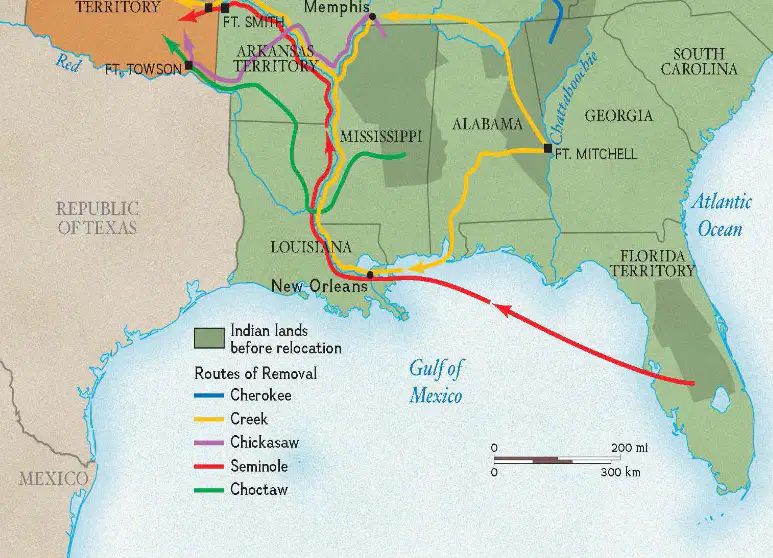
Which southeastern states were part of Cherokee homelands before removal, as shown on maps?
Illinois and Wisconsin areas
Arizona and New Mexico areas
Maine and New Hampshire areas
Georgia and North Carolina areas
Which statement best describes the Reservation System in the United States?
It encouraged settlers to share fertile lands equally
It granted tribes full control over wide territories
It eliminated government involvement in tribal affairs
It placed Native Americans on small pieces of land
Under the Reservation System, who made most decisions about life on reservations?
Federal government officials and agents
Local settlers and ranch owners
Tribal leaders with complete autonomy
Private companies managing resources
What was a common characteristic of reservation lands during this era?
Strategically chosen areas for tribal prosperity
Highly profitable mining regions and forests
Prime farmland near major rivers and towns
Often poor quality land unwanted by settlers
Which outcome did Native Americans experience because of reservations?
Loss of freedom to live on ancestral lands
Increased independence and self-governance
Guaranteed access to traditional resources
Protection from all outside cultural influences
What is the most accurate definition of assimilation in this historical context?
Trading goods between neighboring communities
Adopting the culture and ways of another group
Returning to traditional tribal governance
Migrating to cities for economic opportunity
Which action reflects the government’s push for Native American assimilation?
Forcing the abandonment of languages and traditions
Allowing tribes to choose their cultural practices
Funding the revival of tribal religions and arts
Promoting bilingual education and cultural exchange
What belief guided government officials who supported assimilation?
Native Americans should become "American" culturally
Traditional lifeways must be preserved forever
Tribal diversity strengthened national democracy
Cultural pluralism was key to social harmony
What effect did assimilation policies have on Native communities?
Tremendous harm to identities and cohesion
Rapid improvement in economic self-sufficiency
Stable preservation of sacred traditions
Expanding political power within reservations
What was the main purpose of Indian Boarding Schools?
To provide optional vocational training
To reunite families living on reservations
To "civilize" Native American children
To restore tribal languages and customs
Which practice was enforced at Indian Boarding Schools?
Living with parents during the school year
Celebrating traditional ceremonies regularly
Using tribal languages in daily instruction
Speaking English and wearing American clothes
What family impact did boarding schools commonly cause?
Immediate reunification after enrollment
Long separations between children and families
Frequent weekend visits and home stays
Short-term camps with parental supervision
Which long-term consequence is linked to Indian Boarding Schools?
Greater control over reservation governance
Widespread revival of Native traditions
Lasting trauma and cultural loss
Improved access to fertile ancestral lands
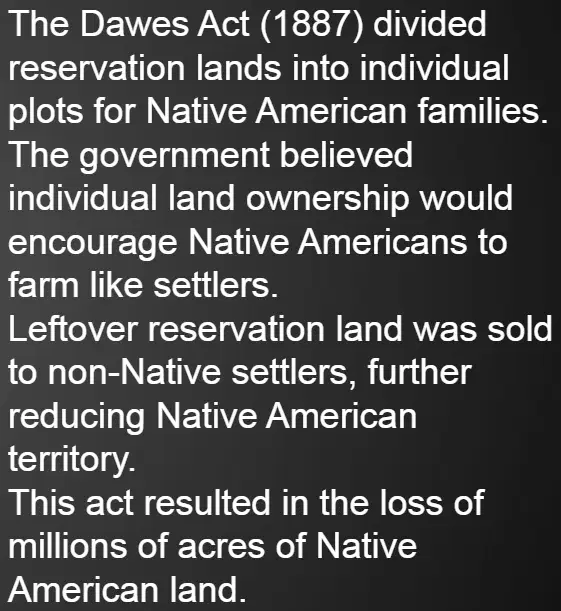
What was a primary goal of the Dawes Act of 1887?
Promote communal landholding traditions
Encourage individual Native land ownership
Expand military forts across reservations
Restore all tribal lands to nations
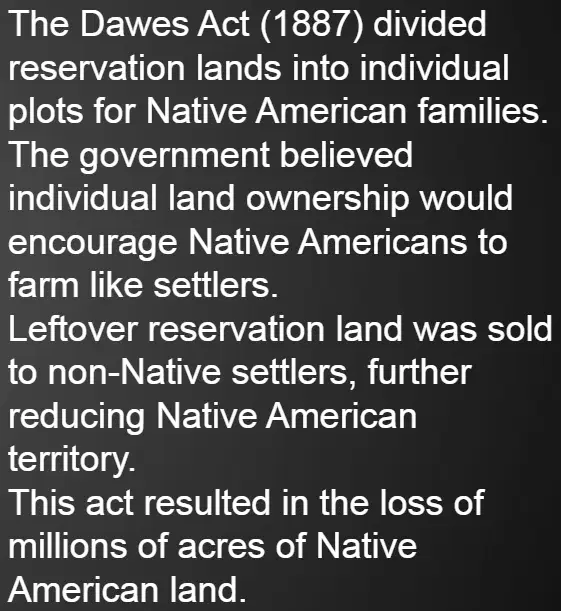
Which outcome followed division of reservation lands under the Dawes Act?
Increase in tribal sovereignty rights
Sale of leftover land to settlers
Creation of new federal territories
Return of lands to original owners
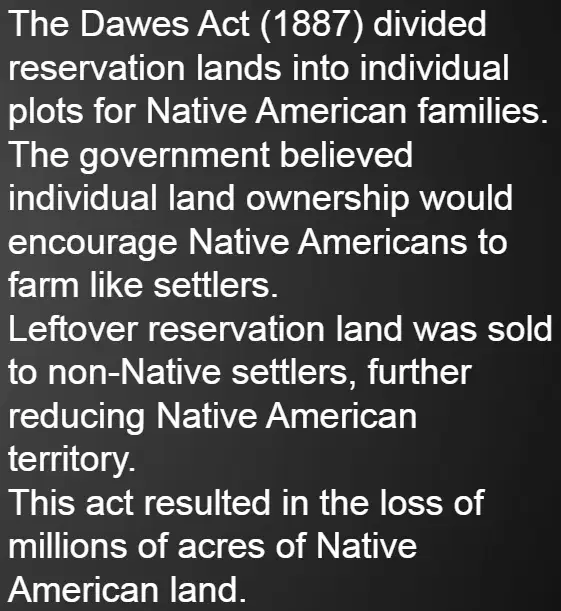
About how much land did Native Americans lose due to the Dawes Act?
Thousands of acres of territory
Hundreds of acres of territory
Millions of acres of territory
Dozens of acres of territory
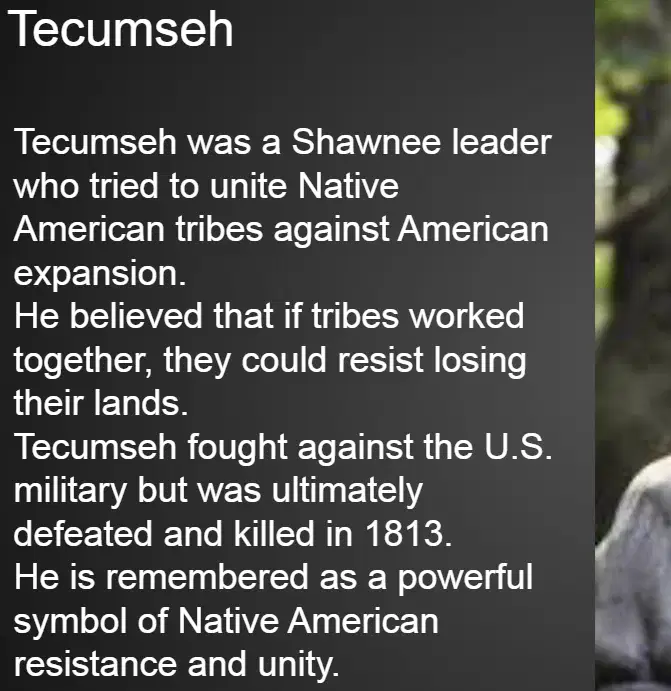
Tecumseh led which nation while urging tribal unity?
Navajo in the Southwest
Shawnee in the Midwest
Sioux on the Plains
Cherokee in the Southeast
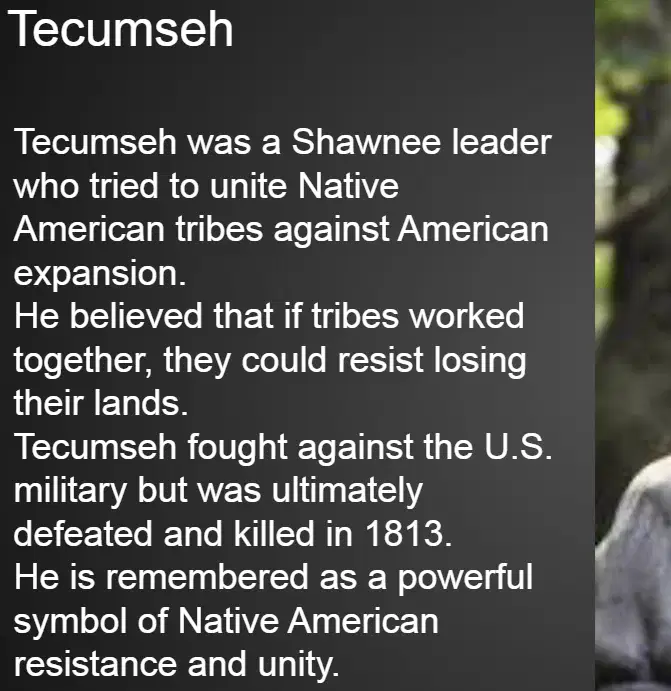
What strategy did Tecumseh advocate to resist American expansion?
Negotiating separate tribal treaties
Working together across many tribes
Retreating to remote territories
Relying solely on legal courts
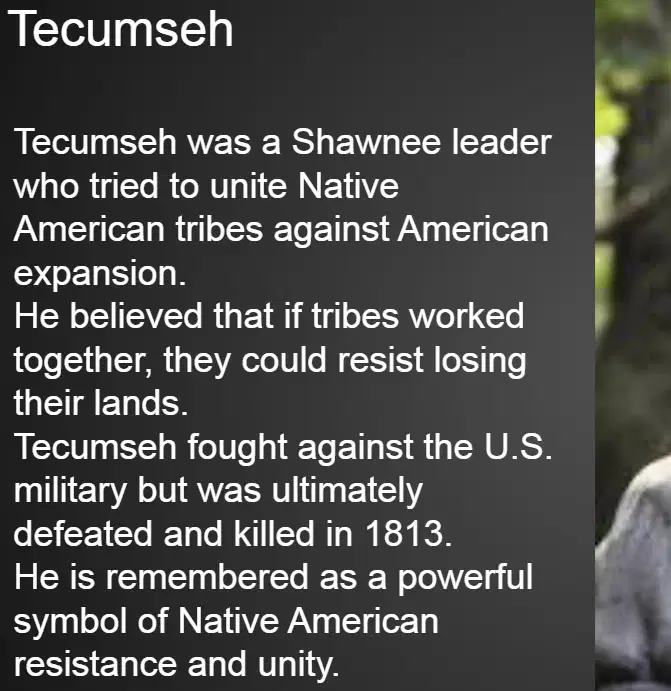
What was Tecumseh’s fate during his resistance to the United States?
Granted amnesty in 1815
Defeated and killed in 1813
Exiled to Canada for life
Captured and imprisoned for decades
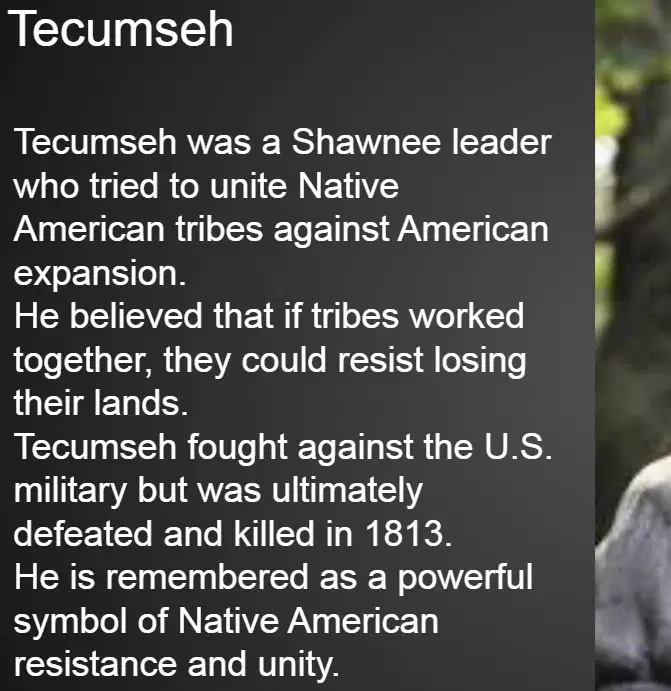
How is Tecumseh remembered in U.S. history?
As a proponent of individual allotments
As a champion of federal expansion
As a symbol of resistance and unity
As a symbol of assimilation policies
Where did the Wounded Knee massacre occur in 1890?
Arizona Territory in the Southwest
South Dakota on the Plains
Oregon Territory in the Northwest
Texas Panhandle in the South
Approximately how many Lakota Sioux were killed at Wounded Knee?
About fifty people were killed
Around one hundred people were killed
More than three hundred people
Approximately one hundred fifty people
What broader significance did Wounded Knee have for Native resistance?
It began large new uprisings
It ended major armed resistance
It restored several tribal lands
It created new reservation borders
Which statement best captures the impact of Wounded Knee?
It showed peaceful compromise success
It revealed devastating conflict consequences
It confirmed fair enforcement of treaties
It proved total victory for tribal forces
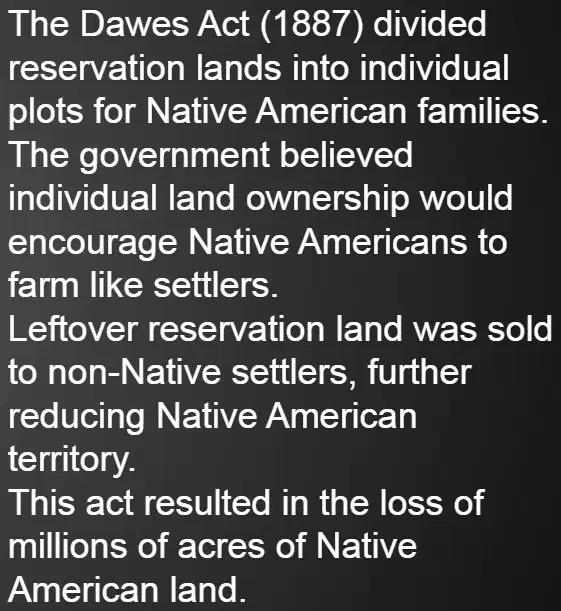
What did the government believe individual land ownership would encourage?
Return to pre-contact traditions
Farming lifestyles similar to settlers
Nomadic buffalo hunting practices
Expansion of tribal confederations
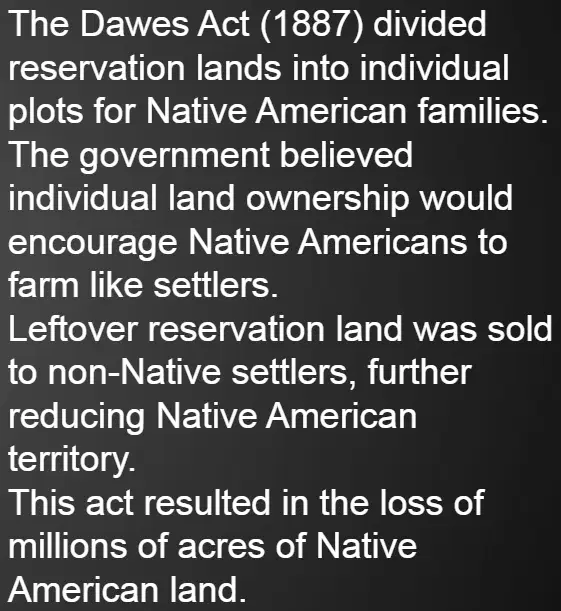
What happened to reservation land not allotted under the Dawes Act?
Allocated to tribal councils
Converted into national parks
Sold to non-Native settlers
Used for federal military bases
Which concept describes canceling or ending formal agreements, such as treaties?
Annexation of lands
Abrogation of treaties
Codification of laws
Ratification of compacts
Which pair correctly links event and year from this unit?
Wounded Knee—1887 massacre year
Tecumseh—1813 death year
Abrogation—1787 treaty year
Dawes Act—1890 passage year

What does abrogation mean in a historical legal context?
To cancel or end an agreement
To temporarily pause enforcement
To expand rights within a pact
To renegotiate terms of a treaty
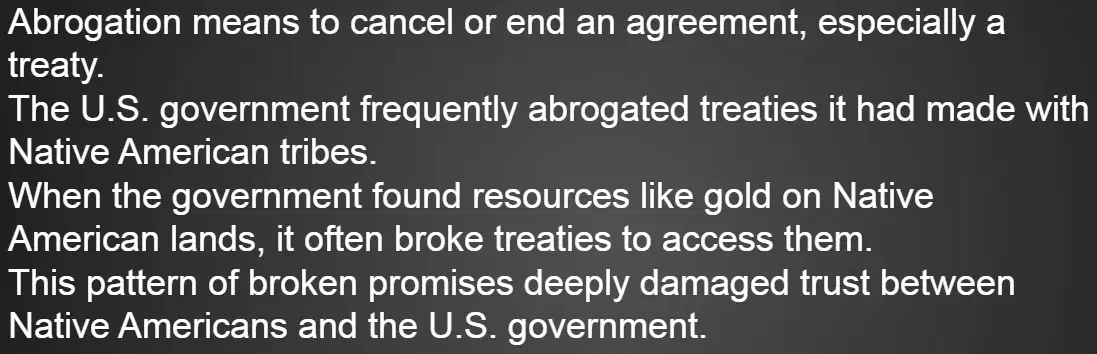
Which action did the U.S. government frequently take regarding treaties with Native tribes?
It delegated treaties to private firms
It avoided making any treaties
It strictly enforced every treaty
It abrogated many existing treaties
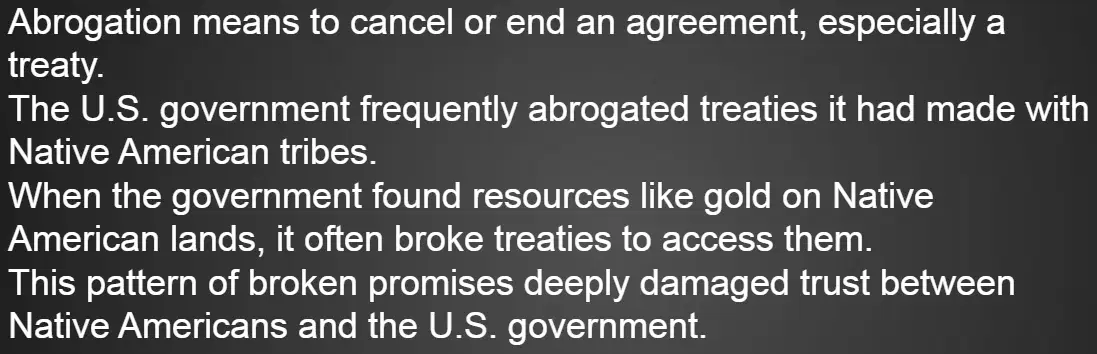
Why were treaties often broken after resources were found on Native lands?
To reduce military conflicts nationwide
To standardize trade rules across states
To access gold and other resources
To improve diplomatic relations globally

