
 Worksheets
Untitled Quiz
Total questions: 30
Worksheet time: 15mins
What is the main purpose of the lesson “practice subtractive color mixing”?
Practice mixing colors
Practice preventing ink layer overlap
Experiment with the principles of subtractive color mixing
All three answers
To evaluate color characteristics in the lesson “practice subtractive color mixing,” which parameters are used?
RGB
XYZ
Lab
CMYK
Given the formula C∗=a2+b2 with a and b as color components in the CIE Lab system, which color characteristic does this allow you to quantify?
Hue
Chroma
Lightness
Contrast
In the experiment, what is the purpose of the color difference ΔE ?
All three answers
Compare the color difference between two samples
Determine ink layer thickness
Calculate mixing ratios
Given three inks with Lab values: M1 ( L∗=48.3 , a∗=−25.2 , b∗=5.8 ), M2 ( L∗=84.3 , a∗=2.8 , b∗=108.6 ), M3 ( L∗=41.3 , a∗=6.0 , b∗=−21.1 ). Which statement is correct?
M1 is a primary color
M2 is a primary color
M3 is a primary color
M2 is a secondary color
Given four ink layers with Lab values labeled M1, M2, M3, M4 (with equal layer thickness). Which pair represents subtractive mixing from two ink layers?
M1 and M2
M1 and M3
M2 and M4
M3 and M4
Which statement is correct based on your experimental results?
Complementary color has lower lightness than the mixed ink color (with equal thickness)
Secondary color in subtractive mixing is brighter than the primary color
Complementary color has a different total ink amount than the mixed ink from printing
All three answers
When comparing M2 (mix C–M–Y) with M6 (anti C–M–Y) and black K, which conclusion is most reasonable?
M2 and M6 always match completely with black K
M6 usually has lower L∗ than M2 because it absorbs light from multiple layers
M2 becomes M6 because inks are diffusely mixed
They cannot be compared because the two methods are different
What is the main purpose of the experiment investigating color density versus ink layer thickness?
Determine the optical density of the ink layer
Assess how color changes when ink layer thickness changes
Evaluate how ink layer color changes on different substrates
All three answers
In the experiment, how is the ink layer thickness varied?
Change the surface density of the ink layer
Change the number of ink layers overlaying one another
Change the amount of ink transferred per unit area of the substrate
Change the sample’s dimensions
Color density of the ink layer is determined based on which quantity?
Radiant energy from the ink surface
The ratio of light that is reflected or transmitted through the ink layer
Light absorbed by the ink layer
The ratio of light absorbed by the ink layer
Color density of the ink layer does not depend on which factor?
Printed area
Ink layer thickness
Paper surface smoothness
Specific absorption of light by the ink
Based on the experimental results, how should the ink layer thickness be selected to achieve the required optical density?
Thickness corresponding to the extremely high optical density
Thickness corresponding to the optical density just reaching saturation
Thickness corresponding to an optical density that decreases after reaching an extreme
The smallest thickness that achieves the required optical density
When ink layer thickness increases, which trend best describes the change?
Optical density decreases
Color shifts
Optical density increases
Optical density changes randomly
Which statement aligns with your experimental results?
Chroma of the ink layer is proportional to its thickness
Total color of the ink can change when thickness increases
The lightness of the ink layer increases when thickness increases
Color characteristics of the ink layer do not change when thickness varies
When the ink layer thickness becomes too large, why does the color density stop increasing (reaches a limit)?
The thickness reaches saturation
The optical density reaches its theoretical maximum
The ink layer blocks light absorption
The density reaches the ultimate theoretical value
What is the main purpose of the experiment analyzing color by the reflectance spectrum of light?
Identify color characteristics based on the reflectance spectrum
Identify color characteristics based on color from three components
Determine color mixing ratios based on the reflectance spectrum
All three answers
How is the total color of a sample determined based on the reflectance spectrum?
Area of the dominant reflectance band
Average reflectance coefficient
Dominant wavelength band (dominant spectrum)
Absorbed color band
How is the brightness (luminance) of a color determined based on the reflectance spectrum?
Total reflected energy
Average reflectance coefficient
Coefficient of the dominant wavelengths (dominant color)
Total reflectance
How is color purity determined from a reflectance spectrum?
By the ratio of the reflectance coefficient at the dominant wavelength to the ideal reflectance coefficient
By the ratio of the reflectance coefficient at the dominant wavelength to the average reflectance across all wavelengths
By the ratio of the luminance of the dominant wavelength to the total luminance of all light in the reflectance spectrum
By the ratio of the luminance of the dominant wavelength to the luminance of the remaining light in the reflectance spectrum
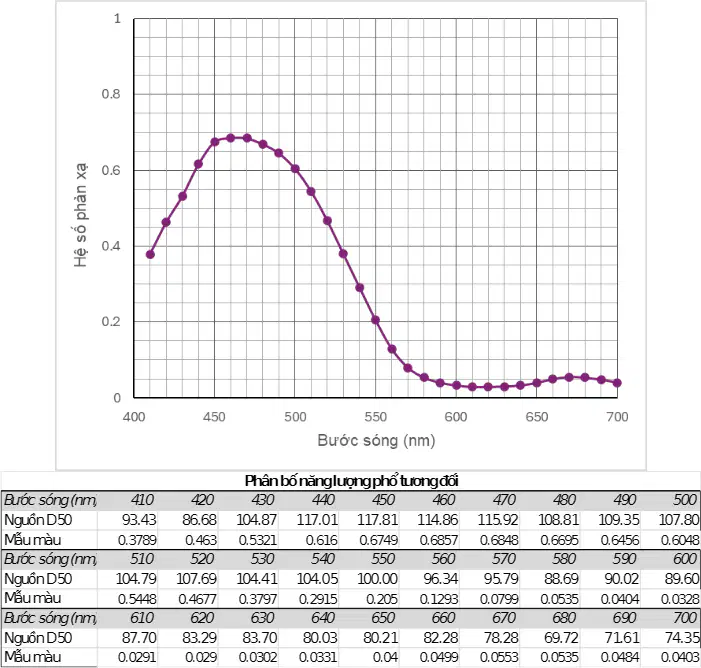
Using the measured reflectance spectrum and tabulated data for a single ink layer on white paper (assume nearly perfect substrate reflectance, eye sensitivity function, illuminant D50), identify the dominant wavelength range, relative luminance, and color purity of the sample.
Dominant wavelength: 460–470 nm; relative luminance: 0.32; color purity: 8.7%
Dominant wavelength: 460–470 nm; relative luminance: 0.29; color purity: 16.7%
Dominant wavelength: 450–480 nm; relative luminance: 0.32; color purity: 31.1%
Dominant wavelength: 450–480 nm; relative luminance: 0.29; color purity: 25.4%
According to experimental results, when the ink layer thickness increases, how does the ink’s reflectance spectrum change?
The reflectance coefficient increases at all wavelengths
The reflectance coefficient increases with thickness in regions of strong absorption characteristic of the ink
The reflectance coefficient decreases with thickness in regions of strong absorption characteristic of the ink
The position of the characteristic reflectance peak (dominant wavelength) shifts as thickness changes
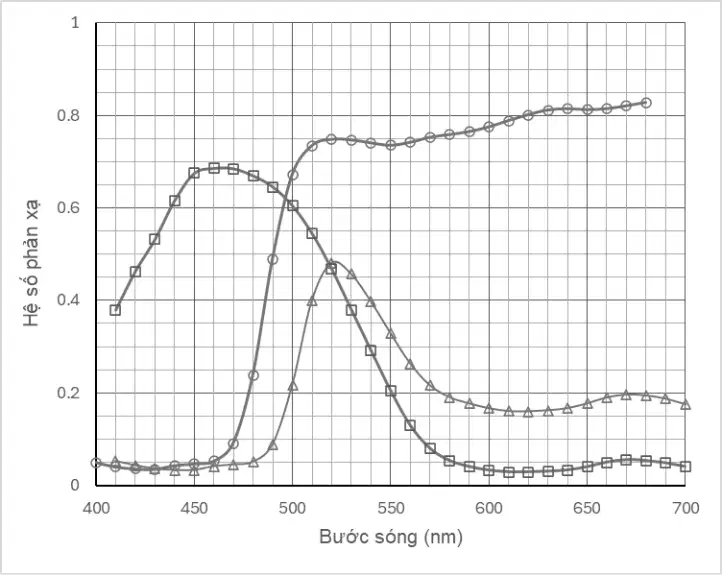
Given the reflectance spectrum of a secondary color patch created by overprinting two primary inks (Layer 1 marked by square points in front; Layer 2 marked by circular points behind), predict the relative proportion of the two primary inks forming the secondary color.
M1 (Blue) : M2 (Green) = 1.0 : 0.75
M1 (Blue) : M2 (Green) = 0.75 : 1.0
M1 (Cyan) : M2 (Yellow) = 0.75 : 1.0
M1 (Cyan) : M2 (Yellow) = 1.0 : 0.75
What is the main purpose of constructing the color gamut of a printing system?
To determine appropriate ink layer thickness
To evaluate the system’s color reproduction capability
To compare the system’s color reproduction with a standard
All of the above
What is understood by the color gamut boundary of a printing system?
The boundary line enclosing the set of reproducible colors
The boundary line enclosing the set of colors found in nature
The space of maximum color reproduction
The set containing all colors that exist
Which factor below does not directly affect the color gamut of a printing system?
Paper
Ink
Viewing conditions
Printer
In a two‑dimensional color gamut (CIE xy or CIE ab), which color characteristic is not represented?
Dominant wavelength
Color purity
Luminance
None
Which statement characterizes the convex‑hull method for constructing a color gamut?
It accurately describes all types of gamuts
Its algorithm is complex and difficult to apply
It cannot accurately describe gamuts with concave regions
It applies only in the Lab color space
Based on experimental results, compare the color gamut of a printing system on coated versus uncoated paper.
The gamut on coated paper is larger than on uncoated paper
The gamut on coated paper is no different from that on uncoated paper
The gamut on coated paper is smaller than on uncoated paper
The gamuts on coated and uncoated papers differ only in certain regions
Which paper property significantly narrows the color gamut of a printing system?
Low whiteness
High gloss
No surface coating
Porous structure

