
 Worksheets
🤗HW40: 2.8
Total questions: 130
Worksheet time: 1hrs 25mins

Match each missing word statement with the correct term.
A balanced chemical reaction obeys the law of ___.
conservation of matter
Within the electron cloud there are different ___ of electrons.
energy levels
Rusting metal is an example of a ___ change.
chemical
Sugar dissolving, water boiling and ice melting are examples of ___ changes.
physical

Select the people MOST responsible for your academic performances. (Select all that apply)
ME
me
Me
Duh- Me!

What is the dominant trait?
yellow pea seeds
green pea seeds
there is no dominant seed
Jolly green giant

What does a Punnett Square do?
tell you exactly what your offspring will look like
increase the chance you pass on recessive traits
predict genotypes and phenotypes in offspring
have no purpose but for Taylor to give us extra assignments

Heredity is the passing of traits from ____ to _____.
predators to prey
water to rain
parents to offspring
fungi to protists

Match each of these definitions with its term.
Another term for Child.
Offspring
Passing genetic information from parent to offspring.
Heredity
Genetic info; map of organism's makeup.
DNA
Characteristic or feature.
Trait
Segment of DNA located on Chromosome.
Gene

Match each term with its definition.
Hetero-
Means different
Homo-
Means same.
-Zygous
Referring to allele or genetic info.
Allele
Version of a gene.
Trait
Characteristic or feature.

Match each of these terms with its meaning.
Dominant Allele
Inherited allele is the more popular version.
Recessive Allele
Inherited allele is the rare version.
Homozygous Dominant
Both alleles are dominant (capital).
Homozygous Recessive
Both alleles are recessive (lowercase).
Probability
Likeliness to occur.
Labeling the Animal Cell.
Place a dot on the organelle.
RER
SER
Nucleolus
Nucleus
Cytoplasm
Golgi Body
Labeling Plant Cell.
Place a DOT on the organelle.
Ribosomes
Cell Wall
Cell/Plasma Membrane
Central Vacuole
Chloroplast
Match each of these terms with its meaning.
Dominant Allele
Inherited allele is the more popular version.
Recessive Allele
Inherited allele is the rare version.
Homozygous Dominant
Both alleles are dominant (capital).
Homozygous Recessive
Both alleles are recessive (lowercase).
Probability
Likeliness to occur.

T - tall and t = short. In the Punnett square below, what belongs in the missing square?
tt
Tt
Bb
TT

B = brown fur b = white fur In the Punnett square, what is the probability for white fur?
0%
25%
50%
75%

If T=Tall & t=short, what is the genotypic ratio?
1:3
3:1
1:2:1
2:2

B - black, b - brown. Two black mice mate and have some black and some brown mice. What is the genotype of the parents?
BB x Bb
BB x bb
Bb x Bb
Bb x bb

What are the possible genotypes for this cross?
TT = 25% Tt= 50% tt=25%
all tall
TT= 75% tt = 25%
Tt = 100%

In a certain species of plant, the color purple (P) is dominant to the color white (p). According to the Punnett Square, what is the probability of an offspring being white?
25%
0%
100%
50%

Purple (P) is dominant to the white (p). According to the Punnett Square, what is the probability of an offspring being purple?
25%
0%
100%
50%

What is the yellow seed genotype?
aa
Aa
AA
AA or Aa
What is the dominant trait?
yellow pea seeds
green pea seeds
there is no dominant seed
Jolly green giant

What is the genotypic ratio here?
25% blue eye 75 % brown eye
BB = 25% Bb = 50% bb = 25%
BB= 50 % bb = 50%
All brown eye
What does a Punnett Square do?
tell you exactly what your offspring will look like
increase the chance you pass on recessive traits
predict genotypes and phenotypes in offspring
have no purpose but for Taylor to give us extra assignments

What genotype would go in box 2?
BB
Bb
bb

What genotype would go in box 3?
BB
Bb
bb

What genotype would go in box 1?
BB
Bb
bb
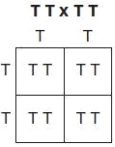
What ratio of the offspring from the cross shown will be homozygous recessive for the trait of tallness?
0 in 4
1 in 4
2 in 4
4 in 4

In a flowering plant species, red flower color (R) is dominant over white flower color (r). What is the genotype of any red-flowering plant resulting from this species?
rr
R
RR
RR or Rr

Which of the characteristics is a lion least likely to pass on to its offspring?
fur color
length of tail
scars on leg
body size
Which of the characteristics is a lion least likely to pass on to its offspring?
fur color
length of tail
scars on leg
body size

How many alleles (letters) does a child get from each parent for each trait?
1
2
3
4
Heredity is the passing of traits from ____ to _____.
predators to prey
water to rain
parents to offspring
fungi to protists

Which trait does a puppy inherit from its parents?
fur color and pattern
obedience to commands
food brand preferences
affection for a specific home

A couple has 6 children, all girls. If the mother gives birth to a 7th child, what is the probability that the seventh child will be a girl?
7 out of 7
6 out of 7
1 out of 2
1 out of 7
Match each term with its definition.
Hetero-
Means different
Homo-
Means same.
-Zygous
Referring to allele or genetic info.
Allele
Version of a gene.
Trait
Characteristic or feature.

Which of these statements is true about Punnett Squares (Select all that apply)?
They are useful to determine likeliness of traits passed to offspring.
Each square is equal to 25% probability of occurrence.
The allele combinations of mom and dad are used.
The allele combinations of the first offspring and one parent are used.
Phenotype percentages can be determined by the percentage outcomes.
Match each of these terms with its meaning.
Dominant Allele
Inherited allele is the more popular version.
Recessive Allele
Inherited allele is the rare version.
Homozygous Dominant
Both alleles are dominant (capital).
Homozygous Recessive
Both alleles are recessive (lowercase).
Probability
Likeliness to occur.

Short tails (T) are dominant to long tails (t). What's the probability of a long-tailed mouse with these parents, Tt x tt?
25%
50%
75%
100%
0%

When combining a plant whose genotype is homozygous dominant for a specific trait with one whose genes are heterozygous for that trait, what's the probability of a heterozygous offspring (use any trait to answer)?
0%
25%
50%
75%
!00%

In seals, the allele for long whiskers is dominant to the allele for short whiskers. What percentage of offspring would be expected to be heterozygous for long whiskers if both parents are heterozygous for long whiskers?
0%
25%
50%
75%
100%

What does the genotype for an allele combination BB represent?
Each letter represents the dominant allele inherited from each parent.
Both letters represent the dominant allele inherited from the mother.
Both letters represent the recessive allele inherited from the father.
Each letter represents the recessive allele inherited from each parent.

In humans, the presence of dimples is dominant to a lack of dimples. If a person without dimples (dd) and a person with dimples (Dd) have children, what can be concluded about the genotypes for the offspring?
There's a 75% chance the offspring will have dimples.
There's a 25% chance the offspring will not have dimples.
There's a 50% chance the offspring will be dd and a 50% chance they'll be Dd.
There's a 50% chance the offspring will be DD and a 50% chance they'll be dd.
In humans, the presence of dimples is dominant to a lack of dimples. If a person without dimples (dd) and a person with dimples (Dd) have children, what can be concluded about the genotypes for the offspring?
There's a 75% chance the offspring will have dimples.
There's a 25% chance the offspring will not have dimples.
There's a 50% chance the offspring will be dd and a 50% chance they'll be Dd.
There's a 50% chance the offspring will be DD and a 50% chance they'll be dd.

How is it possible for an organism to have a recessive phenotype for a trait such as white flowers in pea plants?
The organism inherits the recessive allele from one parent.
The organism inherits the recessive allele from both parents.
The organism fails to inherit the alleles for the trait from either parent.
The organism obtains its traits from the environment.
Match each of these definitions with its term.
Another term for Child.
Offspring
Passing genetic information from parent to offspring.
Heredity
Genetic info; map of organism's makeup.
DNA
Characteristic or feature.
Trait
Segment of DNA located on Chromosome.
Gene
Labeling Plant Cell.
Place a DOT on the organelle.
Ribosomes
Cell Wall
Cell/Plasma Membrane
Central Vacuole
Chloroplast
Labeling the Animal Cell.
Place a dot on the organelle.
RER
SER
Nucleolus
Nucleus
Cytoplasm
Golgi Body
Labeling the Animal Cell.
Place a dot on the organelle.
Plasma Membrane
Lysosome
Mitochondria
RER
SER
Nucleolus


Eukaryotic cells can include _______ (Select all that apply).
protists
plants
animals
fungi
In a certain species of plant, the color purple (P) is dominant to the color white (p). According to the Punnett Square, what is the probability of an offspring being white?
25%
0%
100%
50%
Purple (P) is dominant to the white (p). According to the Punnett Square, what is the probability of an offspring being purple?
25%
0%
100%
50%
What is the genotypic ratio here?
25% blue eye 75 % brown eye
BB = 25% Bb = 50% bb = 25%
BB= 50 % bb = 50%
All brown eye
What does a Punnett Square do?
tell you exactly what your offspring will look like
increase the chance you pass on recessive traits
predict genotypes and phenotypes in offspring
have no purpose but for Taylor to give us extra assignments
What genotype would go in box 1?
BB
Bb
bb
What ratio of the offspring from the cross shown will be homozygous recessive for the trait of tallness?
0 in 4
1 in 4
2 in 4
4 in 4
How many alleles (letters) does a child get from each parent for each trait?
1
2
3
4
Which of these statements is true about Punnett Squares (Select all that apply)?
They are useful to determine likeliness of traits passed to offspring.
Each square is equal to 25% probability of occurrence.
The allele combinations of mom and dad are used.
The allele combinations of the first offspring and one parent are used.
Phenotype percentages can be determined by the percentage outcomes.
Short tails (T) are dominant to long tails (t). What's the probability of a long-tailed mouse with these parents, Tt x tt?
25%
50%
75%
100%
0%

Brown fur (B) is dominant to white fur (b) in rabbits. Which genotype would result from two parents that are homozygous for brown fur?
BB
Bb
bb
b
B
What does the genotype for an allele combination BB represent?
Each letter represents the dominant allele inherited from each parent.
Both letters represent the dominant allele inherited from the mother.
Both letters represent the recessive allele inherited from the father.
Each letter represents the recessive allele inherited from each parent.
In humans, the presence of dimples is dominant to a lack of dimples. If a person without dimples (dd) and a person with dimples (Dd) have children, what can be concluded about the genotypes for the offspring?
There's a 75% chance the offspring will have dimples.
There's a 25% chance the offspring will not have dimples.
There's a 50% chance the offspring will be dd and a 50% chance they'll be Dd.
There's a 50% chance the offspring will be DD and a 50% chance they'll be dd.

Which picture below would correctly support the Law of Conservation of Matter as the match of reactants?


Sodium sulfate and barium chloride react with each other to form sodium chloride and barium sulfate as shown. Which statement MOST accurately describes the mass of the reactants compared to the mass of the products?
The mass of the reactants is the same as the mass of the products.
The products have a greater mass because matter was created during the reaction.
The reactants have a greater mass because some of the mass was converted to heat.
The reactants have a greater mass because some matter was destroyed by the reaction.


In science class, Jonathan added a small amount of sand to a beaker of water. He stirred it vigorously so that all the sand swirled around in the water. Jonathan then claimed to his classmates that he had made a solution. However, his teacher told Jonathan that he was mistaken. Why was the teacher correct?
Jonathan made a compound, not a mixture.
A solid substance cannot dissolve in water to form a solution.
The sand will eventually settle to the bottom and will not dissolve in the water resulting in a heterogeneous mixture.
A chemical reaction did not take place, so a solution was not formed.
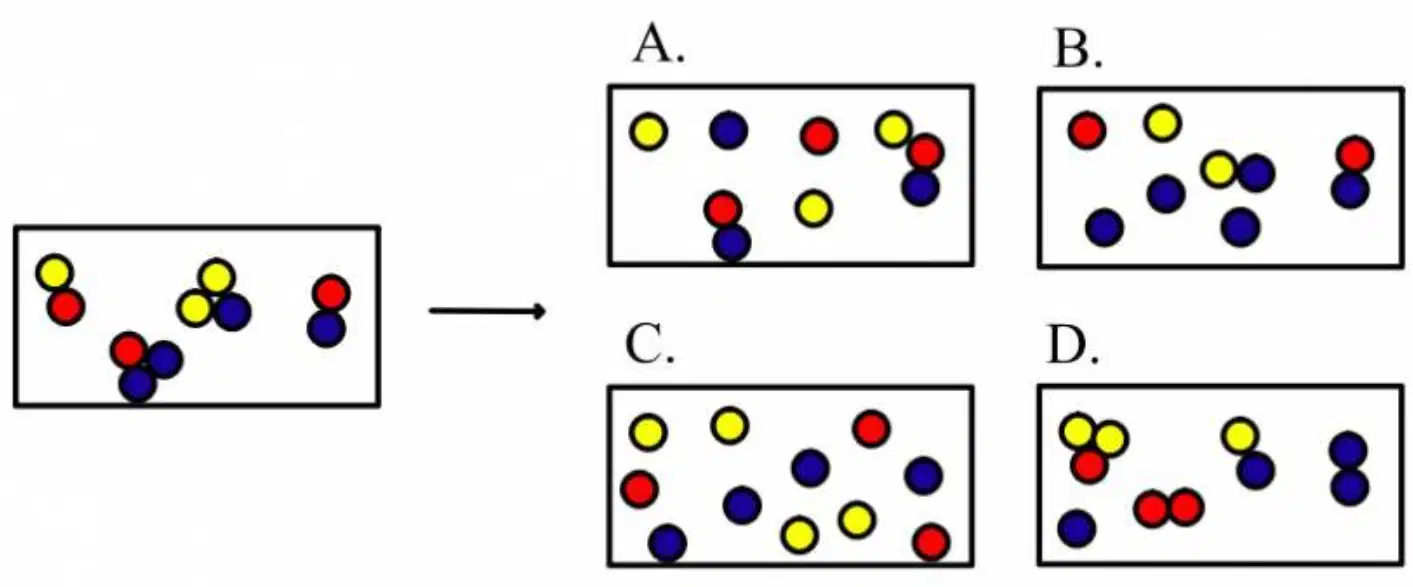
Review the image provided. Picture D represents the only possible options as the correct products. What fact supports this?
Pictures A, B, and C each have the wrong types of atoms compared to the starting reactants.
Pictures A, B, and C each have more total atoms than what the reactants started with.
Picture D has the same number and type of each atom that the reactants contain.
Picture D rearranges the atoms whereas A, B, and C did not.

Which of these statements is not an advantage of sexual reproduction (Select all that apply)?
Rapid reproduction of a large amount of offspring.
More genetic mutations occur.
High genetic variation.
Offspring are identical to parent.
Increased survivorship in a changing ecosystem.

Which of the following is not an advantage to asexual reproduction (Select all that apply)?
Rapid reproduction of large amounts of offspring.
Organisms do not have to find a mate.
High genetic variation.
Increased genetic mutation.
Less Energy required.

Identify the type of asexual reproduction shown in the image.
fragmentation
cloning
binary fision
budding

Identify the type of asexual reproduction shown in the image.
fragmentation
cloning
binary fision
budding

Identify the type of asexual reproduction shown in the image.
fragmentation
cloning
binary fision
budding

Which of the following are disadvantages of sexual reproduction (Select all that apply)?
Requires more time.
High genetic variation.
Requires more energy.
Cannot produce large amounts of offspring in a short amount of time.
Requires a mate.

___________________ is a type of asexual reproduction in which a piece of a parent organism breaks off to form a new organism (ex. starfish)
fission
budding
fragmentation
cloning

Asexual, because asexual organisms always have variation within species.
Sexual, because sexual organisms have variation within species.
Both Asexual and Sexual reproduction would be beneficial, because they both have variation within species.
Asexual, because asexual organisms have no variation, so they can adapt to a changing environment.

What is the cell process called that produces identical cells?
Mitosis
Meiosis
Photosynthesis
Cellular Respiration

A bee flies from one apple blossom to another and transfers pollen as it goes. Which type results from pollination?
Sexual
Asexual
Neither
Both

Which type of reproduction results in offspring that are identical to the parent?
Sexual
Asexual
Neither
Both

Which type of reproduction tends to produce more offspring?
Sexual
Asexual
They occur at the same rate

How did you inherit your genetic information?
most of your chromosomes are from your mother
a random number of chromosomes from each parent
most of your chromosomes are from your father
half of your chromosomes are from your mother and half are from your father

The cells produced by mitosis are
Identical
Different

The cells produced by meiosis are
Identical
Different
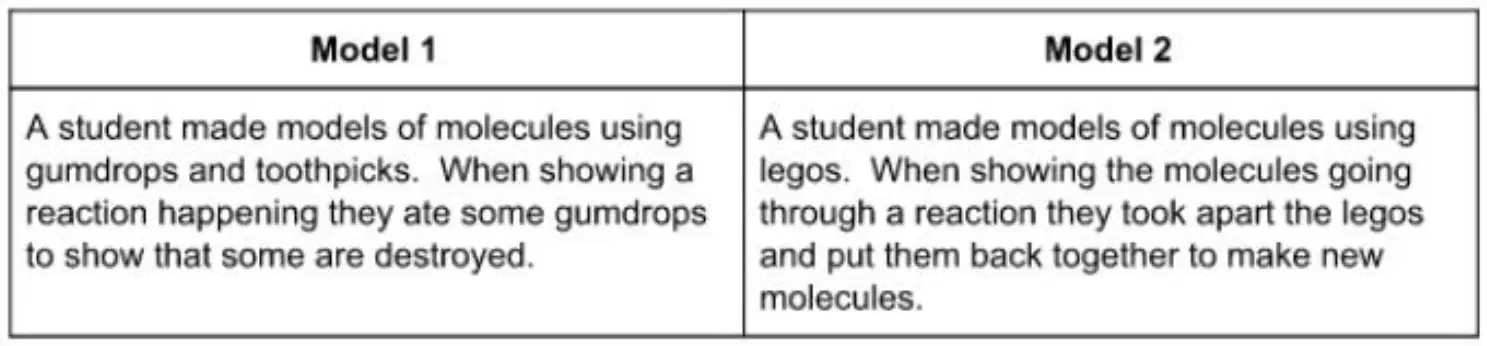
Two students create models that show how the number of atoms change during a reaction. Which of these models is best?
Model 1 is best because it shows atoms can be lost during a reaction.
Model 2 is best because it shows matter is destroyed during a reaction.
Model 2 is best because it shows atoms aren’t lost during a reaction.
Neither of these models accurately shows what happens to atoms during a reaction.

In a chemical reaction, the mass of the reactants ___ the mass of the products Choose the MOST accurate response).
is less than
always differs from
is sometimes the same
is always the same

A student mixes 50 grams of water, 20 grams of sugar and 2 grams of flour. The mixtures gets thick. What is the mass of the product?
80 grams
There's not enough information to determine.
72 grams
122 grams
Which is Chemical Equation is Balanced?
(Think: Balanced Equations support the Law of Conservation of Mass)
CH₄ + O₂→ CO₂+ 2H₂O
H₂ + O₂ → 2H₂O₄
4Al + 3O₂ → 2Al₂O₃
Is this equation balanced or unbalanced?
(Think: Balanced equations support the Law of Conservation of Mass)
2Fe2O3 + 3C → 4Fe + 3CO2
Balanced
Unbalanced

If a reaction starts with a total 75g of reactants it should produce ___.
a total of 180g of products
Which picture below would correctly support the Law of Conservation of Matter as the match of reactants?
Sodium sulfate and barium chloride react with each other to form sodium chloride and barium sulfate as shown. Which statement MOST accurately describes the mass of the reactants compared to the mass of the products?
The mass of the reactants is the same as the mass of the products.
The products have a greater mass because matter was created during the reaction.
The reactants have a greater mass because some of the mass was converted to heat.
The reactants have a greater mass because some matter was destroyed by the reaction.

Which two phase changes happen because energy leaves or is removed from the substance?
Freezing
Condensation
Vaporization (Boiling/Evaporation)
Melting

Which of the following described the properties of particles in liquid? (Select all that apply).
Closely packed in orderly manner
slide over each other
Vibrate about fixed position
Low kinetic energy
Closely packed in disorderly,random manner

Which of these factors would increase the rate of photosynthesis (Select all that apply)?
Increasing the amount of carbon dioxide
Decreasing the amount of oxygen
Increasing the amount of sunlight
Increasing the amount of glucose sugar
Increasing the amount of water

F
G
H
J
Which of these statements is an advantage of sexual reproduction (Select all that apply)?
Rapid reproduction of a large amount of offspring.
More genetic mutations occur.
High genetic variation.
Offspring are identical to parent.
Increased survivorship in a changing ecosystem.
Which of the following is not an advantage to asexual reproduction (Select all that apply)?
Rapid reproduction of large amounts of offspring.
Organisms do not have to find a mate.
High genetic variation.
Increased genetic mutation.
Less Energy required.
Identify the type of asexual reproduction shown in the image.
fragmentation
cloning
binary fision
budding
Which of the following are disadvantages of sexual reproduction (Select all that apply)?
Requires more time.
High genetic variation.
Requires more energy.
Cannot produce large amounts of offspring in a short amount of time.
Requires a mate.
Which of the following are disadvantages of sexual reproduction (Select all that apply)?
Requires more time.
High genetic variation.
Requires more energy.
Cannot produce large amounts of offspring in a short amount of time.
Requires a mate.
___________________ is a type of asexual reproduction in which a piece of a parent organism breaks off to form a new organism (ex. starfish)
fission
budding
fragmentation
cloning
Asexual, because asexual organisms always have variation within species.
Sexual, because sexual organisms have variation within species.
Both Asexual and Sexual reproduction would be beneficial, because they both have variation within species.
Asexual, because asexual organisms have no variation, so they can adapt to a changing environment.

Which results in offspring that are genetically unique and display a combination of traits from each parent?
Sexual
Asexual
Neither
Both
Which type of reproduction results in offspring that are identical to the parent?
Sexual
Asexual
Neither
Both

What are the products (what is released) of cellular respiration? (Mark all of them!)
oxygen
glucose
carbon dioxide
water
ATP (energy)

Which of the following exhibits the correct order of the Organization Levels of Life? (simplest to complex)
Cell > Tissue > organ > organ system > organism
organism > organ system > organ > tissue > cell
Cell > organ > tissue > organ system > organism
Cell > organ > tissue > organ system > organism

Match each protist with its image.

Euglena

Ameba

Paramecium

Asexual, because asexual organisms always have variation within species.
Sexual, because sexual organisms have variation within species.
Both Asexual and Sexual reproduction would be beneficial, because they both have variation within species.
Asexual, because asexual organisms have no variation, so they can adapt to a changing environment.

Which organism would you classify as sexually reproducing?
A strawberry plant that reproduces through runners in the ground
A starfish that reproduces by breaking off and regenerating parts of its body
An amoeba that splits through binary fission
A chicken egg that is fertilized by a rooster

How does the DNA of an asexually reproducing plant relate to its parent(s)?
Its DNA is a combination of two parent’s DNA.
Its DNA has mutations.
Its DNA is identical to its parent.
Heredity is the passing of traits from ____ to _____.
predators to prey
water to rain
parents to offspring
fungi to protists
Match each of these definitions with its term.
Another term for Child.
Offspring
Passing genetic information from parent to offspring.
Heredity
Genetic info; map of organism's makeup.
DNA
Characteristic or feature.
Trait
Segment of DNA located on Chromosome.
Gene

Match each term with the BEST reference.
genetically identical
DNA is the same
genetically diverse
DNA is different
offspring
children
asexual reproduction
1 parent
sexual reproduction
2 parents
Match each definition with its term.
Inherited traits passed from parent to offspring that influence growth.
Genetic Factors
Outside conditions or influences that affect how an organism grows.
Environmental Factors
Plant or animal.
Organism
Specific type within a species that has been selectively bred for certain traits.
Breed
Process of increasing in size or development
Growth
Which of these statements is not an advantage of sexual reproduction (Select all that apply)?
Rapid reproduction of a large amount of offspring.
More genetic mutations occur.
High genetic variation.
Offspring are identical to parent.
Increased survivorship in a changing ecosystem.
Which of the following is not an advantage to asexual reproduction (Select all that apply)?
Rapid reproduction of large amounts of offspring.
Organisms do not have to find a mate.
High genetic variation.
Increased genetic mutation.
Less Energy required.
Which of the following are disadvantages of sexual reproduction (Select all that apply)?
Requires more time.
High genetic variation.
Requires more energy.
Cannot produce large amounts of offspring in a short amount of time.
Requires a mate.
Which results in offspring that are genetically unique and display a combination of traits from each parent?
Sexual
Asexual
Neither
Both
Which type of reproduction results in offspring that are identical to the parent?
Sexual
Asexual
Neither
Both
Match each of these definitions with its term.
Another term for Child.
Offspring
Passing genetic information from parent to offspring.
Heredity
Genetic info; map of organism's makeup.
DNA
Characteristic or feature.
Trait
Segment of DNA located on Chromosome.
Gene


How does the DNA of an asexually reproducing plant relate to its parent(s)?
Its DNA is a combination of two parent’s DNA.
Its DNA has mutations.
Its DNA is identical to its parent.

Which of the following best describes the advantage of sexual reproduction?
All offspring will contain only the best traits, so they will become stronger in each
generation.
Offspring will be identical to their parents, which increases strength of a population.
Offspring will be a mixture of their parent’s traits, increasing variation in the
population.
Males and females will find similar partners which will help to decrease variation in
the population

For each Biological Hierarchical Level match its image.

Population

Biosphere

Organism

Organ System

Ecosystem

Match each of these terms with its correct definition.
Homeostasis
Energy Molecule of the cell
DNA
Maintenance of the internal environment
Internal
Blueprint of creation for the cell
ATP
Means "inside"
Chloroplast
Location of photosynthesis
Match each of these organelles with its specific function (job).
Vacuole
Stores water, food and waste
Mitchondria
Converts cell food into cell energy (ATP)
Nucleolus
Location of MOST of cell DNA
Golgi Body
Packages and ships substances in and out of cell
Cell Wall
Provides rigid structure and maintains plant pressure
For each Biological Hierarchical Level match its image.
Population

Tissue

Community

Biome

Organ System

