
 Worksheets
Sci 8 Reviewer
Total questions: 51
Worksheet time: 26mins
At the exciting science fair, our friend Mia dazzled the audience with her project on the fascinating history of atomic theory! She shared that there was a time when scientists believed atoms were the smallest building blocks of matter, indivisible and mysterious. But do you know which brilliant scientist first introduced the idea of these tiny particles called atoms?
Thomson
Democritus
Dalton
Rutherford
During a fun science experiment, Grace and her friends Benjamin and Abigail decided to mix vinegar and baking soda. To their surprise, the mixture fizzed and produced a bubbly gas! Which statement is TRUE according to Dalton’s Atomic Theory?
Atoms rearrange during chemical reactions
Atoms are mostly empty space
Atoms are destroyed during reactions
Atoms can be created
Imagine Anika and Olivia stumble upon a treasure chest filled with pure gold, just like the ones Grace found! If they compare two atoms of that shiny gold, what would Dalton most likely say about them?
They are sometimes alike
They are different from each other
They are always charged
They are identical
In a bustling chemistry lab, our curious friend Mary, along with her classmates Emma, Henry, and Zoe, is diving into the fascinating world of Dalton’s atomic theory. As they mix colorful solutions and observe bubbling reactions, Mary starts to ponder: which part of Dalton’s theory might not hold up against the amazing discoveries of modern science? Can you help her figure out which part was later proven incorrect?
Atoms are indivisible
Atoms combine in whole-number ratios
Elements are made of atoms
Atoms rearrange in reactions
At the exciting science fair, our brilliant friend Grace wowed the crowd with her amazing model of an atom, inspired by the famous gold foil experiment! She shared fascinating insights about how atoms are mostly empty space, yet they have a super dense center. Can you guess which part of the atom is the heavyweight champion, containing most of its mass?
Electron cloud
Shells
Nucleus
Orbitals
Imagine Grace, a curious student in her physics class, is on a quest to uncover the mysteries of electrons. Instead of picturing them zipping along precise paths like tiny cars on a racetrack, her teacher introduces her to a fascinating concept: electrons are better understood as areas of probability, like clouds of possibility! Can you guess which model supports this intriguing idea?
Rutherford Model
Quantum Mechanical Model
Bohr Model
Plum Pudding Model
In a lively science class, Maya is on a mission to create an awesome model of an atom! She knows that the nucleus is like the heart of the atom and contains two types of super important particles. Can you help her figure out which particles she should include in her drawing?
Electrons and protons
Protons and neutrons
Neutrons and electrons
Protons only
In an exciting science experiment, our friend Mary, along with her classmates Ava and Benjamin, observes something fascinating! As they mix different elements, Mary notices that a neutral sodium atom decides to lose one electron while forming a bond with another atom. Can you guess what it transforms into?
Isotope
Positive ion
Neutral particle
Negative ion
In a lively chemistry class, Scarlett is fascinated as her teacher dives into the world of isotopes. With a sparkle in her eye, the teacher explains that isotopes of the same element always share the same atomic number. But why is that the case? Can you help Scarlett figure it out?
they all have the same mass number
they all have the same number of neutrons
they all have the same number of protons
none of the above
Imagine Aria has a magical sealed bottle filled with the purest distilled water, sparkling like a crystal clear lake, and absolutely nothing else mixed in. How would you classify this enchanting substance?
Matter with fixed composition
Any liquid matter
Combination of substances
Compound mixture

Abigail is diving into a fascinating science diagram in her textbook that showcases two identical spheres connected together. Can you guess what this intriguing setup represents? Answer: C
Unbonded atoms
A compound
A mixture
A diatomic element
In a bustling chemistry lab, our curious friend Grace, along with her classmates Ethan, Mia, and Noah, is on a mission to create something amazing! They combine hydrogen and oxygen gases to whip up a batch of water. Which statement best describes the magical process of how compounds are formed?
They can be separated physically
They have changing composition
They form when elements chemically combine
They keep all original properties
Hey there, science explorer! 🌟 Emma is diving into the fascinating world of elements and has her sights set on phosphorus (P), which boasts an atomic number of 15. Can you lend her a hand in uncovering its correct electron configuration in orbital notation? Let's make chemistry fun!
1s2 2s2 2p6 3s2 3p3
1s2 2s2 2p6 3s2 3p5
1s2 2s2 3s2 3p3
1s2 2p6 3s2 3p3
In a fun science experiment, Ava and her friend Mason are mixing iron filings and sand together. After a bit of stirring, they decide to use a magnet to see what happens. What exciting lesson does this teach them?
All substances are pure
Elements chemically bond easily
Mixtures can be separated using physical properties
Compounds can be separated physically
At the annual science fair, Elijah was buzzing with excitement as he showcased his project on the magical composition of water. He confidently declared that water is a fantastic duo made up of two elements: hydrogen and oxygen! Meanwhile, Grace, who was equally enthusiastic about her project on chemical compounds, chimed in, arguing that compounds are like intricate puzzles, more complex than simple elements. Now, let's dive into the fun! Which of the following statements is TRUE?
Water is composed of more than two elements.
Ferrous sulfate cannot be broken down into simpler substances.
Compounds are more complex than elements.
Compounds are made up of one kind of element.
In a bustling chemistry lab, our curious student Aiden is diving into the fascinating world of electron configurations. While exploring, he stumbles upon an atom with the intriguing electron configuration: 1s2 2s2 2p6 3s2 3p6 4s2 3d10 4p3. With a spark of curiosity, Aiden wonders: What element could this be?
Gallium (Ga)
Zinc (Zn)
Germanium (Ge)
Arsenic (As)
In a lively chemistry class, Grace and her friends Aria and Samuel are diving into the fascinating world of molecules! Their teacher enthusiastically explains that when different elements come together, they create a brand new substance with its own unique properties. So, what exactly is a molecule?
Components lose their properties
Components can be separated by physical means
Components form a new substance
Components are chemically combined
One sunny afternoon, Zoe decided to whip up a delicious fruit salad. She tossed together juicy apples, ripe bananas, and zesty oranges in a big bowl. Can you guess what kind of mixture Zoe created?
It has properties usually different from the properties of elements it contains
It is always homogeneous
It has two or more elements or compounds not chemically combined
It has two or more elements or compounds chemically combined
In a lively science class, our curious friend Noah is peering into a fascinating container filled with small single blue balls and pairs of gray balls mixed together. What exciting discovery does this container reveal?
A mixture of identical compounds
Only one kind of element present
A mixture of different elements
Only one compound present
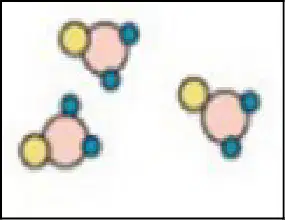
In a colorful chemistry adventure, Maya is conducting an experiment in her lab! She has groups of vibrant colored balls: each group features a pink ball joined with a cheerful yellow ball and a playful blue ball. What do you think each group represents?
One compound made of bonded atoms
One element made of one atom
A mixture of separate elements
Loose atoms not connected
In the charming little town of Fruitville, two friends, Emma and Mason, are famous for their delightful fruit collection. Emma has a basket full of shiny apples, while Mason boasts an equal number of juicy oranges. The townsfolk say that when the number of apples Emma has matches the number of oranges Mason has, the town is in perfect harmony! Now, let's dive into the world of atoms: Atoms are neutral when they have the same number of which two particles?
Protons and electrons
Neutrons and protons
Neutrons and electrons
Protons and nuclei
In a lively chemistry class, Grace and her friends Benjamin and Michael are diving into the fascinating world of elements. Today, Grace stumbles upon an intriguing fact: an oxygen atom with atomic number 8 and mass number 18. Can you help her figure out how many protons this oxygen atom has?
10 protons
18 protons
9 protons
8 protons
Imagine Grace, a budding scientist, has a fascinating collection of atoms! One of her prized atoms has 17 protons, 18 neutrons, and 17 electrons. Can you help her figure out what is true about its charge?
It changes every second
It is positive overall
It is negative overall
It is neutral overall
In a lively chemistry class, Maya is diving into the fascinating world of atoms! Her teacher enthusiastically explains that the atomic number reveals the count of which particles in an atom. Can you help Maya figure it out?
Neutrons in the nucleus
Protons in the nucleus
All particles combined
Electrons in the outer shell
In a vibrant chemistry lab, our curious student Luna is on a quest to uncover the secrets of an element with atomic number 84 and mass number 210. Can you help Luna calculate how many neutrons this mysterious element holds?
210 neutrons
294 neutrons
126 neutrons
84 neutrons
In a vibrant chemistry lab, our curious student Maya is on an exciting quest to uncover the secrets of an atom! This particular atom has 28 protons, 28 electrons, and 34 neutrons. Can you help Maya determine its atomic number? What is the atomic number of this atom?
28
34
62
56
In the vibrant world of chemistry, our curious friend Grace is on a quest in her lab! She has adorned her walls with fascinating pictures that tell a story of elements and compounds. One picture showcases a lively mixture of different single atoms, while another is a mysterious blank canvas. A third picture reveals identical bonded groups, and the last one features a single type of atom repeated like a loyal friend. Can you help Grace figure out which picture represents a mixture of elements, rather than a single compound?
Picture with different single atoms mixed
Picture with nothing shown at all
Picture with identical bonded groups only
Picture with one kind of atom repeated
In her exciting chemistry class, Mia is diving into the world of atoms! She discovers that if you add the number of protons and neutrons in an atom, what fascinating number do you uncover?
Group number
Mass number
Atomic number
Charge number
Join Grace, Mary, and their curious friends Henry and Noah as they embark on an exciting adventure to explore the world around them! They wonder, what tiny parts make up everything they see?
Planets are tiny building blocks
Clouds are tiny building blocks
Mountains are tiny building blocks
Atoms are tiny building blocks
In a lively science class, Mary and her friends Jackson, Grace, and Anika are diving into the fascinating world of atoms. Their enthusiastic teacher poses a fun challenge to the class, asking, "Can you tell me which part of an atom is positively charged?"
Proton in the nucleus
Electron in clouds
Neutron in space
Shell around atom
In the lively town of Atomville, students are buzzing with excitement at the annual science fair! Among the fascinating projects, a bright student named Evelyn is captivating the audience with her knowledge about atoms. She poses a fun question to everyone, "Can anyone tell me which part of an atom carries a negative charge?"
Electron around nucleus
Proton in center
Neutron in core
Energy level ring
In a lively science class, Grace is enthusiastically explaining the fascinating structure of an atom to her curious classmates, including William and Henry. She playfully asks, "What do we call the center of an atom?"
Orbiting electron
Outer space
Nucleus in the middle
Energy shell
One sunny afternoon, Evelyn and her friend Grace were exploring the fascinating world of atoms. Grace stumbled upon a mysterious atom that had 11 protons. Can you help them figure out how many electrons this neutral atom has?
Zero electrons here
Two electrons total
Nine electrons only
Eleven electrons too
In her exciting chemistry class, Lily is diving into the fascinating world of atoms! She discovers that the total number of protons and neutrons in an atom is a key concept. Can you help her figure out what this total is called?
Mass number of atom
Atomic number only
Electron number list
Energy level count
While diving into the fascinating world of chemistry, James, Isla, and Noah stumble upon a curious fact: lithium, sodium, and potassium are like the best of friends! Can you guess what they have in common that makes them act alike?
Atomic numbers equal
Valence electrons shared
Atomic masses same
Periods on table
In a lively chemistry class, Liam, Nora, and Benjamin are diving into a fascinating discussion about elements that share the same row in the periodic table. Can you guess what they all have in common when it comes to sodium, magnesium, and aluminum?
Reactivity with water
Number of electron shells
Number of protons each
Valence electrons count
In a lively science class, Maya and Michael were deep in discussion about the fascinating building blocks of matter. Maya excitedly shared that matter is made of tiny, indivisible particles called atoms. Just then, their teacher chimed in, "Can anyone tell me which brilliant scientist first proposed this groundbreaking idea?"
Rutherford said this idea
Bohr said this idea
Thomson said this idea
Dalton said this idea
At the exciting science fair, our brilliant student Grace dazzled everyone with her project on atomic structure! She passionately explained how a tiny, dense nucleus with a positive charge sits at the heart of every atom. Grace also shared fascinating stories about the scientists who contributed to this groundbreaking discovery. Can you guess who first uncovered the secret of the small, dense nucleus with a positive charge?
Thomson found nucleus
Bohr found nucleus
Democritus found nucleus
Rutherford found nucleus
During an exciting science class, Mary enthusiastically explains how electrons dance around the nucleus of an atom in fixed energy levels. But wait! Who was the brilliant mind that proposed this fascinating model? Was it the wise Dalton, the innovative Bohr, the ancient Democritus, or the clever Thomson?
Dalton made this model
Bohr made this model
Democritus made this model
Thomson made this model
During a lively science class, Emma excitedly described a quirky model where electrons were like plums scattered in a deliciously positive pudding. Can you guess which model she was referring to?
Dalton solid sphere
Rutherford nuclear model
Bohr energy levels
Thomson plum pudding
In a lively science class, Grace, along with her friends Daniel and Nora, is diving into the fascinating world of sodium! With a mass number of 23 and an atomic number of 11, Grace is curious about how many neutrons are hiding in a sodium atom. Can you help her figure it out?
Twelve neutrons total
Eleven neutrons total
Twenty-three neutrons
Two neutrons only
In a vibrant chemistry lab, our curious friend Grace is diving into the fascinating world of the element Chlorine! With an atomic number of 17 and a mass number of 35, she wonders: how many protons are there in this intriguing element?
Seventeen protons present
Eighteen protons present
Thirty-five protons here
Zero protons present
In a vibrant chemistry lab, our curious student Grace, alongside her friends Henry and Abigail, is diving into the fascinating world of Chlorine, specifically the isotope with a mass number of 35. As they mix colorful solutions, Grace wonders aloud: how many neutrons are hiding in this intriguing isotope of Chlorine?
Eighteen neutrons total
One neutron only
Seventeen neutrons total
Thirty-five neutrons total
In a lively chemistry class, Ava is diving into the fascinating world of atoms! Her teacher passionately explains that the outermost electrons are the stars of the show when it comes to bonding with other atoms. Can you guess what we call these important outermost electrons?
Nuclear neutrons inside
Core protons inside
Inner shells only
Valence electrons outside
At the exciting science fair, Grace, Daniel, and their classmates are diving into the wonders of the periodic table! Grace spots something interesting: elements that are lined up in the same column often share a special trait. Can you guess what it is?
Same valence electrons
Same atomic number
Same nucleus size
Same total mass
Hey there, chemistry whiz! Mia is diving into the fascinating world of the periodic table in her class. She discovers that iodine is nestled in Group 17. Can you help her figure out how many valence electrons an iodine atom has?
One valence electron
Eight valence electrons
Five valence electrons
Seven valence electrons
In a colorful game of marbles, Grace and her friends Nora, Ethan, and Aria are on a mission to collect marbles of different colors. As they move from one vibrant color to the next in a row of jars, what usually happens to the number of marbles of each color?
Increases by one each
Becomes zero suddenly
Stays always same
Decreases by one each
In a lively science class, Emma is diving into the fascinating world of atoms! She learns that in a neutral atom, the number of protons is equal to the number of electrons. Can you help Emma figure out which statement about a neutral atom is spot on?
Neutrons equal shells
Electrons equal mass
Protons equal neutrons
Protons equal electrons
In a bustling science lab, our inquisitive friend Leo is exploring the fascinating world of chemical reactions! He learns that when substances combine to form a new substance, they undergo a transformation. What is this process called?
Chemical reaction
Physical change
Mixture formation
Phase transition
During an exciting chemistry experiment, Ava and her classmates are investigating the properties of gases. They discover that gases fill their containers completely and can be compressed. What term describes this unique behavior of gases?
Viscosity
Fluidity
Compressibility
Incompressibility
In a lively classroom, our curious student Mia is learning about the periodic table! She notices that elements are arranged in a specific order based on their atomic number. What does this arrangement help predict about the elements?
Their density
Their size
Their reactivity
Their color

