
 Worksheets
Introduction to Cyber-Physical Systems
Total questions: 26
Worksheet time: 43mins
A city reports frequent rush-hour congestion despite fixed-timing traffic lights. Propose a control strategy for a CPS-based smart traffic system that reduces average wait time without creating gridlock, and justify how feedback is used between sensors, computation, and actuators.
Which scenario best demonstrates tight integration of computation and physical processes in a cyber-physical system, and why is it a stronger example than the others?
A weather website posts yesterday’s wind speeds from stations
A mechanic schedules oil changes using a printed checklist
A spreadsheet logs weekly temperatures for later analysis
A drone alters altitude from obstacle sensor data in real time
In remote robotic surgery, identify the single most critical feedback variable that must be regulated to maintain patient safety under latency, and fill in the blank with a precise term: The controller should prioritize stabilizing (a) to prevent tissue damage when delays occur.
A railway signaling CPS must prevent two trains from entering the same track section while operating under strict time limits and over a 5G link. Which design choice best balances determinism and networked communication to meet safety goals?
Prioritize throughput over latency in the network
Use deterministic scheduling with bounded-delay wireless QoS
Rely on best-effort Wi‑Fi with redundant controllers
Adopt event-driven tasks without timing guarantees
You are tasked to integrate a factory robot from Vendor A with a conveyor from Vendor B while enabling real-time shutdown within 50 ms if an obstruction is detected. Propose a protocol choice and control-loop strategy that satisfies interoperability and timing.
In an autonomous vehicle CPS, the airbag subsystem must deploy in milliseconds after crash detection while allowing a human to take over steering during anomalies. Which layered architecture mapping best supports these requirements?
Physical sensors and actuators at the physical layer, real-time embedded crash logic in the cyber layer, low-latency in-vehicle network in the communication layer, and driver override UI in the application layer
Use cloud-hosted crash logic for scalability, with periodic updates over the internet and manual override through a mobile app
Crash detection algorithms placed in the application layer, human override in the communication layer, sensors abstracted entirely in software, and actuators controlled over best-effort Wi‑Fi
All layers merged into a single software process to reduce latency, with human control handled by background tasks
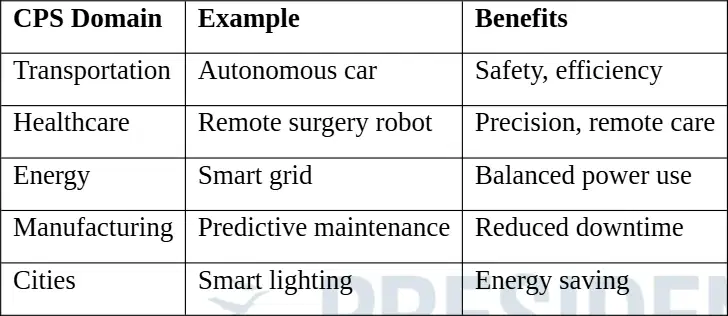
Given the summary table of CPS domains, choose the pairing that most logically extends the pattern of domain–example–benefit with equivalent specificity.
Agriculture – Soil moisture drones – Yield stability
Finance – Mobile apps – Convenient payments
Retail – Smart shelves – Real-time inventory
Education – Online courses – Flexible schedules
Design a brief plan for migrating a conventional assembly line to Industry 4.0. Specify at least three capabilities and justify how each reduces downtime or improves quality.
A bottling plant wants to adjust filling speeds in real time while also forecasting machine failures. Which integrated setup best meets both goals with minimal downtime?
Cloud-only dashboards with manual operator overrides
Standalone 3D printers for rapid tooling prototyping
Edge analytics with AI-driven predictive maintenance
AR headsets for step-by-step procedural guidance
Engineers plan to validate a jet engine control strategy without risking hardware damage. Outline a plan that combines Digital Twin and IIoT data to iteratively improve the controller and justify why this reduces deployment risk.
Fill in the blank: In Industry 4.0, (a) creates products layer by layer and supports on-demand spare parts.
Which mitigation most directly addresses the primary risk when connecting legacy machines to networks for real-time monitoring?
Deploy strong encryption and layered firewalls at all endpoints
Expand cloud storage capacity for long-term data retention
Increase 3D printer utilization for faster spare production
Rely on manual approvals for every sensor data upload
You are redesigning a smart thermostat to improve maintainability and security. Which architectural change best aligns with modular design and layered architecture principles while minimizing coupling between functions?
Keep all functions in a single fast monolithic service
Merge sensing and control into one optimized module
Bind UI events directly to motor drivers for speed
Separate sensing, networking, logic, and UI into modules
A delivery drone occasionally loses its cellular link when flying near tall buildings. Propose a fail-safe and redundancy plan that prevents harm and maintains partial capability. Justify how each element addresses specific risks.
An industrial CPS team moves object detection from cloud servers to on-device processing at the edge. Which outcome most directly supports safety in real-time operation?
Lower latency enables faster actuation decisions locally
Shared processing pools reduce device power usage
Higher bandwidth allows more data to the cloud
Centralized analytics improves long-term model training
You are designing an autonomous drone that must hover within 0.5 m even when GPS briefly drops. Which requirement is most appropriate to prioritize first in the specification?
Computation and decision-making algorithms for rotor control
High-throughput video analytics for multi-stream monitoring
Aesthetic design guidelines for the user interface
Long-term data archival for maintenance reporting
A medical infusion pump must never overdose even if a sensor glitches. Propose a requirement that addresses this risk and justify how it mitigates failure modes.
Which statement best distinguishes functional from non-functional requirements in a CPS?
Functional addresses availability; non-functional addresses decision logic
Functional defines what tasks the system performs; non-functional defines how well it performs them
Functional defines system quality attributes; non-functional defines core behaviors
Functional covers timing and reliability; non-functional covers sensing and actuation
An anti-lock braking controller must actuate within 10 ms after detecting wheel lock-up while processing minimal data per event. Which pair of quality attributes is being specified?
Low latency and predictable timing behavior
High availability and robust fault isolation
Maximum throughput and secure encryption
Human factors and modular maintainability
A city plans to add third‑party smart meters from multiple vendors to an existing smart grid, while keeping data exchange seamless and secure. Which requirement should be prioritized first in the specification and why? Provide a rationale that compares at least two candidate approaches.
A smart thermostat senses a drop in room temperature and turns on the HVAC, but the room continues cooling. Which failure in the CPS feedback loop is the most plausible first hypothesis to test?
Sensor bias causing incorrect temperature readings
Power grid latency delaying actuator commands
Cyber core algorithm overfitting to past data
Network encryption increasing message size
In a robot arm used on an Industry 4.0 assembly line, match each CPS component to the correct role: sensors, actuators, cyber core, networking, feedback loop.
Actuators move joints; cyber core runs control algorithms
Cyber core transmits power; networking converts torque
Networking measures vibration; feedback loop supplies electricity
Sensors detect position; actuators compute logic decisions
A utility faces a heatwave causing afternoon demand spikes while wind output is variable. Design a control action sequence for a dynamic energy distribution CPS that minimizes blackout risk without overcurtailing renewables. Which plan best aligns sensing, cyber analysis, and actuation?
Collect smart meter data, forecast spike, switch flows and cycle smart loads
Collect hourly surveys, wait for faults, manually dispatch repair crews
Install new turbines, store data offline, alert customers by email only
Ignore meter noise, average last week, run all generators continuously
In lane-keeping assist, identify the most critical failure mode if the forward camera briefly loses lane markings on a curved road. Propose the best mitigation using existing CPS loops.
Unintended lane departure; fuse camera with steering and continuous feedback
Tire wear; schedule maintenance and disable the cyber core
Battery drain; reduce actuator torque and dim the headlights
Engine overheating; throttle back and increase radiator fan speed
A bridge monitoring CPS flags increasing vibration at a specific pier during rush hours. Using evidence and reasoning, explain a step-by-step investigative plan that separates sensor fault, environmental load, and structural fatigue, and justify which follow-up action you would take.
COMPREHENSION PASSAGE: A cyber-physical robotic system was built for the Amazon Picking Challenge to automate warehouse pick-and-place. The system uses a 6-DOF industrial arm named Hoppy with interchangeable end-effectors: a parallel gripper and a suction cup. RGB-D and CMOS cameras feed a perception module that detects objects with YOLO, reconstructs meshes via ORK, and estimates 6D pose using a pipeline combining LineMOD, ICP, and RANSAC. A manipulation module plans and executes motion, choosing between gripper or suction based on object properties. Trajectories are planned in MoveIt!, accelerated with guided-policy search reinforcement learning, and refined through visual servoing for real-time corrections. Communication runs through ROS topics, with a GUI for human supervision. The dataset comprises 40,000 images of 18 items captured under varied orientations and backgrounds. Experiments in a simulated warehouse included objects like a duck toy, tennis ball, brush, book, water bottle, and pens. The goal is fast, low-cost automation, especially for novel or oddly shaped items where traditional hand-designed algorithms struggle.
Given the system described, justify which end-effector the robot should select to pick a paperback book lying flat on a smooth shelf and explain why an alternative is less suitable.
Which sequence best reflects the perception pipeline from raw sensing to a graspable pose?
YOLO detection → 3D mesh via ORK → LineMOD+ICP+RANSAC for 6D pose
3D mesh via ORK → YOLO detection → LineMOD+ICP+RANSAC for 6D pose
LineMOD+ICP+RANSAC for 6D pose → YOLO detection → 3D mesh via ORK
YOLO detection → LineMOD+ICP+RANSAC for 6D pose → 3D mesh via ORK
A collision-free path planned in MoveIt! leads to small placement errors due to object shift during grasp. Propose a control strategy using available modules to reduce these errors and argue how it works.
When would guided-policy search be most beneficial in this system, and what trade-off does it address compared with pure sampling-based planning?

