
 Worksheets
DSP-1
Total questions: 25
Worksheet time: 50mins
∫−∞∞2t3δ(t−1)=
2
3
0
1
∫252t3δ(t−1)=
2
3
0
1
Which of the following impulse response h(n) represents a stable LTI system
2nu(n)
0.2nu(n)
2nu(n−1)
Both A & C
y(t) +3=x(t) is a linear system
True
False
y(n)=x(n)+x(n−1)1
Check whether the DT system is linear or not?
Linear system
Non Linear system
y(n)=x2(n)
Check the linearity and causality of the given DT system.
Linear & Causal
Non Linear & Causal
Non Linear & Non Causal
Linear & Non Causal
y(n)=x(n)+x(n−1)1
Check whether the DT system is causal or not?
Causal system
Non Causal system
y(n)=x(n)+x(n+1)1
Check whether the DT system is causal or not?
Causal system
Non Causal system
y(n)=x(n)+x(n−1)
Check whether the given system is Time Invariant or Variant?
Time Invariant
Time variant
y(n)=x(−n−1)
Check whether the given system is Time Invariant or Variant?
Time Invariant
Time variant
In Z-Transform, z =
re−jw
re−w
rejw
rew
Let Z{x(n)}=X(Z) and its ROC includes the unit circle in z-plane, then DTFT exists for given x(n).
True
False
Nyquist rate is
fs<2fm
fs=fm
fs=2fm
fs<fm
Z{u(n)}=
z−1z;z<1
z−1z;z<−1
z−1z;z>1
z−1z;z=1

I & II
II & III
I & III
III only
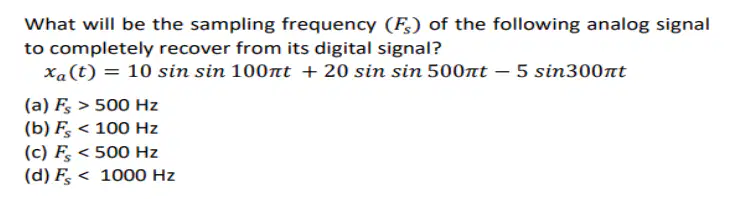
a
b
c
d
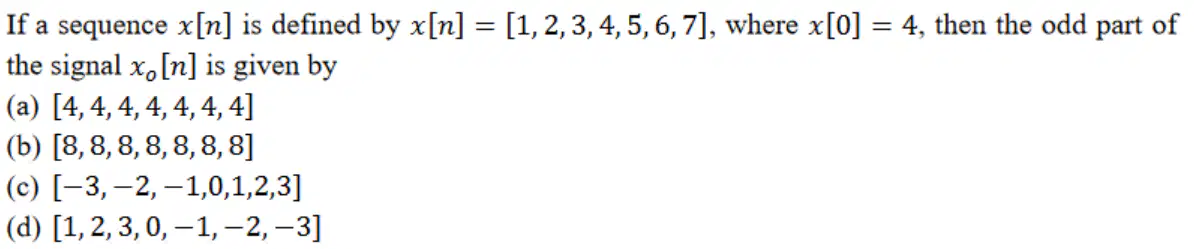
a
b
c
d
x(n)=[1, 3, 3, 1], h(n)=[1, 5, 5, 1]
perform convolution between x(n) and h(n)
[1, 8, 23, 32, 23, 8, 1 ]
[1, 8, 32, 23, 32, 8, 1]
[8, 1, 32, 32, 32, 1, 8]
[8, 1, 23, 23, 23, 1, 8]
x(n)=[1, 3, 3, 1], h(n)=[1, 5, 5, 1]
perform 4- circular convolution between x(n) and h(n)
[24, 16, 24, 32]
[12, 36, 36, 12]
[24, 24, 16, 32]
[24, 32, 24, 16]
x(n)=[1, 3, 3, 1]
Evaluate 4-DFT of x(n) using FFT
[8, -2+2j, 0, -2-2j]
[8, -2-2j, 0, -2+2j]
[8, 2-2j, 0, 2+2j]
[8, 2+2j, 0, 2-2j]
N-DFT of x(n) =
n=0∑N−1x(n) e−j N2πkn
n=0∑Nx(n) e−j N2πkn
n=0∑N−1x(n) ej N2πkn
n=0∑N−1x(n) e−j 2πkn
WN=?
e−Nj2πk
ej2πN
eNj2π
e−Nj2π
W82=?
j
−j
−j2
j2
Computation of N-DFT of a sequence requires______ complex multiplications
N
4N2
N2
N−1
Computation of N-DFT of a sequence requires______ complex additions
(N−1)2
4N
N−1
N(N−1)

