
 Worksheets
Unit 6: Light and the Solar System (Final review)
Total questions: 45
Worksheet time: 23mins
What is the name given to a ray of light that strikes a surface?
The reflected ray
The bending ray
The incident ray
The exit ray
Which of the following best describes the path of light in a periscope?
It travels in a curved line through the tube.
It reflects off the object, then the top mirror, then the bottom mirror, then to the eye.
It reflects off the bottom mirror first, then the top mirror.
It travels directly from the eye to the object.
In a periscope, how are the mirrors arranged to allow you to see over an obstacle?
They are placed at 90-degree angles facing each other.
They are placed at 45-degree angles parallel to each other.
They are curved to magnify the image.
One mirror is flat and the other is a lens.
True or False: A lens reflects light.
True
False
When you see an object in a mirror, the light has:
Passed through the mirror.
Been refracted by the mirror.
Been absorbed by the mirror.
Reflected off the mirror.
Which statement about the Moon's light is correct?
The Moon creates its own light like a star.
The Moon reflects the light of the Earth.
The Moon reflects the light of the Sun.
The Moon glows because of its atmosphere.
For a periscope to work, what is the first step in the sequence of light travel?
Light reflects off the top mirror.
Light reflects off the bottom mirror into your eye.
Light travels from a source (like the Sun) to the object.
Light travels down the periscope tube.
If a ray of light hits a mirror, what happens next?
It changes speed and bends.
It bounces off in a new direction.
It stops completely.
It passes through the glass.
In the periscope diagram from your quiz, light travels down the tube between the two mirrors. How does it travel?
In a straight line.
In a zig-zag pattern.
In a spiral.
It slows down significantly.
What happens to light when it travels from air into water?
It travels faster and bends.
It travels at the same speed but changes color.
It slows down and changes direction (refracts).
It stops at the surface.
What is the scientific name for the 'bending' of light?
Reflection
Orbiting
Refraction
Incidence
Why does a coin in a swimming pool look higher than it actually is?
The water magnifies the coin.
Light bends as it leaves the water and enters the air.
Light reflects off the bottom of the pool.
The water is moving, creating an illusion.
According to your mark scheme, why does refraction happen?
Because water is colder than air.
Because light travels at different speeds in different materials.
Because the water surface is shiny.
Because the air pressure pushes the light.
If you look at a straw in a glass of water, it looks broken or bent. This is because:
The straw has actually broken.
Light travels faster in water than in air.
Light travels slower in water than in air.
The glass reflects the image of the straw.
In the 'coin in the pool' diagram, the 'apparent depth' is:
Deeper than the actual depth.
Shallower (higher) than the actual depth.
The same as the actual depth.
Determined by the size of the coin.
Which of the following objects works by refracting light?
A periscope
A flat mirror
A lens (e.g., in glasses or a magnifying glass).
The Moon
Complete the sentence: Light bends when it passes from air to water because it change its (a) .
When light leaves the water and enters the air (as seen in the pool diagram), what happens to its direction?
It continues in a perfectly straight line.
It bends away from the surface.
It reflects back into the water.
It spirals upward.
If light traveled at the same speed in water as it does in air, would refraction occur?
Yes, it would still bend.
No, it would travel in a straight line without bending.
Yes, but only in deep water.
No, but it would change color.
How long does it take for the Moon to complete one full orbit around the Earth?
24 hours
365 days
28 days exactly
29.5 days
In the Moon phase diagram, Position 1 (directly between the Earth and Sun) represents which phase?
Full Moon
First Quarter
New Moon
Last Quarter
What phase is the Moon in at Position 5 (when Earth is between the Moon and Sun)?
New Moon
Full Moon
Waning Crescent
Waxing Gibbous
When the Moon is 'waning,' the lit part of the Moon we see is:
Getting larger.
Getting smaller.
Staying the same.
Changing color.
Based on the diagram in your quiz, between which positions is the Moon waxing (growing)?
Between positions 5 and 1.
Between positions 1 and 5.
Only at position 3.
It never waxes.
Which statement about the Solar System is true?
The Sun orbits the Earth.
Most planets orbit the Sun.
Mars orbits Saturn.
The Earth takes 29.5 days to orbit the Sun.
Compare the orbits of Mars and Saturn. Which statement is correct?
Mars takes longer to orbit the Sun than Saturn.
Saturn takes longer to orbit the Sun than Mars.
They take the exact same amount of time.
Mars orbits the Earth, not the Sun.
At Position 3 in your diagram (half-lit, usually the top position in the circle), what is the phase called?
New Moon
Full Moon
First Quarter
Waning Gibbous
The 'cycle of phases' of the Moon is caused by:
The Earth's shadow falling on the Moon.
The Moon orbiting the Earth.
Clouds covering the Moon.
The Sun getting brighter and dimmer.
If the Sun is on the right side of the diagram, which side of the Moon is lit up in space (not as seen from Earth)?
The side facing away from the Sun.
The side facing the Sun (the right half).
The entire Moon is always dark.
The left half only.

Which planet is the farthest from the sun?
Jupiter
Saturn
Uranus
Neptune

Which planet is closest to the sun?
Mercury
Venus
Earth
Jupiter
The arriving ray is the incident ray.
True
False
The Moon reflects the light of the Sun.
True
False
A lens reflects light.
True
False
Most of the planets orbit the Sun.
True
False
Mars takes longer to orbit the Sun than Saturn.
True
False
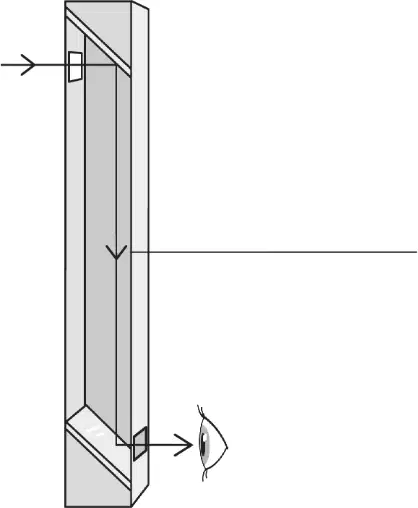
List these statements A, B, C and D about how a periscope works in the correct order. Match each position with its correct statement: A: Light reflects off the bottom mirror into your eye. B: Light travels from a source to the object. C: Light reflects off the object and travels to the top mirror. D: Light reflects off the top mirror and travels down the periscope to the bottom mirror.
First
B
Second
C
Third
D
Fourth
A
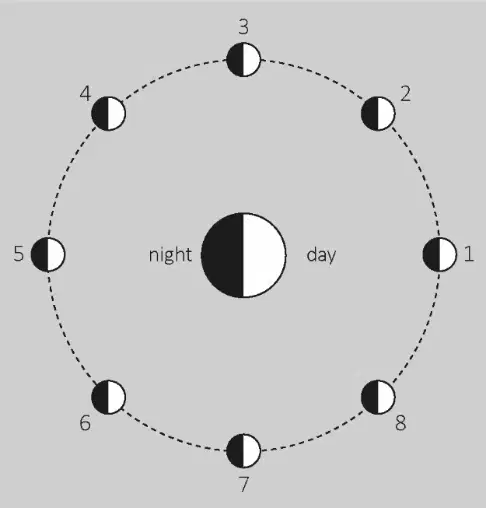
Look at the diagram of the Moon moving around Earth and showing phases. What does this diagram represent?
The phases of the Moon during one lunar cycle
The seasons of the Earth
The orbit of the Earth around the Sun only
How eclipses happen

On which side of the diagram is the Sun shining?
Left side
Right side
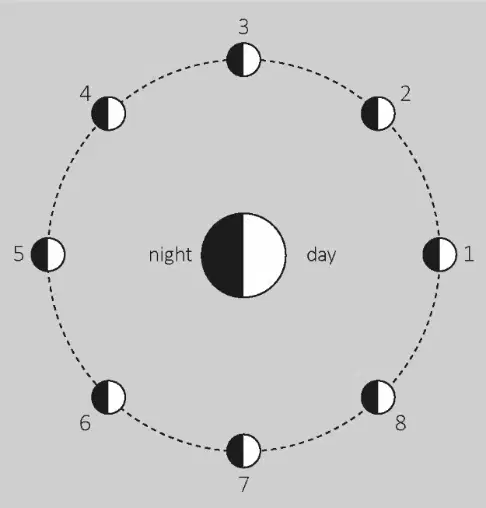
Name the phases of the Moon at points 1, 3 and 5.
Point 1
New Moon
Point 3
First Quarter
Point 5
Full Moon
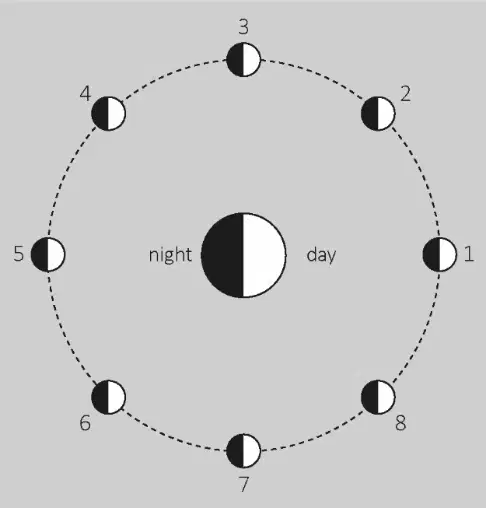
How long does it take the Moon to complete its orbit of the Earth?
24 hours
About 29.5 days
About 12 months
About 7 days
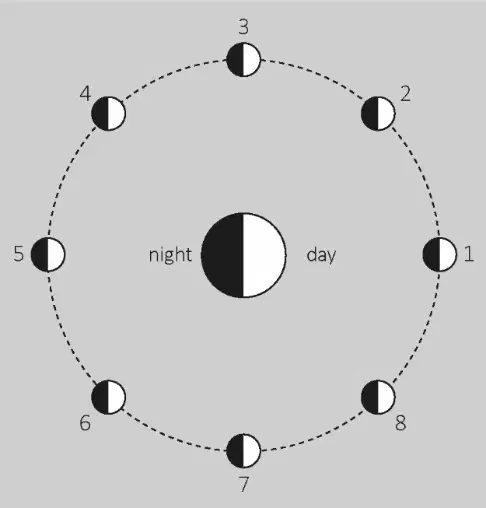
Between which numbers is the Moon waning? Complete the sentence: The moon is waning between positions ____ and ____.
1 and 4
5 and 8
2 and 4
6 and 1
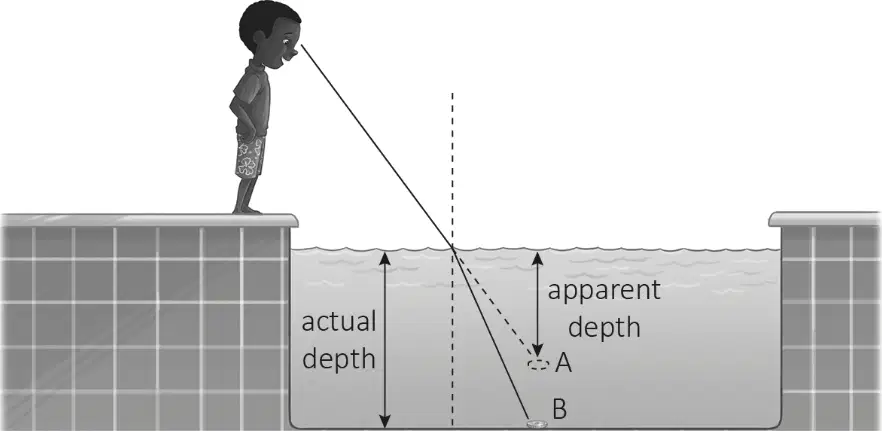
Marcus has dropped a coin in the swimming pool. When he looks into the water, the coin looks higher than it really is. What happens to the light as it travels from the water to the air?
It bends as it leaves the water and changes direction
It keeps going straight without any change
It is absorbed by the air and disappears
It reflects completely off the surface
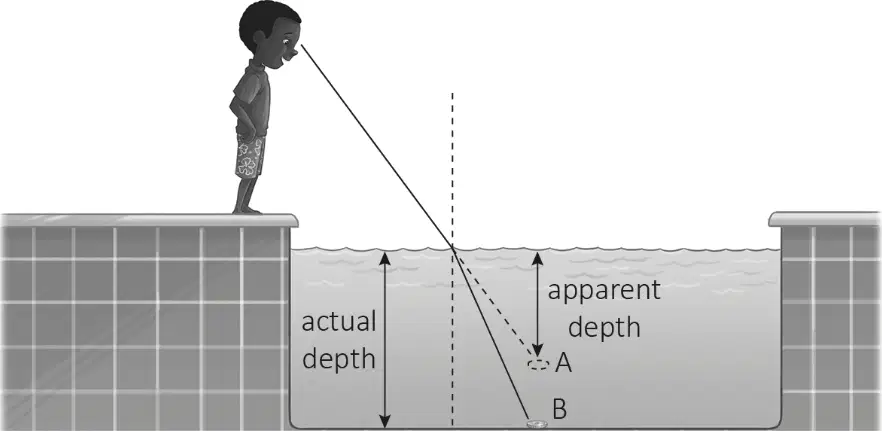
What is the name of this change?
Reflection
Refraction
Diffusion
Absorption
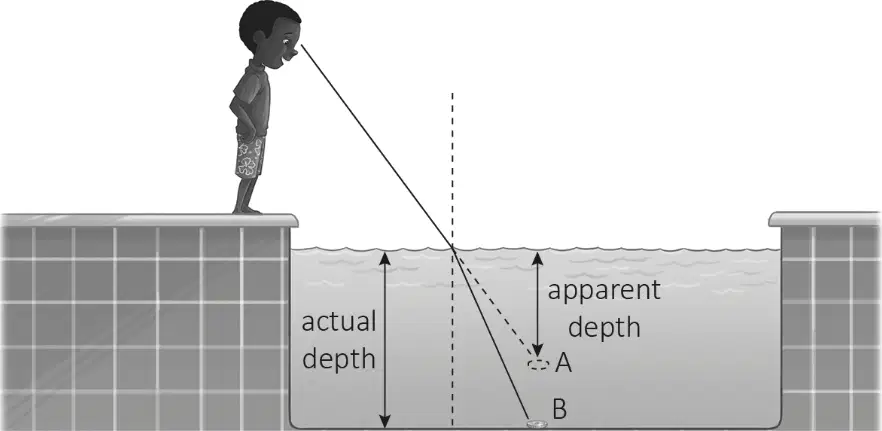
Explain why this change happens.
Light changes speed when moving between water and air, so it bends
Gravity pulls the light upward near the surface
The observer’s eyes distort the image inside water
Water reflects all light like a mirror

