

6th Grade 24-hour Clock Quizzes
Test your Grade 6 understanding of the 24-hour clock system with interactive practice questions and instant feedback. This self-paced assessment helps you master converting between 12-hour and 24-hour time formats through targeted problems.

17 questions
Digital 24 hour clock

Quiz
•
6th Grade

35 questions
24-hour clock
Quiz
•
6th Grade
15 questions
The 24 Hour clock system
Quiz
•
5th - 7th Grade

20 questions
The 24-Hour Clock
Quiz
•
3rd - 6th Grade

15 questions
Converting 12- to 24-hour clock times
Quiz
•
1st - 7th Grade

20 questions
24 Hour Clock
Quiz
•
1st - 12th Grade
Explore 6th Grade 24-hour Clock Quizzes
The 24-hour clock system presents a fundamental time-reading skill that Grade 6 students must master to develop comprehensive temporal literacy. Through Wayground's extensive collection of mathematics quizzes, students engage with systematic practice questions that build their understanding of converting between 12-hour and 24-hour time formats, interpreting military time notation, and solving real-world problems involving 24-hour clock applications. These assessment tools provide immediate feedback on student comprehension while reinforcing critical mathematical concepts such as number patterns, addition and subtraction within time contexts, and logical reasoning skills essential for advanced mathematical thinking. The interactive quiz format allows students to practice identifying times like 14:30 as 2:30 PM, calculating elapsed time using 24-hour notation, and understanding the practical applications of this time system in transportation schedules, international communication, and digital displays. Wayground's platform empowers educators with access to millions of teacher-created quiz resources specifically designed for Grade 6 mathematics instruction on 24-hour clock concepts. The robust search and filtering capabilities enable teachers to locate standards-aligned content that matches their specific curriculum requirements while supporting diverse learning needs through differentiation and customization tools. These digital-first quiz collections can be seamlessly integrated into classroom instruction, assigned as homework, or used for formative assessment, providing teachers with flexible delivery formats that accommodate various teaching styles and student preferences. The comprehensive resource library supports effective lesson planning by offering ready-made materials for introducing new concepts, conducting remediation sessions for struggling learners, providing enrichment opportunities for advanced students, and reinforcing essential time-reading skills through repeated practice and application in meaningful mathematical contexts.
FAQs
How do I teach the 24-hour clock to Grade 6 students?
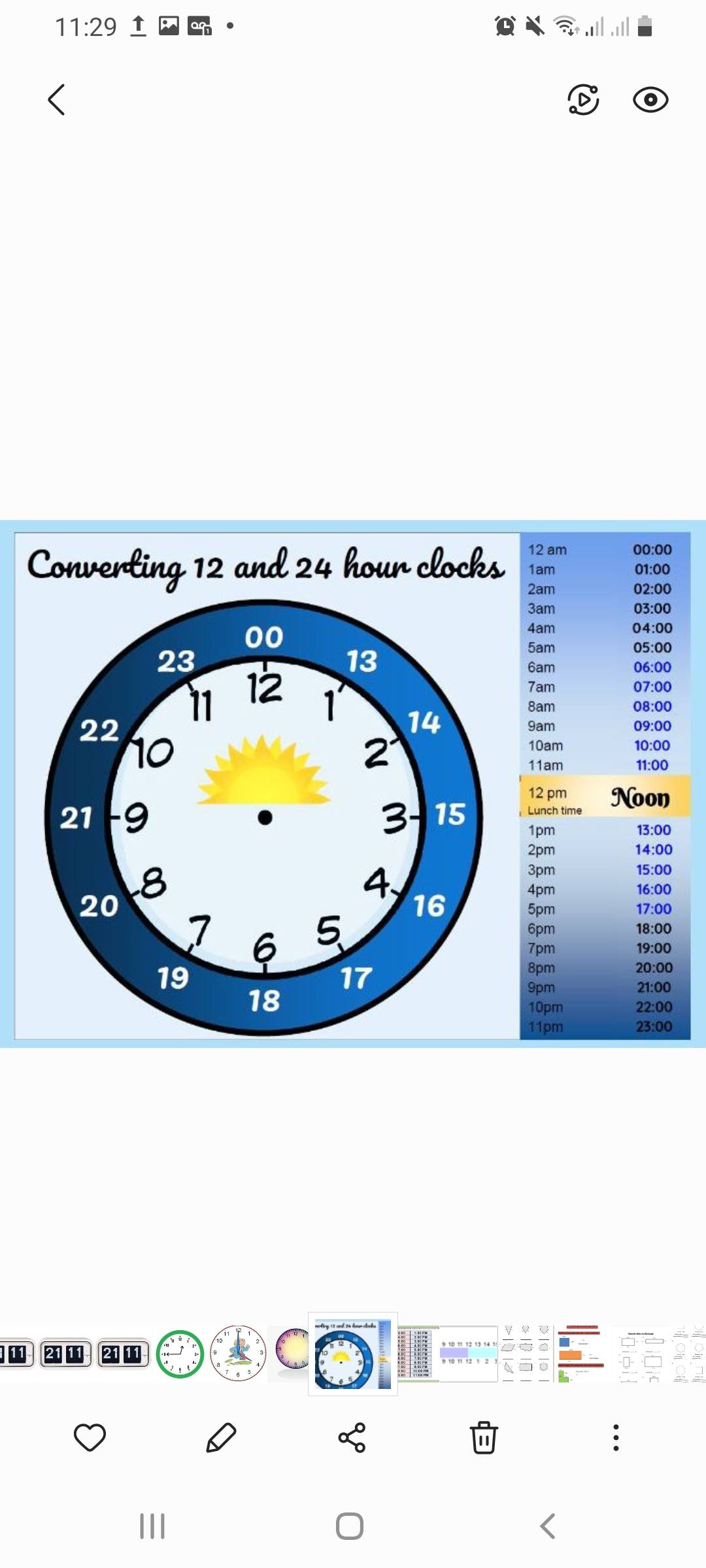
Start by connecting 00:00, 12:00, and 24:00 to midnight and noon. Then have students convert afternoon times by adding 12 to the hour, compare matching pairs such as 3:45 p.m. and 15:45, and apply the system to a familiar timetable.
What exercises help sixth graders practice the 24-hour clock?
Use a progression of matching 12-hour and 24-hour times, completing schedule tables, and solving elapsed-time problems. Authentic examples such as train departures and digital clock displays make the notation useful rather than purely mechanical.
What mistakes do students commonly make when converting 12-hour time to 24-hour time?
Students often write noon as 00:00, add 12 to a morning hour, or leave a.m. and p.m. attached to 24-hour notation. A useful check is to ask whether the time falls before noon, at noon, or after noon before converting it.
How can I use a Grade 6 24-hour clock quiz in class?
Assign the quiz as a digital quiz on Wayground or print the PDF for paper practice. Every quiz includes a complete answer key, and teachers using the printable route can scan or capture submissions for grading with the Wayground for Teachers app.
How does 24-hour clock practice fit the Grade 6 math curriculum?
This practice supports Common Core's emphasis on applying mathematics to real situations. It builds from earlier work reading clocks and calculating time intervals, then extends those skills to schedules, time-zone comparisons, and elapsed-time problems written in 24-hour notation.
How can I differentiate 24-hour clock practice for mixed-ability students?
Give students who need support a version with fewer answer choices or extended time, while advanced learners work on multi-step timetable and time-zone problems. For easier reading, teachers can also enlarge the quiz text or increase font spacing.
What grade level is appropriate for these 24-hour clock quizzes?
These quizzes are designed for Grade 6. They suit students who already understand a.m., p.m., and basic elapsed time and are ready to apply conversions to schedules and other real-world contexts.

Accessibility
Features
Wayground Super
School & District
Wayground for Business
Create a quiz
Create a presentation
Wayground AI
Subjects
Mathematics
Social Studies
Science
Physics
Chemistry
Biology
About
Our Story
Wayground Blog
Media Kit
Careers
Support
F.A.Q.
Help & Support
Privacy Policy
Terms of Service
Teacher Resources
2026 Wayground


Get our app

