


10th Grade Composite 3d Figures Quizzes
Test your understanding of composite 3D figures with this comprehensive Grade 10 geometry quiz designed to assess your knowledge through practice questions and instant feedback. Challenge yourself with problems involving volume, surface area, and spatial relationships of combined three-dimensional shapes at your own pace.

10 questions
Composite 3D Figures

Quiz
•
10th Grade

10 questions
Identifying Composite 3D Figures
Quiz
•
10th Grade

20 questions
3D Composite Figures
Quiz
•
10th Grade
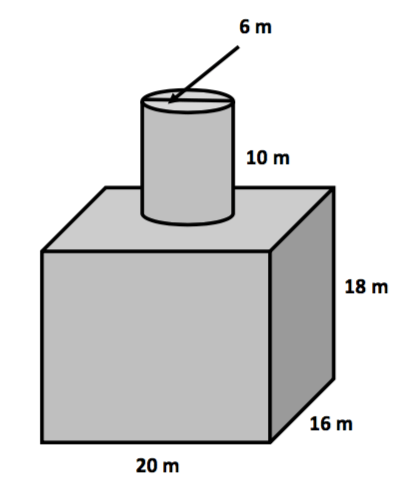
10 questions
3D Composite Figures
Quiz
•
10th Grade
10 questions
Volume of Composite Figures
Quiz
•
10th Grade

25 questions
Composite Volume
Quiz
•
10th Grade
16 questions
Composite 3D Shapes
Quiz
•
9th - 12th Grade
15 questions
Volume of Composite Figures
Quiz
•
9th - 12th Grade
20 questions
Identifying Composite 3D Figures
Quiz
•
7th Grade
15 questions
Composite Solids
Quiz
•
8th Grade
15 questions
Composite Solid
Quiz
•
8th Grade
20 questions
Intro to 3D Figures and Net
Quiz
•
7th Grade
Explore 10th Grade Composite 3d Figures Quizzes
Composite 3D figures represent a critical area of Grade 10 geometry that challenges students to analyze complex three-dimensional shapes formed by combining basic solids such as prisms, pyramids, cylinders, cones, and spheres. These comprehensive quiz collections on Wayground provide targeted assessment opportunities that evaluate students' understanding of volume calculations, surface area determinations, and spatial reasoning skills essential for advanced geometric problem-solving. Through carefully structured practice questions, students receive immediate feedback on their ability to decompose composite figures into constituent shapes, apply appropriate formulas, and synthesize mathematical concepts to solve multi-step problems involving real-world applications of three-dimensional geometry. Wayground supports mathematics educators with an extensive library of millions of teacher-created quiz resources specifically designed for composite 3D figures instruction and assessment. The platform's robust search and filtering capabilities enable teachers to locate quizzes aligned with curriculum standards while offering comprehensive customization tools that support differentiation for diverse learning needs. These digital-first quiz collections provide flexible delivery options that accommodate various classroom environments, from individual practice sessions to collaborative problem-solving activities, empowering educators to implement targeted remediation for struggling students and enrichment opportunities for advanced learners. The platform's assessment analytics help teachers identify specific areas where students need additional support in understanding complex geometric relationships, enabling data-driven instructional decisions that reinforce critical spatial reasoning and mathematical computation skills.
FAQs
How do I teach composite 3D figures to Grade 10 students?
Begin by having students trace the boundaries of each component solid and label shared or hidden faces. Model one figure by decomposing it into familiar prisms, cylinders, pyramids, or spheres, then show students how to add volumes while excluding internal faces from surface-area calculations.
What exercises help students practice composite 3D figures?
Use a progression from identifying component solids to calculating volume and surface area in multi-step figures. Problems involving a cylinder inside a rectangular prism or a pyramid on a polyhedron are especially useful because students must decide whether to add, subtract, or omit measurements.
What mistakes do students make when finding the surface area or volume of composite solids?
Students often count a shared face twice, include an internal face in the exposed surface area, or subtract a solid that should be added. A labeled decomposition sketch and a quick units check can reveal most of these errors before students finalize an answer.
How can I use these Grade 10 composite 3D figures quizzes?
Assign a quiz as a digital quiz on Wayground or download the printable PDF for paper practice. Every quiz includes a complete answer key, and teachers using the paper route can scan or capture submissions for grading with the Wayground for Teachers app.
How do composite 3D figures fit into the Common Core high school geometry progression?
This topic matches Common Core high school geometry's use of volume and surface-area formulas to solve problems with real objects. Students build on measurements of individual prisms, cylinders, pyramids, cones, and spheres, then learn to decompose combined figures and account for shared or removed regions.
How can I differentiate composite 3D figure practice for mixed-ability students?
Give students who struggle with spatial visualization a version with larger print or wider spacing, and provide extended time for multi-step calculations. Advanced students can work with intersecting solids or missing dimensions while classmates practice figures whose component shapes are already outlined.
What grade do students learn composite 3D figures?
Composite 3D figures are commonly studied in high school geometry; this Grade 10 collection focuses on decomposing combined solids and calculating their surface areas and volumes.

Accessibility
Features
Wayground Super
School & District
Wayground for Business
Create a quiz
Create a presentation
Wayground AI
Subjects
Mathematics
Social Studies
Science
Physics
Chemistry
Biology
About
Our Story
Wayground Blog
Media Kit
Careers
Support
F.A.Q.
Help & Support
Privacy Policy
Terms of Service
Teacher Resources
2026 Wayground


Get our app

