


10th Grade Parallel Line Proofs Quizzes
Test your understanding of parallel line proofs with this comprehensive Grade 10 geometry quiz featuring practice questions and instant feedback. Assess your knowledge of geometric reasoning, angle relationships, and proof techniques through self-paced problems designed to strengthen your mathematical problem-solving skills.

15 questions
Parallel Lines and Proofs Quiz

Quiz
•
10th Grade

15 questions
Proving lines are parallel
Quiz
•
10th Grade

15 questions
Proofs Parallel Lines
Quiz
•
10th Grade
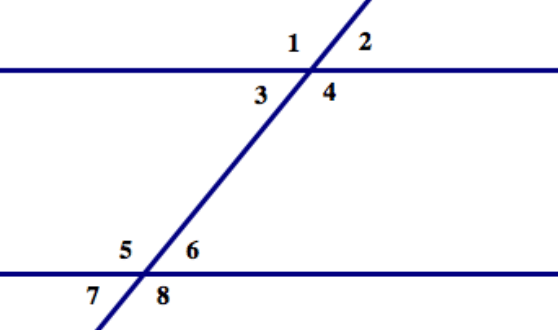
15 questions
Unit 2 Angle, Lines, & Proofs: Parallel Review
Quiz
•
10th Grade

20 questions
Parallel lines cut by transversal
Quiz
•
10th Grade

18 questions
Parallel Line Proofs
Quiz
•
9th - 10th Grade
29 questions
Parallel Line Proofs
Quiz
•
10th - 12th Grade
11 questions
(2-2) Parallel Proof+
Quiz
•
10th - 12th Grade
10 questions
(2-3) Parallel Proofs Pt 2+
Quiz
•
10th - 12th Grade
20 questions
Parallel Lines Proofs
Quiz
•
9th - 12th Grade
12 questions
Intro to Parallel Line Proofs
Quiz
•
9th - 12th Grade
60 questions
Review Parallel Proofs
Quiz
•
8th - 11th Grade
Browse by grade
Explore 10th Grade Parallel Line Proofs Quizzes
Parallel line proofs represent a fundamental component of geometric reasoning for Grade 10 mathematics students, requiring the systematic application of postulates, theorems, and logical deduction to establish relationships between lines and angles. Wayground's comprehensive quiz collection provides targeted assessment opportunities that help students master the essential skills of identifying parallel line conditions, applying properties such as corresponding angles, alternate interior angles, and same-side interior angles, while developing proficiency in constructing formal geometric proofs. These practice questions offer immediate feedback to reinforce understanding of proof structures, logical sequencing, and the proper application of geometric principles, enabling students to build confidence in their analytical reasoning abilities and mathematical communication skills. Wayground empowers educators with access to millions of teacher-created quiz resources specifically designed to support parallel line proof instruction and assessment. The platform's robust search and filtering capabilities allow teachers to quickly locate quizzes aligned with specific mathematical standards and learning objectives, while differentiation tools enable customization of question difficulty and format to meet diverse student needs. These digital-first quiz collections support flexible delivery options for both classroom and remote learning environments, providing teachers with essential resources for lesson planning, targeted remediation for struggling learners, and enrichment opportunities for advanced students. The comprehensive assessment data generated through these quizzes enables educators to identify knowledge gaps, track student progress in geometric reasoning, and implement targeted interventions that strengthen foundational proof-writing skills essential for advanced mathematics courses.
FAQs
Are parallel line proofs a 10th-grade topic?
Yes, parallel line proofs are a standard part of the high school Geometry curriculum, which is typically taught in either 9th or 10th grade. The exact timing depends on a school district's chosen math sequence.
What's an effective strategy for teaching parallel line proofs?
Emphasize the logical "if-then" structure of the theorems. For each step in a proof, require students to explicitly state the full theorem they are using, such as the "Alternate Interior Angles Converse." This reinforces that each statement must be justified by a previously established geometric fact.
What makes a good parallel line proof quiz?
A strong quiz includes a mix of problems. It should have some proofs where students are given parallel lines and must prove a conclusion about angles, and others where they are given an angle relationship and must prove the lines are parallel. This helps them master both the theorems and their converses.
What's a common misconception with parallel line theorems?
The most frequent misconception is confusing a theorem with its converse. For example, students might incorrectly cite the Corresponding Angles Postulate (which states if lines are parallel, then corresponding angles are congruent) when they should be using the Converse of the Corresponding Angles Postulate (if corresponding angles are congruent, then lines are parallel).
How can I assign and grade this quiz?
This resource can be assigned as a printable PDF for traditional paper-and-pencil work. You can then use the Wayground for Teachers mobile app to scan and grade student submissions against the provided answer key. The quiz can also be assigned as a digital quiz on the Wayground platform.
How can I support struggling students with two-column proofs?
Provide a partially completed proof as a scaffold, asking students to fill in only the missing statements or reasons. When using Wayground's digital format for multiple-choice questions about proof steps, you can enable the "Reduced answer choices" accommodation for specific students to lower the cognitive load.

Accessibility
Features
Wayground Super
School & District
Wayground for Business
Create a quiz
Create a presentation
Wayground AI
Subjects
Mathematics
Social Studies
Science
Physics
Chemistry
Biology
About
Our Story
Wayground Blog
Media Kit
Careers
Support
F.A.Q.
Help & Support
Privacy Policy
Terms of Service
Teacher Resources
2026 Wayground


Get our app

