


Cvc Words Quizzes
Test your students' understanding of CVC words with this interactive phonics quiz designed for focused assessment and practice. Provide instant feedback while students work at their own pace to master three-letter consonant-vowel-consonant word patterns.

8 questions
Read CVC Words and Blends/Match

Quiz
•
1st Grade

12 questions
Magic 'e' CVC Words
Quiz
•
1st Grade
15 questions
CVC Words
Quiz
•
1st - 5th Grade

10 questions
cvc words
Quiz
•
KG

10 questions
CVC Words
Quiz
•
KG - 1st Grade

10 questions
PHONICS CVC WORDS IG
Quiz
•
1st Grade
12 questions
CVC words
Quiz
•
2nd Grade
10 questions
CVC words
Quiz
•
KG
20 questions
Short e cvc words
Quiz
•
KG - 1st Grade
18 questions
CVC words
Quiz
•
KG - 1st Grade
21 questions
CVC Words-Reorder, Multiple Choice, Type
Quiz
•
1st - 5th Grade
7 questions
CVC words
Quiz
•
Browse by grade
Explore Cvc Words Quizzes
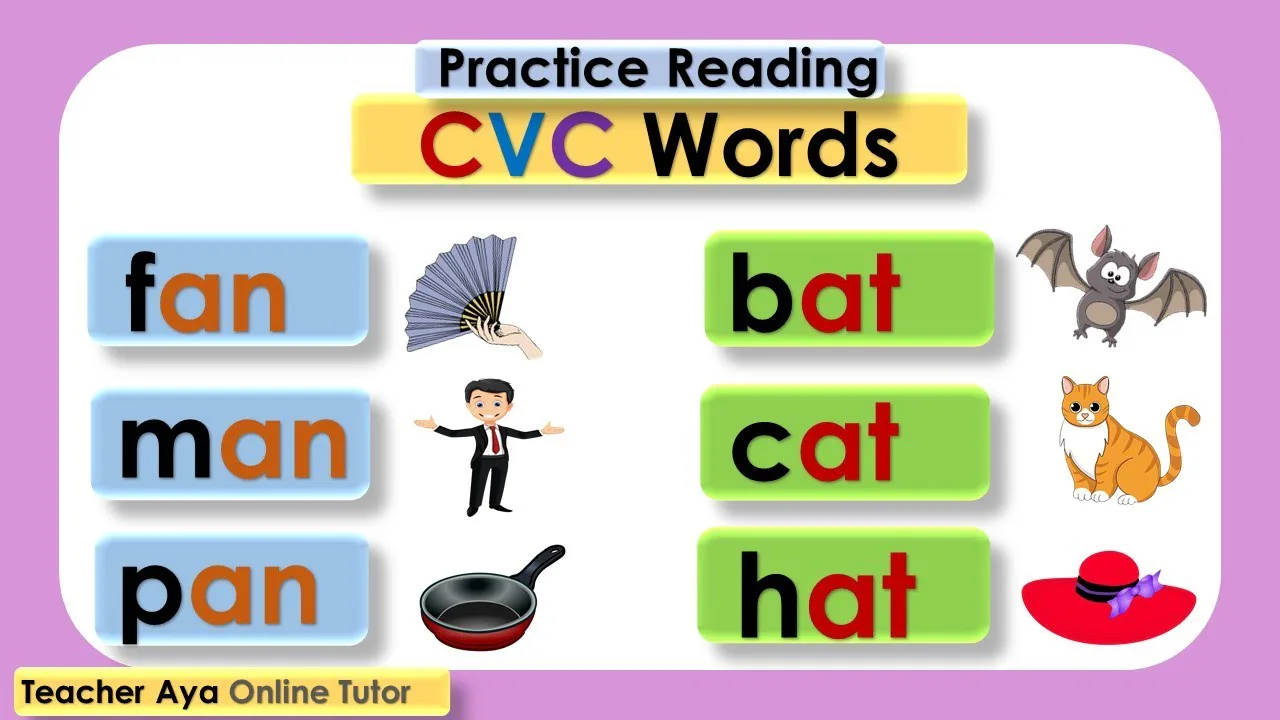
CVC words form the foundation of early reading instruction, representing the simplest consonant-vowel-consonant pattern that helps beginning readers decode their first complete words. These comprehensive quizzes available through Wayground provide systematic assessment and practice questions designed to strengthen students' ability to blend individual letter sounds into recognizable three-letter words like "cat," "pen," and "dog." Through targeted feedback and structured understanding checks, students develop essential phonemic awareness and decoding skills that serve as building blocks for more complex reading tasks. The practice questions systematically progress through different vowel patterns and consonant combinations, ensuring learners gain confidence in sound-symbol relationships while building their sight word vocabulary through repeated exposure and assessment. Wayground supports teachers with access to millions of teacher-created CVC word quiz collections that can be easily searched and filtered to match specific phonics instruction needs and reading standards alignment. The platform's differentiation tools allow educators to customize quiz difficulty, adjust timing, and modify question formats to accommodate diverse learning styles and reading abilities within their classrooms. These digital-first quiz resources offer flexible delivery options that enable teachers to implement immediate remediation for struggling readers, provide enrichment opportunities for advanced students, and reinforce essential decoding skills through engaging interactive formats. The comprehensive search capabilities help educators quickly locate age-appropriate content that aligns with their phonics curriculum sequence, supporting both whole-group instruction and individualized skill reinforcement across various stages of CVC word mastery.
FAQs
How do I teach CVC words to beginning readers?
Start by introducing each consonant-vowel-consonant pattern explicitly, blending individual phonemes before asking students to decode whole words. Use picture-word matching activities to build meaning alongside decoding, and practice with word families (e.g., -at, -og, -un) so students recognize recurring patterns. Consistent, short daily practice sessions are more effective than infrequent longer ones for cementing phonemic awareness at this stage.
What activities help students practice CVC word patterns?
Word building exercises, picture-to-word matching tasks, and fill-in-the-blank problems are among the most effective practice formats for CVC words because they require students to actively apply phoneme-grapheme knowledge rather than passively recognize words. Varying the activity type within a single practice session reduces fatigue and reinforces the same pattern through multiple cognitive pathways, which strengthens retention.
What mistakes do students commonly make when reading CVC words?
The most frequent error is vowel confusion, where students substitute the short vowel sound with a long vowel or a similar short vowel (e.g., reading 'pet' as 'pit' or 'pat'). Students also commonly omit the medial vowel entirely, blending only the initial and final consonants. Targeted practice that isolates the middle vowel sound, such as picture-sorting by short vowel, helps address this directly.
How can I differentiate CVC word instruction for students at different skill levels?
For students who are still developing phonemic awareness, reduce the number of answer choices presented at a time to lower cognitive load and allow them to focus on individual phonemes. More advanced students can move into word-family sorting or simple sentence completion. On Wayground, teachers can apply accommodations such as reduced answer choices, read-aloud support, and extended time to individual students without signaling those differences to the rest of the class.
How do I use CVC words quizzes from Wayground in my classroom?
Wayground's CVC words quizzes are available as printable PDFs for traditional paper-based practice and in digital formats for technology-integrated classrooms. Teachers can assign them as independent seat work, small-group interventions, or homework, and the included answer keys make grading fast. Digital versions can also be hosted as a quiz on Wayground, enabling real-time tracking of student responses and immediate feedback.
When should students be able to read CVC words fluently?
Most students are introduced to CVC words in kindergarten and are expected to decode simple three-letter words with automaticity by the end of first grade. Students who struggle with CVC fluency beyond that point may need targeted phonics intervention, as this skill underpins the ability to decode longer, multisyllabic words in later grades.

Accessibility
Features
Wayground Super
School & District
Wayground for Business
Create a quiz
Create a presentation
Wayground AI
Subjects
Mathematics
Social Studies
Science
Physics
Chemistry
Biology
About
Our Story
Wayground Blog
Media Kit
Careers
Support
F.A.Q.
Help & Support
Privacy Policy
Terms of Service
Teacher Resources
2026 Wayground


Get our app

